
4.5 vs 5 Inch Angle Grinder: Key Differences Explained
This post contains affiliate links. As an Amazon Associate, we earn from qualifying purchases.
The difference between a 4.5-inch and 5-inch angle grinder boils down to disc diameter, not an inherent power class. The real choice is between a slightly more compact tool and one that can handle a larger disc, which often comes paired with a more powerful motor, like the 13-amp DEWALT DWE43116. For most DIY and pro metal or masonry work, the 5-inch model is the more versatile buy.
That extra half-inch of disc size changes more than you think. It shifts the tool’s balance point, alters the guard you need, and decides which jobs you can tackle efficiently. Most people land on the 4.5 vs 5 inch angle grinder question because they’ve seen both sizes on the shelf and assume one is just a bigger version of the other. It’s a bit more nuanced.
What follows is a look at the concrete differences: the specs that actually matter, the jobs each size excels at, and the one accessory that flips the entire comparison on its head when dust control is your priority.
Key Takeaways
- A 5-inch grinder like the DEWALT DWE43116 typically pairs its larger disc with a more robust motor (13 amps, 2.3 HP), making it better for heavy-duty metal and concrete work.
- The 4.5-inch size wins on maneuverability, fitting more easily into tight spaces and causing less user fatigue during overhead or detailed tasks.
- You cannot use a 4.5-inch guard on a 5-inch grinder; using the wrong Type 1 or Type 27/28 guard is a major safety violation.
- For any indoor grinding, a dust shroud like the HERZO universal model is essential for silica dust control, despite its often imperfect fit.
- Your choice should be guided by the thickest material you’ll cut regularly; a 5-inch grinder offers a deeper maximum cut depth.
The 4.5 vs 5 Inch Grinder Specs Side-by-Side
To be honest. Comparing these tools by disc size alone misses the point. The real differences live in the motor specs, the weight in your hand, and the safety gear required. Here’s where the rubber meets the road, using two versions of the same DEWALT model as our baseline.
The DEWALT DWE43116 4-1/2″ – 5″ model is listed with a no-load speed of 11,000 RPM, while the DWE43116 5-inch model is listed at 9,000 RPM, both with a 13.0 Amp, 2.3 HP motor. This illustrates that manufacturer specs can vary even within a single product line. Always verify the exact model number.
| Specification | DEWALT DWE43116 (4-1/2″ – 5″ Model) | DEWALT DWE43116 (5″ Model) | Why It Matters |
|---|---|---|---|
| No-Load Speed | 11,000 RPM | 9,000 RPM | Higher RPM suits grinding/dressing; lower RPM often pairs with higher torque for cutting. |
| Motor | 13.0 Amp, 2.3 HP, 1,700 MWO | 13 Amp, 2.3 HP | Identical power rating; performance differences come from gearing and disc size. |
| Tool Weight | 5.2 lbs | 5.1 lbs | Nearly identical, but weight distribution feels different with a larger guard and disc. |
| Disc Diameter | 4-1/2″ to 5″ | 5″ | The 5″ model is locked to its size; the other can use smaller discs for flexibility. |
| Key Feature | E-Clutch®, Power-Loss Reset® | E-Clutch®, Power-Loss Reset® | Safety features are the same, which is excellent. |
The takeaway? Don’t buy based on a spec sheet RPM number alone. That 11,000 RPM vs 9,000 RPM discrepancy is a documented point of confusion. DEWALT’s own product pages list different values for what seems like the same tool. It highlights a crucial rule: you’re not just buying a size, you’re buying a specific model with its own engineering.
Where this goes sideways: Assuming all 5-inch grinders are more powerful. A cheap 5-inch grinder with a weak motor will bog down instantly, while a 4.5-inch tool with a brushless motor like some Milwaukee M18 Fuel models will outwork it. The disc size allows for more aggressive work, but the motor does the actual work.
Wheel Compatibility and Guard Types: The Safety Lock
This is the part that ties people in knots. Can you put a 4.5-inch disc on a 5-inch grinder? Technically, yes, if the spindle thread matches (common 5/8″-11). Should you? Almost never.
The guard is the deciding factor. Angle grinder guards are classified by the ANSI and OSHA standards they meet.
- Type 1 Guard: Designed for cutting. It’s a full, fixed guard that covers the disc’s sides and top.
- Type 27/28 Guard: Designed for grinding. It’s an adjustable, partial guard that allows for work on surfaces.
Common mistake: Using a 4.5-inch guard on a 5-inch grinder. The guard is rated for a maximum disc diameter. Exceeding it leaves your hands and body exposed to a disc fragment’s trajectory in a failure.
The guard type, not just its size, dictates the disc you can use, so understanding the types of grinder discs is key. A Type 1 guard on a cutting-dedicated grinder won’t accommodate a thick grinding wheel. This is a common frustration in forum threads, someone buys a 5-inch grinder for cutting, then finds they can’t fit a grinding disc under the guard. Your grinders are often specialized from the factory, which extends to features like the paddle vs slide switch.
TL;DR: Match the disc to the guard’s rated size and type. Don’t mix and match.
Power, Performance, and Real-World Material Removal
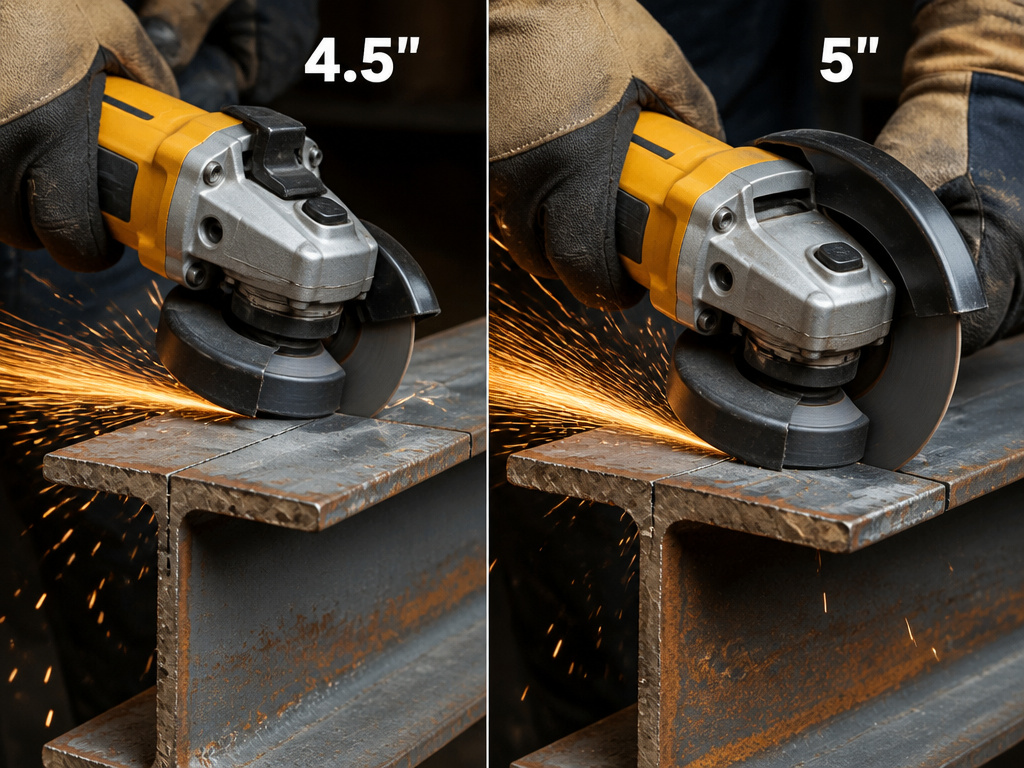
The YouTube myth is that a bigger disc automatically cuts faster. It depends more on sustained power under load. A larger disc has more surface area contacting the material, which requires more torque from the motor to maintain speed.
That’s why the move from 4.5 to 5 inches often coincides with a jump in motor specs. The DEWALT DWE43116 carries a 13-amp, 2.3 HP motor in both sizes, which is substantial. But a cordless 5-inch grinder, like the Milwaukee 2880-20, delivers 8,500 RPM with a brushless POWERSTATE™ motor, similar to other top cordless angle grinders.
For concrete work or grinding down large welds, that extra disc surface area is a genuine efficiency gain. You cover more ground per pass. For cutting, the larger diameter translates directly to a deeper maximum cut, a fundamental point when learning how to use an angle grinder. A 5-inch cutting disc can achieve a deeper maximum cut than a 4.5-inch disc due to its larger diameter. That half-inch matters when you’re slicing through rebar or thick-wall tubing.
A grinder’s performance under load depends on both motor power and, for cordless models, the battery’s ability to deliver sufficient current.
Ergonomics, Fatigue, and the “Universal Fit” Dust Shroud
Here’s where your personal experience diverges from the marketing. DEWALT lists the 5-inch DWE43116 as “compact and lightweight” at 5.1 lbs. However, aggregated user reviews suggest its weight and bulk can lead to fatigue during prolonged overhead work, indicating experiences vary.
The 4.5-inch form factor, by virtue of a smaller guard and often a more compact motor housing, simply fits into tighter spaces. Trimming a bolt flush in a corner, notching a joist in a crawlspace, the smaller tool wins.
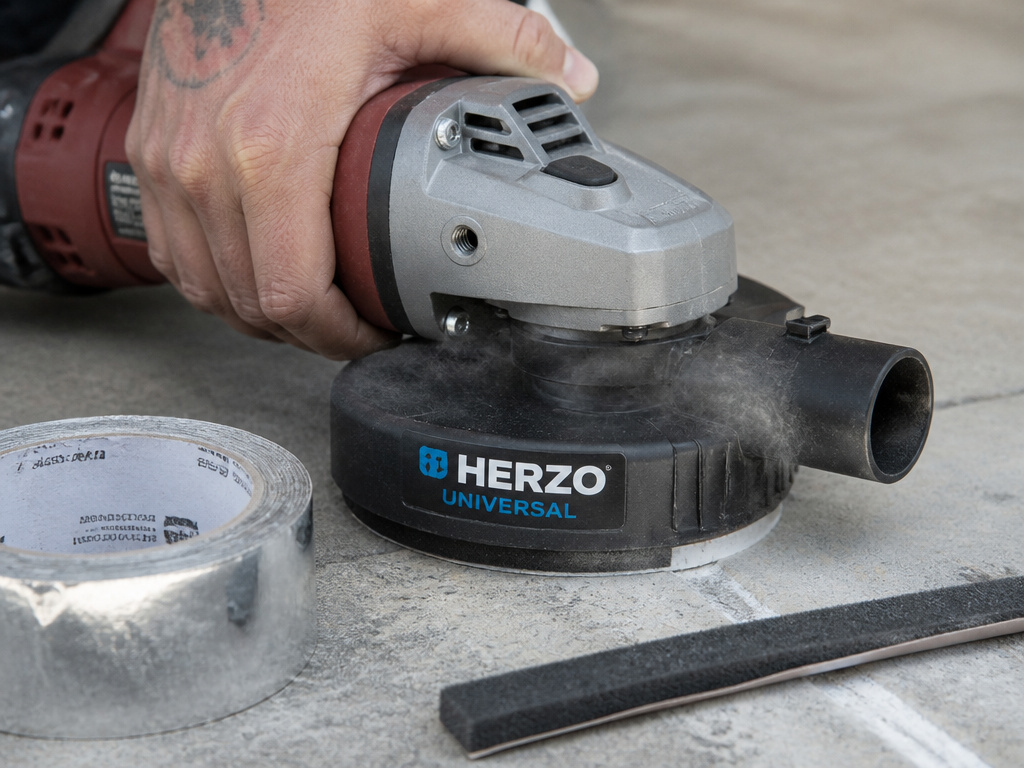
Now, introduce a dust shroud, and the game changes completely. For any indoor masonry, tile mortar removal, or concrete smoothing, controlling silica dust isn’t optional. The HERZO universal dust shroud is the budget go-to. It fits 4, 4.5, and 5-inch discs and connects to a shop vacuum.
What most people get wrong: The HERZO shroud’s “universal fit.” Owners widely report that the seal is imperfect on many grinder models. You’ll often see fine dust escaping from gaps between the shroud collar and the grinder’s neck. The solution isn’t a different shroud; it’s foil tape or closed-cell foam weather stripping to customize the seal.
This turns the comparison from a simple 4.5 vs 5 inch angle grinder choice to “which one works better with my dust control setup?” The shroud works with both, but its efficiency depends entirely on the physical match to your specific grinder model.
Best Use Cases: Which Grinder Wins and When
You don’t need both sizes. You need the right one for 80% of your work. This table cuts through the “it depends” and gives you a decision tree.
| Your Primary Project Type | Recommended Size | Key Reason | A Model to Look At |
|---|---|---|---|
| DIY Metal Fab & Welding | 5-inch | Greater grinding surface area for weld cleanup; more powerful motors handle sustained use. | DEWALT DWE43116 (5″) |
| General Home DIY & Repair | 4.5-inch | Lighter, more maneuverable, cheaper discs. Ample for cutting bolts, rods, and light grinding. | Various Corded Models |
| Concrete & Masonry Work | 5-inch | Pairs best with diamond cup wheels and dust shrouds for effective material removal. | DEWALT DWE43116 with HERZO Shroud |
| Detail Work & Tight Spaces | 4.5-inch | Smaller guard and head profile access corners and overhead spots with less fatigue. | Compact Cordless Models |
| Cutting-Only Applications | Size by Depth | Choose the smallest grinder whose discs can cut through your material’s full thickness in one pass. | Dedicated Cut-Off Tools |
For metal fabrication and concrete, the 5-inch grinder is the professional default. For the weekend warrior trimming a fence or modifying a bike frame, the 4.5-inch is the smarter, more controllable choice. If you find yourself constantly reaching for a grinder for heavy-duty work, the step up to 5 inches is justified.
Long-Term Costs: Discs, Durability, and Value
The upfront price difference between sizes is often minimal. The long-term costs aren’t.
- Disc Cost & Availability: 4.5-inch (115mm) discs are ubiquitously cheap. You’ll find them at every big-box store. 5-inch (125mm) discs are also common, but the selection of specialized types (like diamond cup wheels) can be slightly narrower and sometimes more expensive. The price gap per disc is usually a dollar or two.
- Disc Life: A larger grinding disc has more abrasive material. It can last longer on big, flat surfaces simply because there’s more to wear down. For cutting, there’s no real longevity advantage.
- Tool Durability: A grinder built for a 5-inch disc typically has a more robust gearbox and bearings to handle the increased mechanical force and potential load. This doesn’t mean 4.5-inch grinders are frail, but the heavy-duty models often live in the 5-inch and larger category.
If you’re grinding concrete weekly, the longer life of a 5-inch diamond cup wheel can offset its higher initial cost. For occasional use, the savings are negligible. Focus your value assessment on the tool’s features, like the DEWALT’s E-Clutch or the Milwaukee 2880-20’s RAPIDSTOP™ brake, that prevent costly accidents or disc replacements.
Wheel/Disc Availability & Variety
When you compare a 4.5 vs 5 inch angle grinder, both have excellent accessory availability. A key advantage of the 5-inch size is its larger disc diameter, which allows it to cover more surface area per pass. This makes it more efficient for tasks like grinding large welds or removing significant amounts of material. For dust control, universal dust shrouds are marketed to fit multiple disc sizes, including 4, 4.5, and 5 inches. However, user experience shows the fit can be highly variable depending on the specific grinder model, sometimes requiring modification for an optimal seal.
Frequently Asked Questions
What is the difference between a 4.5 and 5-inch angle grinder?
The core difference is the maximum disc diameter they accept: 4.5 inches (115mm) vs. 5 inches (125mm). This leads to practical differences in cut depth, grinding surface area, and the tool’s physical size. Often, 5-inch models are built with more powerful motors to drive the larger disc effectively.
Can I use a 4.5-inch blade on a 5-inch grinder?
You can physically mount a 4.5-inch disc on a 5-inch grinder if the spindle thread matches (commonly 5/8″-11). However, you must also use the correct guard rated for that smaller disc size. Using a 5-inch guard with a 4.5-inch disc creates a dangerous gap. It’s usually not worth the safety risk; use the size disc the grinder is designed for.
What is the best size of angle grinder for home use?
For most homeowners, a 4.5-inch angle grinder is the best choice. It’s sufficiently powerful for tasks like cutting rebar, grinding down metal, or removing old mortar, while being lighter, easier to control, and cheaper to feed with discs. It’s the right balance of capability and maneuverability.
How deep will a 4.5-inch grinder cut?
4.5-inch cutting disc can slice through material up to about 1.25 inches thick in a single pass. A 5-inch disc increases that to roughly 1.5 inches. For cutting thicker materials, you would need to make multiple passes, flipping the workpiece.
The Bottom Line
Pick the 5-inch angle grinder if your work regularly involves heavy-duty metal fabrication, masonry, or concrete. The DEWALT DWE43116 with its 13-amp motor and E-Clutch is a benchmark here. Choose the 4.5-inch size if you value control, work in confined spaces, or tackle general DIY projects. The difference isn’t about one being universally better; it’s about matching the tool’s strengths to your most common tasks.
And remember, no matter which size you pick, never remove the guard. That’s the line between a useful tool and a trip to the emergency room. Your first accessory should be a dust shroud compatible with 4″, 4.5″, or 5″ discs, even if you have to tweak its fit with tape, if you plan to grind anything indoors. That fine dust is the invisible hazard that does long-term damage.
