
8 Best Wet Tile Saws Under 00 in 2026
This post contains affiliate links. As an Amazon Associate, we earn from qualifying purchases.
Our best overall pick for a high-capacity wet tile saw is the DEWALT D36000 for its thirty-seven-inch rip capacity and professional-grade accuracy. The Brevetti Montolit 906EV02 excels at cutting thick materials, while the CRAFTSMAN CMCS4000M1 is the top choice for a cordless design. Choosing the right saw prevents frustration and wasted tile on your project. This guide compares the key strengths of eight models to match you with a suitable tool.
Top 8 Budget-Friendly Wet Tile Saws in the Market
Certain content that appears on this site comes from Amazon. This content is provided "as is" and is subject to change or removal at any time.
The Best Budget-Friendly Wet Tile Saws, Reviewed
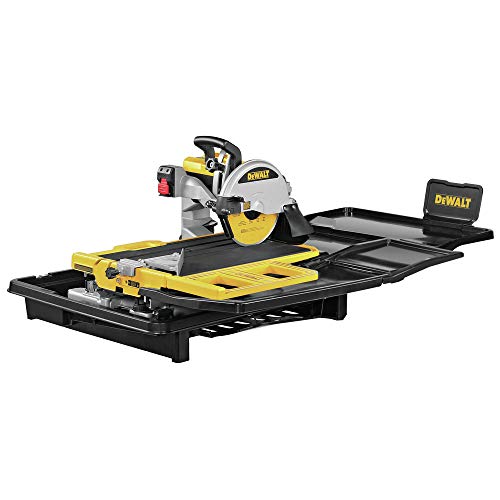
DEWALT D36000 High Capacity Wet Tile Saw
What We Like
- Massive 37-inch rip capacity for large format tile
- Rigid frame and stainless steel rollers for high accuracy
- Integrated storage for accessories during transport
Trade-offs
- At 91 pounds, it's significantly heavier than portable 7-inch saws.
- Its 35.8-inch length demands substantial storage space.
- The large frame and capacity are overkill for small mosaic or subway tile.
A 37-inch rip capacity, expandable to 41 inches with a plunge cut, is the defining feature here. It means you can cleanly bisect a full 36-inch by 36-inch tile, a task that stops most other saws in this guide cold. This saw is built for the professional or serious DIYer regularly tackling large-format porcelain, marble, or stone. The rigid frame and stainless steel rollers deliver the precision needed for those expensive materials, keeping cuts accurate to within a thirty-second of an inch over long runs. It’s a high-capacity rail saw designed to handle the biggest jobsite challenges.
That capability comes with real trade-offs in size and weight. At 91 pounds, this isn’t a tool you casually carry up a flight of stairs. While it’s engineered for portability between jobs and fits through standard doorways, its heft and footprint are a world apart from a compact saw like the CRAFTSMAN CMCS4000M1. You buy the D36000 for its singular ability to manage large tiles. If your work revolves around smaller formats or tight spaces, its strengths become unnecessary burdens.
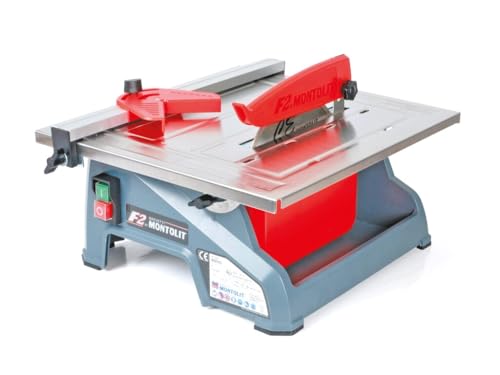
Brevetti Montolit 906EV02 Wet Tile Saw
What We Like
- Cuts dense materials up to 35mm thick
- Premium 180mm diamond blade for chip-free cuts
- Advanced water system minimizes dust and extends blade life
- Stable, heavy-duty frame reduces vibration
Trade-offs
- 180mm blade limits cut depth
- Smaller table than full-sized saws
With a maximum cut capacity of 35mm, this saw can handle thick porcelain, granite, and marble that would stall a lighter-duty machine. That heavy-duty capability, paired with its continuous-rim diamond blade and stable anti-slip work surface, suits renovation pros or dedicated DIYers who regularly face dense materials. The versatile cutting angles handle complex layouts, while the water cooling system keeps the blade cool and minimizes dust during extended use.
The trade-off for that power is a work area and blade size smaller than a full-size station like the DEWALT D24000S. Its 180mm blade defines its limits, so for massive slabs or volume production, a larger, cart-based saw would be the next step up. For intricate work on large-format tiles that are also thick, this Montolit hits a unique sweet spot.
Product photos
CRAFTSMAN CMCS4000M1 Cordless Wet Tile Saw

What We Like
- Cordless design for complete jobsite freedom
- Innovative sliding cart for improved cutting accuracy
- Excellent water containment for clean indoor use
Trade-offs
- 17-inch capacity limits it to standard tile work
- 34.1 lb weight is heavier than other compact 7-inch saws
- Cordless runtime depends on battery charge state
A 17-inch cutting capacity and cordless operation make this saw the obvious choice for pros or dedicated DIYers tackling jobs away from a power outlet. The included battery and charger, combined with the roll cage handle, mean you can carry it right to a bathroom or kitchen remodel without hunting for an extension cord. It’s built for the contractor who needs to make quick, accurate cuts on-site without the mess, thanks to its excellent water containment system. This is the tool you grab when outlet access is a hassle, not the project itself.
This cordless design does limit the tool’s scale. While its sliding cart is accurate, the 17-inch rip capacity won’t handle large-format tiles or lengthy diagonal cuts. For big, stationary tile jobs with a dedicated workspace, a corded model often makes more sense. For mobility and contained indoor work, however, this Craftsman has a clear and useful niche.
QEP 22700Q 7-Inch Wet Tile Saw

What We Like
- Compact, portable with built-in handle
- Cuts tile, stone, and porcelain
- Includes water recirculation channel
- Rip and diagonal cuts on any size tile
Trade-offs
- 18.6 lb weight is portable but lacks a stand for larger jobs
- Smaller 7-inch blade limits depth of cut versus 10-inch saws
This compact wet tile saw is built around a 3/4 peak HP motor that handles ceramic, marble, and porcelain, giving it the power for most DIY materials. Its 18.6-pound weight and built-in handle make it easy to carry from a truck to a bathroom, and the 20.5-inch length means it can sit on a countertop without dominating the space. A water recirculation channel helps manage the inherent mess of wet cutting, though it remains a wet process.
The trade-off is in the cut. You’re scoring and snapping, not making powered, continuous cuts, which can limit precision on intricate shapes. For a homeowner laying a simple backsplash or floor, it’s a clever, affordable solution. If your project involves complex angles or harder stone, you’ll feel the limitation quickly. For those larger, more demanding jobs, a powered wet saw like the DEWALT D24000S is the tool you’ll want, despite its significantly larger footprint.
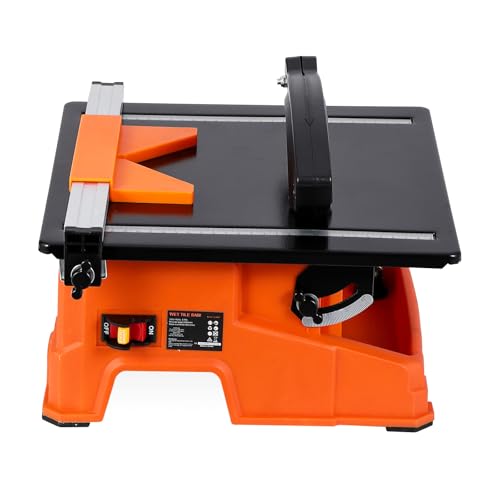
Garvee 7-Inch Wet Tile Saw
What We Like
- High-speed 6500 RPM motor for fast cuts
- Compact 18.3 lb design enhances portability
- Integrated water reservoir for cleaner, cooler operation
- Galvanized, corrosion-resistant worktable for durability
Trade-offs
- 13×14 inch worktable limits large tile support
- 1.34 inch max cut depth restricts very thick materials
- No stand or extension included for bigger projects
A 6500 RPM motor spins the blade fast enough to slice through ceramic and porcelain with minimal effort, which is the core reason this saw stands out in its class. That speed, paired with a compact 18-pound frame, makes it a natural fit for DIYers who need to move the tool around a bathroom or kitchen project without wrestling a heavy machine. The integrated water tray and galvanized table are thoughtful touches that keep the mess contained and the saw stable on a workbench, exactly what you need for weekend tile jobs.
Its 13×14 inch corrosion-resistant worktable provides a stable cutting surface for typical projects, but this compact size means large-format tiles must be carefully supported by hand during longer cuts. While capable for standard wall tiles and backsplashes, the physical limits of the table are a consideration for floor tiles larger than the work surface. The QEP 22700Q model has a larger overall footprint, which can offer more inherent support for bigger materials.
Product photos
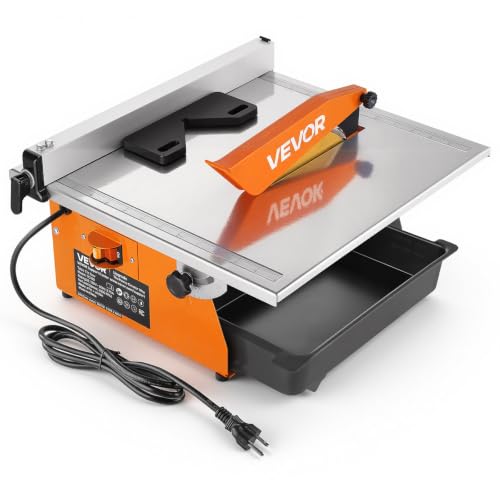
VEVOR 7-Inch Wet Tile Saw
What We Like
- Detachable water reservoir reduces dust and cleanup
- Galvanized worktable resists scratches
- Built-in reset switch prevents unexpected startup
Trade-offs
- 1.2-inch depth limits thick stone or large format tile
A 22.5-pound weight and a 17-inch length make this saw exceptionally easy to move from the garage to the backyard and store out of the way when the job is done. That portability, combined with a basic 0-45 degree bevel and a water-cooled 3600 RPM motor, squarely targets the DIYer tackling a bathroom backsplash or a kitchen floor. It’s a simple, purpose-built machine for someone who needs clean, straight cuts on ceramic or marble without dedicating permanent floor space to a bulky tool.
Its compact size does come with limitations, including a fixed worktable and a maximum cut depth of 1.2 inches. This restricts the tool to standard wall tiles and thinner materials. For larger projects, a model with greater capacity would be necessary. If your project list is measured in square feet, not square yards, this VEVOR gets the fundamentals right in a package that won’t overwhelm your workspace.
Product photos
VEVOR 10-Inch Wet Tile Saw with Stand

What We Like
- Includes a stable, wheeled stand for mobility.
- Infrared guidance lines enhance cutting accuracy.
- Removable water reservoir reduces airborne dust.
- Adjustable base provides stability on uneven surfaces.
Trade-offs
- Maximum 36-inch tile capacity limits large format work.
- Maximum 36-inch tile capacity.
Its included stand with caster wheels is the defining feature, transforming this from a benchtop tool into a mobile cutting station. This makes it a serious contender for DIYers and contractors tackling multi-room projects where you need to roll the saw to the work. With a 10-inch blade and a 4500 RPM motor, it has the core power to handle ceramic and stone. The infrared guide and 0-45 degree miter adjustment help keep your cuts precise even when you’re moving around.
Its maximum 36-inch tile capacity defines the practical scope of this saw, which handles most common backsplash and floor tile sizes but not the largest format materials. The integrated stand and wheels create a ready-to-roll cutting station that moves easily around a worksite, a key advantage over heavier stationary units like the 91-pound DEWALT D36000. This design prioritizes convenient mobility for home renovation tasks over the massive capacity needed for slab cutting.
Product photos
LALFPET 7-Inch Heavy-Duty Wet Tile Saw

What We Like
- Spacious 13"x14" galvanized worktable
- 0-45° adjustable bevel cutting
- Built-in water reservoir for dust control
- Reset safety switch for power interruptions
Trade-offs
- The 7-inch blade limits depth for thicker stone.
A 13×14 inch galvanized worktable gives you a stable, rust-resistant surface for handling larger tiles or multiple cuts without constant repositioning. This saw suits the DIYer tackling a kitchen backsplash or bathroom floor who needs a dependable, fixed station for a weekend project. The 3450 RPM induction motor and water reservoir provide clean, controlled cuts, while the safety switch adds a layer of security in a home workshop.
The trade-off is its footprint. Compared to the more compact QEP 22700Q, the LALFPET offers a significantly larger cutting area but sacrifices portability. For a permanent setup in a garage, it’s a solid performer. For someone needing to move the saw from job site to job site, its length becomes a real consideration.
Product photos
How We Evaluated Wet Tile Saws
Our evaluation started with manufacturer specifications to understand each saw’s core capabilities, like rip capacity, motor power, and maximum cut depth. We then studied expert round-ups and patterns in owner feedback to see how these specs translated to real-world performance, focusing on accuracy, durability, and ease of use.
For this budget-focused category, we prioritized cutting capacity for the price, portability, and effective water management. A saw’s rip capacity determines the largest tile it can handle, while its weight and design impact how easy it is to move around a jobsite. We also looked for features that contain water and dust to keep the work area clean.
This guide is based on product specifications and listings to help inform a purchase decision. For those considering more expensive options, a separate guide on higher budget wet saws is available.
What To Look For In Wet Tile Saws
Focus on the saw’s core capabilities relative to your specific project needs. A saw perfect for a large kitchen floor may be overkill for a small bathroom backsplash.
Key criteria are cutting capacity, portability, motor power, and water management. Match the saw’s rip capacity to your largest tile, and prioritize a stable frame for accuracy. A good water system minimizes cleanup and extends blade life.
Cutting Capacity and Table Size
The rip capacity, or the distance from the blade to the fence, dictates the largest tile you can cut in a straight line. For cutting large-format tile, a capacity of 24 inches or more is essential. Diagonal capacity, often larger than the rip capacity, is crucial for cutting tiles corner-to-corner. A spacious, stable worktable supports the tile during the cut, preventing chipping and ensuring accuracy. Consider if the table is galvanized to resist rust and scratches from abrasive materials.
Portability and Design
Weight and footprint determine how easy a saw is to transport and store. Compact, sub-20-pound saws are ideal for DIYers who need to carry the tool from a garage to a worksite, but they often sacrifice cutting capacity and table stability. Models with built-in handles or included wheeled stands, like some budget-friendly options, offer a good balance. For complete jobsite freedom without a power cord, a cordless design is a major advantage, though runtime depends on your battery investment.
Motor Power and Blade
Motor horsepower (HP) or amperage determines the saw’s ability to cut through dense materials like porcelain or natural stone without bogging down. A high-speed motor, measured in RPMs, can make faster, cleaner cuts. The included blade is equally important; a continuous-rim diamond blade is standard for clean cuts in ceramic and porcelain, while a turbo-rim blade is better for faster cuts in softer materials. For specialized tasks, you may need to purchase a replacement blade.
- Check the maximum cut depth, which is limited by the blade diameter.
- Look for a sliding table or cart system for smoother, more controlled cuts.
- Ensure the water pump and reservoir are easy to fill, clean, and don’t leak.
- A safety reset switch prevents the saw from restarting unexpectedly after a power interruption.
Always verify the saw’s maximum cut depth is greater than the thickness of your tile.
Budget-Friendly Wet Tile Saws Compared
The table below compares the key specifications of our top picks to help you see the differences at a glance.
| Product | Blade Size | Max Cut Thickness/Depth | Weight |
|---|---|---|---|
| DEWALT D36000 High Capacity Wet Tile Saw | N/A | N/A | 91 pounds |
| Brevetti Montolit 906EV02 Wet Tile Saw | 180mm | 35mm | N/A |
| CRAFTSMAN CMCS4000M1 Cordless Wet Tile Saw | 7 inch | N/A | 34.1 pounds |
| QEP 22700Q 7-Inch Wet Tile Saw | 7 inches | 1- .25 in. | 18.6 Pounds |
| Garvee 7-Inch Wet Tile Saw | 7 inch | 1.34 inches | 18.3 pounds |
| VEVOR 7-Inch Wet Tile Saw | 7 Inch | 1.2 inches | 22.5 pounds |
| VEVOR 10-Inch Wet Tile Saw with Stand | 10-inch | 3.75 inches | 20.2 pounds |
| LALFPET 7-Inch Heavy-Duty Wet Tile Saw | 7-Inch | N/A | 20.8 Pounds |
Frequently Asked Questions
Which wet tile saw is best rated?
The DEWALT D36000 is a top-rated model for professionals due to its thirty-seven-inch capacity and sturdy build. Among more portable and budget-friendly options, the QEP 22700Q is frequently noted for reliable performance in straightforward DIY projects.
Which wet tile saw is better, DeWalt or Ridgid?
While Ridgid models are not featured in this specific budget round-up, DeWalt is renowned in professional circles for building durable, high-capacity saws like the D36000. The “better” choice depends on your specific needs for capacity, portability, and intended use, which is why we evaluate multiple brands.
What is the best 7 inch wet tile saw blade for porcelain tile?
For cutting hard porcelain tile with a 7-inch saw, a continuous-rim diamond blade is generally recommended for the cleanest, chip-free finish. The specific best blade can vary by saw and project, so consulting a dedicated wet saw blade guide is wise for detailed recommendations.
Are Harbor Freight tile saws any good?
Harbor Freight saws can be a viable budget option for very infrequent DIY use, but they are generally not included in professional round-ups due to concerns about long-term durability and accuracy under heavy use. This list focuses on models with stronger feedback for reliability in the budget category.
How do I cut porcelain tile without chipping it?
Using a wet saw with a sharp, continuous-rim diamond blade is key. Ensure the water system is working to keep the blade cool and lubricated. Feed the tile into the blade slowly and steadily, and use a guide fence for straight cuts. For detailed techniques, review a guide on how to cut porcelain tile with a wet saw.
The Bottom Line
The DEWALT D36000 is our best overall pick, a professional-grade tool ideal for installers routinely tackling large-format tile up to 36 inches. Its accuracy and capacity are unmatched in this price range.
For DIYers on a tight budget, the QEP 22700Q is a capable portable saw, while those needing to cut thick stone should look at the Brevetti Montolit. If you value cordless operation for indoor jobs, the CRAFTSMAN CMCS4000M1 is the clear choice.
Ultimately, matching the saw’s cutting capacity to the size of your tile is the single most important factor. A saw that’s too small will limit your project, while one that’s overly large may be cumbersome and unnecessary.
