
Cordless vs Corded Circular Saw: Which Should You Buy?
This post contains affiliate links. As an Amazon Associate, we earn from qualifying purchases.
In the cordless vs corded circular saw decision, a cordless saw runs on a battery for ultimate portability, while a corded saw plugs into an outlet for unlimited runtime. For most modern users tackling varied projects, an 18V or higher cordless model is the better, more versatile buy, matching corded power for the majority of cuts. The real choice comes down to your specific workflow: constant, stationary cutting favors the cord; mobility and convenience demand the battery.
That’s the elevator pitch. The deeper answer lives in the specifics, the weight of the batteries you’ll actually carry, the exact cut depths published in the manuals, and the kind of job site you’re on. This isn’t about a vague “cordless for small jobs, corded for big ones” cliché. It’s about matching a complete tool system, batteries and extension cords included, to the work you’re doing this weekend.
What follows: a head-to-head breakdown of real models, a clear map of which scenarios dictate the winner, and a frank look at what you’re really signing up for regarding power, runtime, and setup.
Key Takeaways
- Modern cordless saws like the Makita XSH06Z (18V X2) match corded depth and power for most tasks, cutting over 600 2x4s on a charge.
- Cord management is a hidden tax. A corded saw’s unlimited power hinges on a 12-gauge extension cord; undersized cords cause voltage drop and overheating.
- The performance gap has a specific shape. Corded still wins for sustained, high-volume cutting from a fixed position, like a cut-off station or workshop panel saw.
- Battery thermal protection is a real limit. On hot days or during prolonged use, a cordless saw’s protection circuit will stop the tool before the battery is damaged, plan for cooldown pauses.
- Your existing tool ecosystem often decides. Investing in a new battery platform for one saw rarely makes sense; buy into the brand whose other tools you’ll want next.
The 4-Way Showdown: Specs, Weight, and Power
You can’t compare categories, only tools. We’ll put three leading models side-by-side: one corded, two cordless. All three use a 7-1/4″ blade, the standard for framing and general construction.
The electric brake, a feature on better models like the DeWalt DWE575SB, stops the blade within 2 seconds of releasing the trigger. Without it, the blade spins down for 5–10 seconds, a significant safety and productivity difference.
The numbers below come straight from the manufacturers’ published specs and manuals. Notice what’s similar, and where the differences actually lie.
| Spec | DeWalt DWE575SB (Corded) | Makita XSH06Z (Cordless) | Milwaukee 2834-20 (Cordless) |
|---|---|---|---|
| Power Source | 120V, 15A outlet | Two 18V LXT batteries | M18 Battery |
| Max Cut at 90° | 2-9/16″ | 2-5/8″ | 2-5/8″ |
| Weight (as used) | 8.8 lb (tool) | 10.5 lb (with bats) | 11.2 lb (with HD12.0) |
| Key Feature | Electric brake | Up to 610 cuts in 2×4 SPF | High-output M18 power |
The published maximum cuts for these specific cordless models (2-5/8″) are slightly deeper than for this specific corded model (2-9/16″), but sources disagree on the standard depth for a 7-1/4″ blade, with some citing about 2-1/2″. The corded saw is lighter on paper. But the working weight of a cordless saw includes its batteries, which pushes it over the 10-pound mark. That weight sits in your hand, not on the ground behind you.
The Makita XSH06Z’s runtime figure is telling: up to 610 crosscuts in a 2×4 on two 5.0Ah batteries, a benchmark among the best battery circular saws. It shows that for the dominant task, cutting dimensional lumber, the performance question is largely settled.
Where this goes sideways: Assuming a corded saw is always more powerful. The DeWalt DWE575SB manual warns that an undersized extension cord can cause voltage drop, power loss, and overheating. Your 16-gauge 100-foot cord is choking a 15-amp saw. You need a 12-gauge cord for long runs, which is heavy, expensive, and another trip hazard to manage.
Scenarios That Decide, Not Generalizations
The “cordless for pros, corded for shop” rule is dead. Modern job sites prove it. The real decision in the cordless vs corded circular saw debate is a series of concrete “if-then” statements based on your environment and cutting volume.
When Cordless Is the Only Sensible Choice
Cordless dominance isn’t about power; it’s about eliminating a fundamental constraint. If your work involves movement, elevation, or absent outlets, the math is simple.
- Remote or Multi-Story Sites: Building a deck, working on a rooftop, or framing a second-floor addition. Running a 12-gauge cord up a ladder is a non-starter.
- Renovations in Occupied Spaces: Cutting trim in a finished home, working in a basement, or any place where a cord is a major trip hazard for you or others.
- Quick, Repetitive Cuts with Breaks: If you’re cutting a stack of deck boards, then fastening them, then cutting again, the natural pauses align perfectly with battery swaps or quick charges. European crews report cordless saws now handle 70% of cuts for this reason.
The tactile benefit is immediate. There’s no tug on the saw from a snagging cord, no mental map of where the cord lies. You just cut.
When a Corded Saw Still Earns Its Keep
Corded saws have a narrower, sharper advantage. It’s about uninterrupted, high-torque output in a fixed location.
- The Dedicated Cut-Off Station: If you’re processing hundreds of studs for a framing crew, a corded saw hooked to a permanent stand doesn’t think about batteries. It just runs.
- Long Shop Sessions Ripping Sheet Goods: Cutting a stack of 4×8 plywood into shelves? The unlimited runtime matters more than moving three feet to the next cut.
- The Scenario of Maximum Load: Sustained cutting of dense, thick hardwoods with minimal pauses. This is where the slightly higher power ceiling of a large corded motor and the absence of battery thermal limits can translate to a measurable speed advantage. If battery charge depletes faster than your charging system can rotate packs, corded is more reliable.
Think of it as a production line. If the saw is a fixed station in a workflow, plug it in. If the saw moves to the work, cut the cord.
Common mistake: Using a corded saw with a cheap extension cord. The manual for the DeWalt DWE575SB specifies using an outdoor-rated cord outdoors and keeping it away from heat, oil, and sharp edges. Ignoring this doesn’t just sap power; it creates a genuine fire and shock hazard.
The Hidden Variables: Battery Life and Blade Choice
Discussions about cordless tools inevitably circle back to batteries. It’s the right concern, but often focused on the wrong thing. It’s not just about “how many cuts,” but about how the tool manages power and heat.
Battery protection circuits will shut the saw down if the battery pack overheats. You’ll feel the power fade, then stop, often before the battery indicator flashes. On a hot day, this can happen sooner than the spec sheet suggests. The fix is to let it cool for 15-20 minutes, a forced break you don’t get with a corded tool.
Blade choice is the great equalizer, and it’s more critical for cordless saws. A dull or wrong blade strains the motor, killing runtime and cut quality.
| Blade Tooth Count | Best For | Why It Matters for Cordless |
|---|---|---|
| 24T | Framing, rough cuts | Aggressive gullets clear material fast, reducing motor strain and saving battery. |
| 40T | General cross-cutting, decking | Balances speed with a cleaner edge. The sweet spot for most DIY and pro work. |
| 60T+ | Finish carpentry, veneered panels | Creates a glue-ready edge but cuts slower. Drains batteries faster for the same linear foot of cut. |
A sharp 40-tooth carbide blade is the best single investment for any circular saw, corded or cordless. It makes a cordless saw feel more powerful and a corded saw last longer between sharpenings.
Making Your Choice: A Practical Filter
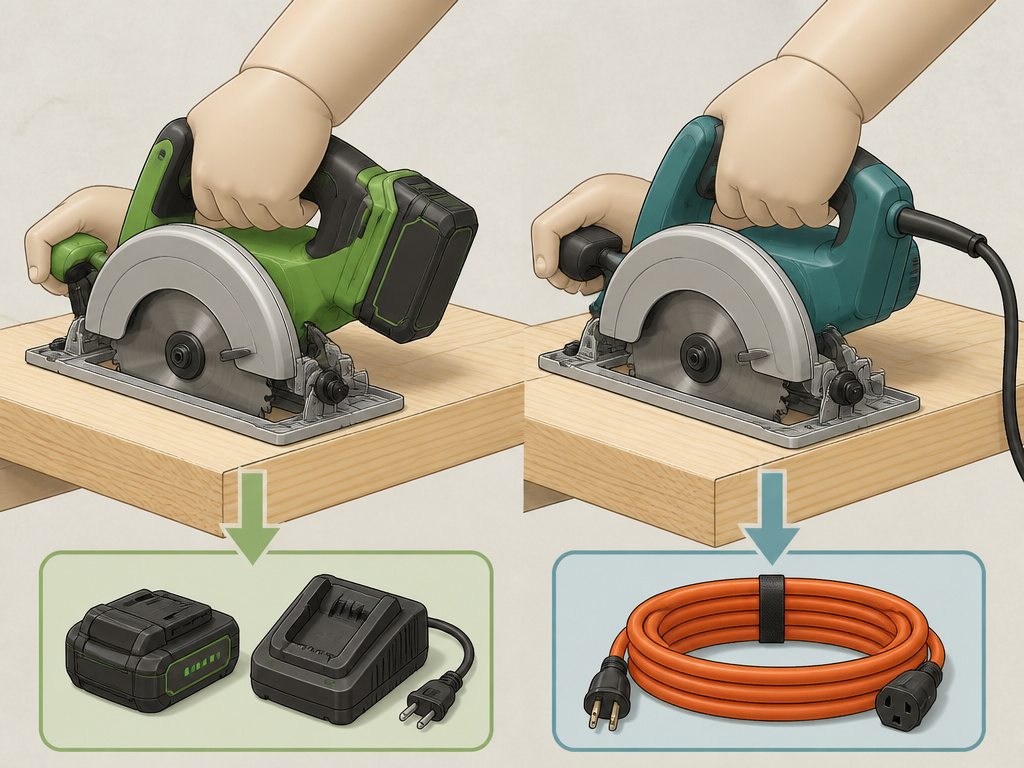
Now, move from theory to a decision. Answer these questions in order.
-
Do you already own quality batteries for a major tool brand (Milwaukee M18, Makita 18V LXT, DeWalt 20V MAX)?
- Yes: Buy a bare tool cordless saw from that brand. The value of sharing batteries across your drill, impact, and saw is immense. Look at the Milwaukee 2834-20 or the Makita XSH06Z.
- No: You’re buying a system.
-
Describe your most common cutting scenario.
- “I move around a lot, work outdoors or above ground, and make cuts in batches.” → Cordless. The portability payoff is instant.
- “I work in a garage or shop, near an outlet, and often cut for long stretches without stopping.” → Corded. The DeWalt DWE575SB is a benchmark here.
-
What’s your tolerance for management?
- Battery Management: Keeping 2-3 charged batteries, storing them properly, and replacing them every 3-5 years.
- Cord Management: Having the right heavy-gauge extension cords, coiling them, inspecting for damage, and routing them safely.
Both require upkeep. Pick the one that irritates you less.
For the large majority of people building a tool kit today, the answer leans cordless, especially for circular saws for home use. The performance is there, and the freedom is real. But if your work looks like the second scenario, a corded saw isn’t a relic, it’s the optimal, no-compromise tool for that specific job (check our picks for the best corded circular saws).
How do the costs compare, including batteries?
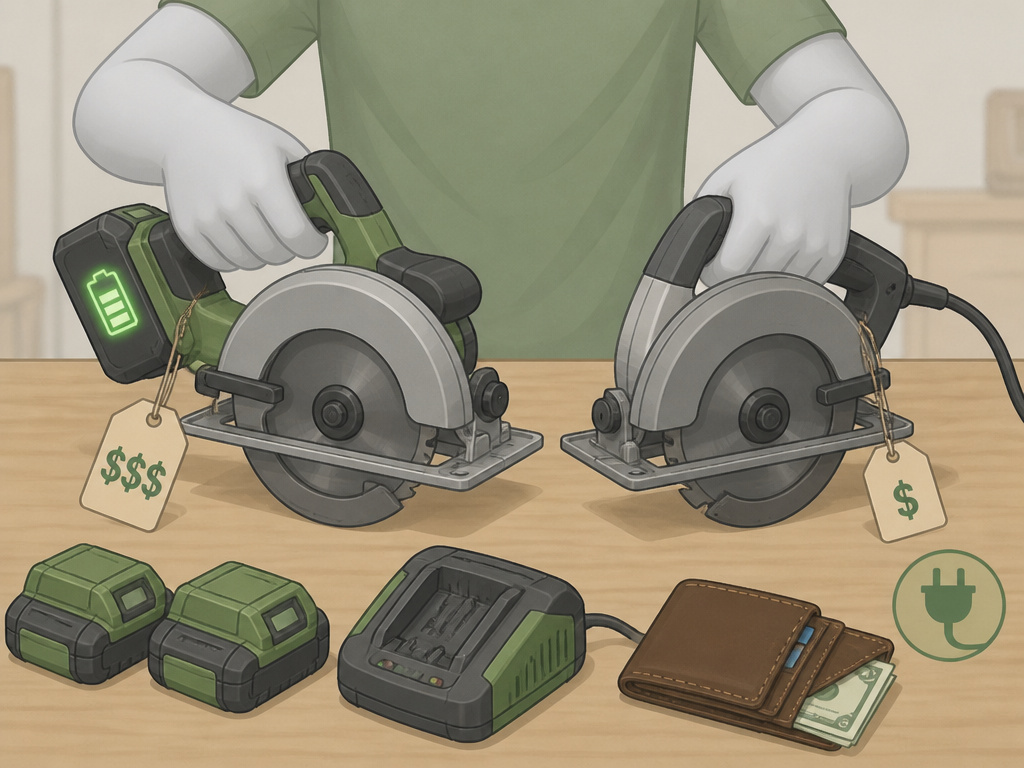
Looking at the initial price, a corded circular saw is typically less expensive. You are buying just the tool. A cordless saw often costs more upfront because you are buying into a battery platform. The long-term cost depends on your battery situation. If you already own compatible batteries and a charger, the cost is effectively just the tool. If you are starting fresh, you must factor in the price of at least two high-capacity batteries and a charger, which can be a significant addition. For sustained, high-volume cutting, the unlimited runtime of a corded saw means no ongoing cost for additional battery packs. For most users, the convenience of cordless operation justifies the higher initial investment, especially as modern cordless saws now match corded performance for common tasks.
Frequently Asked Questions
Are cordless circular saws as powerful as corded ones?
For the most common tasks, cutting 2x4s, plywood, and decking, modern 18V brushless and higher-voltage cordless saws match corded performance. The Makita XSH06Z cuts over 600 2x4s on a charge. The power gap now only appears in extreme, sustained applications like continuous cutting of thick, dense hardwoods.
What is the biggest drawback of a cordless circular saw?
Runtime management and battery lifespan. You must plan for battery swaps and charging cycles, and the batteries themselves are consumables that will need replacement after several years of use. Battery protection circuits can also cause the tool to stop under heavy load to prevent overheating, forcing a cooldown break.
How long do cordless circular saw batteries last?
Using the Makita XSH06Z with two 5.0Ah batteries as an example, you can expect up to 610 crosscuts in a 2×4. Battery lifespan is different, as batteries will eventually need replacement after years of regular use.
When does a corded circular saw make more sense?
Choose corded when you have a fixed, powered workstation and need uninterrupted runtime. Prime examples are a cut-off station for a framing crew, a workshop dedicated to ripping sheet goods, or any scenario where you are cutting continuously for longer than your battery rotation can support.
The Bottom Line
Stop thinking about cordless vs corded circular saws as a battle of power. That war is mostly over for the work 90% of us do. Think about it as a choice between two different kinds of freedom.
Cordless offers freedom of movement. It’s the right choice if your work takes you more than six feet from a reliable outlet, or if you simply never want to wrestle with a cord again. Invest in an 18V or higher brushless model from a brand you’ll stick with, and buy enough batteries to keep working.
Corded offers freedom from power management. It’s the right choice if your saw lives in one spot, eating through material for hours on end. Just respect it: use a 12-gauge extension cord, keep the vents clean, and let it breathe.
My take? If you’re building a tool collection from scratch today, start cordless. The versatility wins. But never let anyone tell you a corded saw is obsolete. In its specific, demanding niche, it’s still the clear champion.
