
Band Saw Alternatives for Woodworking: The 3-Inch Ceiling
This post contains affiliate links. As an Amazon Associate, we earn from qualifying purchases.
A bandsaw alternative matches the tool to the specific job: a scroll saw or coping saw for curves, a table saw with a tall fence for resawing up to 3 inches, or a circular saw with a guide for breaking down sheet goods. No single tool replicates a bandsaw’s full range, but the right combination covers about 85% of its functions for hobby work. When considering band saw alternatives for woodworking, this principle of matching the tool to the task is key.
That 85% figure is the key when you compare a band saw alternatives for woodworking. It means you can build most things without a bandsaw, but you’ll be trading off speed, precision, and sometimes safety. The rest of this guide is about where those trades happen, which tool wins for which cut, what you lose in the switch, and how to avoid the setups that get people hurt.
What follows is a map of the band saw alternatives for woodworking, broken down by the three things a bandsaw does best: cutting curves, resawing thick stock, and making straight rips. For each, we’ll name the real tools that work, the specs that matter, and the safety lines you shouldn’t cross.
Key Takeaways
- A table saw with a tall fence can resaw stock up to 3 inches thick with zero drift, but it’s geometrically impossible to add a riving knife to an inverted circular saw table, a major safety trade-off.
- For cutting curves in stock thicker than a scroll saw can handle, a jigsaw with a sharp blade is the next best powered option, though blade deflection is real on deeper cuts.
- The only common machine that can resaw lumber wider than 3 inches is a bandsaw. Without one, the alternative is hand tools: a frame saw or a well-tuned rip saw followed by a hand plane, a process that takes skill and time.
- A circular saw with a guide rail can rip sheet goods and wide boards as well as a table saw, but it chokes on stock narrower than about 3 inches because the base plate loses support.
- When assessing any alternative, check for the three commercial table saw safety features mandated by OSHA 29 CFR 1910.213: a blade guard, a riving knife, and anti-kickback devices. Missing even one changes the risk calculation.
The 0.025-Inch Kerf That Decides the Cut
Bandsaw blades for resawing are thin, typically 0.025 to 0.035 inches thick. Sources disagree on typical kerf width: one states it’s 0.028 inches, while another states it’s 1/16 inch or less. That’s less than half the width of a common table saw blade’s kerf. This thinness is the bandsaw’s superpower and its biggest limitation. It wastes far less wood, which matters when you’re milling expensive hardwood. It also allows the blade to bend, making curves possible.
But a thin blade is a weak blade. It can wander, or drift, if the tension isn’t perfect or the wood grain is inconsistent. The ANSI B7.1 industry standard for cut deviation in milling is less than 0.05 inches over a 10-foot cut. A bandsaw typically hits 0.012 inches over that distance, while a chainsaw mill might drift 0.08 inches. That difference is the line between a glue-ready edge and an afternoon at the planer.
Where this goes sideways: Assuming any saw with a thin kerf can resaw. Blade stability comes from tension, guide alignment, and tooth geometry, not just thickness. A poorly tuned bandsaw with a 0.025-inch blade will wander more than a well-set-up table saw with a 1/8-inch kerf blade.
This is why alternatives aren’t just about finding a different motor. They’re about matching the physical limits of the cutting action to the job you have on the bench.
What a Circular Saw Can and Can’t Do (Compared to a Bandsaw)
To be clear about this. For breaking down plywood or ripping a long board, a circular saw with a straightedge guide is often faster and safer than manhandling a full sheet on a table saw. The WoodWiki circular saw guide lays this out clearly: a guided circular saw can handle most rip cuts a table saw does. What it can’t do is become a table saw.
The difference is in the setup. Every cut requires clamping a guide. There’s no locked fence for repeatable, identical rips. And then there’s the hard limit: width.
A circular saw cannot reliably rip stock narrower than about 3 inches. The base plate overhangs the cut line, and on the final pass, there’s not enough material under the saw to keep it stable. The cut drifts, the saw tips, and you’re left with a ruined piece and a loud reminder of physics.
| Task | Circular Saw + Guide | 14″ Bandsaw | Why the Bandsaw Wins |
|---|---|---|---|
| Rip 8′ plywood sheet | Excellent | Poor | Bandsaw throat too small |
| Rip 2″ wide hard maple strip | Impossible | Good | Circular saw base lacks support |
| Cut gentle curve in 2×4 | Poor (freehand) | Excellent | Circular saw blade doesn’t turn |
| Resaw 6″ wide board | No | Yes (with riser block) | Circular saw depth max is ~2.5″ |
For the tasks it can do, your setup choice is critical. The guide-rail method, where the saw runs along a clamped track, keeps all the saw’s safety features intact. The Kreg Rip-Cut is a popular accessory here, giving you an adjustable fence with a 0–24 inch rip capacity for about $35.
The inverted table method, mounting the saw under a table with the blade pointing up, replicates the look of a table saw but strips its safety systems. This setup removes the blade guard, and it’s geometrically impossible to add a riving knife. It also typically lacks anti-kickback pawls. You are trading a purpose-built safety system for a shop-built hazard.
Before you start: Any inverted saw table removes the manufacturer’s blade guard and splitter. Kickback can throw stock back at you at high speed. Always use push sticks and a featherboard, and never stand directly behind the workpiece.
If dados and rabbets are what’s holding you back from ditching a table saw (and thus needing a bandsaw for curves), remember a router with a straight-bit handles dadoes and rabbets. The combo of a circular saw, a router, and a Kreg fence genuinely covers about 85% of what a table saw does in hobby woodworking.
Resawing Without a Band Saw: The 3-Inch Ceiling
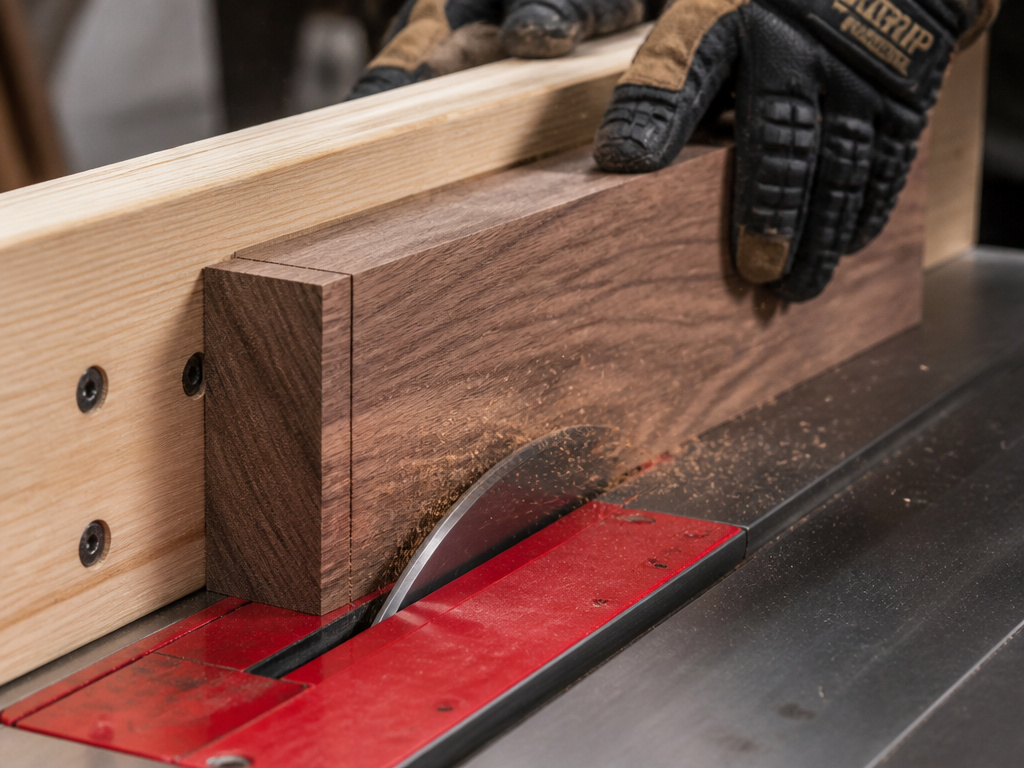
Resawing is the bandsaw’s party trick, slicing a thick board along its width to make two thinner boards. It’s how you make bookmatched panels or your own veneer. No other common shop tool is built for this. So how do you do it without one?
You have two paths: cheat with a table saw, or go old-school with hand tools.
The Table Saw Cheat
Your 10-inch table saw blade only sticks up about 3-1/8 inches. In practice, table saws top out at 3 inches for resawing. In practice, you want to stay under 3 inches for safety and cut quality. The process is simple but requires focus:
- Joint one face of your board perfectly flat.
- Build a tall, rigid auxiliary fence that attaches to your rip fence, at least 12 inches high.
- Use a thin-kerf rip blade (a 1/8-inch kerf or less) to minimize waste.
- Stand the board on edge against the tall fence and make a pass, cutting about 2 inches deep.
- Flip the board end-for-end and make another pass to meet the first cut.
I’ve done this with thick hardwood. It works, but you can feel the motor bog down. The dust extraction is poor, and you’re making multiple passes with the blade fully exposed. It’s a controlled risk for a one-off panel. For production work, it’s a non-starter.
The Hand Tool Path
This is the only way to resaw stock wider than your table saw blade is tall. You’ll need a rip-filed frame saw or a dedicated rip saw, and a sturdy vise.
- Score a deep knife line on all four sides of the board to define the cut.
- Start sawing, keeping the blade just outside the line. The goal is to split the line, not erase it.
- Saw down one side, then rotate the board and work your way around, never cutting more than an inch or two deeper on any one side before moving on. This keeps the kerf open and prevents binding.
- Once the pieces are separated, flatten the sawn faces with a hand plane or a drum sander.
It’s a workout. It requires practice to keep the saw straight. For a single special panel, it can be a satisfying method.
Curves and Shapes: From Scroll Saws to Jigsaws
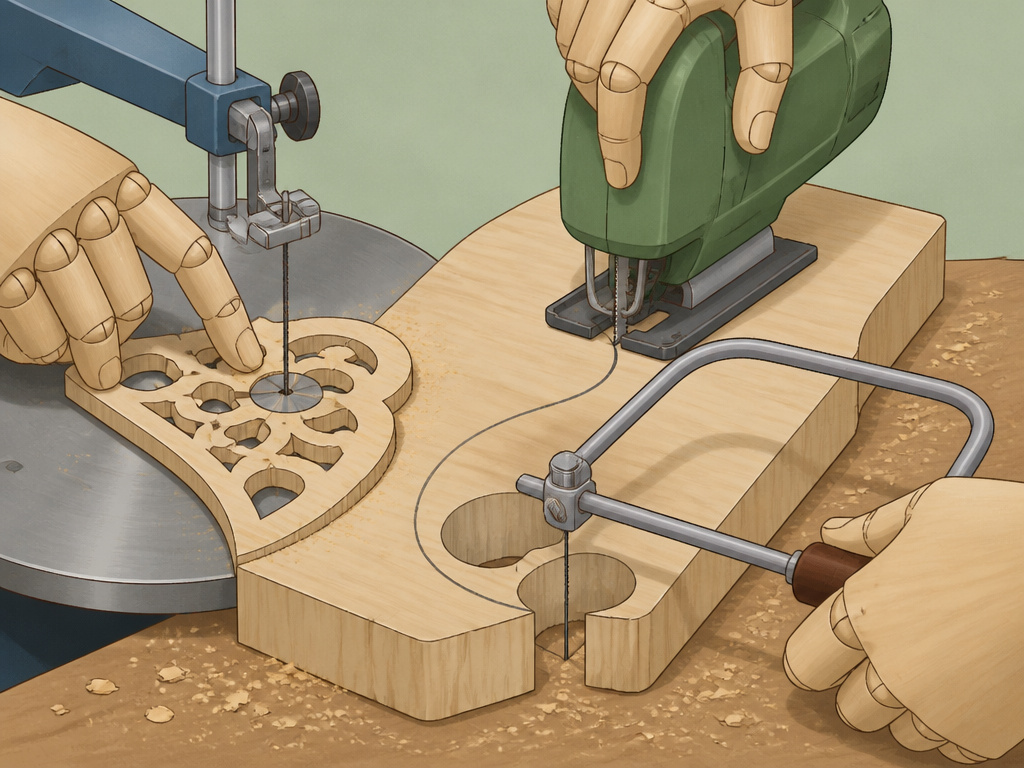
When people think bandsaw, they think curves. A bandsaw can cut a tight scrollwork pattern in 2-inch thick stock that would make a scroll saw choke. So what’s the hierarchy of curve-cutting alternatives?
Scroll Saws: The precision king for thin stock. A good scroll saw is unbeatable for intricate, fretwork-style curves in thin material. It makes a cleaner, more controlled cut than a bandsaw on delicate work. But it’s slow, and the throat depth, the distance from the blade to the frame, limits the size of the workpiece. For cutting curves in thicker material, you hit its ceiling fast.
Jigsaws: The versatile workhorse. This is your best powered alternative for general curve-cutting in thicker stock. The key is blade selection. Use a sharp, coarse-tooth blade for faster cuts in thick wood, and a fine-tooth blade for cleaner edges in plywood. The limitation is blade deflection. On deeper cuts, the blade can bend, causing the back of the cut to be wider than the front. The workaround is to go slow and let the saw do the work without forcing it.
Coping Saws & Frame Saws: The hand-powered options. A coping saw is for tight interior cuts and fine details. A larger frame saw or bow saw is for rougher, exterior curves in thicker stock. Both require muscle and skill. The first few cuts will likely be wobbly. The learning curve is the price of admission, but the control is absolute, and the tool cost is low.
I won’t recommend a cheap benchtop bandsaw for resawing hardwoods. I tried a cheap benchtop bandsaw on a laminated hardwood scrap. The motor bogged down, the cut wandered badly, and the blade nearly bound. It’s fine for small curves in softwood, but it reinforces the rule: match the tool’s rated capacity to your actual material.
The Power Tool Matrix: Choosing Your Alternative
Your shop space, budget, and project list decide everything. This isn’t about finding a “bandsaw replacement.” It’s about assembling a kit that covers your needs.
Here’s how the common alternatives stack up for core bandsaw tasks. Use it to diagnose your own situation.
| Alternative Tool | Best For… | Worst For… | Shop Size Needed | Key Spec to Check |
|---|---|---|---|---|
| Table Saw | Straight rips, repeatable cuts, dados (with stack). | Any curve, resawing >3″, narrow rips <3″. | Large (needs infeed/outfeed). | Fence rigidity, riving knife presence. |
| Track Saw / Guided Circular Saw | Breaking down sheet goods, long straight rips in wide boards. | Narrow rips, curves, any joinery cuts. | Small (portable). | Guide rail straightness, saw base compatibility. |
| Jigsaw | Curves in stock up to 2-3″ thick, interior cutouts. | Thick, hard resawing; perfectly straight lines. | Very Small. | Orbital action setting, blade shank type (T-shank vs. U-shank). |
| Router | Dadoes, rabbets, edge profiling, template-guided shapes. | Breaking down stock, long rips. | Medium (needs table for some work). | Collet size (1/4″ vs. 1/2″), horsepower. |
| Hand Saws (Frame, Rip, Coping) | Resawing any width, curves, minimal dust/noise, ultimate control. | Speed, production work, reducing arm fatigue. | Any (minimal). | Teeth Per Inch (TPI) – lower for ripping, higher for curves. |
If your projects are 80% straight-line furniture builds, a solid table saw and a good circular saw might be all you need. If you’re into making wooden toys or art pieces with lots of curves, investing in one of the best scroll saws could be a smarter move than squeezing a bandsaw into a tiny shop.
The financial reality is this: a new 14-inch bandsaw represents a significant investment. For that, you could get a serviceable jigsaw, a basic router, and the Kreg Rip-Cut fence. That kit will let you start building. The bandsaw is a luxury of efficiency and capability, not a strict necessity.
Safety and the Things You Didn’t Know You Needed
Swapping tools means swapping risks. A table saw’s riving knife is a brilliant, simple device that keeps the kerf from closing on the blade and kicking the workpiece back. Most aftermarket table saw vs track saw comparisons focus on cut quality, but the safety system difference is monumental.
An inverted circular saw table has none of that. It’s a blade spinning in the open. The OSHA standard exists for a reason. In a commercial shop, that setup would be a violation. In your garage, it’s just a risk you’ve chosen to accept. Understand the trade.
Other hidden needs emerge. Resawing by any method creates a huge amount of dust. A bandsaw with a large-diameter dust port near the lower guide captures it well. A table saw or hand saw leaves it in the air. Do you have the respiratory protection and dust collection for that?
Power is another. A typical 14-inch bandsaw runs fine on a 15-amp circuit for most typical small-shop cutting operations, but a 20-amp circuit is best while resawing. A table saw under heavy load while resawing may draw more power. Your shop’s electrical wiring is part of the tool equation.
Confusion Over Tool Names (Bow Saw vs. Frame Saw vs. Coping Saw)
The fact sheet does not contain specific information to distinguish between a bow saw, frame saw, or coping saw. In general woodworking, these are all hand-powered saws with a thin blade held in tension within a frame, but they are designed for different tasks. A coping saw is typically used for intricate curved cuts and interior cutouts in woodworking. A bow saw, with a deeper frame, is often associated with cutting green wood or rough lumber. A frame saw is a broader category that can include large saws for ripping or resawing planks by hand. For practical guidance, focus on the cut you need to make: fine, tight curves call for a saw with a narrow, fine-toothed blade, while breaking down larger stock requires a saw with a more robust frame and a blade suited for the material.
Frequently Asked Questions
What is the best immediate alternative to a bandsaw?
For most people, the best single alternative is a jigsaw for curves and a table saw for straight cuts and limited resawing. If you can only have one, choose based on your project list: more curves = jigsaw, more straight lines = table saw. A guided circular saw system is a close second for straight-line work if space is too tight for a table saw.
Can a table saw do everything a bandsaw can?
No. A table saw cannot cut curves or resaw material thicker than its blade height (about 3 inches). It is the king of straight, repeatable rips. A bandsaw is the king of curves and resawing. They are complementary tools, not substitutes. Our guide to woodworking saws breaks down this specialization further.
How do you resaw a 6-inch wide board without a bandsaw?
You have two options. 1) Use a table saw to resaw each half separately if the board is less than 3 inches thick, essentially cutting it down the middle in two steps. 2) Use a hand-held frame saw or a rip saw. The hand tool method is slower and requires more skill, but it’s the only way to cleanly resaw a wide, thick board in one pass without a bandsaw.
Is a scroll saw a good bandsaw alternative?
For curves in thin material (under 2 inches), yes, a scroll saw is often better. It offers more control and precision for intricate work. For curves in thicker stock or for resawing, no, a scroll saw is not a substitute. Its blade is too fine and its throat capacity is too limited. Think of them as specialists in the same family.
Before You Go
One rule most guides skip: if your project plan calls for resawing wood wider than 3 inches, stop and reconsider the design before you commit to a hand-tool method. Three hours of sawing and planing is a noble way to spend an afternoon, but it’s also a fast way to burn out on a project. Sometimes, the real alternative to a bandsaw is a different board thickness from the lumberyard.
The bandsaw’s versatility is a trap. It makes you think you need it for everything. You don. Start with the cuts you actually make most often. If they’re 90% straight lines, build around a table saw or a track saw. If they’re complex curves in thin stock, look at a scroll saw. Assemble your kit one real problem at a time. The bandsaw can wait.
