
10 Best 12 Miter Saw Blades in 2026
This post contains affiliate links. As an Amazon Associate, we earn from qualifying purchases.
Our best overall 12-inch miter saw blade is the Diablo 12-Inch 80T Hi-ATB Saw Blade for its exceptional ability to produce fine, tear-out-free crosscuts. For sliding miter saws, the Freud LU91R012 offers a thin kerf for easier cutting, while the DEWALT 100T excels at minimizing vibration.
Choosing the right blade transforms a miter saw from a rough cutter into a precision tool for furniture, trim, and fine woodworking. The wrong blade can cause tear-out, burning, and frustration, especially on expensive materials. We built this guide by researching specifications, manufacturer data, and patterns in expert and owner feedback.
You’ll find picks for every need, from budget combo sets to specialized blades for metal.
Top 10 12-Inch Miter Saw Blades in the Market
Certain content that appears on this site comes from Amazon. This content is provided "as is" and is subject to change or removal at any time.
The Best 12-Inch Miter Saw Blades, Reviewed
Diablo 12-Inch 80T Hi-ATB Saw Blade

What We Like
- 80 Hi-ATB teeth for fine, tear-out-free crosscuts.
- Perma-SHIELD coating reduces heat and gumming.
- Super thin kerf design minimizes material waste.
- TiCo Hi-Density carbide ensures long-lasting sharpness.
Trade-offs
- At 2.5 pounds, it's heavier than the CMT blade.
- 80-tooth design is specialized, not for ripping lumber.
- Fine finish focus means slower cutting than low-tooth blades.
Designed for fine finish crosscuts in hardwoods and softwoods, the Diablo blade’s 80-tooth Hi-ATB geometry delivers the precise, clean results needed for trim work. Its Perma-SHIELD coating protects against heat and gumming, which can extend the tool’s life between sharpenings. A super thin kerf design reduces material waste and helps produce durable, clean cuts.
The specialized tooth count means you’ll want to keep a general-purpose blade on hand for rougher work. For projects demanding the absolute pinnacle of finish, like museum-grade furniture, a dedicated ultra-fine blade like the Forrest Chopmaster with its different grind might be the next step. But for the carpenter who needs one blade to handle crown molding, picture frames, and fine furniture parts with consistent excellence, this Diablo delivers that perfect balance without forcing a compromise.
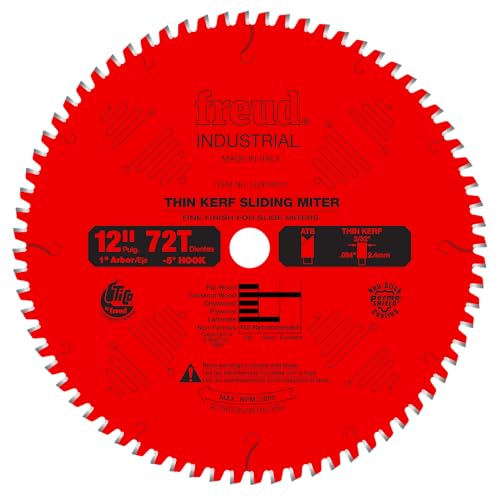
Freud LU91R012 Thin Kerf Miter Saw Blade
What We Like
- Thin kerf design reduces required saw horsepower
- 5° negative hook angle prevents aggressive grabbing
- Premium TiCo carbide blend for clean crosscuts
- Perma-Shield coating reduces friction and pitch buildup
Trade-offs
- Thin kerf design is less rigid than a full-kerf blade
- Weighs 2.4 pounds, lighter than some premium blades like the 3.6 lb Forrest
- Negative hook angle is not ideal for ripping operations
A 5° negative hook angle is the key here, it keeps the workpiece pressed down and controlled, preventing the blade from climbing and grabbing, which is a common concern on sliding miter saws. Combined with its thin kerf, this blade is engineered to deliver smooth, clean finish cuts with less strain on your saw’s motor. It’s a premium choice for woodworkers who demand precision from their sliding compound miter saws and want to minimize tear-out on moldings and fine trim.
The trade-off is in the blade’s thin profile, which sacrifices some rigidity for its efficiency. For the absolute most durable, vibration-resistant cut on a stationary chop saw, a heavier full-kerf blade like the Freud LU85R012 might be a better anchor. But for the specific dynamics of a sliding miter saw, where control and finish are paramount, this blade’s optimized design hits the mark. Expert round-ups consistently place Freud in the top tier for lasting value, and this model is a prime example of that engineering.
Product photos
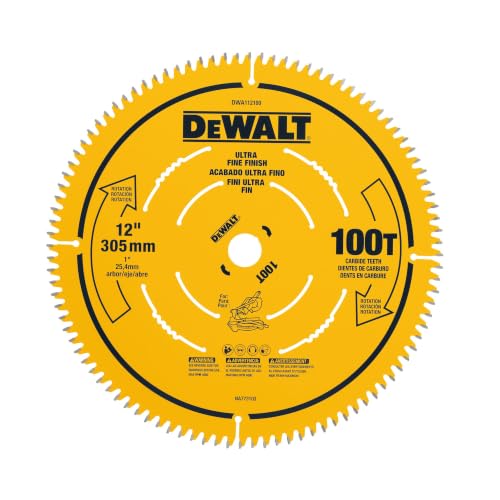
DEWALT 12-Inch 100T Fine Finish Blade
What We Like
- Patented slot design minimizes vibration
- 100 teeth deliver a fine finish
- Ultra sharp carbide for clean cuts
- Precision tensioning increases blade stiffness
Trade-offs
- 100 teeth cut slower than lower-tooth blades
- Fine finish geometry is not for rough lumber
The patented body slot design is what sets this blade apart, actively working to dampen vibration so your saw stays steadier and your cut line stays exactly where you put it. That engineering, combined with its 100 ultra-sharp teeth, makes it a clear choice for the woodworker who needs glassy-smooth crosscuts in trim, furniture, or any finished stock where tear-out is the enemy. This is a blade built for precision, not speed.
You pay for that stability with a bit of heft, at 2.7 pounds, it’s a solid chunk of steel. If your primary jobs are quick framing chops or cutting abrasive materials, the fine geometry and high tooth count will feel like overkill. For pure finish work, however, its controlled performance is hard to beat.
Product photos
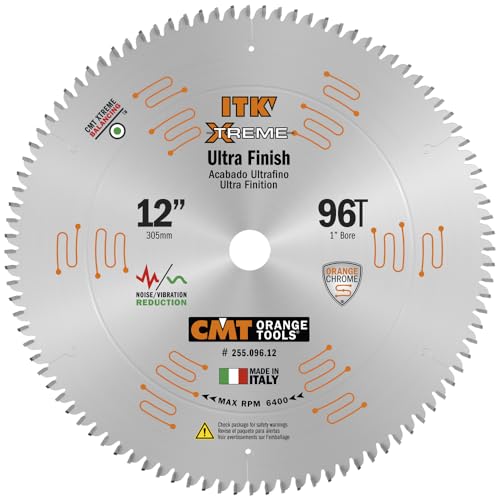
CMT ORANGE TOOLS 255.096.12 12 Miter Saw Blade
What We Like
- Ultra-fine finishing Hi-ATB tooth geometry.
- Laser-cut sound dampening slots reduce vibration.
- Precision mirror-finish sharpening on carbide teeth.
- Ideal for veneered plywood and delicate materials.
Trade-offs
- A 0.102-inch kerf requires more power than a thin-kerf blade.
- Specialized for crosscutting, not for ripping lumber.
- At 2.0 lb, it's lighter than some premium blades like the Forrest Chopmaster.
The Hi-ATB 30 tooth geometry and a 0.102-inch kerf are engineered for slicing through materials without tear-out, making it a specialist for pristine crosscuts. This blade is built for the craftsman who works with expensive hardwoods, melamine, and veneered plywood where the cut face is the final product. Its laser-cut dampening slots and tensioning ring aim for a smooth, chatter-free run, which is critical when a single flawed pass can ruin a workpiece.
Designed exclusively for crosscutting, the CMT blade is a dedicated tool for fine finishing work on materials like hardwoods and veneered plywood. Its standard kerf, rather than a thin-kerf design, requires a saw with sufficient power for clean cuts. This specialization means it is not intended for ripping or general construction tasks, where a separate combination blade would be needed.
Freud LU85R012 12-Inch Crosscut Blade

What We Like
- Anti-Vibration design for flawless cuts
- Silver I.C.E. Coating reduces heat and rust
- Perma-Shield non-stick coating reduces blade drag
- Hi-Tolerance Precision Plate for ultimate accuracy
Trade-offs
- Weighs 3.0 pounds, heavier than many 12-inch blades
- 96-tooth ATB grind is specialized for crosscutting only
Designed specifically for crosscutting, the Freud LU85R012 uses an Anti-Vibration design to eliminate movement and reduce chatter for smoother cuts. Its 96-tooth Alternate Top Bevel grind and 10-degree hook angle are configured to produce a fine finish on materials like hardwoods and trim. Freud’s Silver I.C.E. and Perma-Shield coatings work to reduce heat, drag, and corrosion over the blade’s lifetime. A laser-cut steel plate is tensioned to remain flat, which supports accuracy for detailed work such as picture frames.
That heft and its dedicated crosscut grind mean it’s not a blade you’ll swap in for a quick rip cut. For general shop use, a combination blade like the Diablo 12-Inch 60T offers more versatility. But when smooth, vibration-free crosscuts are the only goal, this Freud is a frequent recommendation among owners of saws like the Bosch 4212L, who pair it with their stationary saws for finish work.
Product photos
Forrest Chopmaster 12-Inch 80T Blade

What We Like
- Double-hard C-4 Submicron Carbide for extended life
- Heavier steel plate for maximum cutting stability
- Produces tight miter joints with no bottom splinters
- Works with all makes of chop, miter, and radial arm saws
Trade-offs
- A 3.6 lb weight is substantial for a blade in this class
- The 1/8-inch kerf is not a thin-kerf design
- Specific 80-tooth configuration is optimized for crosscuts, not ripping
For serious woodworkers, the Forrest Chopmaster blade uses double-hard C-4 Submicron Carbide for up to 300% longer life than standard blades, turning it from a consumable into a long-term investment. Its heavier-than-normal steel plate maintains maximum stability during cuts, which is key for producing tight miter joints without bottom splintering. An expert round-up noted that the advanced features and exceptional performance of Forrest, Freud, and Tenryu blades make them the best investments of lasting value.
The trade-off for that legendary durability and stability is a solid 3.6-pound heft and a standard 1/8-inch kerf. It’s a workhorse, not a featherweight. If your priority is a lighter, thinner kerf for easier cutting on lower-powered saws, the Freud LU91R012 is a compelling alternative to consider. But for a miter saw that sees daily use, the Forrest Chopmaster is built to be the last blade you’ll need to buy for that machine.
Diablo 12-Inch 60T Combination Blade

What We Like
- TiCo carbide for ripping and crosscutting.
- Non-stick coating resists heat and gumming.
- Thin kerf for faster, cleaner cuts.
- Tri-metal brazing for impact resistance.
Trade-offs
- 60-tooth design is not a dedicated fine-finish blade.
- Lacks a specialty grind like ATB for pure crosscuts.
A 60-tooth combination grind is the core of this blade’s versatility, allowing it to handle both rip cuts and crosscuts competently in a single package. That makes it a logical first blade for a new saw or a reliable workhorse for general construction and framing where you’re cutting a mix of dimensional lumber and sheet goods. The Perma-SHIELD coating and hardened steel body are built to resist the gumming and wear of all-day use, so you can keep working without constant cleanup.
While the Diablo blade handles both ripping and crosscutting, it won’t deliver the glass-smooth surface of a dedicated finishing blade like the DEWALT 12-Inch 100T. Its 60-tooth combination design and Perma-SHIELD coating aim for durable, all-around use with minimal gumming. For a shop that demands one blade to tackle the majority of cuts on a miter saw without frequent changes, this Diablo’s balanced design and protective features make it a pragmatic, mid-range choice.
DEWALT 12-Inch Miter Saw Blade Combo

What We Like
- Includes two versatile tooth counts in one pack.
- Patented body slot design minimizes vibration.
- Ultra-sharp carbide teeth for clean cuts.
- Optimized tooth geometry enhances cutting accuracy.
Trade-offs
- Pack lacks a dedicated ultra-fine blade like an 80T or 100T option.
This combo pack includes two blades, a 40-tooth and a 60-tooth, so you can tackle different jobs without a separate purchase. The patented body slot design reduces vibration, which helps maintain accuracy during cuts. Having both tooth counts provides flexibility for a range of projects.
The trade-off is that you don’t get a dedicated ultra-fine finishing blade. For pristine, chip-free cuts on veneered plywood or delicate moldings, you’d still need a blade with a higher tooth count, like the Diablo 12-Inch 80T Hi-ATB. Think of this combo as a foundational set that efficiently covers a lot of ground, making it a sensible starting point for building a blade collection.
Product photos
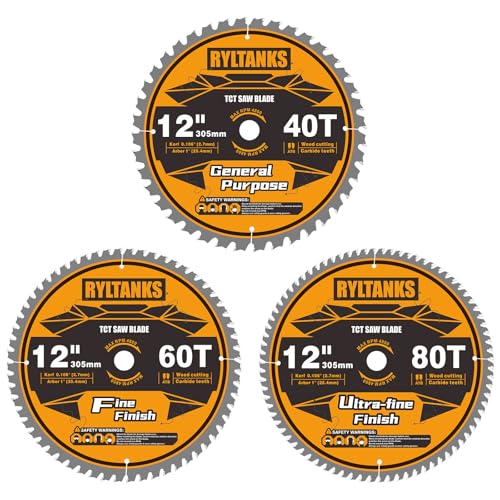
Ryltanks 12-Inch Miter Saw Blade 3-Pack
What We Like
- Three-purpose blade set covers general to ultra-fine cuts
- Ultra-thin kerf design requires less cutting power
- Laser-cut stabilizer vents reduce noise and vibration
- Compatible with most major 12-inch miter saw brands
Trade-offs
- Maximum RPM of 4,800
- Pack contains only one of each tooth count
The three-blade combo tackles everything from framing lumber to finish trim, which makes it a compelling starter kit for the cost-conscious woodworker. You get a 40-tooth blade for rough work, a 60-tooth for cleaner crosscuts, and an 80-tooth for the finest finishes on plywood or oak. All three feature C3 carbide and laser-cut vents, so they should stay cooler and last longer than typical bargain-bin blades. This approach provides genuine versatility without the immediate need to invest in separate, more expensive specialty blades.
This three-blade pack covers general, fine, and ultra-fine finish cutting, offering a versatile starter set for a new workshop. Its 40-tooth blade handles nail-embedded lumber and plywood, while the 60-tooth and 80-tooth versions are for progressively smoother cuts in hardwoods and softwoods. All three use C3 grade tungsten carbide for toughness and wear resistance, and the ultra-thin kerf design reduces strain on the saw motor for better control.
Product photos
FOXBC 12-Inch 96T TCG Metal Blade

What We Like
- TCG geometry for clean, burr-free cuts in metal.
- Laser-cut stabilizer vents reduce vibration and noise.
- High-density FoxCarbide for impact resistance and long life.
- Explicitly rated for thin, medium, and thick non-ferrous metals.
Trade-offs
- 2.6 lb weight is heavier than most wood-cutting blades.
- Specific -5° hook angle is optimized for metal, not wood.
This 96-tooth Triple Chip Grind blade cuts non-ferrous metals like aluminum, brass, and copper pipe, as well as plastic, aiming for clean, burr-free results. Its -5° hook angle and laser-cut stabilizer vents are intended to reduce vibration for more accurate cuts. The blade is compatible with many 12-inch miter, slide miter, and table saws, making it a dedicated option for shops that frequently handle these materials.
Its specialization is clear when compared to wood-cutting blades like the Diablo 80T Hi-ATB. The carbide is described for extreme life in metal cutting applications, and the tooth geometry is designed for that purpose. For optimal results, this blade should be reserved for its intended stock while a separate blade is used for wood.
Product photos
How We Evaluated 12-Inch Miter Saw Blades
Our evaluation is based on comprehensive research of manufacturer specifications, expert round-up reviews, and consistent patterns in owner feedback. We did not physically test these blades. The key criteria were cut quality for fine crosscutting, blade design features that impact performance on a miter saw, and material compatibility.
For cut quality, we prioritized tooth count, geometry like Alternate Top Bevel (ATB), and coatings that reduce heat and gumming, as these are critical for clean finishes in woodworking. In blade design, we focused on factors like kerf thickness, hook angle, and anti-vibration features, which directly affect how a blade performs on the unique chop-and-stop action of a miter saw.
A research-led evaluation like this can identify standout performers and key trade-offs, but it cannot replicate the tactile experience of feed pressure or the long-term durability assessment that comes from years of shop use. For a deeper dive into specific models, you can explore our full review of the best 12-inch miter saw blades.
What To Look For In 12-Inch Miter Saw Blades
Selecting a miter saw blade is about matching its specifications to your saw and your most common projects. A blade that excels at ripping lumber on a table saw will often disappoint on a miter saw used for fine crosscuts.
Focus on tooth count and geometry for your primary material, choose a kerf that suits your saw’s power, and consider coatings for longevity and cleaner cuts.
Tooth Count & Geometry
Tooth count is the primary driver of cut finish. Blades with 60 to 100 teeth are standard for miter saws, designed for crosscutting. Higher tooth counts, like 80 or 100, produce smoother finishes with less tear-out on veneers and hardwoods but cut slower.
The tooth geometry is equally important. An Alternate Top Bevel (ATB) grind is ideal for clean crosscuts in wood, while a Triple Chip Grind (TCG) is necessary for cutting aluminum and plastics without burrs. For general-purpose use where you might crosscut and rip, a combination blade with around 60 teeth offers more versatility, though it won’t match a dedicated high-tooth blade’s finish.
Kerf & Hook Angle
Kerf is the width of the cut the blade makes. A thin kerf removes less material, requires less power from your saw, and produces less waste. This is advantageous for sliding miter saws or lower-powered models.
A full kerf (typically 1/8 inch) is more rigid and resists deflection, which is beneficial for heavy, straight cuts but demands more saw horsepower. The hook angle is the forward or backward tilt of the tooth. A negative hook angle (like -5°) provides a more controlled, less aggressive cut, which is safer and better for sliding miter saws and crosscutting. A positive hook angle pulls material into the cut, which is better for ripping.
Specialized Features & Build
Many premium blades include features to enhance performance. Anti-vibration slots or designs dampen harmonic noise and can improve cut smoothness. Non-stick coatings like Perma-SHIELD or Silver I.C.E. Reduce friction, heat buildup, and pitch accumulation, helping the blade stay cleaner and cut cooler. The carbide quality also dictates longevity; premium blades use high-density or submicron carbide that stays sharper longer. For heavy use, a thicker, heavier steel plate can increase stability, though it adds weight.
- Check your saw’s maximum RPM rating to ensure any blade you choose is compatible.
- Verify the arbor hole size, as one inch is common for many twelve-inch blades.
- Consider if you need a blade specifically rated for non-ferrous metals if cutting aluminum.
- Owner feedback on blade longevity and consistency of cut quality can be helpful. For intricate trim work, a blade designed for clean trim cuts is a worthwhile investment.
The best blade is a specialized tool; choose one optimized for your most frequent task rather than seeking a single blade to do everything perfectly.
12-Inch Miter Saw Blades Compared
The following table lets you quickly compare the key specifications of our top picks side-by-side.
| Product | Tooth Count | Tooth Geometry | Kerf Design |
|---|---|---|---|
| Diablo 12-Inch 80T Hi-ATB Saw Blade | 80 teeth | Hi-ATB | Super Thin Kerf |
| Freud LU91R012 Thin Kerf Miter Saw Blade | 72 teeth | ATB Grind | Thin kerf |
| DEWALT 12-Inch 100T Fine Finish Blade | 100 teeth | N/A | N/A |
| CMT ORANGE TOOLS 255.096.12 12 Miter Saw Blade | N/A | Hi-ATB 30 | 0.102 inches |
| Freud LU85R012 12-Inch Crosscut Blade | 96 ATB | ATB | .116" |
| Forrest Chopmaster 12-Inch 80T Blade | 80 | 4 PTS + 1 Flat | 1/8 inch |
| Diablo 12-Inch 60T Combination Blade | 60 combination teeth | N/A | Super thin laser-cut |
| DEWALT 12-Inch Miter Saw Blade Combo | 40T & 60T | N/A | N/A |
| Ryltanks 12-Inch Miter Saw Blade 3-Pack | 40T, 60T, 80T | N/A | 0.106 inch |
| FOXBC 12-Inch 96T TCG Metal Blade | 96 teeth | Triple Chip Grind (TCG) | .094" |
Frequently Asked Questions
Who makes the best 12 inch miter saw blade?
Several manufacturers produce excellent 12-inch miter saw blades, with the “best” depending on your specific need. Brands like Diablo, Freud, DEWALT, CMT, and Forrest are consistently noted for high-quality blades. Our research indicates Diablo and Freud offer outstanding performance for fine woodworking, while Forrest is renowned for extreme durability. Your choice should be guided by whether you prioritize a fine finish, long life, or value, as detailed in our guide to selecting miter saw blades.
What is the best type of blade for a miter saw?
The best type of blade for a miter saw is a crosscut blade with a high tooth count (typically 80 to 100 teeth) and an Alternate Top Bevel (ATB) tooth geometry. This configuration is designed specifically for making smooth, clean cuts across the wood grain, which is the primary function of a miter saw. For cutting aluminum or plastics, a blade with a Triple Chip Grind (TCG) is required.
How do I choose between a thin kerf and full kerf blade?
Choose a thin kerf blade if you have a sliding miter saw, a lower-powered saw, or you want to minimize material waste and strain on the motor. Opt for a full kerf blade if you have a powerful stationary saw, need maximum rigidity for precise bevel cuts, or prioritize blade stability over easier cutting. Understanding the difference between thin and full kerf blades is key to this decision.
Can I use a 12-inch blade on a 10-inch miter saw?
No, you cannot use a 12-inch blade on a 10-inch miter saw. The saw’s guard and arbor are designed for a specific maximum blade diameter. Using a larger blade is extremely dangerous and will cause catastrophic failure. If you own a 10-inch saw, you need to explore blade options for a 10-inch miter saw.
When should I replace my miter saw blade?
Replace your miter saw blade when you notice a decline in cut quality, such as increased tear-out, burning, or a requirement for much more force to push the saw through the cut. Other signs include visible chipping on the carbide teeth or excessive vibration. For a detailed look at maintenance and signs of a dull blade, consult our dedicated resource.
The Bottom Line
For woodworkers and finish carpenters who need one reliable blade for exceptionally clean crosscuts, the Diablo 12-Inch 80T Hi-ATB Saw Blade is the best overall choice. Its combination of high tooth count, thin kerf, and protective coating delivers fine, tear-out-free results in hardwoods and trim.
If you’re on a budget or just starting out, the Ryltanks 3-Pack offers remarkable versatility, while those regularly cutting materials like aluminum extrusions should look directly to the specialized FOXBC 96T TCG blade. Ultimately, the single most important factor is matching the blade’s specialty, be it fine finish, vibration control, or material compatibility, to the majority of work on your saw table.
