
8 Best Air Compressors For Sandblasting in 2026
This post contains affiliate links. As an Amazon Associate, we earn from qualifying purchases.
Our best overall air compressor for sandblasting is the DEWALT 60-Gallon Stationary Air Compressor for its high CFM delivery and large tank reserve. The Ingersoll Rand 5HP Two-Stage model excels for industrial duty, while the VEVOR 15HP Gas Powered unit is ideal for mobile, off-grid work.
Sandblasting demands a lot more air than most shop tools. If your compressor can’t keep up, you’ll spend more time waiting than working. We built this guide by analyzing manufacturer specifications, expert round-ups, and patterns in professional feedback to help you find a compressor that matches your blasting nozzle’s true appetite.
Top 8 Air Compressors For Sandblasting in the Market
Certain content that appears on this site comes from Amazon. This content is provided "as is" and is subject to change or removal at any time.
The Best Air Compressors For Sandblasting, Reviewed
DEWALT 60-Gallon Stationary Air Compressor

What We Like
- Large 60-gallon ASME tank for extended run time
- Delivers 14.6 CFM at 90 PSI for demanding tools
- 175 max PSI offers strong pressure reserve
Trade-offs
- Single-stage pump is less efficient than two-stage models
- Requires a dedicated 240V electrical circuit
- Substantial footprint at 65.2 inches tall
Delivering 14.6 CFM at 90 PSI, this compressor provides the consistent, high-volume airflow that sandblasting demands. The 60-gallon ASME tank gives you a substantial reservoir, letting you work longer before the pump cycles on. For a serious home shop or a professional tackling medium-duty blasting jobs, this DEWALT offers a solid, reliable foundation. Its 5 HP motor and 175 PSI maximum pressure mean it won’t choke under load, making it a dependable workhorse you can build a system around.
The trade-off is its single-stage pump design. It generates its pressure in one shot, which can run hotter and less efficiently than a two-stage compressor like the Ingersoll Rand 2340N5-V when pushed hard for hours. That makes it better suited for sustained, but not continuous, industrial use. For a weekend warrior restoring a car or cleaning equipment, however, its performance and DEWALT’s durable construction strike an excellent balance, offering pro-grade capability without the complexity or cost of a true industrial two-stage unit.
Ingersoll Rand 5HP Two-Stage Air Compressor

What We Like
- Cast iron construction for extended durability
- 100% continuous duty cycle for non-stop operation
- 80-gallon tank provides substantial air reserve
Trade-offs
- At 435 pounds, it requires a permanent, reinforced installation
- Occupies a significant footprint of 37.1"L x 26.0"W
- 5 HP motor requires appropriate 220V electrical wiring
With a 100% continuous duty cycle, this compressor can run non-stop without overheating, making it suitable for extended industrial tasks. It delivers 14.3 CFM at 90 PSI, providing a steady air supply for multiple tools. The 80-gallon ASME tank serves as a large air reservoir, minimizing how often the pump needs to cycle on and off.
The trade-off for this industrial stamina is a substantial physical and electrical commitment. You’re not moving this 435-pound unit once it’s bolted down, and its 5 HP motor demands proper 220V wiring. For a high-volume professional shop, this is a foundational tool. If your needs are more intermittent, a smaller unit like the DEWALT 60-Gallon Stationary Air Compressor offers a more manageable footprint and electrical requirement, though with less air on tap for marathon tasks.
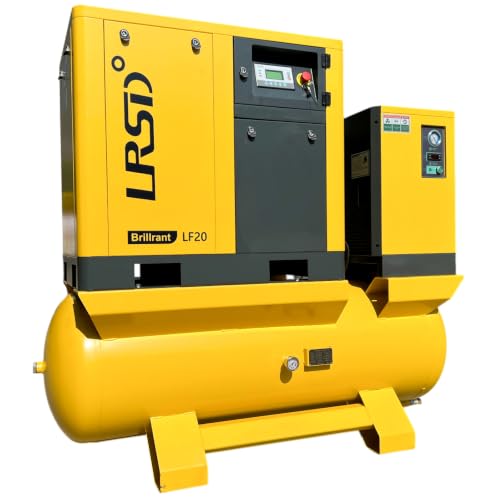
LRSD 20HP Rotary Screw Air Compressor
What We Like
- Plug-and-play 4-in-1 integrated system
- High-efficiency screw air end for stable airflow
- IP55 motor rated for harsh industrial environments
- Large cooling fan for continuous operation
Trade-offs
- Requires a 230V 3-phase electrical hookup
- Massive 1168-pound weight limits placement
- Substantial 74-inch length demands significant floor space
This all-in-one system combines a 20HP rotary screw compressor, a 120-gallon tank, a refrigerated dryer, and multi-stage filters in a single pre-assembled unit. That plug-and-play design means no on-site assembly is required for shops with the right power, so you can connect it and start production. It’s built for industrial applications like CNC machining and manufacturing, where its stable, high-volume airflow supports continuous operation without waiting for a tank to refill.
The major compromise is its complete dependence on three-phase industrial power, which rules out most home workshops and smaller facilities. You also need a concrete pad and a forklift to handle its substantial footprint and weight. For a shop with the right electrical service and floor space, this compressor eliminates the air supply as a bottleneck. Compared to a piston-driven model like the Ingersoll Rand 5HP Two-Stage, this system is about relentless volume and lower maintenance, not portability or simple plug-in operation.
Product photos
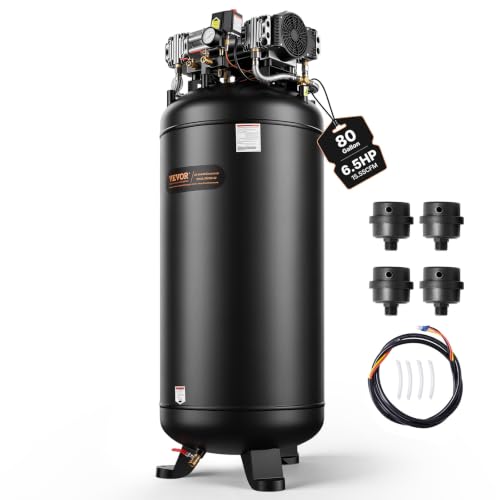
VEVOR 80-Gallon Oil-Free Air Compressor
What We Like
- Large 80-gallon tank for extended runtime
- Oil-free pump reduces maintenance needs
- 86 dB operation is relatively quiet for its class
- High-strength steel tank construction for durability
Trade-offs
- At 264.6 lb, it's a permanent installation only
- Requires dedicated 220V single-phase power
- 15.5 SCFM may be insufficient for large industrial sandblasters
An 86 dB noise level makes this 80-gallon stationary compressor a standout for shops where keeping the peace matters. Its oil-free design means you won’t be buying lubricants or dealing with messy maintenance, and the massive tank provides a long, steady air reserve for tools like a small to medium sandblasting cabinet. This setup is ideal for a dedicated workshop where you need reliable air for hours without the typical roar, and where you have the 220-volt outlet to feed it.
Its size and air volume are the main considerations. More critically, the 15.5 CFM output is solid for many pneumatic tools but sits at the lower end for sandblasting. It will run a smaller cabinet well, though it could struggle with a larger pressure pot or continuous heavy blasting. For bigger industrial tasks, the Ingersoll Rand 5HP Two-Stage unit delivers significantly more air, but it has a different power profile and footprint.
VEVOR 15HP Gas Powered Air Compressor

What We Like
- Gas engine provides cordless, on-site power.
- High 33 CFM flow runs demanding tools continuously.
- Four wheels enable movement across rough ground.
- Dual air outlets allow two-tool operation.
Trade-offs
- Gas operation limits use in enclosed workshops.
The 33 CFM air delivery is the key spec here. It provides the volume needed to run a sandblaster without constant stalling, turning a messy job into a steady, productive one. This compressor suits contractors and restoration crews who need serious air power far from an electrical outlet. Its gas engine and four-wheeled portability mean you can drive it right up to a jobsite, whether that’s a rusty tractor in a field or a steel beam on a foundation.
A 15HP gas engine and 33 CFM air delivery provide serious portable power, but this unit is not a compact workshop tool. Its 48.8-inch length and 271-pound weight, on wheels, are built for a trailer or truck bed to run tools where there is no electrical outlet. This design trades the large tank capacity of a stationary compressor for the ability to bring high air volume to remote job sites.
Product photos
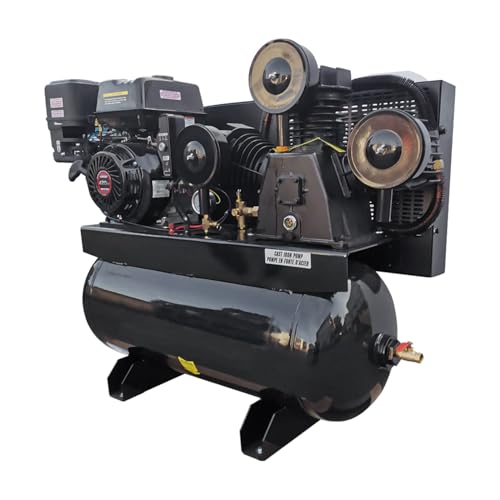
MutsMover 13HP Gas Powered Air Compressor
What We Like
- High 44 CFM output for demanding tools
- Gas engine enables cordless, mobile operation
- Heavy-duty cast iron pump for durability
- ASME certified 30-gallon tank for stable pressure
Trade-offs
- Single-stage design limits maximum pressure compared to two-stage units
- Requires a truck bed or trailer for transport
With up to 44 CFM from its 13HP gas engine, this compressor can run demanding pneumatic tools like impact wrenches and sandblasters where electricity is unavailable. The 30-gallon ASME certified tank provides a reservoir of compressed air to help maintain stable pressure and reduce how often the engine needs to cycle. This truck-mounted design is intended for mobile service units, construction crews, and remote job sites that require a portable air supply.
The single-stage pump and 44 CFM output are intended for mobile and field applications. For operations based in a fixed workshop with constant high-volume needs, a larger stationary compressor may be required. However, the gasoline engine and truck-mounting design mean this unit brings its air capacity directly to the work location.
Product photos
Ingersoll Rand SS3L3 Single Stage Air Compressor

What We Like
- All Season Select synthetic lubricant lasts 2,000 hours between changes.
- 100% continuous duty rating for demanding, prolonged tasks.
- Fully assembled and pre-wired for straightforward setup.
Trade-offs
- 11.3 CFM is modest for large industrial sandblasting nozzles.
- Single-stage design limits pressure to 135 PSI for finer media.
Its All Season Select synthetic lubricant delivers 2,000 hours between changes, which translates to years of typical workshop use before you even think about maintenance. For a shop that runs a sandblasting cabinet intermittently or tackles smaller projects, the 11.3 CFM at 90 PSI and 60-gallon tank provide a solid, reliable air supply without the complexity of a two-stage system.
The main limitation is in raw output. That 11.3 CFM will struggle to feed a large suction-fed blast gun or a high-production operation. It’s a workhorse for sustained use, not a sprinter for maximum volume. If your projects demand more air, you’d look at a two-stage compressor like the Ingersoll Rand 2340N5-V. For the user who values minimal downtime and simplified maintenance in a durable single-stage package, this compressor is a pragmatic foundation.
DEWALT DXCM602 Stationary Air Compressor

What We Like
- Dual-voltage motor for versatile workshop wiring
- ASME-certified 60-gallon tank for safe, sustained use
- Oil-lubricated pump designed for extended service life
- Delivers 175 max PSI for consistent tool performance
Trade-offs
- 11.5 CFM is modest for large industrial sandblasting nozzles
- Stationary 200-pound weight requires a dedicated floor space
A 60-gallon tank paired with a dual-voltage motor makes this compressor a solid, adaptable foundation for a serious home shop. The 11.5 CFM at 90 PSI output is enough to run a mid-sized sandblasting cabinet or a siphon-fed gun for smaller projects. Its ability to wire for either 208V or 230V also removes a major headache during installation. For the craftsman whose needs are consistent but not extreme, this DEWALT offers a reliable, safety-certified core that integrates smoothly into an existing workshop without requiring special electrical service.
The 11.5 CFM airflow suits tasks that don’t demand constant, high-volume air. For extended jobs requiring more air, a unit with greater output would be necessary. The Ingersoll Rand 5HP model, for instance, is physically larger and heavier, indicating a different class of compressor built for more demanding applications.
Product photos
How We Evaluated Air Compressors For Sandblasting
Our evaluation started with manufacturer data on critical performance specs: CFM at 90 PSI, maximum PSI, tank capacity, and duty cycle. We cross-referenced this with expert round-ups to understand how these numbers translate to real-world sandblasting performance. We prioritized models known for delivering the sustained, high-volume airflow that abrasive blasting requires, not just peak pressure.
The most important criteria were delivered CFM, pressure stability, and power source. Sandblasting consumes air rapidly; a compressor’s CFM output must meet or exceed your nozzle’s consumption to prevent pressure drops. A stable, high PSI reserve ensures consistent media velocity, while the power source (electric or gas) dictates where you can use the machine. We also considered durability signals like construction and pump type.
A research-led evaluation has limits. We can identify compressors with the right specs for a given nozzle size, but we cannot simulate years of daily workshop wear. Our recommendations are based on design intent and reported performance, not long-term durability testing.
What To Look For In Air Compressors For Sandblasting
Choosing the right compressor means matching its output to your sandblaster’s air hunger. A unit that’s fine for impact wrenches will often stall under the continuous demand of a blasting nozzle.
The key is CFM at your operating PSI, not tank size or horsepower alone. Start with your nozzle’s CFM requirement, then add margin for hose loss and nozzle wear. A larger tank provides a buffer, but only sufficient compressor CFM prevents pressure drop during long blasts.
CFM Delivery Is Everything
Cubic Feet per Minute (CFM) measures airflow volume. For sandblasting, the compressor’s CFM rating at 90 PSI is the most critical number. Small hobbyist blasters might run on 10-20 CFM, but industrial pressure blasting with a 7/16-inch nozzle can demand over 200 CFM. The compressor must supply this air continuously; if the nozzle consumes air faster than the pump can make it, pressure will fall and blasting stops. Our research into the air compressor size needed for sandblasting confirms that you must start with your specific nozzle’s manufacturer-stated CFM need.
Pressure Stability & Reserve
Operating pressure for efficient sandblasting is typically 90 to 100 PSI. Your compressor must not only reach this pressure but hold it steadily under load. A higher maximum PSI, like 175 PSI, indicates a strong pressure reserve that helps maintain stable output at the nozzle. This is especially important as nozzles wear and begin to consume more air. Two-stage compressors, like our Best Industrial Duty pick, are often better at maintaining stable pressure over long periods than single-stage models.
Power Source & Duty Cycle
Your workspace dictates the power source. Electric models require appropriate voltage (120V, 240V, or 3-phase) and a dedicated circuit, but they’re clean for indoor shops. Gas-powered compressors offer complete mobility for outdoor or remote jobsites.
The duty cycle, the percentage of time a compressor can run, is vital. A 100% duty cycle, as found on our Ingersoll Rand picks, means it can run non-stop, which is essential for prolonged blasting sessions. For a full range of tools these compressors can run, see our guide on the best air compressors for pneumatic tools.
- Check your shop’s electrical panel for available 240V circuits before buying a large stationary compressor.
- For gas models, factor in fuel storage, ventilation, and noise for your worksite.
- Always verify the CFM rating is for 90 PSI, not a lower, less useful pressure.
Match the compressor’s continuous CFM output to your blaster’s needs, not its tank size.
Air Compressors For Sandblasting Compared
The table below compares the key specifications of our top picks to help you see the differences at a glance.
| Product | Tank Capacity | Motor/Engine Power | Max Pressure |
|---|---|---|---|
| DEWALT 60-Gallon Stationary Air Compressor | 60 gallon | 5 HP | 175 PSI |
| Ingersoll Rand 5HP Two-Stage Air Compressor | 80-gallon | 5 HP | 175 PSI |
| LRSD 20HP Rotary Screw Air Compressor | 120 gallons | 20HP | N/A |
| VEVOR 80-Gallon Oil-Free Air Compressor | 80 Gallon | 6.5 HP | 145PSI |
| VEVOR 15HP Gas Powered Air Compressor | 30-gallon | 15HP gas powered | 115 PSI |
| MutsMover 13HP Gas Powered Air Compressor | 30-gallon | 13HP gasoline | 125 PSI |
| Ingersoll Rand SS3L3 Single Stage Air Compressor | 60 gal | 3 HP | 135 PSIG |
| DEWALT DXCM602 Stationary Air Compressor | 60 gallons | 3.7 HP | 175 PSI |
Frequently Asked Questions
What air compressor is best for sandblasting?
The best compressor depends on your nozzle size and worksite. For most workshops needing high, sustained airflow, a large stationary electric unit like the DEWALT 60-Gallon Stationary Air Compressor is a strong choice. For mobile contractors blasting outdoors, a high-CFM gas-powered model like the VEVOR 15HP Gas Powered Air Compressor is essential. You can explore more specialized options in our dedicated best sandblasters guide.
What size compressor is required for sandblasting?
There is no universal size. Required compressor size is determined by your blast nozzle’s orifice diameter and your target operating PSI. A small nozzle may need under twenty CFM, while a large industrial nozzle can require several hundred CFM. You must consult your sandblaster and nozzle manufacturer for the specific CFM requirement at your working pressure.
How much CFM do I need to run a sandblaster?
You need enough CFM to match your nozzle’s air consumption at your chosen PSI, plus a margin for system losses. For example, running a common nozzle at ninety PSI can require a significant amount of CFM. It is prudent to choose a compressor rated for a higher amount to account for hose length, fittings, and nozzle wear over time, which increases air consumption.
What psi should you sand blast at?
Most abrasive blasting is most efficient between 90 and 100 PSI. This range provides a good balance of cleaning speed and media control. Operating at lower PSI will significantly slow the job, while higher PSI can accelerate nozzle wear and may not improve results proportionally. Your compressor should be capable of a maximum PSI well above this (e.g., 135-175 PSI) to maintain a stable supply.
Can I use a small portable compressor for sandblasting?
You can, but only for very small, intermittent tasks with a correspondingly tiny blast nozzle. Most portable “pancake” or hot-dog compressors deliver less than 5 CFM at 90 PSI, which is insufficient for even hobbyist sandblasting guns. You will experience constant pressure drops and extended recovery times, making the process frustratingly slow.
The Bottom Line
For a workshop setting where high, continuous airflow is the priority, the DEWALT 60-Gallon Stationary Air Compressor is our best overall recommendation. Its combination of 14.6 CFM at 90 PSI and a large tank suits a range of demanding pneumatic tools, including many sandblasters.
If your budget is tight or your needs are specialized, look to our award winners. The VEVOR 15HP Gas Powered Air Compressor is the clear choice for mobile work, while the Ingersoll Rand SS3L3 offers exceptional maintenance intervals for frequent shop use. Ultimately, the single most important factor is matching your compressor’s true CFM output to the specific demands of your sandblasting nozzle.
