
10 Best Cordless Belt Sanders in 2026
This post contains affiliate links. As an Amazon Associate, we earn from qualifying purchases.
Our best overall cordless belt sander is the DEWALT 20V MAX Belt Sander for its precise speed control and efficient dust collection. For professional power, the Milwaukee M18 Fuel Belt Sander excels, while budget-conscious DIYers should see the WEN 20V Max Cordless Belt Sander. Choosing the right cordless belt sander means matching tool power and belt width to your projects.
Battery platform compatibility and ergonomics are also key for comfort and cost. Our research is based on manufacturer specifications, expert round-ups, and patterns in owner feedback. This guide gives you the details to pick a sander that fits your needs.
Top 10 Cordless Belt Sanders in the Market
Certain content that appears on this site comes from Amazon. This content is provided "as is" and is subject to change or removal at any time.
The Best Cordless Belt Sanders, Reviewed
DEWALT 20V MAX Belt Sander

What We Like
- Variable speed dial for precise material control
- Quick-release tool-free belt change system
- Comfortable overmolded auxiliary handle for two-handed use
- High-efficiency dust collection minimizes workspace exposure
Trade-offs
- Tool only: requires separate purchase of a DEWALT 20V battery and charger.
- Dust collection airlock system is sold separately.
The DEWALT 20V MAX Belt Sander can handle traditionally corded sanding applications with its brushless motor, offering cordless freedom for large jobs. Its design provides 16.7% more sanding surface area than the Milwaukee M18 Fuel model, which means you can finish big sanding tasks faster. Reviewers reported that this cordless model delivered the smoothest finish of any battery-powered sander they tested, feeling well-balanced during use.
The trade-off is that you’re buying into a system. You’ll need to already own or purchase DEWALT’s 20V MAX batteries. For detail work in cramped corners, the narrower belt on DEWALT’s own Bandfile sander might be more appropriate. But for the majority of sanding tasks, from flattening tabletops to refinishing floors, this belt sander’s balance of power, runtime, and user control is hard to beat.
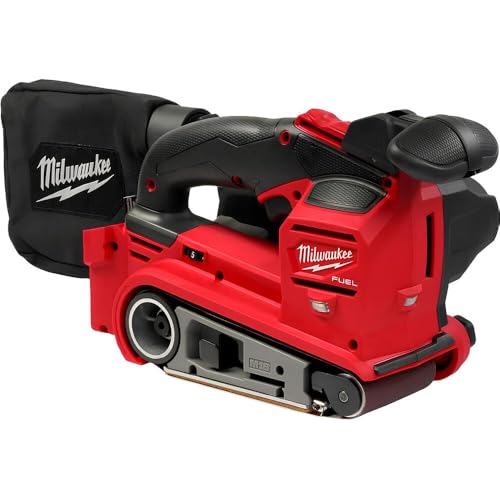
Milwaukee M18 Fuel Belt Sander
What We Like
- Brushless motor matches corded 8A sander power.
- Variable speed dial for precise material removal control.
- Tool-free lever enables quick sanding belt changes.
- REDLINK PLUS protects from overload and overheating.
Trade-offs
- Requires specific 3 x 18 sanding belts only.
- Bare tool; requires M18 battery and charger.
Its brushless motor delivers the power of a corded 8-amp sander, which means you can tackle heavy stock removal and prolonged sanding sessions without a cord holding you back. This makes it a prime choice for tradespeople and serious woodworkers who need cordless convenience without sacrificing performance. The variable speed dial, offering a wide range from 750 to 1350 surface feet per minute, gives you the control to handle everything from delicate shaping to aggressive leveling.
This sander’s brushless motor generates power comparable to larger 8-amp corded models, so it removes material quickly on big surfaces. That professional capability comes with significant weight; at 8.8 pounds, it demands more arm strength than lighter-duty models, a factor for overhead tasks. A tool-free lever allows for quick belt changes, minimizing downtime when switching grits.
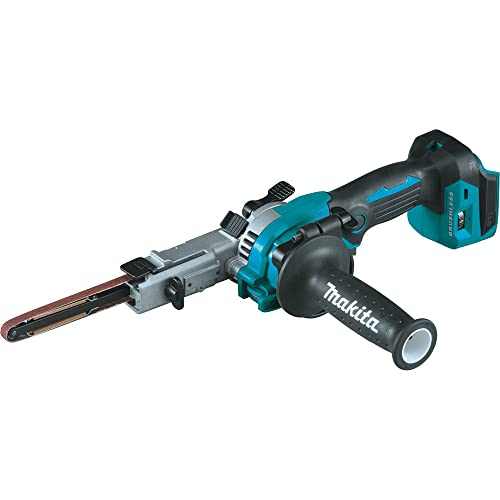
Makita 18V LXT Detail Belt Sander
What We Like
- Compact arm pivots 160° for easy storage
- L.E.D. light adjusts with the sanding arm
- Electric brake for faster repositioning
- Delivers corded performance cordlessly
Trade-offs
- Tool only: requires a Makita 18V LXT battery
- Smaller 3/8" belt limits width of sanding passes
- At 4.2 lb, less mass can mean more user effort on large flats
Weighing just over four pounds, the Makita 18V LXT Detail Belt Sander is a cordless tool designed for confined spaces. Its 3/8-inch by 21-inch belt and pivoting arm can reach into corners bulkier sanders cannot. Research found it removed material nearly as quickly as the Metabo HPT and Makita 9903 models while maintaining control, delivering corded-like performance without the cord.
The compact sanding arm pivots up to 160 degrees for storage, and its L.E.D. light adjusts with the arm to illuminate the workspace. An electric brake stops the belt quickly, allowing for faster repositioning between passes. This tool-only package requires a separate Makita 18V LXT battery and charger, which must be purchased separately.
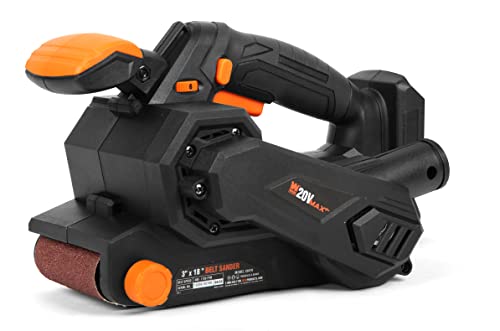
WEN 20V Max Cordless Belt Sander
What We Like
- Variable speed for material control
- Lock-on switch for continuous operation
- Quick-release lever for fast belt changes
- Includes dust bag and 80-grit belt
Trade-offs
- Battery and charger sold separately
A variable speed motor that pushes a 3×18-inch belt up to 1150 feet per minute gives you enough muscle for serious stock removal on flat surfaces. That lock-on trigger is a genuine work saver for long sanding sessions, letting you focus on guiding the tool instead of squeezing. For the DIYer or occasional woodworker already invested in the WEN 20V Max battery platform, this sander delivers core functionality without frills. It handles the fundamental task of leveling and shaping efficiently, making it a straightforward entry into cordless belt sanding.
This cordless belt sander requires a separate purchase of a WEN 20V Max battery and charger, an important cost factor for anyone not already invested in the brand’s tool system. Weighing 6.2 pounds, it has a substantial feel that provides stability during sanding but is less nimble than compact detail-oriented models. Its variable speed motor and lock-on switch support extended work on larger surfaces, making it a portable option for general woodworking tasks away from an outlet.
Product photos
DEWALT 20V MAX XR Bandfile Sander

What We Like
- High-speed brushless motor for aggressive material removal
- Tool-free, lever-release belt changes are quick and simple
- 104-degree rotating arm for storage and tight-space access
- Variable speed dial provides control for delicate contours
Trade-offs
- Bare tool only: requires separate DeWalt 20V battery and charger
- Less suited for large panels compared to full-size belt sanders
A brushless motor delivers 700 MWO of power, rotating the belt up to 5,600 feet per minute for fast material removal. The variable speed dial and trigger provide control, which reviewers report was useful for delicate curves and contours. A 104-degree rotating arm and changeable contact arm provide flexibility for multiple applications.
The trade-off is its focused design. While it’s a master of detail, the 1/2-inch belt isn’t meant for smoothing large tabletops or deck boards. For those bigger, flatter surfaces, you’d want a full-size model like the DeWalt DCW220B. But if your projects involve intricate shapes, welds, or confined areas, this bandfile delivers pro-grade power without the cord, and its well-balanced, textured grip keeps fatigue at bay during longer sessions.
Ryobi 18V ONE+ Belt Sander

What We Like
- Comes with three belts ready to start
- Multi-position handle for flush sanding
- Cordless design for large project mobility
- Uses common 76x533mm belt accessories
Trade-offs
- Tool-only listing requires a separate battery purchase
- Belt speed is a fixed rate, not variable
Three belts are included, so you can start a project right away without a separate accessory purchase. For users already invested in the Ryobi ONE+ system, this cordless design offers freedom for large sanding tasks away from an outlet. The multi-position top handle provides comfort and allows the tool to sand flush to walls.
The tool weighs 7.2 pounds without a battery, which requires more arm strength than lighter sanders like the 4.2-pound Makita detail model during extended use. Its cordless capability suits users who need to move freely around a worksite, rather than those requiring the fastest completion of fine-finishing tasks.
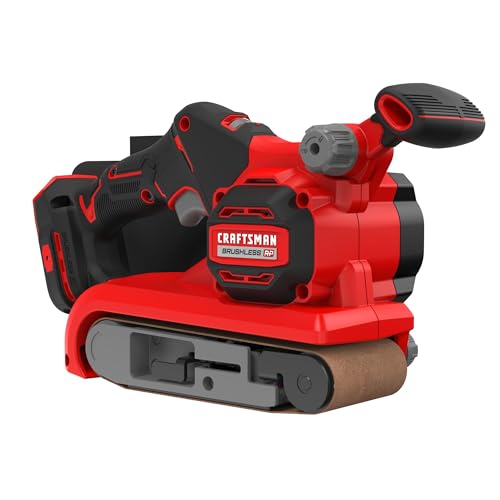
CRAFTSMAN V20 Brushless Belt Sander
What We Like
- Brushless motor for fast material removal
- Five variable speed settings for versatility
- Three-position auxiliary handle improves control
- Tool-free belt tracking for easy adjustments
Trade-offs
- Tool-only format requires a separate V20 battery purchase
- Weighs 8.0 pounds
A 3-position auxiliary handle gives you multiple, secure grips for tackling edges, vertical surfaces, and long horizontal passes. That flexibility, combined with a brushless motor hitting 950 FPM, makes this a serious option for the weekend warrior who demands control without sacrificing power. It’s built for the DIYer who has a handful of demanding projects a year, from refinishing a deck to building shop furniture, and doesn’t want to compromise on feel.
The Craftsman V20 brushless belt sander weighs 8.0 pounds, giving it a stable feel for aggressive stock removal on benchtops. It is heavier than the 4.2-pound Makita detail sander, which is designed for a different class of work. With five variable speeds and a brushless motor rated for up to 950 feet per minute, it provides core features common to professional-grade cordless sanders.
Product photos
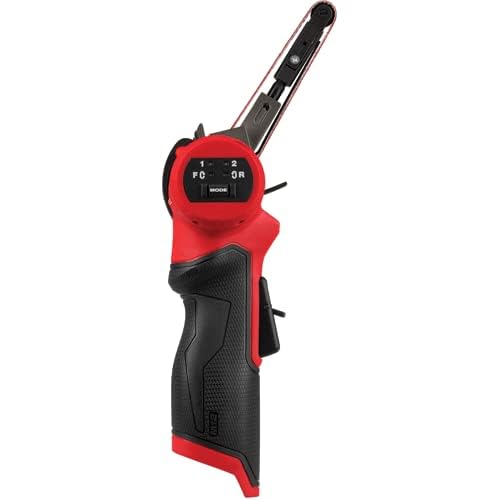
Milwaukee M12 FUEL Bandfile
What We Like
- Extremely lightweight at only 2.4 pounds
- Forward and reverse operation for versatile sanding
- Lock-on button for continuous use
- Best-in-class spot weld removal rate
Trade-offs
- Tool-only listing requires separate M12 battery purchase
- 3/8-inch belt width is narrower than full-size belt sanders
- Compact form factor limits material removal on large surfaces
Weighing 2.4 pounds, the Milwaukee M12 FUEL Bandfile is a notably light tool, which can reduce user fatigue during extended use. It offers two speed settings, 3,600 and 1,800 SFM, and a variable-speed trigger for operator control over material removal. The tool also includes a forward and reverse function, allowing the user to change sanding direction.
The tool uses a 3/8-inch by 13-inch sanding belt, a narrower size compared to the 3-inch belt on the Milwaukee M18 Fuel Belt Sander. This is a bare tool, so a compatible Milwaukee M12 battery and charger must be purchased separately for operation.
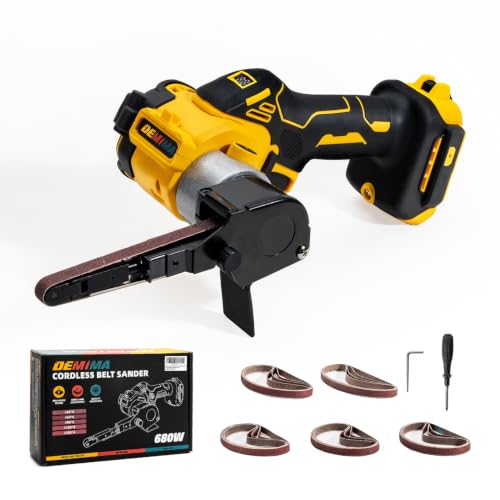
DEMIMA Brushless Belt Sander
What We Like
- Compact 3/8" belt for precision in corners
- Brushless motor for smooth, low-maintenance power
- 360-degree adjustable arm for awkward angles
- Includes 20-pack of assorted grit belts
Trade-offs
- Tool only: requires DeWalt 20V battery
- Narrow belt less suited for large, flat surfaces
- Less material removal than full-size belt sanders
A 3/8″ x 13″ sanding belt defines this tool, giving you a narrow profile for precision work in tight areas. That compact belt size helps reach corners and edges with greater control, supported by a brushless motor for smooth, consistent sanding. The adjustable sanding arm can be positioned and fixed at your preferred angle, providing better access for detailed surfaces. This combination makes it a practical choice for woodworking, metalworking, and DIY projects where maneuverability matters.
Its design prioritizes precision over large-scale removal, using a compact 3/8″ belt suited for corners and hard-to-access surfaces. For broader sanding tasks, other models in its class feature wider belts. Being cordless and compact, this sander offers greater freedom of movement without a power cord, which is useful for repairs and finishing work where you need to maneuver.
Product photos
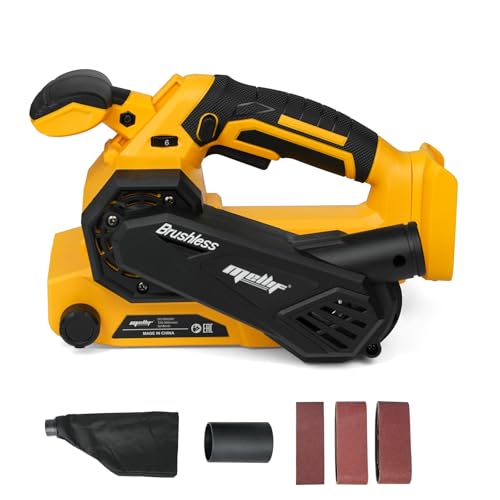
Eastyle Brushless Belt Sander
What We Like
- Includes 10 premium sanding belts for immediate use
- Compatible with existing DeWalt 20V/60V battery platform
- Low-profile nose enables 100% flush sanding
- Smart power control prevents thermal cutoffs under load
Trade-offs
- Tool only: requires a DeWalt 20V battery and charger
- Dust bag collects 85% of particles, not a sealed system
The inclusion of a 10-pack of belts means you can start sanding the moment you open the box, a practical touch that saves a separate trip to the store. For anyone already invested in DeWalt’s 20V ecosystem, this sander leverages that battery collection to deliver corded-class power with a brushless motor and six speed settings. It’s built for the DIYer or tradesperson who needs to switch between aggressive material removal on a deck and fine finishing on a furniture piece, all with the convenience of cordless operation. The upgraded heat management promises consistent performance without the frustration of unexpected stops mid-stroke.
At five pounds, the Eastyle Brushless Belt Sander has more heft than a tool like the Milwaukee M12 Bandfile, so detailed overhead work can become fatiguing. Its feature set is practical, however, with a flat-side design that enables flush sanding against walls and in tight corners during renovations. For users with DeWalt 20V batteries, it provides platform compatibility as a tool-only option, and it comes ready to work with a 10-pack assortment of sanding belts.
Product photos
How We Evaluated Cordless Belt Sanders
We compared specifications and manufacturer data to understand each tool’s core capabilities, like belt speed, dimensions, and weight. We also reviewed expert round-ups for professional insights on performance in tasks like flat sanding and dust collection. Finally, we analyzed patterns in owner feedback to gauge real-world reliability and common praises or complaints.
Our evaluation focused on the criteria most important for cordless sanding: power and speed for material removal, belt size and tool form for project suitability, and ergonomics for user control during extended use. We also considered the practical impact of battery platform compatibility on cost and convenience.
This is a research-based evaluation. We did not personally test these tools, so our assessment is limited to documented performance, specifications, and reported user experiences. For direct comparisons of other sander types, see our guide on belt sander vs orbital sander.
What To Look For In Cordless Belt Sanders
A cordless belt sander trades the unlimited runtime of a cord for mobility, so your choice hinges on balancing power, project size, and your existing tool batteries.
Prioritize a brushless motor for efficiency and a variable speed dial for control. Match the belt size and tool footprint to your work, large flats need a full-size sander, while tight spaces demand a compact bandfile. Ensure it fits your current battery platform to avoid extra cost.
Power & Speed
A brushless motor provides more runtime and power from a battery charge, which is crucial for cordless tools tackling large surfaces. Variable speed control, measured in feet per minute (FPM), lets you dial down for delicate shaping on contours or crank it up for aggressive stock removal on flat wood or metal. Higher top speeds, like those found in dedicated bandfile sanders, are best for fast material work in metal fabrication.
Belt Size & Tool Form
The sanding belt’s width and length determine your work capacity. Standard full-size belt sanders use a 3-inch by 21-inch or 18-inch belt, ideal for leveling floors, doors, or large panels. Compact detail sanders and bandfiles use narrower belts, often 3/8-inch or 1/2-inch wide, for sanding inside curves, smoothing welds, or working in corners. The tool’s physical form also matters; a pivoting or rotating sanding arm on a bandfile greatly improves access in confined spaces.
Ergonomics & Control
A belt sander requires two-handed control to manage its forward pull. Look for a well-placed auxiliary handle that offers multiple grip positions for comfort during long sessions. Features like an electric brake help you reposition the tool faster, and a lock-on trigger switch reduces hand fatigue during prolonged sanding passes. Lower weight is generally better for maneuverability, but some mass helps the tool glide smoothly on flat surfaces.
“As with any sander, proper technique is key to avoiding gouges.”
- Check the belt tracking adjustment is tool-free and easy to access.
- Confirm the dust port is compatible with your shop vacuum hose.
- Prefer a model with a belt release lever over systems requiring tools.
- Ensure the battery placement maintains a balanced feel in your hand.
- Look for a bright LED work light if you often sand in shadowed areas.
Cordless Belt Sanders Compared
For a quick view of how these top cordless belt sanders differ in key specs, see the comparison table below.
| Product | Motor Type | Belt Speed | Weight |
|---|---|---|---|
| DEWALT 20V MAX Belt Sander | Brushless | N/A | 1.0 Pounds |
| Milwaukee M18 Fuel Belt Sander | POWERSTATE Brushless | 750-1350 SFM | 8.8 Pounds |
| Makita 18V LXT Detail Belt Sander | Brushless | N/A | 4.2 Pounds |
| WEN 20V Max Cordless Belt Sander | N/A | 400 to 1150 ft/min | 6.2 pounds |
| DEWALT 20V MAX XR Bandfile Sander | Brushless | 5,600 ft/min | 3.7 Pounds |
| Ryobi 18V ONE+ Belt Sander | N/A | 250m/min | 7.2 pounds |
| CRAFTSMAN V20 Brushless Belt Sander | Brushless | Up to 950 FPM | 8.0 pounds |
| Milwaukee M12 FUEL Bandfile | N/A | 3,600 SFM | 2.4 pounds |
| DEMIMA Brushless Belt Sander | Brushless | 2100 FPM | 3.0 pounds |
| Eastyle Brushless Belt Sander | Brushless | up to 1247 FPM | 5.0 pounds |
Frequently Asked Questions
What is the best cordless belt sander?
The best overall cordless belt sander for most users is the DEWALT 20V MAX Belt Sander. It offers professional-grade variable speed control, effective dust collection, and a comfortable two-handed design, making it suitable for demanding woodworking and renovation projects.
Which belt sander is the best for professional use?
For professional use where corded-level power is needed without the cord, the Milwaukee M18 Fuel Belt Sander is a top choice. Its brushless motor is designed to match the performance of an 8-amp corded sander, providing the sustained power required for job-site tasks like scribing cabinets or leveling flooring.
Who makes the best belt sander belts?
Sanding belt quality varies by brand and material. For woodworking, reputable brands like 3M, Norton, and Diablo are frequently recommended by professionals for their consistent grit adhesion and durability. For metalworking, ceramic or zirconia alumina belts from brands like Cubitron II offer longer life.
What is the best cordless sander for detail work?
For detail work in tight spaces, a compact bandfile sander like the DEWALT 20V MAX XR Bandfile Sander or the Milwaukee M12 FUEL Bandfile is ideal. Their narrow belts and rotating arms allow for precision sanding on contours, inside curves, and for spot weld removal, tasks where a full-size belt sander is too bulky.
Should I choose a corded or cordless belt sander?
Choose a corded belt sander for unlimited runtime and maximum power on large, stationary projects. Choose a cordless belt sander for complete mobility when working on-site, outdoors, or in areas without convenient power outlets. For a look at powerful corded options, read our reviews of best corded belt sanders.
The Bottom Line
The DEWALT 20V MAX Belt Sander is our best overall pick, ideal for professionals and serious DIYers who need a capable, cordless tool for large surface sanding and value precise speed control. If your budget is tight, the WEN 20V Max Cordless Belt Sander offers solid performance, while those needing to sand in extremely tight corners should consider the compact DEMIMA Brushless Belt Sander.
Before you buy, the single most important step is to check your existing power tool batteries. Sticking with a sander that matches your current cordless platform is the easiest way to ensure value and avoid the extra cost of new batteries and chargers. For more options, explore our broader selection of best belt sanders.
