
10 Best Dust Collector Systems in 2026
This post contains affiliate links. As an Amazon Associate, we earn from qualifying purchases.
Our best overall dust collector system is the Bucktool 1.5 HP Dust Collector, which wins for its high 1100 CFM airflow, mobile base, and ability to serve multiple machines in a home shop. For superior fine dust capture, the Powermatic Cyclone offers certified HEPA filtration, while the WEN DC1300 provides excellent high-CFM value on a practical budget.
Choosing the wrong system leaves fine dust airborne, clogs filters, or fails to keep up with your tools, creating a real health hazard. We built this guide by researching specifications, manufacturer data, expert round-ups, and patterns in owner feedback to help you find a system that matches your shop’s specific demands.
Top 10 Dust Collector Systems in the Market
Certain content that appears on this site comes from Amazon. This content is provided "as is" and is subject to change or removal at any time.
The Best Dust Collector Systems, Reviewed
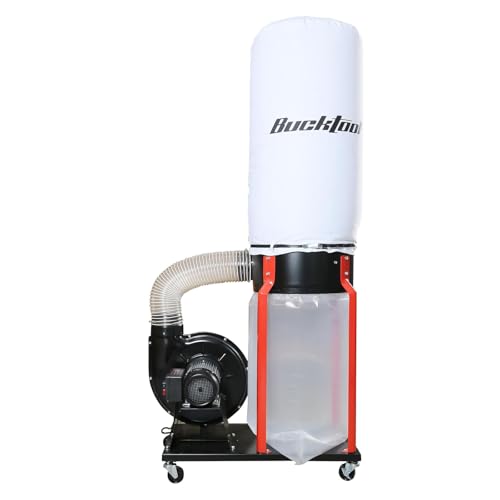
Bucktool 1.5 HP Dust Collector
What We Like
- High 1100 CFM airflow for multiple machines
- Internal dust baffle extends filter life
- Mobile base for flexible workshop positioning
- 6-inch main inlet boosts airflow to 1654 CFM
Trade-offs
- Filtration is 5-micron, not the finest available
- 82.7-inch height requires significant vertical clearance
- 1.5 HP motor is less powerful than 3 HP cyclones
With up to 1100 CFM of airflow from its 1-1/2 HP motor, this collector is built to serve as the central dust management point for a small to mid-size workshop. Its dual 4-inch ports allow you to connect one or two compatible machines, though actual simultaneous performance depends on your duct setup and tools. An internal dust baffle helps direct heavier particles into the lower bag first, which reduces filter buildup and can extend the life of the filter bag. For shops where space is organized around different tasks, the mobile base makes it practical to reposition the unit closer to the machine in use, helping to maintain suction by shortening hose runs.
The trade-off for that mobility and solid airflow is filtration level. It captures 98% of 5-micron particles, which is good, but if your work involves a lot of fine sanding dust, a unit like the Powermatic Cyclone with its 1-micron HEPA filter will provide cleaner air. The Bucktool strikes a balanced middle ground, offering enough power for serious collection without the footprint or electrical requirements of a full 3 HP cyclone system.
Product photos
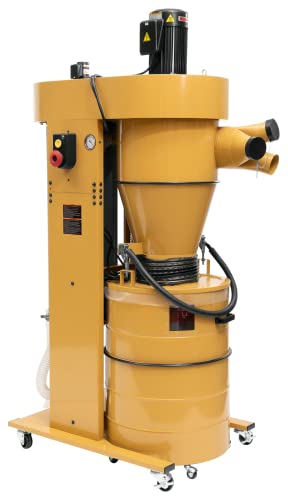
Powermatic Cyclone Dust Collector
What We Like
- Auto-cleaning HEPA filter for superior fine dust capture
- High 1,543 CFM airflow for powerful suction
- Versatile hose mounting with multiple port options
- One-handed drum release simplifies maintenance
Trade-offs
- Large 85.2-inch height requires significant ceiling clearance
- Weighs 370 pounds, making placement a permanent decision
- Requires a dedicated 230-volt circuit for operation
With 99.97% HEPA filtration at 0.3 microns, this collector captures the finest, most hazardous dust, which is crucial for maintaining air quality in a busy workshop. Its auto-cleaning filter system helps sustain that high performance over time, reducing maintenance. The 1,543 CFM airflow from the 3 HP motor is enough to serve multiple tools or a central ducted system, making it suitable for larger operations. In expert comparisons, the Powermatic performed well at trapping dust during use.
Its substantial physical footprint and power requirements are the main considerations. This unit weighs 370 pounds and stands over seven feet tall, so it needs a dedicated, spacious corner and a 230V outlet. You won’t be moving it around. For a shop with lower ceilings or less demanding filtration needs, the JET Cyclone Dust Collector offers a similar 3HP motor and 2-micron filtration in a slightly more compact package, though it lacks the certified HEPA standard.
Product photos
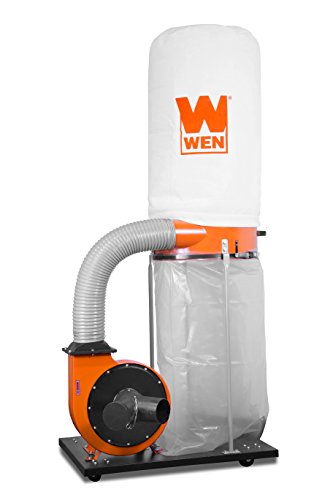
WEN DC1300 Dust Collector
What We Like
- High 1,300 CFM airflow for effective capture
- Dual 4-inch inlets allow two-tool hookup
- Large 50-gallon bag reduces emptying frequency
- Mobile base with casters for easy repositioning
Trade-offs
- Substantial size needs dedicated floor space
- 5-micron bag allows fine dust to remain airborne
Moving 1,300 cubic feet of air per minute, this collector has the muscle to pull chips and dust effectively from larger tools like a table saw or planer. The dual inlets let you run a setup with two stations, and that 50-gallon bag means you can work for hours without stopping to empty it. For the woodworker needing serious airflow on a sensible budget, this WEN model delivers core performance where it counts. It’s a straightforward workhorse.
With a maximum airflow of 1,300 cubic feet per minute, this collector moves enough air to handle general chip collection and sawdust control from two tools at once. It uses a 5-micron collection bag, so the finest dust particles can remain airborne rather than being captured. That high CFM offers substantial capability, though adding a secondary filter or ensuring good ventilation is a practical consideration for air quality.
JET Cyclone Dust Collector

What We Like
- High-efficiency cyclone captures 99% of 2-micron dust
- Large 66-gallon drum on casters simplifies waste removal
- RF remote with timer allows convenient, scheduled operation
- Direct-mounted filter and paddle cleaning maintain airflow
Trade-offs
- Weighs 268 pounds, requiring a dedicated, sturdy floor space
- 54.7-inch length demands a significant shop footprint
The JET Cyclone Dust Collector moves air at 1240 CFM using a two-stage cyclone, a combination that handles a large volume of shop air while its filter captures 99% of 2-micron particles. Heavy debris falls into a 66-gallon drum mounted on independent casters, which allows the full container to be rolled to a disposal area. A direct-mounted filter and the absence of ridged flex hosing contribute to its stated airflow efficiency.
That performance comes with a substantial physical presence. At 268 pounds and over four feet long, this isn’t a unit you’ll tuck into a corner or move around your shop on a whim. It’s a permanent installation. For shops where floor space is at a premium, a wall-mounted option like the Bucktool Wall Mount Dust Collector offers a fraction of the airflow but reclaims that critical floor real estate.
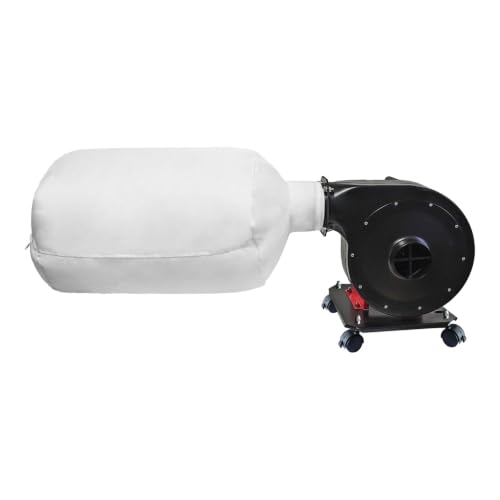
Bucktool Wall Mount Dust Collector
What We Like
- Quiet, low-maintenance TEFC induction motor
- Dual-mount design offers flexible installation
- Captures fine dust down to 2 microns
- Locking casters provide stable portable use
Trade-offs
- 660 CFM is lower than larger floor units
- Filtration is 2-micron, not 1-micron HEPA
A 660 CFM airflow from a wall-mounted unit makes this a smart space-saving solution for a mid-size workshop. The TEFC motor is built for daily use, running quieter and requiring less maintenance than cheaper alternatives, which is crucial if you’re in the shop every weekend. It’s a fit for the woodworker who needs effective dust control from a planer or a table saw but doesn’t have the floor space for a freestanding collector. The dual-mount design with locking casters adds a layer of practicality, letting you secure it to the wall for permanent tool hookups or roll it to a job.
This wall-mount collector delivers up to 660 CFM, which provides strong suction for efficient dust collection at a single woodworking station. While substantial, that airflow is lower than the 1100 CFM from Bucktool’s larger 1.5 HP floor model. Its 2-micron collection bag captures fine woodworking dust, helping maintain a cleaner shop environment compared to units with less fine filtration. The unit is built as a reliable solution for daily tasks, not as the central system for a large operation with several machines running at once.
Product photos
POWERTEC Portable Dust Collector

What We Like
- Compact, portable size on casters.
- 1-micron bag with viewing window and zipper.
- Vortex base design for improved dust removal.
- Dual-voltage motor (120V/240V).
Trade-offs
- 560 CFM is lower than stationary units like the Bucktool 1.5 HP.
- The 4-inch inlet grate requires regular cleaning to prevent clogging.
Its 560 CFM airflow and compact footprint make this dust collector a logical choice for the tight confines of a small pro or hobby shop. The 1-micron filter bag does a serious job of trapping fine particles, and the unit rolls right up to your machine on its casters. That dual-voltage 1 HP motor gives you wiring flexibility, and the Vortex Base design claims a real efficiency boost in moving dust. If your workshop space is measured in square feet, not square yards, this design prioritizes getting the job done without monopolizing your floor.
Its small size means a trade-off in suction power. It moves less air than a full-size collector like the Bucktool 1.5 HP, so it’s better suited for single-tool hookups than running a central duct system. You also need to stay on top of maintenance. The built-in grate on the 4-inch port can collect debris and choke performance if ignored. For a dedicated space where you can install a larger unit, you’ll get more capacity. But for the user who needs to stash the collector in a corner and wheel it out as needed, it’s a pragmatic, space-efficient solution.
Rockler Dust Right Wall Mount Collector

What We Like
- Strong 650 CFM suction for multiple tools
- Space-saving vertical wall-mount design
- Clear bag with window and zipper for easy cleanup
- Upgradable to a 1-micron canister filter
Trade-offs
- Standard 30-micron bag captures only coarse dust
- Lower CFM than large-floor-standing cyclones
A 650 CFM wall-mount collector is built to reclaim floor space without committing to a massive single-stage unit. Its vertical design and keyhole mounting slots let you get it off the ground and out of the way. This is a smart move for organizing a cramped shop. The real appeal is its upgrade path. You start with the included 30-micron bag, which handles chips and coarse sawdust just fine. The option to bolt on a 1-micron canister later means you can significantly improve air quality as your needs evolve. This is for the pragmatist who plans to grow into a system, not buy a new one every few years.
Its standard 30-micron bag provides the initial filtration, which allows the finest dust to circulate back into the shop. For frequent sanding or planing, this is a health consideration from the start. When you look at the larger Bucktool 1.5 HP model with 1100 CFM, the Rockler’s advantage is its compact, wall-mounted design that saves floor space. The unit is designed to be upgradeable with an optional 1-micron canister filter for finer dust control later on.
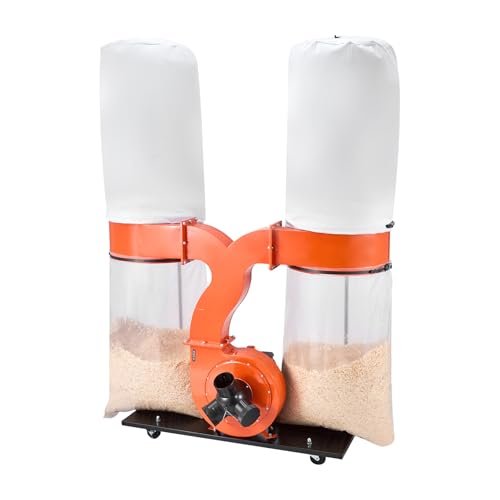
VEVOR 1550 CFM Dust Collector
What We Like
- Large 42-gallon dual bag capacity
- 2.5-micron filtration for fine dust
- Clip-on bags for quick disposal
Trade-offs
- Requires a dedicated 220V outlet
- At 106 pounds, it's not easily moved
- 90 dB motor is louder than some units
The 1550 CFM airflow is the central specification, indicating a strong capacity for rapid dust removal. This supports a cleaner workshop and smoother woodworking tasks by enhancing air circulation. A 3.0 HP induction motor provides the power for this steady suction, and two 42-gallon collection bags allow for longer continuous operation before disposal is needed.
This capability comes with a substantial physical size and a 220V electrical requirement, which limits placement to workshops with appropriate wiring. At 106 pounds, the unit is not easily moved, and its dimensions occupy a significant floor area. For shops equipped to handle it, the trade-off is the high-volume dust collection the system provides.
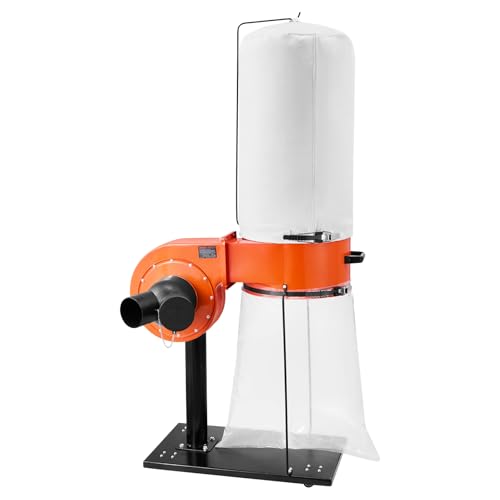
VEVOR 800 CFM Dust Collector
What We Like
- Strong 800 CFM suction for chips and fine dust
- Compact size and casters for easy shop mobility
- Clip-style bag release simplifies maintenance
- 1HP motor runs at a relatively quiet ≤90dB
Trade-offs
- 2.5-micron filter misses finer particles vs. 1-micron units
- 16-gallon capacity requires more frequent emptying than larger systems
Mounted on casters, this 800 CFM dust collector is designed for woodworkers who need to move it between machines. Its 1HP motor delivers strong airflow for capturing planer chips and fine sawdust, while the clip-on 16-gallon bag reduces interruptions for emptying. The unit is a solid fit for smaller shops where floor space is limited and you connect to one tool at a time.
Filtration is rated at 2.5 microns, which captures fine dust and improves air quality, though it is not as fine as a 1-micron HEPA filter like on the Powermatic cyclone. Compared to a stationary wall-mount unit like the 660 CFM Bucktool, you gain the mobility of a floor unit and higher airflow, but you give up a permanent, out-of-the-way installation. Think of it as a mobile option for general shop cleanup.
Product photos
WEN DC3474 Dust Collector

What We Like
- Mobile base with swivel casters for easy repositioning
- Optional wall-mount capability saves floor space
- Onboard carrying handle aids in transport
- Includes a two-year warranty for peace of mind
Trade-offs
- 600 CFM is suitable for single tools, not large central systems
Moving up to 600 cubic feet of air per minute through its 4-inch port, this collector can effectively serve a single woodworking tool at a time, like a table saw. Its real advantage is the choice between a mobile base with swivel casters and an optional wall mount, letting you save floor space or roll it between stations. Weighing 41.1 pounds with an onboard handle, it is genuinely manageable to reposition in a crowded shop.
That mobility and versatility come with a capacity trade-off. Its 15-gallon bag needs more frequent emptying than a stationary collector with a drum, and the 5-micron filtration won’t capture the ultra-fine dust a dedicated filter like the Powermatic Cyclone can. For a dedicated, high-volume setup, you’d look to a larger unit. But for effective dust capture that can change roles as quickly as the project does, this WEN handles the assignment.
Product photos
How We Evaluated Dust Collector Systems
Our evaluation is research-based, focusing on specifications from manufacturers, insights from expert round-ups, and consistent patterns found in owner feedback. We prioritized three key criteria: airflow measured in CFM for effective chip and dust capture, filtration rating to protect lung health from fine particles, and physical design for shop compatibility regarding size, mobility, and electrical requirements. This approach allows us to compare systems objectively, but it cannot replicate the long-term wear and specific ductwork challenges of a real-world installation, which is a limit of any research-led review.
What To Look For In Dust Collector Systems
A good dust collector isn’t just about suction; it’s a system for protecting your health and keeping your shop clean. The right choice balances power, filtration, and footprint with your actual workspace and tools.
Key factors are airflow (CFM), filtration fineness (microns), and physical design. Match the CFM to your most demanding tool, choose filtration based on your sensitivity to fine dust, and ensure the unit’s size and power requirements fit your shop’s space and electrical supply.
Airflow (CFM)
Cubic Feet per Minute (CFM) measures the volume of air a collector can move, determining its ability to capture chips and dust at the source. Higher CFM is critical for larger tools like planers and table saws, or for systems serving multiple machines through ductwork. For effective central collection through a basic duct network, a certain minimum airflow is required. The available models offer a range of airflow, from levels suitable for compact, single-tool use to those designed for high-volume workshops.
Filtration
Filtration determines what size of harmful dust particle is captured versus blown back into your shop air. Bags or canisters are rated in microns; a lower number captures finer dust. Standard 5-micron bags catch visible sawdust but allow fine, lung-damaging particles to escape. For true health protection, look for 2-micron, 1-micron, or HEPA-rated filters, which capture 99.97% of particles as small as 0.3 microns, as emphasized in expert dust collection system reviews.
Physical Design & Compatibility
The collector’s physical form must suit your shop. Consider the footprint and height to ensure it fits under your ceiling. Mobility via casters is invaluable for single-station shops, while a stationary cyclone may be best for a permanent, ducted system. Electrical needs are crucial; many powerful units require a dedicated 230-volt circuit, while others run on standard 120V. Planning your dust collection system setup begins with choosing a unit that fits your space and power.
- Measure your ceiling height and the floor space where the collector will live.
- Check your electrical panel for 230V capacity if considering a high-CFM cyclone. For small shops, explore units designed specifically for small shop dust collection.
Your shop’s size and power availability will narrow your choices faster than any spec sheet.
Dust Collector Systems Compared
The table below compares key specifications across all ten systems to highlight their differences in power, filtration, and size at a glance.
| Product | Motor Power | Airflow (CFM) | Filtration |
|---|---|---|---|
| BUCKTOOL 1-1/2 HP Dust Collector, Internal Dust Baffle, 1100 CFM Airflow | 1.5 HP | 1100 CFM | 98% at 5-micron |
| Powermatic Cyclone Dust Collector, 1-Micron HEPA Filter, 3 HP, 230V 1Ph (Model PM2200HK) | 3 HP | 1,543 CFM | 99.97% at 0.3 micron |
| WEN DC1300 1,300 CFM 14-Amp 5-Micron Woodworking Dust Collector with 50-Gallon Collection Bag and Mobile Base , Black | 14-amp | 1,300 CFM | 5-Micron |
| JET Cyclone Dust Collector, 2-Micron Filter, 3 HP, -230V 1Ph (Model JCDC-3) | 3 HP | 1240 CFM | 99% of 2-micron |
| BUCKTOOL 1.2HP Wall Mount Dust Collector for Woodworking, 660 CFM Airflow | 1.2 HP | 660 CFM | 2-micron |
| POWERTEC 1 HP, 560 CFM Portable Dust Collector with 1 Micron Dust Collector Bags, Dust Collectors for Woodworking Dust Collection System (DC5372) | 1 HP | 560 CFM | 1-micron |
| Rockler Dust Right 650 CFM Wall Mount Dust Collector for Woodworking Shops | N/A | 650 CFM | 30 micron |
| VEVOR Dust Collector, 1550 CFM 2.5 Micron Vortex Cone Dust Collectors, 3.0HP Sawdust Collection System with Two 35-Gallon Dusts Collector Bags & Two 42-Gallon Filter Bags, 3400 RPM.(220V Plug) | 3.0 HP | 1550 CFM | 2.5 micron |
| VEVOR Dust Collector, 800 CFM 2.5 Micron Vortex Cone Dust Collectors, 1HP Sawdust Collection System with 16-Gallon Large Capacity Dusts Collector Bag, Filter Bag, and Casters, 3400 RPM High Speed | 1 HP | 800 CFM | 2.5 micron |
| WEN Woodworking Dust Collector, 7.4-Amp Induction Motor with 15-Gallon Bag, Mobile Base, and Optional Wall Mount (DC3474) | 7.4-amp | 600 CFM | 5-micron |
Frequently Asked Questions
What is the best dust collection system?
The “best” system depends entirely on your shop. For most home woodworkers needing to serve multiple tools, a mobile, high-CFM single-stage collector like our best overall Bucktool 1.5 HP is a great starting point. For shops prioritizing air quality and fine dust capture, a HEPA-filtered cyclone system is the superior choice.
Which dust extractor is better, Bosch or Festool?
This guide focuses on larger dust collector systems for stationary power tools, not portable dust extractors for hand tools. For advice on those categories, please see our dedicated reviews of the best dust collectors.
What is the most powerful dust extractor available?
Among the systems we researched, the VEVOR 1550 CFM Dust Collector offers the highest advertised airflow at 1550 CFM, making it suitable for high-volume workshops. However, “powerful” also relates to suction pressure (static pressure), which is crucial for ducted systems, a strength of dedicated cyclone dust collectors.
What is the best device for removing dust?
For airborne dust created by sanding and machining, a dedicated dust collector system with fine filtration is the best device. For clean-up of fallen debris on floors and benches, a shop vacuum is more appropriate. Some woodworkers even integrate a shop vac for dust collection into their setup for certain tools.
What’s the difference between a dust collector and a shop vac?
Dust collectors are designed for the high-volume, continuous chip and dust flow from stationary woodworking machines, often using large bags and higher CFM. Shop vacuums are for intermittent, lower-volume wet/dry cleanup and have much finer filtration, but can clog quickly with wood chips. Understanding the different types of dust collectors helps clarify their different roles.
The Bottom Line
For most woodworkers setting up a first serious collection system, the Bucktool 1.5 HP Dust Collector is the best overall choice. It delivers strong airflow for multiple tools, is easy to move around a garage shop, and provides a solid foundation without a premium price.
If your budget is tight but you need high volume, look to the WEN DC1300; if floor space is your primary constraint, the Bucktool Wall Mount or POWERTEC Portable models are excellent solutions. Ultimately, matching the collector’s CFM and filtration to your most demanding tool is the single most important step for a cleaner, healthier shop.
