
10 Best Dust Collectors For Home in 2026
This post contains affiliate links. As an Amazon Associate, we earn from qualifying purchases.
Our top pick for home shops is the Oneida Air Systems Supercell HEPA Dust Collector for its outstanding suction and two-stage HEPA filtration. Budget-minded DIYers should consider the mobile Ynomdusa, while small shop owners will love the space-saving POWERTEC Wall Mount. Selecting the right collector makes your workshop cleaner and your woodworking safer.
Many home woodworkers struggle with limited space and tools that create fine, hazardous dust. This guide compares ten units based on shop size, tool needs, and air quality priorities. We built this list through research into manufacturer specifications, expert round-ups, and consistent patterns in owner feedback to help you invest confidently.
Top 10 Dust Collectors For Home in the Market
Certain content that appears on this site comes from Amazon. This content is provided "as is" and is subject to change or removal at any time.
The Best Dust Collectors For Home, Reviewed
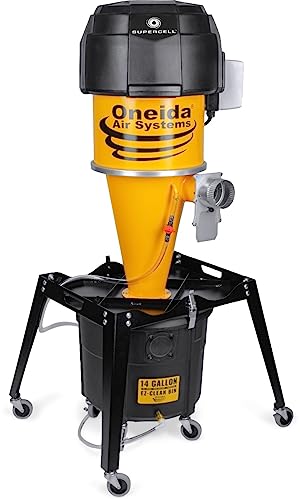
Oneida Air Systems Supercell HEPA Dust Collector
What We Like
- Extremely high suction for tools with 1" to 5" ports
- Cyclone removes 99% of dust before the filter
- Compact rolling stand for flexible shop placement
Trade-offs
- Its high-performance motor and features place it in a premium category.
Claiming 10x the suction power of a standard collector, the Supercell has the muscle to pull fine dust from every tool in a home shop, from a handheld sander to a large-planer. It’s built to handle a complex setup with up to 100 feet of ductwork yet rolls compactly on its stand.
The trade-off for this performance is a substantial physical presence. Its height of nearly five feet and width over two feet mean it will occupy significant floor space, unlike wall-mounted collectors like the POWERTEC model. This is an investment in a complete, freestanding system designed for maximum collection and filtration, not just a basic chip collector. For a dedicated workshop where dust control is paramount, the Supercell delivers a comprehensive solution.
Product photos
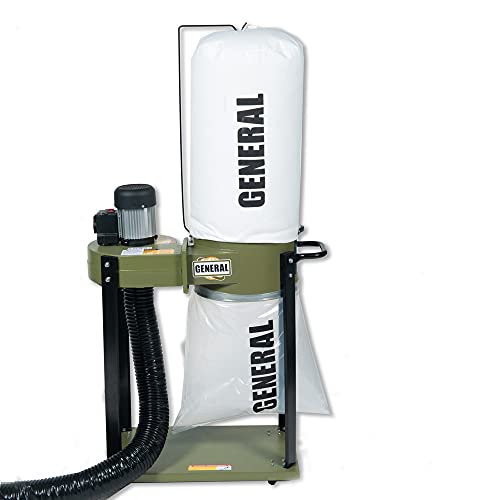
General International SMART Dust Collector
What We Like
- Smart Cone technology improves chip separation
- Quick-release bag clamps for easy emptying
- Precision spin-balanced impeller for quiet operation
- Heavy-duty base provides stable mobility
Trade-offs
- Requires frequent filter cleaning to maintain airflow
- No specific dimensions provided for space planning
A 1 HP motor provides continuous-duty power for small shop applications, while the proprietary Smart Cone technology aims to improve chip separation and prevent filter clogging. This combination targets the home woodworker seeking a cleaner shop and a system designed to maintain airflow. Research on a similar General International model notes that frequent filter maintenance is important to prevent performance loss from dust buildup.
You do have to stay on top of filter maintenance, as owner feedback indicates airflow can drop if dust builds up. It’s not a set-it-and-forget-it system. For a more hands-off, high-efficiency option that tackles finer dust, you’d want to look at something like the Oneida Air Systems Supercell with its HEPA-grade filtration, though that’s a different class of machine altogether.
Product photos
POWERTEC Wall Mount Dust Collector

What We Like
- Wall-mount bracket saves crucial floor space.
- 1-micron bag with viewing window contains fine dust.
- Vortex base design claims 10% improved dust removal.
- Dual-voltage motor offers wiring flexibility.
Trade-offs
- The 4-inch inlet grate requires regular cleaning to prevent clogging.
- 560 CFM is modest for simultaneously running multiple large machines.
- Bag capacity is smaller than freestanding cyclone units.
A 560 CFM suction packed into a 19-inch cube makes the POWERTEC DC5371 the definitive choice for reclaiming floor space. The wall-mount design is a perfect fit for a compact pro or hobby shop where every square foot counts. Its 1-micron bag effectively traps fine particles, and the dual-voltage motor provides setup flexibility whether you’re on a standard outlet or have 240V run to your shop. This unit is built for connecting directly to one machine at a time via its 4-inch port, making it a dedicated and efficient point-source collector.
This collector’s compact design requires more attentive maintenance. A built-in grate protects the impeller from large debris, but reviewers note the hose must be removed regularly to check for clogs that can reduce efficiency. It connects directly to one tool at a time through its 4-inch port, making it a dedicated and space-conscious solution for point-source collection.
DEWALT Air Filtration System

What We Like
- Ceiling mount frees all floor space
- HEPA filter captures 95% of 0.3μm particles
- Auto timer cleans air after you leave
- Washable pre-filter reduces upkeep cost
Trade-offs
- No direct tool connection for source capture
- Auto mode relies on sensor, not manual control
Its ceiling-hung design is the core advantage. Mounted up high with the included hooks and chains, it pulls fine dust from the air without stealing any floor space. The HEPA filter captures over 95% of 0.3 micron particles, and the set-and-forget timer lets it run after you’ve packed up. This design provides cleaner air for a workshop where tools may not all be connected to a central collector.
Remember, this is an air filtration system, not a source collector. It won’t connect to your table saw’s port. For that, you’d look at a dedicated unit like the Oneida Air Systems Supercell. The DeWalt’s two-stage filtration and automatic timer settings are built for cleaning the general workshop air. Its three-year warranty adds confidence for the long haul.
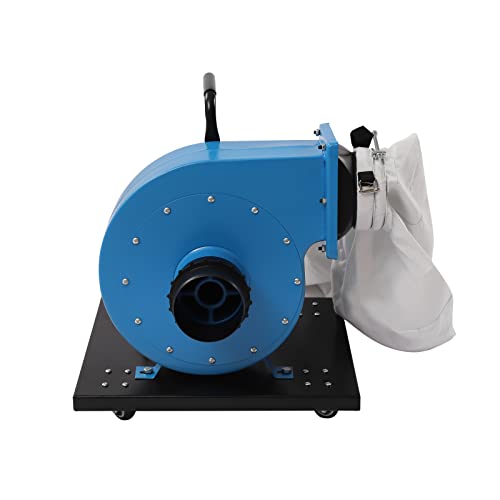
Ynomdusa Wheeled Dust Collector
What We Like
- Strong 550 CFM suction for chip collection
- Four wheels with brakes for easy workshop movement
- Wall-mount design saves floor space
- Motor cooling holes for extended service life
Trade-offs
- 30-micron bag allows fine dust to pass through
- 42-pound weight requires effort for wall mounting
A 550 CFM airflow gives this unit the muscle to handle the big chips from jointers and planers, making it a solid core for a small shop system. Its combination of four-wheel mobility and a wall-mount option provides genuine flexibility for users who need to rearrange their workspace or conserve every square foot of floor space. This makes it a pragmatic choice for the budget-conscious woodworker who needs to move the collector to the tool, not the other way around.
The trade-off comes in filtration, where its 30-micron bag is designed more for chip collection than fine dust control. You’ll want to pair it with a secondary air filter for sanding operations. Compared to a wall-mounted unit like the POWERTEC, which uses a 1-micron bag, the Ynomdusa prioritizes raw chip collection and mobility over capturing the finest particles. It’s a workhorse for rough milling, not a finish-sanding solution.
Product photos
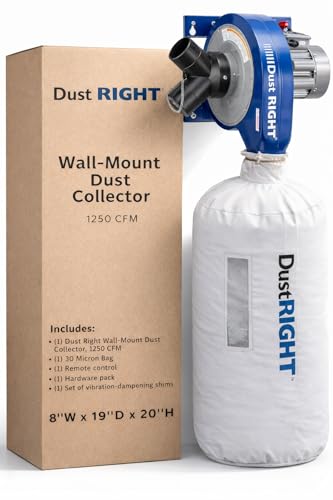
Rockler Dust Right Wall Mount Collector
What We Like
- 1250 CFM supports multiple tools
- Space-saving vertical wall-mount design
- Remote control for shop-wide operation
- Clear bag with zipper for easy cleanup
Trade-offs
- 30-micron bag requires upgrade for fine dust
- Wall-mount only, no mobile cart included
- Lower CFM than freestanding units like the Abestorm
A 1250 CFM airflow gives this wall-mount unit the muscle to pull dust from several tools at once, making it a solid hub for a busy small shop. The included remote lets you fire it up from across the room, and the vertical design keeps your floor clear. This is for the woodworker who needs serious central suction but can’t spare the floor space for a freestanding collector.
The trade-off is the 30-micron bag; it catches chips and coarse dust well, but you’ll want the optional 1-micron canister for finishing work with sanders. Compared to a dedicated air filter like the DEWALT, this is a workhorse collector first. It moves a high volume of air from your tools, but it won’t scrub the ambient air in your shop afterward.
KAKA INDUSTRIAL Cyclone Dust Collector
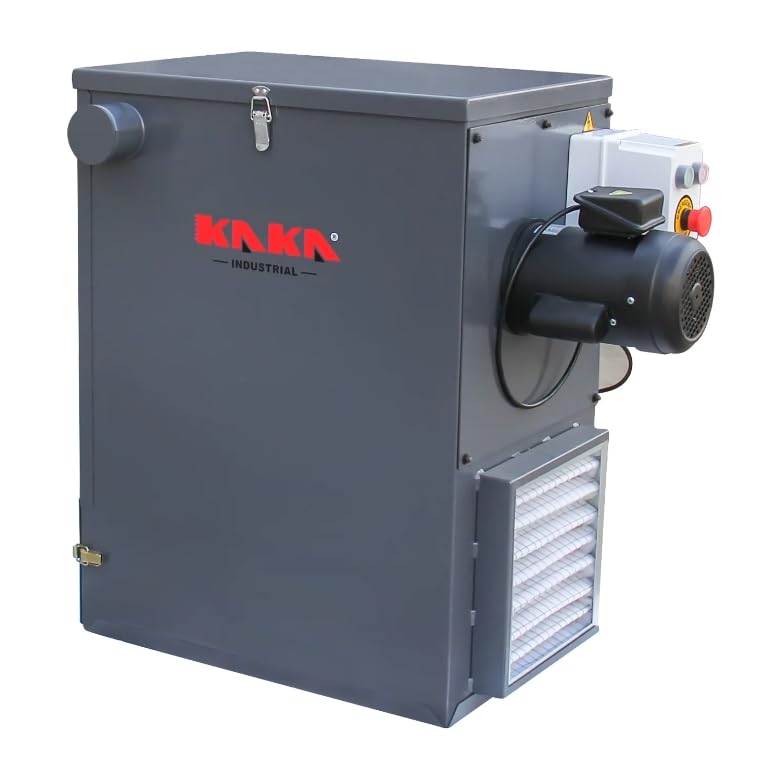
What We Like
- Low-noise operation under 85 dB for indoor shops
- Runs on standard 110V household power
- Includes a 3-inch hose and pull-out chip drawer
- Aluminum fan and housing for durable construction
Trade-offs
- Heavy 156.5-pound weight complicates placement
- Large 57-inch height demands significant vertical space
- Requires lift-gate service or unloading assistance for delivery
A noise level under 85 dB within one meter helps keep operation manageable for an indoor workshop. Its 494 CFM airflow is designed to help move chips and dust away from compatible woodworking, sanding, grinding, and fabrication equipment. The system includes a 3-inch hose and a pull-out chip drawer, while its aluminum fan and housing are listed in the supplied specifications.
Its capacity and quiet operation come with a substantial footprint, requiring a permanent commitment of floor space. Unlike a wall-mounted unit that saves floor area entirely, this collector demands a more traditional shop layout. It is a classic cyclone design scaled for serious hobbyist work rather than a space-saving solution.
Product photos
VEVOR Wall Mount Dust Collector

What We Like
- Large 21-gallon collection bag
- Powerful 560 CFM suction
- Convenient bottom bag zipper
- 2.5-micron fine dust filtration
Trade-offs
- At 40.9 inches long, it requires significant wall space.
- Filtration is not as fine as some 1-micron competitors.
The 21-gallon collection bag is the headline feature here, letting you handle medium-sized projects from start to finish without stopping to empty it. That makes this collector a solid fit for a dedicated home workshop where you run a planer or table saw for extended sessions. Its 560 CFM airflow and 2.5-micron bag will capture the bulk of the dust, keeping your primary work area noticeably cleaner.
With a 2.5-micron filtration bag, this wall-mount collector captures fine sanding dust to improve workshop air quality, though some competing models like the POWERTEC offer a 1-micron bag for finer particle capture. Its 21-gallon collection capacity handles larger amounts of debris from medium and small projects, which means fewer interruptions to empty it during a workflow. The unit’s 40.9-inch length requires adequate wall space for installation.
Product photos
Bucktool Auto-Start Dust Collector
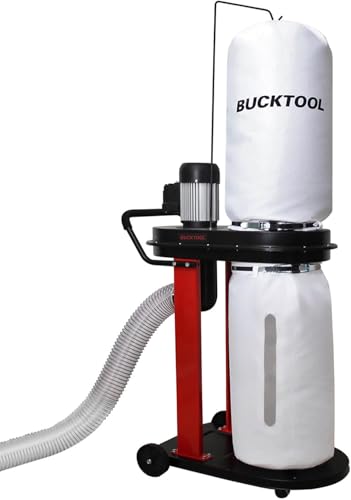
What We Like
- Auto-start function eliminates separate switch operation.
- Mobile base with casters for easy workshop repositioning.
- Includes three collection bags and a reducer set for versatility.
Trade-offs
- Auto-start function only works with tools drawing 7A or less.
The 7A auto-start function is the main event here, letting you trigger the dust collector just by turning on your connected tool. This is a genuine convenience for anyone tired of crossing the shop to flip a switch between cuts. With a 1.2 HP motor pulling 750 CFM, it has the muscle to handle the primary dust stream from a table saw or sander efficiently. The included mobile base makes it a practical choice for a multi-station workshop where you need to roll the unit between machines.
Automatic startup with connected tools up to 7 amps means you can run your sander or saw without hunting for a second switch. The trade-off is a footprint that stands over five feet tall, so it won’t fit under most workbenches. Its included upper bag filters to 2.5 microns, but some competing systems are built specifically for finer, HEPA-level filtration. For workshops where automatic operation and mobility are priorities over clinical air cleaning, the Bucktool simplifies the workflow significantly.
Abestorm DecDust Air Filtration System
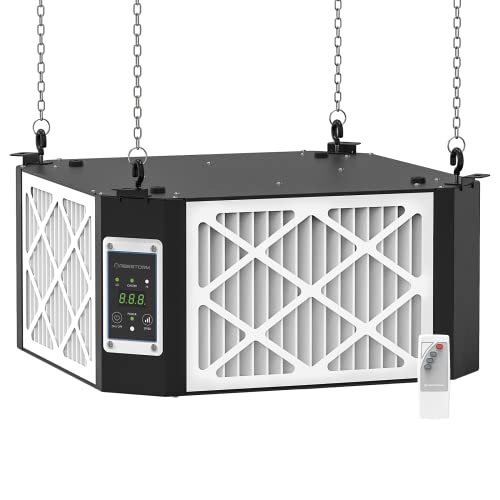
What We Like
- Built-in ionizer for particle and odor treatment
- 360-degree intake for broad air capture
- Remote control operable from 27 feet away
- Compact 20.5-inch square footprint for flexible mounting
Trade-offs
- MERV-11 filters may require replacement every 2-4 months
- At 27 pounds, it's a substantial unit to mount overhead
- Noise up to 69 dBA is noticeable in a quiet shop
The Abestorm DecDust’s built-in ionizer is its defining feature, actively charging particles to improve the capture of fine dust and neutralize odors beyond standard filtration. This makes it a strong match for woodworkers and hobbyists dealing with lingering fines or chemical smells in a garage or workshop up to 1700 square feet. Its compact, square shape and 360-degree intake are designed to hang from the ceiling, circulating air effectively without monopolizing floor space like a freestanding unit.
This system is designed for whole-room air scrubbing, not primary source capture. It moves air at up to 1350 cubic feet per minute to clean airborne particles in a space up to 1700 square feet, which refreshes the air you breathe after sanding or cutting. The included remote control operates the unit from up to 27 feet away, allowing you to start it from across the shop before beginning work.
How We Evaluated Dust Collectors
This guide compares key performance metrics like air flow (CFM), filter micron ratings, and physical dimensions based on manufacturer documentation. The evaluation prioritizes three criteria: filtration quality for safety, suction strength for effective debris capture, and physical footprint to suit home shop spaces. Owner reports on durability, noise, and maintenance provide additional context. This is a research-based evaluation.
What To Look For In Dust Collectors
Balancing power, space, and safety is key when choosing a dust collector for your home workshop. You must consider the tools you use, your shop’s layout, and the type of dust you generate.
Prioritize HEPA or 1-micron filtration for lung safety, ensure CFM matches your largest tool’s port, and choose a footprint, wall-mount, mobile, or freestanding, that fits your space constraints.
Filtration Rating
The filter’s micron rating determines what size of dangerous, breathable particles it can trap. Many budget units come with 30-micron bags, which are fine for coarse chips but allow hazardous fine dust to pass. For true air quality protection, look for a filter rated for 1 to 2.5 microns; HEPA filters capture at least 99.97% of particles as small as 0.3 microns. Seals around the filter bag or canister are also critical to prevent leaks, a common point of failure noted in research on setting up a dust collection system.
Suction Strength (CFM)
Suction, measured in Cubic Feet per Minute (CFM), must be adequate for your most demanding tool. A portable sander may require a lower CFM, while a planer with a four-inch port often requires a higher CFM for effective chip collection. Units selected for high performance offer CFM levels suitable for tools with large ports and longer hose runs.
Remember that CFM drops as the filter loads with dust, so designs with easy filter cleaning or automatic features, like those found in best cyclone dust collectors, help maintain performance.
Physical Footprint & Mobility
Your shop’s available space dictates the collector’s form factor. Wall-mount and ceiling-mounted units save all floor space but require permanent installation. Mobile collectors on casters offer flexibility to move between tool stations. Freestanding cyclone units often have the largest capacity but demand significant floor and vertical space. For tight quarters, research dust collectors for small shops. Consider not just the machine’s footprint, but also the swing space needed for bags and hose connections.
- Measure your available wall, floor, and ceiling space before shopping.
- Check the unit’s weight and whether delivery requires special handling.
- Ensure the inlet port size matches your existing hoses or plan for adapters.
Choose a collector with at least 30% more CFM than your largest tool’s minimum requirement to account for hose length and filter loading.
Dust Collectors For Home Compared
To help you compare the key specifications at a glance, here is a detailed table of all ten dust collectors in our lineup.
| Product | Airflow (CFM) | Filtration | Mounting/Mobility |
|---|---|---|---|
| Oneida Air Systems Supercell HEPA Dust Collector | N/A | HEPA-GFM with PTFE membrane | Freestanding rolling stand |
| General International SMART Dust Collector | N/A | 2 Micron Filter Bag | Four swivel casters with handle |
| POWERTEC Wall Mount Dust Collector | 560 CFM | 1 micron reusable bag | Wall mount |
| DEWALT Air Filtration System | N/A | 2-stage: pre-filter & H11 HEPA | Ceiling-hung (hooks & chains) |
| Ynomdusa Wheeled Dust Collector | 550 CFM | 30 micron bag | Four wheels with brakes |
| Rockler Dust Right Wall Mount Collector | 1250 CFM | 30 micron bag | Wall-mount with keyhole slots |
| KAKA INDUSTRIAL Cyclone Dust Collector | 494 CFM | N/A | N/A |
| VEVOR Wall Mount Dust Collector | 560 CFM | 2.5 micron bag | Wall mount |
| Bucktool Auto-Start Dust Collector | 750 CFM | N/A | Mobile with caster wheels |
| Abestorm DecDust Air Filtration System | 1050-1350 CFM | 4x MERV-11 micron filters | Ceiling-hung |
Frequently Asked Questions
What is the best dust collector for home use?
The best overall dust collector for most home shops is the Oneida Air Systems Supercell HEPA Dust Collector. It offers extremely high suction for a wide range of tools, features a cyclone that removes most dust before it reaches the HEPA filter, and comes on a compact rolling stand for flexible placement. It’s a premium choice for serious woodworkers who prioritize superior dust capture and air filtration.
What is the most powerful dust collector available?
Among the models we researched, the Rockler Dust Right Wall Mount Collector offers a very high 1250 CFM, supporting multiple tools simultaneously. The Oneida Supercell also provides extremely high suction, designed for tools with ports from 1 to 5 inches. Power needs depend on your specific tools; a system with high CFM is essential for large machines like planers and table saws.
What is the best dust absorber for home use?
A true dust collector with source capture is more effective than a passive air absorber. However, for cleaning fine dust that escapes collection, an air filtration system like the DEWALT or Abestorm units is best. They mount to the ceiling or wall, actively pull air through a fine filter, and recirculate clean air back into the shop.
What is a good dust catcher for home use?
A good “catcher” for a beginner or budget-focused DIYer is a mobile, single-stage unit like the Ynomdusa Wheeled Dust Collector. It provides strong suction for chips from planers and jointers, is easy to move around, and its wall-mount design saves floor space. Just be aware that its 30-micron bag allows fine dust to pass, so it’s best for chip collection, not fine dust control.
What’s the difference between a dust collector and a shop vacuum?
Dust collectors move a high volume of air at lower static pressure, ideal for the large wood chips and high airflow needs of stationary tools like table saws. Shop vacuums create high suction pressure but lower volume, better for wet pickup and detailed cleanup. For a deeper comparison, see our resource on the dust collector vs shop vac distinction.
The Bottom Line
For the serious home woodworker running a variety of tools, the Oneida Air Systems Supercell HEPA Dust Collector is the best overall investment, offering top-tier suction and HEPA filtration in a relatively compact package. If you’re on a tight budget or need maximum mobility, look to the Ynomdusa Wheeled Dust Collector, while those in cramped shops should prioritize the space-saving POWERTEC Wall Mount Dust Collector.
Ultimately, matching the collector’s CFM and filtration to your specific tools is more important than any single feature. Prioritize fine filtration for your health, then find a unit whose physical footprint fits your available shop space.
