
Dust Collector vs Shop Vac: Which Should You Use?
This post contains affiliate links. As an Amazon Associate, we earn from qualifying purchases.
Choose a dust collector for stationary tools that move high volumes of chips, think a table saw, planer, or jointer. Choose a shop vac (or a dust extractor) for handheld tools, small ports, and cleanup jobs where suction through a narrow hose matters. The split isn’t about quality; it’s a fundamental trade-off between airflow volume (CFM) and suction force (static pressure).
One side moves huge amounts of air at relatively low pressure, the other pulls hard through a tight space. Understanding the dust collector vs shop vac distinction is key. Picking the wrong one for the job means a clogged filter, a stalled motor, and a shop that never gets clean. You can’t muscle through it with power alone, the physics of airflow decides what works.
What follows is a breakdown of the numbers that force that split, a tool-by-tool guide, and a clear path for when your shop outgrows its first vacuum.
Key Takeaways
- The core difference is CFM vs. Static pressure: a dust collector like the JET DC-1100VX has been measured at 505 CFM at 3.7 in. W.c., while a shop vac like the DeWalt DWV012 moves 132 CFM at 11.8 in. W.c., you need high volume for cabinets, high pressure for hoses.
- For stationary tools (table saw, planer, jointer), you need a dust collector. A shop vac’s lower CFM won’t clear the cabinet housing, leading to clogged tools and airborne dust.
- For handheld tools (sanders, routers, track saws), you need a shop vac or dust extractor. Their high static pressure maintains suction through the small, narrow hoses these tools use.
- Adding a cyclone separator like a Oneida Dust Deputy before your shop vac preserves its filter and maintains suction, but it doesn’t turn a shop vac into a dust collector.
- Wood dust is a known carcinogen. A shop vac without a HEPA filter blasts the finest, most hazardous particles back into the air you breathe.
The CFM vs. Static Pressure Split (Explained with Numbers)
This isn’t an abstract debate. Measured numbers from real tools show the mechanical divide.
According to Air Dynamics Industrial Systems, a dust collector is a High Volume, Low Pressure (HVLP) system, moving large amounts of air (1500 to 4000 FPM) through wide ducts, while a vacuum is a Low Volume, High Pressure (LVHP) system. However, manufacturers like Laguna Tools may describe dust collectors with both high CFM and relatively high static pressure.
Look at the specs for a common 1.5 HP dust collector and a typical shop vac. The data comes from independent measurement, not marketing sheets.
| Machine | Measured CFM | Measured Static Pressure | Primary Design Goal |
|---|---|---|---|
| JET DC-1100VX 1.5 HP Canister Dust Collector | 505 CFM | 3.7 in. W.c. | Move high air volume to keep large tool cabinets clear. |
| DeWalt DWV012 Shop Vac / Dust Extractor | 132 CFM | 11.8 in. W.c. | Generate high suction to pull dust through a narrow hose. |
The dust collector moves roughly four times the air, a key point in the dust collector vs shop vac comparison, while the shop vac generates more than double the suction force. That’s the whole story. A table saw’s cabinet is a large, open space, filling it with chips requires moving a lot of air, quickly. A random orbit sander’s port is tiny; pulling dust through it requires intense suction at that point. Use the wrong machine, and performance collapses.
You’ll hear a shop vac’s motor scream as it tries to move air it wasn’t designed for, and you’ll feel the heat build in the housing after twenty minutes. That’s the sound of a mismatch.
Where the Spec Sheets Disagree
Not every source uses the same numbers. Laguna Tools, the manufacturer, lists the maximum CFM for that same JET DC-1100VX at 1314 CFM and maximum static pressure at 10.1 inches w.c.. An independent measurement by Martin Harris at realdustcollector.com recorded 505 CFM and 3.7 in. W.c. under a real-world load. The manufacturer’s “maximum” figure is a best-case, unrestricted lab test. The measured number is what you get at the end of a hose connected to a tool. Trust the measured data for planning your shop.
Dust Collector: The High-Volume Workhorse
A dust collector’s job is ambient air management. It’s built to capture airborne dust at the source across large areas, think a 4-inch hose hooked to a table saw or a network of ducts running to multiple tools.
How it works: A 1.5 HP motor spins a large impeller (13.5 inches on the JET model) to move air. This is an HVLP system. The air moves slower (1500–4000 FPM) but through a much larger cross-section, like a wide river. A 1-micron pleated filter captures fine particles, and collection happens in a large bag or even a 55-gallon drum.
Common mistake: Using a dust collector with a narrow, long shop vac hose. The large impeller is designed for low resistance; choking it with a small hose crashes the CFM and the tool stops collecting.
You need a dust collector when:
- You regularly use a table saw, planer, jointer, or bandsaw.
- A single session of planing can fill a 16-gallon shop vac.
- You have two or more stationary tools you’d like to connect via a ducted system.
- Health is a priority, you need to capture fine dust before it becomes airborne.
The dust collector’s two-stage design, especially with a cyclone like the Super Dust Deputy, keeps the filter clean by separating chips before they reach it. This is what a true workshop dust collection system is built on.
Shop Vac & Dust Extractor: The High-Pressure Specialists
This category is for point-of-source pickup. It includes your standard wet/dry shop vac and the more refined dust extractor (like a Festool or DeWalt model). Both are LVHP systems, but extractors add features like HEPA sealing and tool-actuated start.
How it works: A motor generates high static pressure to pull air swiftly (up to 10,000 FPM) through a small hose, typically 1.5 to 2.5 inches in diameter. This creates strong suction right at the tool’s port. They are single-stage by default, everything sucked in hits the filter first.
The Dust Extractor Refinement: A dust extractor is a shop vac built for tool dust. Models like the Festool CT 26 EI HEPA offer key upgrades:
- HEPA Filtration: The entire unit is sealed to capture 99.97% of particles at 0.3 microns.
- Tool Actuation: The vacuum starts automatically when you turn on the connected tool.
- Self-Cleaning Filters: Some models pulse air to clear the filter.
- Static Pressure: All Festool corded extractors list 96 inches of water lift.
According to Pro Tool Reviews, dust extractors are not a solution for tools with larger 2-1/2 in. Dust ports, like most stationary saws. Their strength is on handheld sanders, routers, and track saws. For a deep dive on this category, see our guide to the best dust extractors.
Where this goes sideways: Running a shop vac without a filter because it “has more suction.” This doesn’t increase suction at the tool; it just blasts the finest, most hazardous dust past the motor and back into the room. Always use a filter.
Tool-by-Tool Guide: Which One Wins?
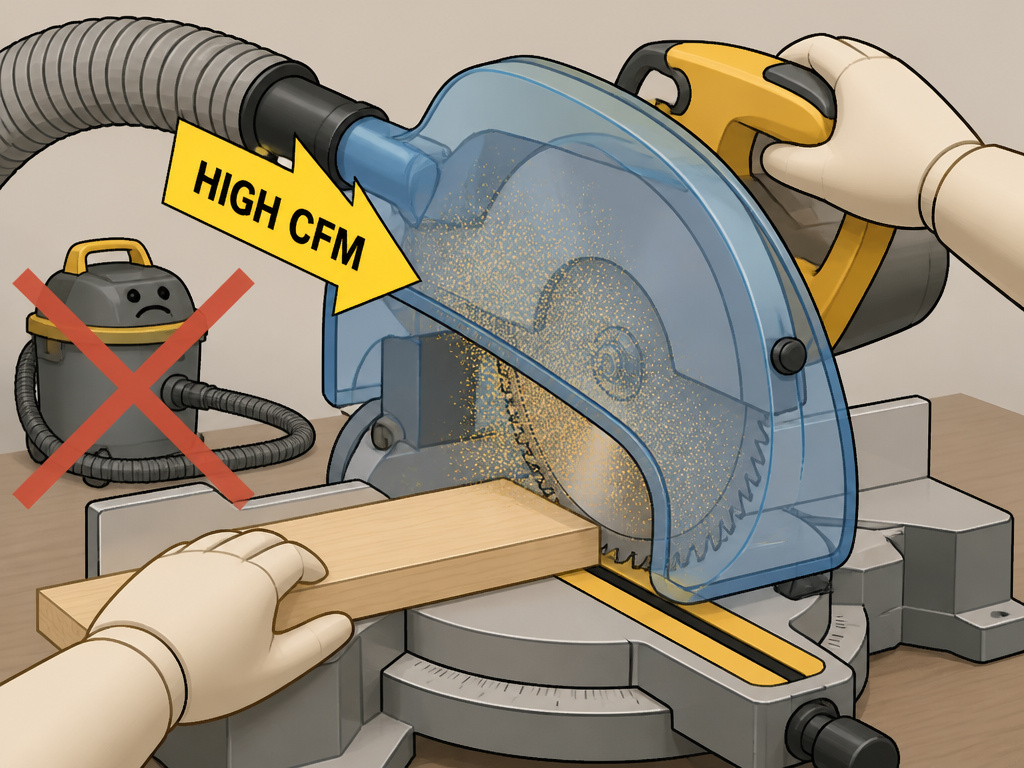
This decision matrix cuts through the noise. Match your most-used tool to the right air mover.
| Tool Type | Best Choice | Why It Wins | Critical Spec to Check |
|---|---|---|---|
| Table Saw, Planer, Jointer | Dust Collector | Needs high CFM (400-500+ CFM) to clear large-volume chips from the cabinet or housing. | CFM at the tool port. |
| Miter Saw | Dust Collector + Hood | Inherently dusty; needs high volume to capture spray. A containment hood is highly recommended. | CFM; focus on capturing at the source. |
| Handheld Sander (Orbital, Detail) | Dust Extractor | Needs high static pressure to pull fine dust through tiny ports; HEPA filter is critical. | Static pressure (water lift), HEPA seal. |
| Router, Track Saw | Dust Extractor / Shop Vac | High pressure maintains suction in small hose; keeps line of sight clear. | Static pressure, hose diameter match. |
| Drill Press, Bandsaw | Dust Collector | Better for capturing drifting dust near the source; shop vac can work for light duty. | CFM; often a secondary port. |
| General Cleanup, Wet Pickup | Shop Vac | The versatile workhorse for spills, debris, and post-project cleanup. | Tank capacity, peak HP. |
The Miter Saw Exception: Even the best shop vacs for woodworking struggle with a miter saw alone. The tool throws dust in a wide spray. A dust collector with a high-CFM pickup works better, but pairing it with a physical containment hood is highly recommended for better control.
The Upgrade Path: When Your Shop Outgrows Its Vac
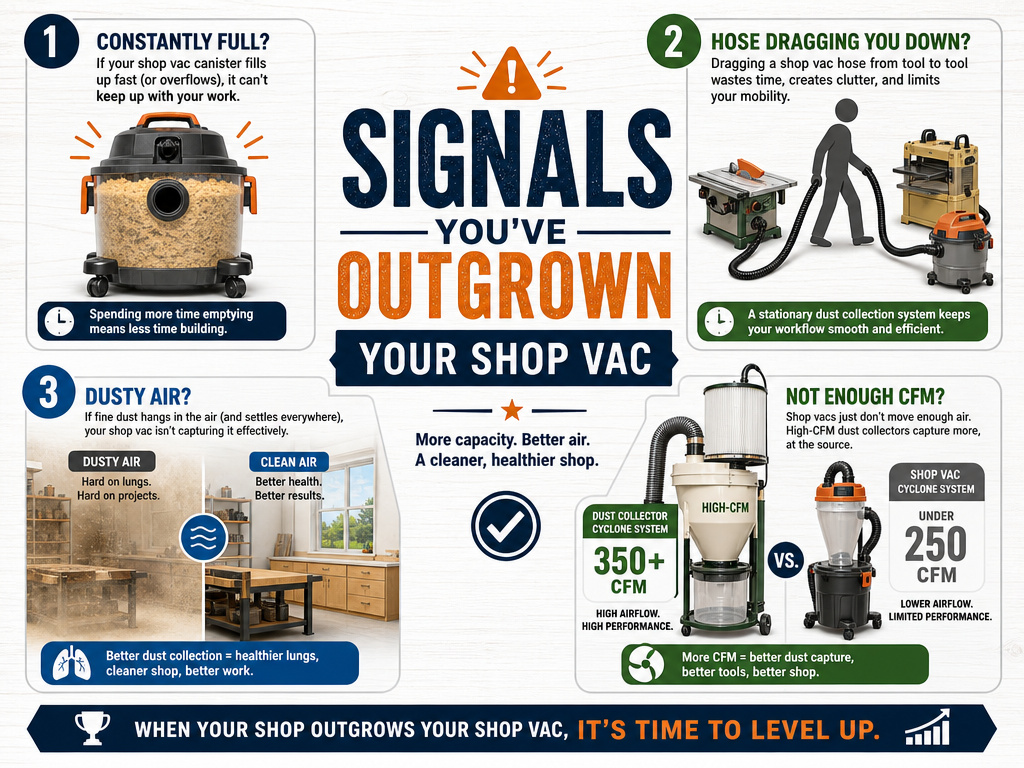
Most shops start with a shop vac. It’s the right call. But growth forces a change. Here are the signals that it’s time to get a dust collector.
- You’re Emptying the Vac After Every Use. If planing a few boards fills your 16-gallon vac, you’re doing more volume than it’s designed for. A dust collector with a large bag or even a 55-gallon drum lets you work for hours.
- You’ve Added a Second Stationary Tool. Dragging a shop vac between a table saw and a planer is inefficient. A dust collector like the Laguna CFlux-1, or a ducted system, becomes a time-saver.
- The Air Stays Hazy. If dust settles everywhere after you work, your vac isn’t capturing the fine particles. A dust collector with a good filter captures at the source, and a dedicated air filter cleans what escapes.
- You’re Adding a Cyclone. If you’re looking at a cyclone dust separator to save your shop vac filter, ask if you’ve actually outgrown the vac itself. A Super Dust Deputy 4/5 requires a minimum of 350 CFM, that’s dust collector territory. The regular Dust Deputy is for shop vacs under 250 CFM.
The next step isn’t abandoning your shop vac. It’s specializing it. Let the dust collector handle the stationary tools. Keep the shop vac for handheld sanding, cleaning up the bench, and connecting to tools that benefit from high pressure. That’s a professional two-stage system.
Health, Filters, and the Fine Dust Problem
This isn’t just about cleanliness. The National Toxicology Program classified wood dust as a known carcinogen in 2002. The dust you can’t see, the particles under 10 microns, is the most dangerous, lodging deep in the lungs.
- Shop Vac Standard Filters: These often let the finest dust pass through the filter media or escape through gaps around the filter housing. They protect the motor, not you.
- HEPA Filtration: A true HEPA filter captures 99.97% of particles at 0.3 microns. In a dust extractor, the whole system is sealed to force all air through it. This is the standard for a reason. The debate between HEPA vs standard filter types is a health decision.
- Dust Collector Filters: Get a 1-micron pleated filter, like on the JET DC-1100VX. It’s more effective than a shop vac filter but may not have the same sealed, whole-unit certification as a HEPA extractor.
A cyclone separator is the best upgrade for any system. By dropping a large portion of the dust out before it reaches the filter, it maintains suction and protects your health investment. Whether you choose a Dust Deputy for a shop vac or a Super Dust Deputy for a collector, the principle is the same: separate first, filter last.
How loud are dust collectors compared to shop vacs?
Frequently Asked Questions
Can a shop vac work as a dust collector?
Pro Tool Reviews notes that using a shop vac with stationary tools can work reasonably well for infrequent use, though it requires frequent emptying. However, Air Dynamics Industrial Systems argues a shop vacuum system in a facility should be avoided as it can create unsafe work environments. You’ll empty it often, and the filter will clog quickly, reducing suction. For any regular use with tools like a planer or table saw, a shop vac’s low CFM is the limiting factor, it cannot move enough air to keep the tool’s housing clear.
What is a dust extractor?
Dust extractor is a specialized shop vac built for use with power tools. Key features include true HEPA filtration, a sealed system to prevent leaks, tool-actuated auto-start, and often quieter operation. Brands like Festool, DeWalt, and Bosch make them. They are ideal for handheld sanding and routing but are not for large stationary tools.
Do I need a dust collector if I have a shop vac with a cyclone?
Cyclone separator (like a Dust Deputy) greatly improves a shop vac’s efficiency by keeping dust out of the filter. However, it does not increase the vac’s CFM. If your stationary tools require 400-500 CFM to run cleanly, a shop vac producing 130 CFM is still inadequate in the dust collector vs shop vac equation. The cyclone saves filter changes; it doesn’t change the machine’s fundamental airflow capacity.
How much CFM do I need for a table saw?
Generally, a table saw needs at least 400-500 CFM at the port for effective dust collection. This ensures enough air volume is moving through the cabinet to carry sawdust away. A shop vac typically delivers 100-150 CFM, which is why it struggles with this task.
Is a two-stage dust collector worth it?
Yes, for any serious workshop. A two-stage system (like a cyclone plus a collector) separates chips and bulk dust before they reach the fan and filter. This protects the impeller from damage, keeps the filter clean longer, and maintains maximum suction and airflow. It’s a significant upgrade over a single-stage collector.
The Bottom Line
Stop trying to make one tool do two opposite jobs. A dust collector moves air; a shop vac creates suction. Your table saw needs the first, your sander needs the second.
If your shop is mostly handheld tools, start with a HEPA-filtered shop vac or dust extractor. The moment you add a planer or start using the table saw regularly, budget for a dust collector. That’s the threshold. Running both a collector for your stationary tools and a dedicated vac for handheld work isn’t overkill, it’s the right tool for the job, twice over.
Finally, filter for your health, not just your motor. The fine dust you ignore today is the hazard you can’t get rid of tomorrow. Start with a good filter, add a cyclone, and never, ever run a vac without one.
