
10 Best Miter Saws For Home Projects in 2026
This post contains affiliate links. As an Amazon Associate, we earn from qualifying purchases.
Our best overall miter saw for home projects is the DeWalt DWS713 for its stainless steel detent plate that delivers repeatable, rock-solid accuracy. The SKIL MS6305-00 is our top budget pick with dual-bevel sliding capacity, and the Ryobi ONE+ 18V Cordless is the best choice for cord-free convenience.
Home DIYers need a saw that balances precision with the capacity to handle common tasks like trim, framing, and decking. We researched specifications, expert round-ups, and owner feedback to evaluate ten top models. This guide explains what matters and helps you match a saw to your specific projects.
Top 10 Miter Saws For Home Projects in the Market
Certain content that appears on this site comes from Amazon. This content is provided "as is" and is subject to change or removal at any time.
The Best Miter Saws For Home Projects, Reviewed
DeWalt DWS713 10-Inch Single Bevel Miter Saw

What We Like
- Stainless steel miter detent plate for reliable angle repeats
- Tall sliding fence supports 4-1/4-inch vertical workpieces
- Precise miter system with machined base fence support
Trade-offs
- Single-bevel design requires flipping wide boards for compound cuts
- Right bevel limited to 3 degrees restricts some crown molding work
- Non-sliding mechanism limits its crosscut width capacity
A 10-inch blade driven by a 15-amp motor gives you the clean, consistent cuts needed for trim and framing. Its stainless-steel miter detent plate with 14 positive stops locks in common angles, so you spend less time fiddling and more time making accurate joints. The tall sliding fence securely braces taller moldings. This combination of precision, solid construction, and straightforward operation makes it the most reliable workhorse for a home workshop where repeatable accuracy matters more than exotic features.
This is a single-bevel saw, tilting 48 degrees left but only 3 degrees right. For a compound cut requiring a right bevel, you must flip the workpiece, adding a step. The double-bevel DeWalt DWS716, listed among other products, offers a different design that tilts fully in both directions.
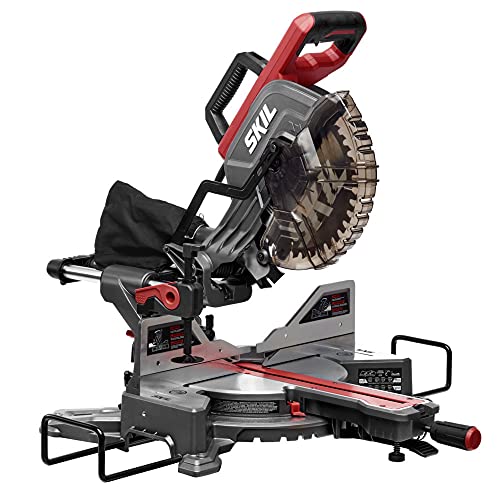
SKIL MS6305-00 10-Inch Dual Bevel Sliding Miter Saw
What We Like
- Powerful 15-amp motor for quick cuts
- Large 2×12 crosscut capacity
- Dual-bevel design with positive stops
- LED shadow line for precise alignment
Trade-offs
- Dust collection system struggles with efficiency
- Weighs 39.4 pounds, less portable than some
- Large 35.4-inch footprint needs ample workspace
With a crosscut capacity that handles 2×12 lumber at 90 degrees, this saw can manage nearly all standard dimensional boards for decks and framing in one pass. The SKIL MS6305-00 combines that useful size with a dual-bevel design for angled cuts in four positions and an LED shadow line for alignment. For DIY projects like trim or flooring, it provides essential power and precision. Research indicates it offers plenty for the price and will meet the needs of most home DIY tasks.
You do make one significant compromise for that capability: dust management. Owner feedback consistently notes the collection system is lacking, so expect to clean up more sawdust afterward. Compared to a more compact option like the Ryobi cordless model, this SKIL is also heavier and requires a dedicated station. If your priority is maximum cut size and bevel flexibility on a budget, and you can work around the mess, this saw is a remarkably capable tool.
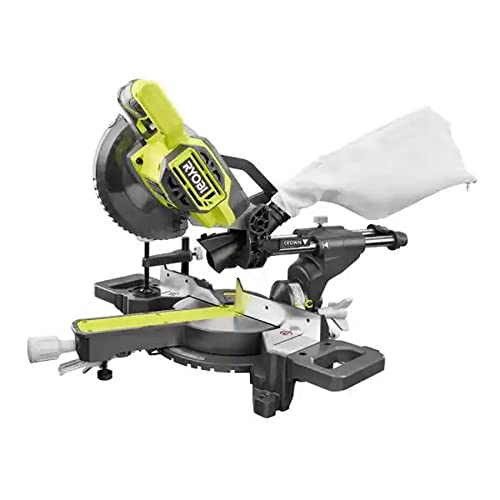
Ryobi ONE+ 18V Cordless 7-1/4-Inch Sliding Miter Saw
What We Like
- Cordless design with up to 800 cuts per charge
- Best-in-class 2×10 cross cut capacity
- LED cutline indicator for precise alignment
Trade-offs
- 7-1/4 inch blade limits depth for thick stock
- Single bevel design complicates compound cuts from both sides
- Cordless runtime may require planning for large projects
Up to 800 cuts on a single charge means you can run baseboards or trim all day without hunting for an outlet. That cordless freedom, combined with a best-in-class 2×10 crosscut capacity, makes this saw a natural fit for DIYers moving from room to room. This is the tool for the homeowner who values setup speed and portability over raw, stationary power.
The cordless convenience does involve a smaller 7-1/4 inch blade, limiting the depth of a single cut compared to larger 10 or 12-inch saws. As a single-bevel saw, cutting complex crown molding requires flipping the workpiece rather than the saw head. For tasks like framing, building shelves, or finish carpentry where cordless portability is key, this Ryobi provides the needed precision.
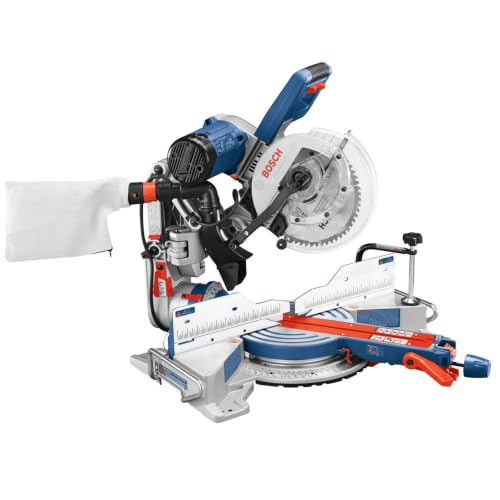
Bosch CM10GD 10-Inch Dual-Bevel Glide Miter Saw
What We Like
- Articulated arms drastically reduce front-to-back footprint
- Axial-Glide System for durable, precise sliding action
- Powerful 15-amp motor handles demanding cuts
- Front-mounted bevel controls for easy adjustments
Trade-offs
- At 64 pounds, it's substantially heavier than many 10-inch competitors
- Wider side-to-side footprint than a basic compound miter saw
Articulated hinge arms reduce this saw’s front-to-back footprint by up to 10 inches compared to slide saws with similar capacities, which is the key feature for anyone with a cramped garage or workshop bench. It delivers a full 12-inch horizontal cut capacity without the rear rail overhang, making it a clear choice for professional-level cutting in a confined space. The Axial-Glide System offers more durable precision than side rail systems, so the motion feels solid and repeatable.
You pay for that compact innovation with significant heft, as the saw weighs 64 pounds. That makes it an anchor compared to many 10-inch competitors, like the 31-pound DeWalt, so moving it around requires more planning. The mechanism positions this as a premium, largely stationary solution, while a homeowner needing frequent portability might find a lighter, more conventional slider more practical.
DeWalt DWS716 12-Inch Double-Bevel Compound Miter Saw

What We Like
- Stainless steel miter detent plate for durable accuracy
- Tall sliding fences support large crown and base molding
- Double-bevel design with positive stops at common angles
- Cam lock miter handle with detent override for quick adjustments
Trade-offs
- At 48.3 pounds, it's a substantial tool to move around frequently
- 27.2-inch length requires a dedicated, spacious work surface
A 12-inch blade and tall fences that handle crown molding up to 6-5/8 inches nested make this miter saw a shop anchor for serious trim and finish work. The stainless steel detent plate and positive stops at 0°, 22.5°, 33.9°, and 45° mean you can set common angles by feel and trust they’ll stay locked. It’s built for the DIYer tackling complex projects like full room crown or wainscoting, where repeatable precision on larger stock matters more than portability.
You trade the space-saving footprint of a sliding saw for that rock-solid, non-sliding stability. The 48-pound weight confirms this is a saw you’ll likely mount on a permanent stand, not haul to a jobsite. For smaller projects or tighter spaces, the single-bevel DeWalt DWS713 is a more compact and lighter alternative, but it won’t match the DWS716’s capacity or convenient double-bevel cuts.
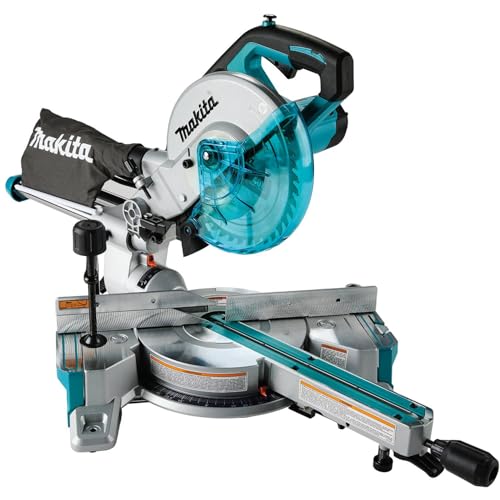
Makita LS0816F 8-1/2-Inch Slide Compound Miter Saw
What We Like
- Linear ball bearing system for accurate cuts
- Built-in LED light illuminates cut line
- Soft start feature for smooth startups
Trade-offs
- Limited bevel range to the right (0°-2°)
- 8-1/2-inch blade limits stock thickness
Weighing just under 31 pounds, the Makita LS0816F is a genuinely portable sliding miter saw, a rare find for a tool with this capability. Its 8-1/2-inch blade and slide mechanism deliver a 12-inch crosscut, which handles standard dimensional lumber with room to spare. This is the saw for anyone who needs to move their workstation frequently or has limited shop space. The dual rear handle bevel lock and positive miter stops make adjustments quick and solid, exactly what you need for repeated, accurate trim work.
The trade-off for that compact design is in material capacity. For those bigger jobs, you’d look to a 10-inch or 12-inch slider like the DeWalt DWS716. But if your projects involve baseboards, window casings, or deck boards, and your truck bed or workshop is already crowded, this Makita’s blend of precision and portability is hard to beat.
Product photos
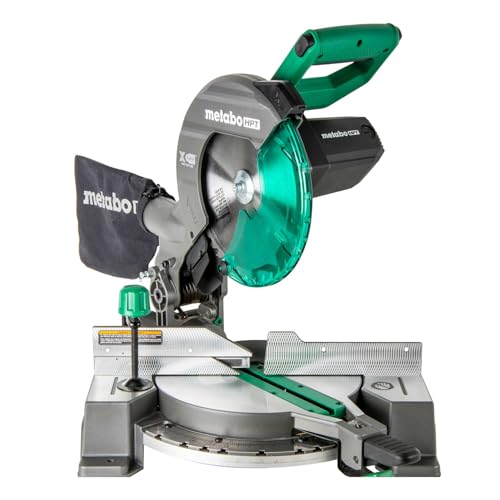
Metabo HPT C10FCG2 10-Inch Compound Miter Saw
What We Like
- Exceptionally lightweight at just over 24 pounds
- Powerful 15-Amp motor for a compact saw
- Large table provides solid workpiece support
- Improved miter scale for accurate adjustments
Trade-offs
- Single-bevel design requires flipping wide boards
- Non-sliding blade limits crosscut capacity
- 24.2 lb weight is light, but the DeWalt DWS713 is 31 lb
Weighing only 24.2 pounds, this saw is easy to carry from the garage to the driveway and lift onto a workbench. Its 15-Amp motor generates a no-load speed up to 5,000 RPM for woodworking projects. The large table and vice clamping system provide material support and secure the workpiece.
You get that portability by accepting a few limitations. This is a single-bevel, non-sliding compound miter saw, so you’ll need to flip the workpiece for certain angled cuts and you won’t tackle wider boards like a sliding model can. Compared to the heavier DeWalt DWS713, you’re giving up some mass and stability for a tool that’s significantly easier to haul around. For basic crosscuts, miters, and single-bevel work on standard stock, its combination of power and light weight is hard to beat in a corded package.
Product photos
Makita XSL05Z 18V LXT 6-1/2-Inch Compact Miter Saw

What We Like
- Extremely light for easy transport
- Cordless brushless motor for cooler running
- Automatic speed change for optimal cuts
- Delivers up to 270 cuts per charge
Trade-offs
- Tool only: requires separate battery purchase
- 6-1/2 inch blade limits stock capacity
At just 14.6 pounds, this cordless saw is light enough to carry with one hand, so moving it between job site locations requires minimal effort. It runs on Makita’s 18V LXT battery platform, delivering the power of a corded tool without an outlet. A brushless motor helps it run efficiently, and Makita claims up to 270 cuts per charge on baseboard when using a 6.0Ah battery.
Its compact 6-1/2-inch blade limits the width of material it can cut compared to larger 10-inch models. Since the tool is sold without a battery or charger, total cost is higher for users not already invested in Makita’s 18V LXT system. For tasks where easy transport is more critical than maximum cut size, this cordless design offers clear utility.
Product photos
Bosch GCM18V-07SN Cordless Miter Saw

What We Like
- Light 26-pound weight with carry handle
- Pro capacity for 8-1/4-inch crosscuts
- Centered sliding bars for smooth operation
- Tall fence supports taller material
Trade-offs
- Bare tool: requires separate battery purchase
- Single-bevel design restricts compound cuts from the right
Weighing just 26 pounds and packing an 8-1/4-inch crosscut capacity, this saw delivers legitimate job-site chops in a package you can easily carry to a backyard deck or a second-floor room. Its brushless motor, smooth sliding action, and tall fence make it a serious cordless option for a contractor needing a truly mobile solution. It’s also a great choice for a dedicated DIYer who values a clean, extension-cord-free workspace above all else. The ability to handle 3-3/4-inch nested crown is a nice touch for finish work.
That portability and cordless freedom come with a smaller 7-1/4-inch blade, which can’t match the depth of cut you get from a corded 10-inch or 12-inch model like the DeWalt DWS716. You’re also buying into a battery system. If you already own Bosch Core18V tools, this becomes a supremely logical addition. If you don’t, the total cost of entry climbs, and a lighter corded model like the Metabo HPT C10FCG2 might offer more immediate cutting power for the money.
Product photos
DOVAMAN 10-Inch Sliding Miter Saw

What We Like
- Includes three TCT blades for multi-material work
- Laser guide for precise cut alignment
- Ambidextrous design for left- or right-handed use
Trade-offs
- At 37.5 lb, it's heavier than many 10-inch non-sliding saws.
- The 34-inch length demands significant bench space.
The inclusion of three TCT blades and a dual-speed motor means you can switch from trimming PVC pipe to cutting aluminum trim without needing a second saw. That versatility is the core of this tool. It suits the home workshop tackling a mix of materials, from basic framing to craft projects with softer metals. The 13-inch sliding rail and extendable tables let you handle wider boards, so you’re not limited to narrow stock.
The DOVAMAN saw’s multi-material capability comes with a larger footprint and heft, making it better suited as a dedicated station saw than a frequent job-site traveler. For projects focused purely on wood, a lighter stationary model like the 31.0-pound DeWalt DWS713 could be a more practical choice. However, if your work regularly includes PVC or soft metals, this saw’s designed-in flexibility saves time.
Product photos
How We Evaluated Miter Saws For Home Projects
Our evaluation was based on a thorough review of manufacturer specifications, expert round-ups from trusted tool publications, and patterns in owner feedback across multiple retailers. We prioritized criteria most relevant to home projects: cutting capacity for common lumber dimensions, accuracy features like detent plates and fences that ensure clean joints, and overall value relative to a homeowner’s likely use.
For those exploring their options, our guide to best miter saws for DIY offers a broader perspective. While research reveals consistent performance trends and design trade-offs, it cannot replicate the feel of a tool in hand or its long-term durability under daily use.
What To Look For In Miter Saws For Home Projects
Choosing the right miter saw means matching its capabilities to the work you plan to do. A saw that’s perfect for a dedicated workshop may be overkill for a portable garage setup.
Focus on blade size for material thickness, sliding action for crosscut width, and bevel design for angled cuts. For most homeowners, a 10-inch saw offers a good balance of capacity and manageability.
Cutting Capacity
Blade diameter dictates how thick a board you can cut through in a single pass; 10-inch blades handle standard 2x lumber, while 12-inch models tackle thicker stock. Sliding mechanisms dramatically increase crosscut width, allowing you to slice across a wide board like a 2×12. It’s crucial to check a saw’s stated capacities for crown molding and baseboards, as these often require vertical placement against the fence. Our 10 vs 12 inch miter saw comparison dives deeper into this key decision.
Accuracy & Adjustability
A precise miter saw hinges on a solid fence and a reliable angle-setting system. Look for tall, sliding fences that support vertical workpieces and stainless steel miter detent plates, which resist wear and ensure angles lock in consistently. Positive stops at common angles like 22.5 and 45 degrees speed up repetitive cuts for projects like picture frames or decking. Understanding how to use a miter saw properly is just as important as the tool’s inherent accuracy.
Power & Portability
A 15-amp motor provides power for demanding cuts in hardwoods, which is common for corded models. For cordless saws, brushless motors and high-capacity batteries deliver performance for many cuts per charge. Weight and size are important for portability; a lighter saw is easier to move, while sliding rails or special arm designs can need significant bench space or save space by needing no rear clearance.
- Check the weight if you’ll move the saw between a garage, driveway, and basement.
- Measure your workspace depth, especially for saws with rear-sliding rails.
- Consider if cordless convenience is worth the investment in a battery platform.
Your most frequent project should dictate your saw’s primary strength, be it capacity, precision, or portability.
Miter Saws For Home Projects Compared
The following table compares key specifications to help you see the differences at a glance.
| Product | Blade Size | Motor/Power | Weight |
|---|---|---|---|
| DeWalt DWS713 10-Inch Single Bevel Miter Saw | 10 inches | 15-Amp | 31.0 pounds |
| SKIL MS6305-00 10-Inch Dual Bevel Sliding Miter Saw | 10 inches | 15 amp, 4,800 RPM | 39.4 pounds |
| Ryobi ONE+ 18V Cordless 7-1/4-Inch Sliding Miter Saw | 7-1/4 inches | Cordless (ONE+ 18V battery) | 30.2 Pounds |
| Bosch CM10GD 10-Inch Dual-Bevel Glide Miter Saw | 10 inches | 15 Amp, 4,800 RPM | 64.0 Pounds |
| DeWalt DWS716 12-Inch Double-Bevel Compound Miter Saw | 12 inches | 15-Amp | 48.3 pounds |
| Makita LS0816F 8-1/2-Inch Slide Compound Miter Saw | 8-1/2” | 10.5 AMP, 5,000 RPM | 30.9 Pounds |
| Metabo HPT C10FCG2 10-Inch Compound Miter Saw | 10 inches | 15 Amp | 24.2 pounds |
| Makita XSL05Z 18V LXT 6-1/2-Inch Compact Miter Saw | 6-1/2 inches | 18V LXT (tool only) | 14.6 lbs |
| Bosch GCM18V-07SN Cordless Miter Saw | 7-1/4 inches | Cordless (PROFACTOR 18V) | 26.0 pounds |
| DOVAMAN 10-Inch Sliding Miter Saw | 10-Inch | 15 Amp pure copper | 37.5 Pounds |
Frequently Asked Questions
What is the best miter saw for home DIY projects?
The DeWalt DWS713 is our top pick for most home DIY projects. It offers exceptional accuracy with its stainless steel detent plate and tall fence, making it ideal for precise trim work, framing, and general carpentry where repeatable angles matter most.
What size miter saw is best for home projects?
A 10-inch miter saw is the best general-purpose size for home projects. It has enough blade diameter to cut through standard 2x lumber and, when paired with a sliding mechanism, can crosscut wide boards.
What is the difference between single and dual bevel?
A single-bevel saw only tilts the blade to one side (usually the left) for angled cuts, requiring you to flip a wide board to make a matching cut from the opposite side. A dual-bevel saw tilts both left and right, which is a major time-saver for complex crown molding and compound cuts.
Are cordless miter saws powerful enough for DIY?
Yes, modern cordless miter saws with brushless motors and high-voltage batteries are now powerful enough for most DIY tasks. They excel at trim, baseboards, and cutting 2x lumber, offering unmatched portability for projects around the house or yard without needing an extension cord.
How important is dust collection on a miter saw?
Dust collection is a significant quality-of-life feature but varies widely. Many saws, especially budget models, struggle to contain the fine sawdust generated. If you work in a garage or basement you plan to keep clean, prioritize models noted for effective dust collection or be prepared to use a dedicated shop vacuum.
The Bottom Line
For homeowners seeking a durable, accurate saw for trim, framing, and general carpentry, the DeWalt DWS713 is a strong choice. Its solid construction and precise miter system provide reliable results.
If you’re on a tight budget but need maximum cut capacity, the SKIL MS6305-00 is the best budget pick. For those who value portability above all, the Ryobi ONE+ cordless saw eliminates the cord without sacrificing performance for typical DIY tasks. Ultimately, matching the saw’s core strength, be it precision, capacity, or portability, to your most common project is the single most important factor for a satisfying purchase.
