
10 Best Sliding Compound Miter Saws in 2026
This post contains affiliate links. As an Amazon Associate, we earn from qualifying purchases.
Our best overall sliding compound miter saw is the DEWALT DWS779 12-Inch Slider, chosen for its high-power motor and tall fences ideal for demanding crown molding. For a space-saving design, the Bosch CM10GD is a top contender, while the SKIL MS6305-00 offers the best shadow-line guide. Choosing the right one depends on your shop space, material needs, and how you’ll move it. We built this guide from manufacturer specifications and patterns in expert round-ups and owner feedback to help you find a saw that fits your real workspace and projects.
Top 10 Sliding Compound Miter Saws in the Market
Certain content that appears on this site comes from Amazon. This content is provided "as is" and is subject to change or removal at any time.
The Best Sliding Compound Miter Saws, Reviewed
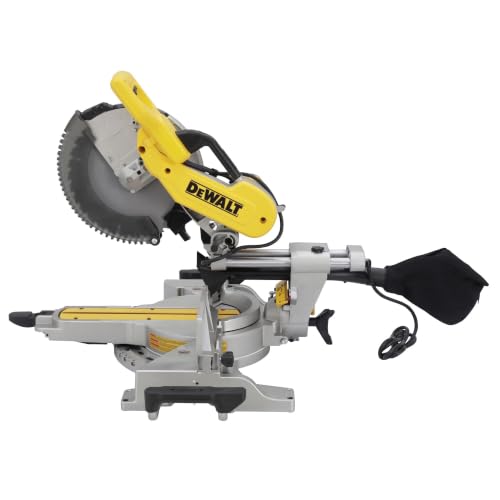
DEWALT DWS779 12-Inch Sliding Compound Miter Saw
What We Like
- Powerful 15-amp motor for demanding cuts
- Tall sliding fences support large crown molding
- Precise adjustable stainless-steel miter detent plate
- Effective dust collection captures over 75% of dust
Trade-offs
- Weighs 67.7 pounds, making it a substantial bench saw.
- No built-in laser or shadow cutline system.
- Miter scale may require user calibration for perfect alignment.
The dual-bevel action and wide miter ranges provide exceptional versatility for complex crown and framing work. It’s a workhorse built for accuracy and repeatability, with a motor that won’t bog down and a fence system designed for real-world molding jobs. This is the saw you anchor to your primary workstation for a reason.
For that kind of portability, a model like the Makita LS1019L is worth a look. The DWS779 also forgoes a laser guide, relying on your eye and the precise cam-lock miter handle. It demands an initial setup, including calibrating the miter scale, but once dialed in, it’s a benchmark for reliable, powerful cutting.
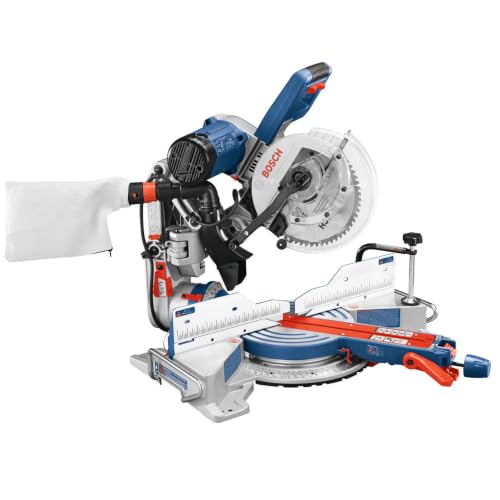
Bosch CM10GD 10-Inch Dual-Bevel Glide Miter Saw
What We Like
- Articulated hinge arms drastically reduce front-to-back footprint
- Axial-Glide System provides smooth, durable sliding motion
- Front-mounted bevel lock and selector for easy adjustments
- Wide 47-degree bevel capacity with common angle detents
Trade-offs
- At 64 pounds, it's a substantial lift onto a workbench
- 10-inch blade limits maximum cut depth versus 12-inch models
A front-to-back footprint roughly 10 inches shorter than a typical sliding miter saw means this Bosch can tuck against a wall in a cramped shop without sacrificing cutting capacity. Its articulated-arm Axial-Glide System is the reason, eliminating the rear rails that force other saws to need breathing room. That makes it the clear choice for anyone working in a garage or basement where every inch of depth counts. You still get a powerful 15-amp motor and professional-grade capacities for crown molding and wide boards, all in a package that stays put on your bench.
Articulated hinge arms shrink the front-to-back footprint by up to 10 inches compared to sliding saws with similar cutting capacity, so the Bosch fits into much tighter workshop spaces. Its 64-pound weight means it’s built solidly for a stationary setup, not for frequent job-site transport. The Axial-Glide System provides a smooth, precise motion that reviewers report operates without hiccups, though alignment depends on the blade and your mark rather than a laser guide.
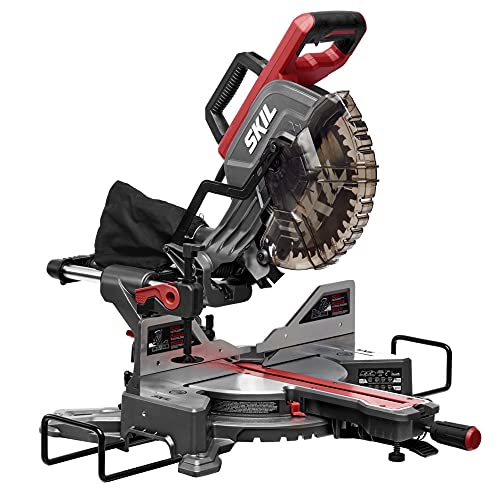
SKIL MS6305-00 10-Inch Dual Bevel Sliding Miter Saw
What We Like
- LED shadow line for high-precision alignment
- Powerful 15-amp motor for quick cuts
- Dual bevel with four positive stop positions
- Cuts common angles with 11 positive stops
Trade-offs
- Weighs 39.4 lb, requiring a sturdy work surface
- Large 35.4-inch length demands significant bench space
The LED shadow line provides a projected cut guide for greater accuracy than lasers, which means you can align cuts without dealing with a laser dot. Its 15-amp motor delivers 4,800 RPM for quick cuts. The saw can crosscut lumber up to 2×12 at 90 degrees.
At 39.4 pounds and 35.4 inches long, this saw requires a stable bench and space for its sliding arms. The Bosch CM10GD model has a more compact footprint, but the SKIL model includes the LED shadow line feature.
DEWALT DCS785B 12-Inch Cordless Sliding Miter Saw

What We Like
- Large 14-inch horizontal cut capacity
- Cordless freedom with full 20V/FLEXVOLT battery compatibility
- Highly efficient dust collection system
- Regenerative braking extends battery life
Trade-offs
- Tool-only model requires separate battery and charger purchase.
- At 51.7 pounds, it's heavier than some corded 12-inch competitors.
As a cordless 12-inch sliding miter saw, the DEWALT DCS785B delivers a 14-inch horizontal cut capacity, which allows for handling wide crown molding and baseboards without a power cord. Its design suits professionals moving between job sites where managing extension cords can be difficult. The tool captures up to 97% of dust during use and includes integrated wireless vacuum control, helping to maintain a cleaner work environment when connected to a compatible vacuum.
You pay for that cordless capability, of course, both in the initial tool-only price and in the need to invest in DEWALT’s battery ecosystem. While lighter than its corded sibling, the DWS779, it’s still a substantial 51.7-pound machine that benefits from a stand. Compared to a compact glide saw like the Bosch CM10GD, it demands more footprint but offers significantly greater crosscut capacity. This is the trade-off: ultimate portability and power for a premium price and platform commitment.
Product photos
Makita LS1019L 10-Inch Sliding Compound Miter Saw

What We Like
- Most compact design in its class
- Operates flush against a wall
- Crown capacity of a larger 12-inch saw
Trade-offs
- 57.9 lb weight still needs a sturdy stand
- Vertical cut capacity limited to 5-1/4 inches
With the crown molding cutting capacity of a 12-inch miter saw, this 10-inch model handles complex trim without the bulk. Its 2-steel rail sliding system uses a single slide-glide operation, reducing the saw’s footprint so it can operate flush against a wall. This design gives finish carpenters maximum capability in a minimal workshop space.
That compact design comes with a weight of 57.9 pounds, which Makita calls the most compact and least weight in its class for jobsite portability. Among saws with dual-rail slides, the Makita operated smoothest according to expert comparisons. For ultimate portability, a model like the cordless Ryobi ONE+ weighs 30.2 pounds.
Metabo HPT C12RSH3 12-Inch Sliding Miter Saw

What We Like
- Xact Cut Shadow Line for clear cut marking
- Asymmetric miter range for complex angles
- Nine detent stops for quick miter adjustments
- One-touch bevel and miter locks
Trade-offs
- Lacks a laser guide for cut line indication
The asymmetric miter range, going to 57 degrees on the right, opens up possibilities for complex crown molding and trim work that many saws can’t handle without flipping the workpiece. This makes it a standout for finish carpenters and dedicated DIYers tackling intricate projects. Its 4,000 RPM motor provides plenty of speed for clean crosscuts, and the shadow line system eliminates the fuss of aligning a laser in various shop lighting conditions.
You do pay for that versatility in bulk, as the saw’s footprint and weight demand a dedicated, sturdy stand. For purely standard framing or square cuts, the heavier DEWALT DWS779 offers greater crosscut capacity. But if your work regularly calls for odd-angled cuts, the Metabo HPT’s unique range is a genuine advantage that simplifies the process and reduces setup time.
Makita LS1219L 12-Inch Sliding Compound Miter Saw

What We Like
- Large capacity for crown and base molding
- Dual dust ports for excellent extraction
- Front bevel lock for convenient adjustments
Trade-offs
- At 81.6 lb, it's heavy for frequent transport
- Large footprint limits portability versus cordless options
A 15-inch crosscut capacity lets you slice through wide boards without flipping them, a true advantage for large trim and framing work. The innovative rail system slides smoothly and tucks the saw close to a wall, which is perfect for a permanent station in a crowded shop. This saw is built for the user who regularly tackles big material and values a solid, precise cut over easy portability.
The Makita LS1219L weighs 81.6 pounds, which positions it as a substantial, stationary tool for a dedicated workshop space rather than one for frequent transport. This heft is a trade-off for its large cutting capacity. For users prioritizing easier transport, the Metabo HPT C12RSH3 is a 12-inch sliding miter saw with a listed weight of 53.6 pounds.
Product photos
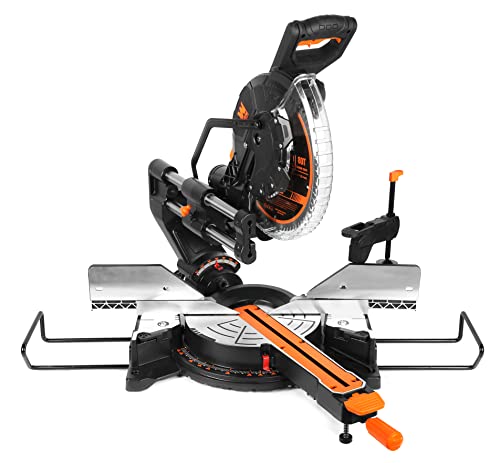
WEN MM1215 12-Inch Dual Bevel Sliding Miter Saw
What We Like
- Powerful 15-amp motor handles thick stock
- Dual-rail slide minimizes workspace footprint
- LED cutline guide improves cutting accuracy
- Includes table extensions and support fences
Trade-offs
- Weighs 53.5 pounds, a two-person lift for some
- Dust collection is a port and bag only
With a 15-amp motor that crosscuts boards up to 13.25 inches wide and 4.5 inches thick, this saw handles dimensional lumber and composite trim. Its dual-rail slide system allows for compact operation flush against a wall, which minimizes the saw’s footprint. The included 80-tooth carbide-tipped blade and two-year warranty are part of the package.
The trade-off for that capability is a 53.5-pound saw body, which demands a dedicated stand or a very sturdy workbench. It’s not a tool you’ll want to haul in and out of a truck bed alone every day. For users who prioritize extreme portability, the cordless and lighter Ryobi ONE+ 7-1/4″ model represents a different compromise, sacrificing cutting capacity for easy transport.
Product photos
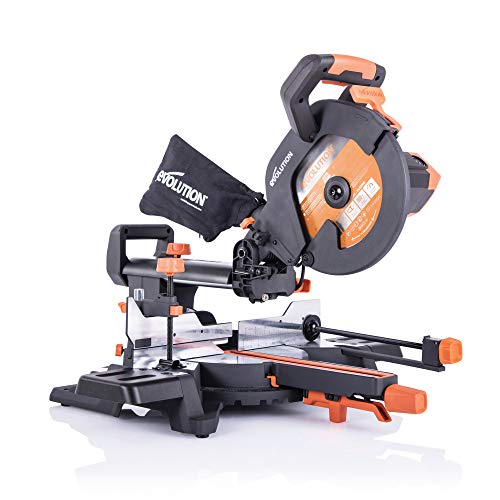
Evolution R255SMS+ 10-Inch Sliding Miter Saw
What We Like
- Cuts wood, metal, plastic, and more with one blade.
- Virtually no sparks when cutting mild steel.
- Includes dual quick-release clamps and taller fences.
- Integrated carry handles and slide rail protector.
Trade-offs
- 10-inch blade limits maximum cut depth versus 12-inch saws.
- No laser or LED cutline mentioned in provided features.
The ability to cut wood, plastic, and mild steel with the same included blade fundamentally changes what a single saw can do in a mixed-material shop. This makes it a standout for anyone tackling decks with composite boards, metal studs, or projects that blend materials without constant blade changes. Cuts stay cool and spark-free in metal, which is a genuine safety benefit you don’t get from a standard wood blade. For the contractor or serious DIYer who regularly encounters more than just lumber, this versatility saves significant time and tool investment.
You do trade some pure woodcutting capacity found in dedicated saws. Compared to a 12-inch model like the DEWALT DWS779, the crosscut capacity on wide stock will be less. At 41.8 pounds, it’s also not the lightest in its class, though the integrated handles help. It’s a specialist in versatility rather than a max-capacity wood saw, so weigh your material list. If your projects are exclusively wood, a traditional sliding compound miter saw might offer more dedicated features for that sole purpose.
Product photos
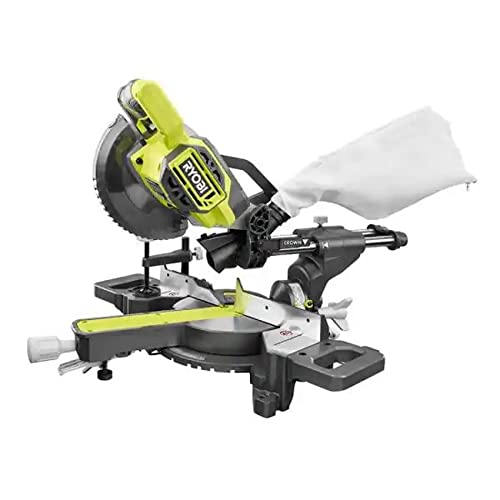
Ryobi ONE+ 18V 7-1/4" Sliding Miter Saw
What We Like
- Lightweight and highly portable at 30.2 lb
- Excellent crosscut capacity for its size
- Works with extensive ONE+ 18V tool system
Trade-offs
- 7-1/4-inch blade limits depth of cut
- Lighter build may not suit heavy job site use
Crosscutting a full 2×10 while being cordless makes this saw a standout for mobility. This is the tool you grab for quick trim jobs, deck repairs, or any project where dragging out a cord or a heavy saw is a hassle. The fact that it shares batteries with over 260 other Ryobi tools means it slides right into an existing workshop ecosystem without needing new chargers. For the DIYer or contractor who values speed and setup simplicity over brawn, this cordless design is a logical fit.
The trade-off for that portability is found in the 7-1/4-inch blade, which simply can’t match the cutting depth of a 10-inch or 12-inch saw. You won’t be slicing through thick crown molding or large dimensional lumber in a single pass. Compared to a corded beast like the DEWALT DWS779, which weighs more than twice as much, the Ryobi is about finesse and freedom, not all-day production cutting through heavy stock. It excels in its intended role but clearly defines its limits.
How We Evaluated Sliding Compound Miter Saws
Our evaluation is based on comparing specifications, manufacturer documentation, and synthesizing insights from expert tool round-ups. We looked for consistent patterns in owner feedback across platforms to understand real-world performance and common trade-offs.
We focused on three core criteria for sliding compound miter saws: cutting capacity relative to the saw’s footprint, accuracy features, and overall usability. Cutting capacity isn’t just about blade size; it’s about how much horizontal and vertical material a saw can handle, especially important for crown molding.
Accuracy hinges on the miter and bevel detent systems, the quality of the cutline guide (laser or shadow), and the saw’s ability to hold its settings. Usability covers the slide mechanism’s smoothness, control placement, weight for portability, and how much rear clearance the saw needs to operate.
A key limit of a research-led evaluation is that we cannot assess the subjective “feel” of a saw’s slide action or the precise force needed for its bevel lock. We rely on documented patterns, like experts consistently praising the smooth action of sliding miter saws with articulated arms for workshop use. Our goal is to arm you with the comparative data needed to narrow your choices confidently.
What To Look For In Sliding Compound Miter Saws
Selecting a sliding compound miter saw means balancing cutting power with the physical constraints of your workspace. The right choice depends heavily on whether it will live on a permanent bench or move between job sites.
Key factors are blade size (10-inch vs. 12-inch) for depth of cut, the slide mechanism’s space requirements, accuracy features like detent plates and cutline guides, and overall weight for portability.
Blade Size & Cutting Capacity
The blade diameter determines your maximum depth of cut. A 12-inch blade can typically cut thicker stock vertically, which is crucial for tall crown molding or thick dimensional lumber. However, 10-inch blades on a sliding saw still offer impressive horizontal crosscut capacity, often matching or exceeding that of non-sliding 12-inch models. The trade-off is that 10-inch sliding compound miter saws are generally lighter and sometimes more compact than their 12-inch counterparts, making our guide on 10-inch vs 12-inch miter saws a useful resource for this decision.
Workspace Footprint & Slide Design
How much room the saw needs behind it is a critical shop consideration. Traditional dual-rail slides often require significant rear clearance, pushing the saw away from a wall. Space-saving designs use articulated arms (like Bosch’s Axial-Glide) or compact rail systems (like Makita’s) that allow the saw to operate flush against a wall. If your workshop is tight on depth, prioritizing a compact slide mechanism can reclaim valuable floor space without sacrificing cut capacity.
Accuracy & Usability Features
Precision work demands reliable angle settings and clear cut-line indication. Look for a stainless-steel miter detent plate that can be user-calibrated, a feature found on many pro-grade models. For cut alignment, LED shadow lines are often praised for their clarity over lasers in various lighting conditions. Also, consider control placement; front-mounted bevel locks and easy-to-reach miter locks make repetitive adjustments faster and more accurate, especially on dual bevel sliding miter saws used for complex trim work.
- Check the saw’s weight if you need to move it regularly; models over 60 pounds are best suited for a permanent station.
- Ensure the dust collection port is compatible with your shop vac hose for a cleaner workspace.
- Plan to upgrade the stock blade for finer cuts in hardwoods; using quality miter saw blades is a best practice for finish work.
A saw that fits your space and feels intuitive to adjust will get used more often and deliver better results.
Sliding Compound Miter Saws Compared
For a quick view of how these ten sliding compound miter saws compare across key specifications, see the table below.
| Product | Motor | Bevel Range | Weight |
|---|---|---|---|
| DEWALT DWS779 12-Inch Sliding Compound Miter Saw | 15 Amp, 3800 RPM | 49° right and left | 67.7 Pounds |
| Bosch CM10GD 10-Inch Dual-Bevel Glide Miter Saw | 15 Amp, 4800 RPM | 47° left and right | 64.0 pounds |
| SKIL MS6305-00 10-Inch Dual Bevel Sliding Miter Saw | 15 Amp, 4,800 RPM | N/A | 39.4 Pounds |
| DEWALT DCS785B 12-Inch Cordless Sliding Miter Saw | N/A | Double bevel | 51.7 pounds |
| Makita LS1019L 10-Inch Sliding Compound Miter Saw | N/A | N/A | 72.8 pounds |
| Metabo HPT C12RSH3 12-Inch Sliding Miter Saw | 4,000 RPM | 45° left and right | 53.6 pounds |
| Makita LS1219L 12-Inch Sliding Compound Miter Saw | N/A | Dual-bevel | 81.6 pounds |
| WEN MM1215 12-Inch Dual Bevel Sliding Miter Saw | 15-amp | 45° left & right | 53.5 pounds |
| Evolution R255SMS+ 10-Inch Sliding Miter Saw | N/A | 0° – 45° | 41.8 pounds |
| Ryobi ONE+ 18V 7-1/4" Sliding Miter Saw | N/A | N/A | 30.2 pounds |
Frequently Asked Questions
Which sliding compound miter saw is the most accurate?
Accuracy depends on a combination of a precise, calibratable miter detent system and a clear cutline guide. Models like the DEWALT DWS779 and Bosch CM10GD are noted for their durable stainless-steel detent plates that hold angles well. For visual alignment, shadow-line systems, such as on the SKIL MS6305-00, project a blade-width shadow that many users find more reliable than a single laser line.
What is the difference between a compound and a sliding compound miter saw?
A standard compound miter saw can tilt its blade (bevel) and swivel left/right (miter) to cut compound angles, but its crosscut capacity is limited by the blade radius. A sliding compound miter saw adds a sliding mechanism that moves the blade forward and backward, greatly increasing its horizontal cutting capacity, allowing it to cut much wider boards. You can learn more about this key distinction in our article on sliding vs. Compound miter saws.
Are 10-inch or 12-inch sliding miter saws better?
Neither is universally better; it depends on your needs. A 12-inch sliding miter saw, like those featured in our guide to 12-inch sliding compound miter saws, offers greater maximum depth of cut for thick stock and tall moldings. A 10-inch slider is often lighter, more compact, and still provides ample crosscut width for most trim and board work, making it a favorite for space-conscious workshops.
What should I look for in a sliding miter saw for crown molding?
For crown molding, you need a saw with tall fences that can support the molding nested against the base, and sufficient bevel capacity. A dual-bevel function is highly beneficial, as it allows you to make complex left and right bevel cuts without flipping the workpiece. Adequate vertical cut capacity (often tied to blade size) is also crucial for cutting the thicker backer blocks sometimes used.
Can a sliding miter saw cut metal?
Typically, no, unless it is specifically designed for multi-material cutting. Standard wood-cutting blades and saw motors are not suited for metal. The Evolution R255SMS+ is an exception in our list, as it comes with a blade designed to cut wood, plastic, and light-gauge metals like aluminum and steel without creating dangerous sparks.
The Bottom Line
The DEWALT DWS779 12-Inch Sliding Compound Miter Saw is our best overall pick for its powerful motor and excellent capacity, making it ideal for the serious DIYer or contractor with a dedicated workshop station. If you’re on a tighter budget but still need 12-inch capabilities, consider the WEN MM1215, while mobile users should look at the compact Ryobi ONE+ cordless model.
Ultimately, the most important factor is matching the saw’s physical footprint and cutting capacity to your actual workspace and projects. A saw that doesn’t fit your bench or can’t handle your common stock sizes will become a frustration, not a tool you reach for with confidence.
