
10 Best Small Power Saws in 2026
This post contains affiliate links. As an Amazon Associate, we earn from qualifying purchases.
Our best overall small power saw is the BLACK+DECKER BDEJS300C Jigsaw for its dependable corded power and user-friendly design. For cordless convenience, we like the DEWALT DCS334B Jigsaw, and for precise cuts in tight spaces, the Fanttik R11 Pro Reciprocating Saw excels. Small power saws solve the need for a capable tool that doesn’t dominate your workspace or require two hands to control.
They are ideal for detailed work, cutting in confined areas, and handling sheet goods without the bulk of a full-size saw. Our research compares specifications, manufacturer features, and patterns in owner feedback to identify the best compact models for different needs and budgets.
Top 10 Small Power Saws in the Market
Certain content that appears on this site comes from Amazon. This content is provided "as is" and is subject to change or removal at any time.
The Best Small Power Saws, Reviewed
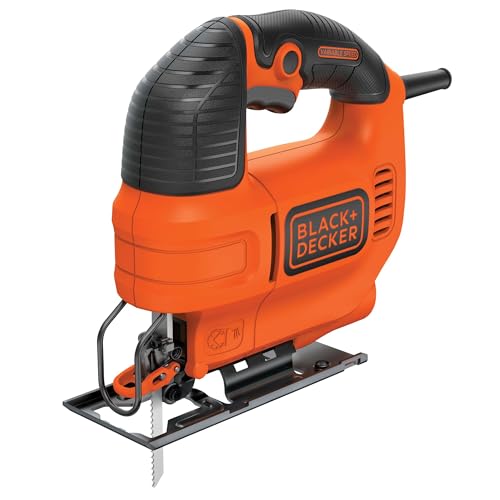
BLACK+DECKER BDEJS300C Jigsaw
What We Like
- Compact, lightweight design for easy control
- Built-in dust blower maintains line of sight
- Variable-speed motor handles wood and metal
- Adjustable shoe provides extra stability
Trade-offs
- Corded design limits mobility compared to cordless models
- 3/4-inch stroke length is shorter than some pro jigsaws
- At 4.4 lb, it's heavier than the cordless DEWALT DCS334B
A 4.5-amp motor driving a 3,000-stroke-per-minute blade gives this jigsaw the guts to handle most common materials in the shop, from plywood to thin metal. Its real strength is blending that capability with user-friendly design. The tool-free blade clamp, tilting base plate, and clear wire guard make it a straightforward choice for DIYers who need a reliable, corded saw for detailed cuts and bevels without fuss.
You trade some cordless freedom for consistent power and a lower upfront cost, since there’s no battery to buy. It’s a bit heavier than a bare cordless tool, but the weight helps dampen vibration. For intricate scroll work or all-day cutting, the dedicated corded power is an advantage over a cordless model like the DEKOPRO, though you’ll need to manage the cord. This is a saw that gets the fundamentals right for its class.
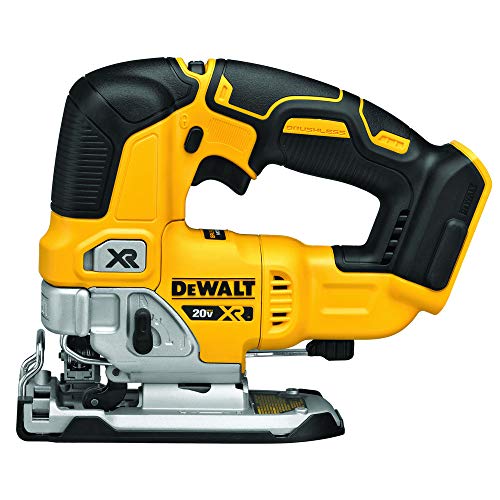
DEWALT DCS334B Cordless Jigsaw
What We Like
- Brushless motor for efficient, longer runtime.
- Compact size and weight for easy grip and control.
- All-metal, keyless shoe bevel with 0-45° detents.
- Integrated dust blower and LED light for visibility.
Trade-offs
- Tool only: requires separate 20V MAX battery and charger.
- Maximum bevel stop is 45 degrees, not beyond.
A brushless motor and a compact 4.2-pound frame make this jigsaw a go-to for cordless freedom without sacrificing control. The four-position orbital action and variable speed dial let you dial in the aggression for anything from plywood to hardwoods, while the keyless blade change and shoe adjustment keep you working, not fumbling. It’s the right choice for the builder who values a clean, portable tool for jobsite or shop cuts where an outlet isn’t handy.
Sold as a bare tool, the DEWALT DCS334B requires a separate purchase of a compatible 20V MAX battery and charger. This cordless design trades the unlimited runtime of a plug-in model, like the corded BOSCH JS365, for greater job-site portability. Owners of other DEWALT 20V tools can use their existing batteries with this jigsaw.
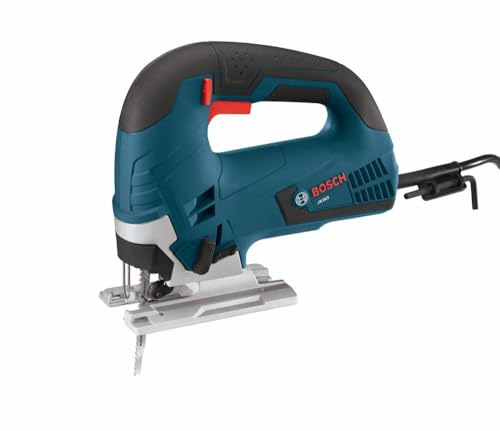
BOSCH JS365 Top-Handle Jigsaw
What We Like
- Tool-less blade change with ejection lever.
- Four orbital settings for smooth to aggressive cuts.
- Variable speed dial with accelerator trigger control.
- Adjustable dust blower and on-board bevel key storage.
Trade-offs
- At 5.3 pounds, it's heavier than the DEKOPRO corded jigsaw.
- Corded design limits mobility compared to cordless models.
With four orbital-action settings and a 45-degree bevel capacity, the Bosch JS365 can be adjusted for smooth to aggressive cuts in materials like wood, aluminum, and steel. Its 6.5-amp motor provides consistent power for varied cutting tasks. A tool-less blade-change system allows for fast blade insertion, and a blade ejection lever eliminates the need to touch a hot blade.
The corded, top-handle design measures 13.0 inches in length and weighs 5.3 pounds. This makes it less compact than tools like the one-handed Makita XRJ08Z reciprocating saw. A variable speed dial sets the maximum blade speed, while an accelerator trigger controls the operating speed during use.
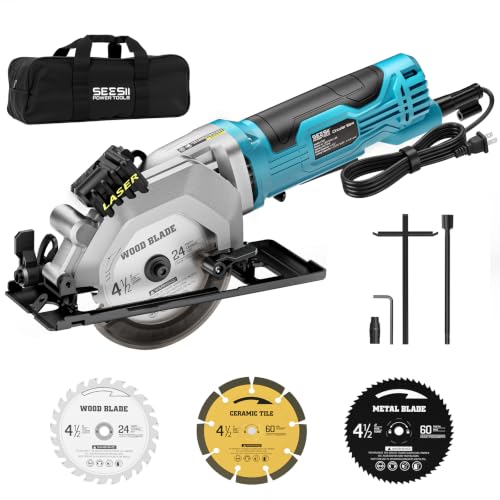
SEESII Mini Circular Saw
What We Like
- Includes three blades for wood, metal, and tile
- Laser guide and dust port for precise, clean cuts
- Double-switch safety lock prevents accidental starts
- Weighs about half a standard 7-1/4" saw
Trade-offs
- Corded design limits mobility compared to battery tools
- Lacks the raw power of larger, higher-amp circular saws
A 4.8-amp motor spinning at 4000 RPM gives this compact saw enough grunt for quick plywood cuts and trim work. Its 4.7-pound frame also makes one-handed operation a genuine possibility. That combination of capable power and lightweight design is exactly why it fits so well in a home workshop. For DIYers who need to tackle a mix of materials, the included TCT, HSS, and diamond blades mean you can jump from a 2×4 to PVC pipe or even ceramic tile without a trip to the store. The laser guide and dust extraction hookup are thoughtful additions that help keep cuts straight and your workspace clear.
A 4.8-amp corded motor spins the blade up to 4000 RPM, which provides enough power for home renovation and furniture making. Compared to general mini circular saws, this model has a 20% increase in cutting efficiency. Its corded design means you never have to manage battery life, but you must work within reach of an outlet.
Product photos
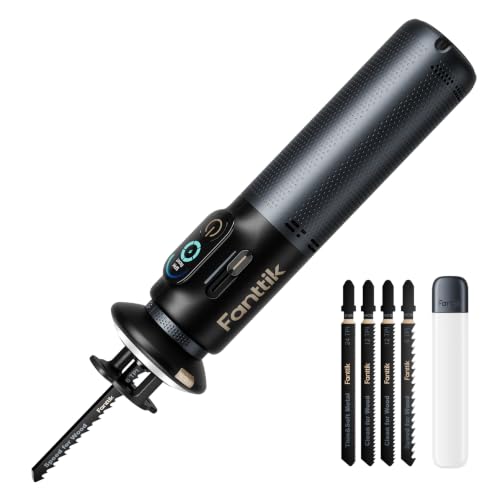
Fanttik R11 Pro Reciprocating Saw
What We Like
- Ultra-compact 8.9-inch length for easy storage
- Brushless motor and dual counterweight system reduce vibration
- Gradient LED display shows real-time speed and battery
- Includes five blades for versatile material cutting
Trade-offs
- Limited to blades 1.4mm thick or less
- Maximum cut depth is only 3/4 inch
At just under nine inches long, the Fanttik R11 Pro is a genuinely compact reciprocating saw, which means it stores easily in a drawer or backpack. This small size, combined with its dual counterweight system, reduces vibration and makes it suitable for detailed work in confined areas where a larger saw would be unwieldy. A 160W brushless motor and stepless speed control up to 2200 SPM allow the stroke rate to be matched to different materials, providing control for tasks like trimming wood or cutting PVC.
The trade-off for that miniature size is capacity; it’s strictly for light-duty work, with a maximum cut depth of 3/4 inch. You’ll also need to mind your blade selection, as the clamp accepts only T-shank jigsaw blades under 1.4mm thick. For bigger demolition or cutting through thicker lumber, you’d step up to a tool like the Makita XRJ08Z, which offers greater power and reach. But for quick, controlled cuts in confined areas, the Fanttik’s integrated battery and clear LED display make it a uniquely convenient and specialized tool.
Makita SH02R1 Cordless Circular Saw

What We Like
- Extremely light at just 3.5 pounds
- Adjustable depth and bevel for versatile cuts
- Compact 14.5-inch length for easy handling
- Cuts plywood, MDF, and drywall effectively
Trade-offs
- 1-inch maximum depth limits thicker material
- 3-3/8-inch blade is smaller than standard saws
At 3.5 pounds, this saw is effortless to lift and control overhead or in tight spaces, making it a standout for lightweight cordless operation. Its 3-3/8-inch blade spins at 1,500 RPM to cleanly slice through sheet goods and trim, while the tilting base handles bevels up to 45 degrees. This is the saw you grab for quick plywood cuts, installing subfloor, or trimming door bottoms without wrestling a heavier tool.
The trade-off is capacity. With a maximum cut depth of 1 inch, it is designed for lighter-duty tasks. For users who need to cut deeper, the larger 6-1/2-inch Bosch GKS18V-22N is a more capable choice. The Makita excels precisely because it sacrifices raw cutting depth for exceptional portability and control.
BOSCH GKS18V-22N Circular Saw

What We Like
- Cut-line LED illuminates the workpiece
- Electronic brake stops blade quickly
- Auxiliary handle for ambidextrous use
- Brushless motor for efficient runtime
Trade-offs
- Tool only: requires separate 18V battery and charger
- At 6.2 lb, it's heavier than some compact saws like the Makita SH02R1
- Blade-right design may obstruct view for some left-handed cuts
Illuminating the workpiece directly, the cut-line LED helps track the blade in dusty or dim conditions. This focus on visibility pairs with an electronic brake to reduce downtime between repeated cuts. An auxiliary handle and depth gauges visible from either side support handling in different orientations.
Weighing 6.2 pounds, this saw is heavier than some compact models like the 4.7-pound SEESII Mini Circular Saw. The tool’s illuminated cut-line and 50-degree bevel range with detents at common angles are features designed for improved visibility and angled cuts.
Product photos
DEKOPRO Corded Jigsaw

What We Like
- Six-speed dial for material-specific control
- Four orbital settings for cut quality choice
- Tool-less blade changes save time mid-project
- Includes parallel guide for straight cuts
Trade-offs
- Corded design limits mobility on a jobsite
- Vacuum hose for dust control is not included
A maximum speed of 3,000 strokes per minute with variable speed control allows the cutting pace to be adjusted for the blade and application, which suits a range of DIY or beginner woodworking projects. This corded DEKOPRO jigsaw provides a fundamental set of features for a workshop tool, including a base plate that adjusts to 45 degrees for bevel cuts and four orbital settings for different material types. Its design covers curved and straight cutting needs, positioning it as a straightforward option for cost-conscious users who prioritize core functions over portability.
As a corded tool, it requires a nearby outlet, unlike cordless models such as the DEWALT DCS334B. This provides consistent power from a wall source but limits movement around large workpieces without an extension cord. For stationary tasks at a bench, the tool includes a tool-less blade clamp and a parallel guide for straight cuts. It also has a dust port for attaching a vacuum hose to maintain a clear view of the cut line.
Product photos
Makita XRJ08Z Recipro Saw

What We Like
- Extremely lightweight at just 1 pound
- Brushless motor for faster, more efficient cutting
- Low vibration design improves control
- Loop-shaped handle guard adds rigidity
Trade-offs
- Battery and charger sold separately
- Compact size limits leverage for heavy demolition
At just one pound, the Makita XRJ08Z is a tool you can operate all day with one hand. This makes it a standout for overhead cuts or working in tight spaces where a full-size saw is cumbersome. Its brushless motor hits 3,100 strokes per minute, and the low-vibration design means you can follow a line accurately without your arm going numb. This is the saw you grab for plumbing notches, pruning branches, or cutting PVC, any quick, precise task where maneuverability trumps raw power.
This compact reciprocating saw uses an 18V LXT battery, sold separately, so it’s ready for Makita cordless tool owners. Its 7/8-inch stroke length and brushless motor deliver up to 3,100 strokes per minute, which Makita states can result in faster cutting. The one-handed grip and loop-shaped handle guard are designed to transmit force efficiently and reduce user fatigue during operation.
Product photos
DEWALT DCS571B Atomic Circular Saw

What We Like
- Brushless motor for long runtime and durability
- Bevel gear cuts full 2x lumber at 90 degrees
- Electronic blade brake for quick, safe stops
- Removable auxiliary handle for precise control
Trade-offs
- Battery and charger are sold separately
- At 6.5 pounds, it's heavier than some compact saws like the Makita SH02R1
- 4-1/2 inch blade limits depth compared to larger 6-1/2 inch models
The key here is that bevel gear. It lets this 4-1/2 inch saw handle a full 2×4 at a square 90-degree cut, a job that usually demands a bigger blade. That makes it a serious contender for framers and carpenters who need a compact, cordless saw but can’t sacrifice capacity. The brushless motor spins at 4,950 RPM, delivering enough power for sheet goods and crosscuts without bogging down. For anyone regularly breaking down dimensional lumber on a job site, this tool packs full-sized capability into a package that’s easier to stow than a full-size circular saw.
You do trade some depth for that compact form. When you need to plunge into thicker material, you’ll hit the limit of its 2⅛-inch cut. Compared to a dedicated mini saw like the SEESII, the DeWalt is also a bit heavier, which matters for overhead work or all-day use. But if your priority is a saw that can disappear into a tool bag yet still square up a stud, the DCS571B’s specific engineering for 2x material is hard to beat. It’s a focused tool that excels at its primary task.
Product photos
How We Evaluated Small Power Saws
Our research focused on manufacturer specifications and documentation to compare core metrics like weight, cutting depth, and motor type. We also analyzed expert round-ups and aggregated common themes from owner feedback regarding ease of use, durability, and real-world performance. Key criteria for this category included size and weight for one-handed control, cutting versatility across materials, and the practical trade-offs between corded and cordless power.
A review of product specifications can identify tools with comprehensive features, but it cannot assess long-term durability, which is often proven through extensive professional use. Beginners may find this guide to user-friendly saws helpful: beginner-friendly saws.
What To Look For In Small Power Saws
The right small power saw balances capability with comfort, letting you work precisely without fatigue.
Prioritize a tool’s weight and grip over raw power. A compact saw should feel natural in one hand, allowing you to focus on the cut line, not on managing the tool’s heft. Consider the materials you’ll cut most and whether corded consistency or cordless freedom suits your projects.
Size And Weight
The primary advantage of a compact saw is maneuverability. Our top picks range from just 1 pound to about 6.5 pounds. A lighter tool, like the 3.5-pound Makita SH02R1, drastically reduces arm fatigue during overhead work or extended use. Consider the tool’s length and grip design as well; a shorter body, such as the 8.9-inch Fanttik R11 Pro, allows you to work inside cabinets or between studs where a standard saw won’t fit.
Cutting Capability
Small saws make trade-offs between size and cutting depth. A mini circular saw with a 3-3/8-inch blade, for instance, may max out at a 1-inch depth, perfect for plywood and trim but insufficient for framing lumber. For cutting 2x4s, you need a tool like the DEWALT DCS571B with its 4-1/2-inch blade. Look at the saw’s bevel capacity for angled cuts and check if it includes useful guides, like a laser or rip fence, to improve accuracy on your projects.
Power Source
The choice between corded and cordless models defines your workflow. Corded saws, like the BOSCH JS365, offer consistent, unlimited runtime, ideal for workshop projects near an outlet. Cordless models, such as the DEWALT DCS334B, provide complete freedom of movement but require you to invest in a compatible battery system. Brushless motors in cordless tools are more efficient and offer longer runtime per charge. For a deeper look at this choice, our guide on battery-powered saws can help.
- Check the tool’s stroke length (for jigsaws) or RPM rating to gauge its speed.
- Verify the maximum blade thickness it accepts, especially for compact reciprocating saws.
- Look for integrated features like a dust blower or LED light to maintain visibility.
As a rule, if your work is stationary and near power, a corded saw offers great value. If you move around a lot or work overhead, a capable cordless model is worth the investment.
Small Power Saws Compared
The comparison table below highlights key specifications like weight, power source, and maximum cut depth to help you see the differences at a glance.
| Product | Motor / Power | Max Speed | Weight |
|---|---|---|---|
| BLACK+DECKER Jig Saw, 4.5 -Amp (BDEJS300C) | 4.5 Amp | 3,000 spm | 4.4 pounds |
| DEWALT 20V MAX XR Jig Saw, 3,200 Blade Speed, Cordless, Brushless Motor, LED Light, Bare Tool Only (DCS334B) | Brushless | 3,200 SPM | 4.2 pounds |
| BOSCH JS365 120V 6.5 Amp Top-Handle Jigsaw Kit Variable Speed, 45 Degree Bevel Cuts, Up to 3,000 SPM | 6.5 Amp | 3,000 SPM | 5.3 pounds |
| SEESII Mini Circular Saw, 4.8A 4000RPM Corded Compact 4-1/2" Saw with Laser | 4.8A corded, 4000 RPM | 4000 RPM | 4.7 lb |
| Fanttik R11 Pro Cordless Mini Reciprocating Saw for Wood & PVC Cutting | N/A | 0-2200 SPM | N/A |
| Makita SH02R1 12V max CXT® Lithium-Ion Cordless 3-3/8" Circular Saw Kit (2.0Ah) | N/A | 1,500 RPM | 3.5 Pounds |
| BOSCH GKS18V-22N 18V Brushless Blade-Right 6-1/2 In. Circular Saw (Bare Tool) | Brushless | 5,000 rpm | 6.2 pounds |
| DEKOPRO Electric Jigsaw Tool Power Jig Saws for Woodworking, Wood Cutter Hand Tool with 6 Variable Speed, 4 Orbital Settings, ±45° Bevel Cutting, Tool-less Blade Quick Release | N/A | 3,000 SPM max | 4.9 pounds |
| Makita XRJ08Z 18V LXT® Lithium-Ion Brushless Cordless Compact One-Handed Recipro Saw, Tool Only | Brushless | 0 – 3,100 strokes per minute | 1.0 Pounds |
| DEWALT ATOMIC 20V MAX* Circular Saw, 4-1/2-Inch, Tool Only (DCS571B) | Brushless | N/A | 6.5 pounds |
Frequently Asked Questions
What are the best small electric saws?
The best small electric saw depends on your primary task. For curved and intricate cuts in wood or metal, a compact jigsaw like our best overall, the BLACK+DECKER BDEJS300C, is an excellent choice. For straight cuts in sheet goods and trim, a mini circular saw such as the SEESII model is highly effective. Our research into the best small electric saws covers these options in detail.
Which mini cordless saw is the best?
The best mini cordless saw balances power, runtime, and ergonomics. For a jigsaw, the DEWALT DCS334B offers a brushless motor and compact design. For a circular saw, the Makita SH02R1 is remarkably light at 3.5 pounds, making it easy to handle. Your decision should factor in which battery platform you already own, as this can represent a significant cost savings.
What is the best saw to cut small branches?
For pruning and cutting small branches, a compact reciprocating saw is often the best tool. Models like the Makita XRJ08Z, which weighs just 1 pound, are easy to control with one hand for pruning or light demolition. While not a chainsaw, its fast reciprocating action can quickly zip through branches up to its maximum cut depth, which is ideal for yard cleanup.
What type of saw is best for small projects?
Jigsaws and mini circular saws are the most versatile for small projects. A jigsaw handles curves, scrollwork, and cutouts, while a mini circular saw excels at breaking down plywood and making straight cuts. For a first workshop saw, a capable, budget-friendly jigsaw like the DEKOPRO Corded Jigsaw provides great value and a wide range of uses for common DIY tasks.
How do I choose between a jigsaw and a circular saw?
Choose based on the cut you need to make. A jigsaw is for curved, irregular, or internal cutouts where you must plunge into the material. A circular saw is for fast, straight-line cuts and crosscuts. Many DIYers find having both is ideal; a compact circular saw handles the bulk of the rough cutting, and a jigsaw finishes the detailed work. Our comparative guide to power saws explores these distinctions further.
The Bottom Line
The BLACK+DECKER BDEJS300C Jigsaw is our best overall pick for its reliable corded power, adjustable shoe, and built-in dust blower, making it a trustworthy first saw for any DIYer’s bench. If your budget is tight, start with the DEKOPRO Corded Jigsaw; if you frequently cut dimensional lumber like 2x4s, the cordless DEWALT DCS571B Atomic Circular Saw is the specialized tool you need. Ultimately, the most important factor is matching the saw’s physical size and cutting capacity to the spaces you work in and the materials you cut most often.
