
10 Best 10 Inch Wet Tile Saw Blades in 2026
This post contains affiliate links. As an Amazon Associate, we earn from qualifying purchases.
Our best overall pick for a 10-inch wet tile saw blade is the POWERTEC Continuous Rim Diamond Saw Blade, which offers excellent compatibility and clean cutting for a range of materials. We also highlight the PEARL P4 for porcelain and the SHDIATOOL Super Thin Turbo for budget versatility. The right blade transforms your wet saw from a simple cutter into a precise tool for clean, chip-free tile work.
Choosing a blade is about matching its design to your material and your saw’s power. A blade for hard porcelain is built differently than one for standard ceramic, and using the wrong one leads to chipping, slow cuts, and a worn-out blade. We built this guide to cut through the confusion.
This list is the result of researching specifications, manufacturer data, and patterns in professional feedback. We evaluated blades on their rim design, material compatibility, build quality, and value to help you find the right match for your next tiling project.
Top 10 10-Inch Wet Tile Saw Blades in the Market
Certain content that appears on this site comes from Amazon. This content is provided "as is" and is subject to change or removal at any time.
The Best 10-Inch Wet Tile Saw Blades, Reviewed
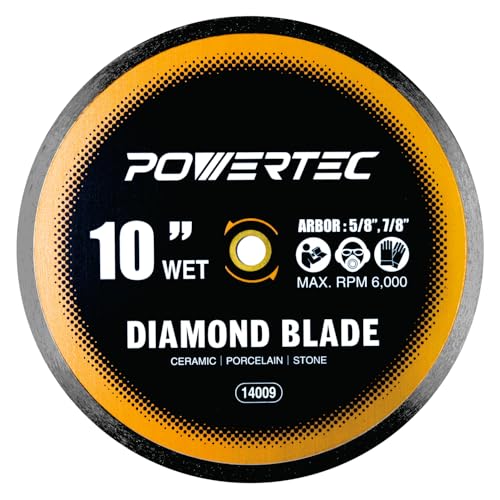
POWERTEC Continuous Rim Diamond Saw Blade
What We Like
- Includes 5/8-inch adapter ring for wide compatibility.
- Continuous rim design for clean, precise cuts.
- Spring steel core and diamond matrix for durability.
- Engineered for wet cutting to maximize blade life.
Trade-offs
- Exclusively for wet cutting; a single dry cut ruins it.
Exclusively engineered for wet cutting, this blade requires a constant water flow to cool it, flush debris, and prevent damage. Its continuous rim design and premium diamond grit aim for smooth cuts with reduced chipping on ceramic, porcelain, and natural stone. The included 5/8-inch adapter ring expands compatibility from its standard 7/8-inch arbor to fit more tile saw models. A spring steel core and diamond matrix are intended to provide durability for repeated use on these hard materials.
The critical trade-off is its absolute requirement for water. Forget a ‘quick’ dry cut, as the manufacturer states it will ruin the blade. For projects where portability or dry cutting is a necessity, a dedicated blade like the DEWALT DW4762 is a better comparison. But for anyone setting up a dedicated wet station, the POWERTEC provides a balanced, durable foundation that covers most tile and stone jobs you’ll throw at it.
Product photos
PEARL P4 Porcelain Diamond Blade

What We Like
- Premium diamond bond for fast, long-lasting cuts
- Continuous rim reduces chipping for clean edges
- Laser-cut slots cool blade and extend tool life
- Strong DST bond to high tensile steel core
Trade-offs
- At 1.4 lb, it's heavier than the MK-225 Hot Dog blade
The P4’s premium diamond bond and continuous rim are engineered specifically for hard, dense materials like porcelain. That focus means it cuts fast and resists wear where other blades might dull quickly, while the smooth rim minimizes chipping on finish-sensitive tile. This makes it the clear choice for professionals or dedicated DIYers who frequently tackle porcelain or hard stone and need a blade that can handle the abuse without sacrificing cut quality.
The trade-off for that specialized toughness is a bit of heft; it’s not the lightest blade in the guide. For a pure porcelain specialist, that weight is a non-issue next to its longevity. If your work mixes in a lot of softer ceramic or requires a more general-purpose blade, something like the DEWALT DW4762 Continuous Rim might offer a better balance for a varied project list.
DEWALT DW4764 Premium Porcelain Blade

What We Like
- Optimized for premium porcelain tile
- 10-inch diameter for deep cuts
- Heavy-duty 1.5-pound construction
Trade-offs
- At 1.5 lb, it's heavier than the 0.8 lb MK-225 Hot Dog.
- Weighs 1.5 lb, requiring a saw with a solid motor.
This 10-inch diamond blade is marketed specifically for premium porcelain tile. That focus means its design targets one of the hardest, densest tile materials. For a contractor on a large porcelain job or a serious DIYer installing expensive tile, this specialization is the primary reason to consider it over a general-purpose blade.
The trade-off is in its weight and thickness. At 1.5 pounds, it demands a saw with a solid motor, unlike lighter blades like the MK Diamond MK-225 Hot Dog. This blade is about precision and longevity in its niche, not about being the lightest or fastest cutter for every material.
QEP Premium Diamond Blade

What We Like
- Diamond-shaped laser cutouts keep blade cooler
- Reinforced hub enhances stability during cuts
- Thin continuous rim for chip-free tile cuts
- Dual arbor compatibility fits most tile saws
Trade-offs
- No listed weight suggests a standard build, not super-lightweight
- Wet use only, not for dry cutting applications
The diamond-shaped laser cutouts are the key feature here, actively pulling air and water through the blade to manage heat. This makes the QEP a standout for anyone tackling dense porcelain or granite in long sessions, as a cooler blade resists warping and keeps its edge longer. It’s a smart pick for pros or serious DIYers who need consistent, smooth cuts without the blade bogging down or glazing over from heat buildup.
The blade’s unique diamond-shaped laser cutouts are designed to keep it cooler during use, which helps maintain performance during extended cutting sessions on dense materials. This engineered ventilation supports the reinforced hub and thin continuous diamond rim, features aimed at enhancing stability and durability for demanding tile work. While a basic continuous rim blade like the DEWALT DW4762 could handle occasional softer ceramic cuts, the QEP blade’s cooling design is built for consecutive cuts on tougher porcelain and stone.
Product photos
DEWALT DW4762 Continuous Rim Blade

What We Like
- Continuous rim design for clean cuts in porcelain.
- 10-inch size handles standard tile formats.
- 5/8-inch arbor fits most common wet saws.
- Explicitly engineered for porcelain and tile.
Trade-offs
- At 1.3 pounds, it's heavier than some thin-rim blades.
- Designed for tile, not for heavy stone or masonry.
Designed specifically for porcelain and tile, the DEWALT DW4762 blade’s continuous rim geometry aims to produce clean, chip-free cuts on these common but brittle materials. Its 5/8-inch arbor is a standard size, allowing it to fit directly into most common wet saws without needing an adapter. The blade weighs 1.3 pounds, giving it a substantial feel that helps maintain stability during a cut.
As a dedicated porcelain and tile blade with a continuous rim, its cutting action is focused on edge quality rather than aggressive material removal. For tasks requiring fast, rough cuts on materials like natural stone, a different blade type would be more appropriate. This blade’s specifications indicate it is built for the specific application of wet-cutting porcelain and ceramic tile.
MK Diamond MK-225 Hot Dog Blade

What We Like
- Continuous rim for clean cuts
- Lightweight at under a pound
- Manufacturer backs it for life
Trade-offs
- Lighter weight than dedicated porcelain blades
- 5/8-inch arbor may not fit all saws
MK Diamond’s MK-225 is a 10-inch continuous rim diamond blade for wet cutting, a design focused on clean cuts in porcelain and vitreous tile. Its premium grade listing and limited lifetime warranty signal a durable tool built for repeated shop use. Research categorizes MK Diamond blades as workhorses that many shops keep in stock for handling a wide range of tile without needing something specialized.
The trade-off is that this isn’t a dedicated porcelain blade like the Montolit Progres CG, which uses a cooler-running matrix for the hardest materials. The MK-225 is a generalist. For the typical mix of bathroom and kitchen tile, however, this Hot Dog blade covers the bases reliably.
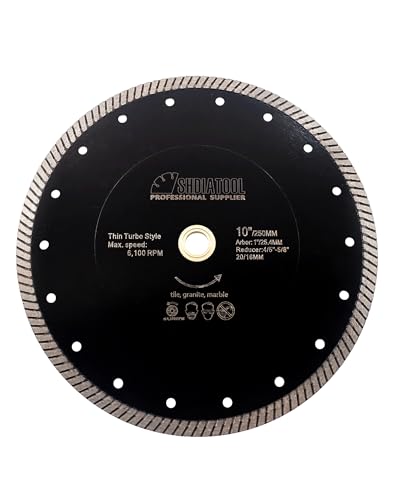
SHDIATOOL Super Thin Turbo Blade
What We Like
- Super thin 2mm rim for clean, precise cuts
- Reinforced core reduces blade flex
- Includes reducer washers for wide compatibility
- Designed for both wet and dry cutting
Trade-offs
- Dry cutting use will shorten diamond segment life
- Requires wet cutting for optimal segment life
A super thin 2mm turbo rim delivers smooth, precise cuts with reduced chipping and dust in porcelain and ceramic tile. That reinforced core adds rigidity to reduce blade flex during cutting, which helps users maintain better control for a cleaner finish. Its design for cutting porcelain, ceramic, granite, marble, masonry, and stone, plus included reducer washers for the 1-inch arbor, provides wide material and machine compatibility for various renovation projects.
The blade is designed for both wet and dry cutting, but wet cutting is recommended to help control heat and dust and extend diamond segment life. This means dry cutting, while possible, is a less optimal use case that can affect the blade’s longevity.
Product photos
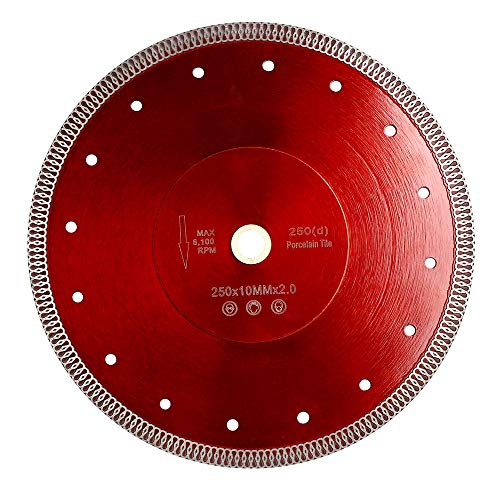
YIJING Super Thin Diamond Blade
What We Like
- Super thin core enables fast cutting
- Turbo-mesh rim minimizes chipping
- Wet or dry cutting flexibility
- Cuts porcelain, ceramic, and natural stone
Trade-offs
- Arbor size is 7/8"-5/8", requiring an adapter for some tools.
- Material list includes 'ect.', suggesting a broad but unspecified range.
The ability to cut wet or dry is the defining feature here. It means you can use this blade on a stationary saw with a water feed or take it to a job site with a standard angle grinder, which is a serious advantage for mixed-use scenarios. The super thin core and turbo-mesh design are built for speed and reduced chipping on a broad range of materials from porcelain to quartz. This makes it a true all-rounder for the installer who tackles varied tile and stone jobs without wanting to swap blades constantly.
Its thin core and turbo-mesh rim design are intended for fast cutting with minimal chipping, which helps when working with materials like porcelain and ceramic. This blade can be used for wet or dry cutting, offering flexibility for different job site setups. While the design aims for speed, some dedicated wet-only blades from other brands are marketed specifically for precision porcelain cutting.
Product photos
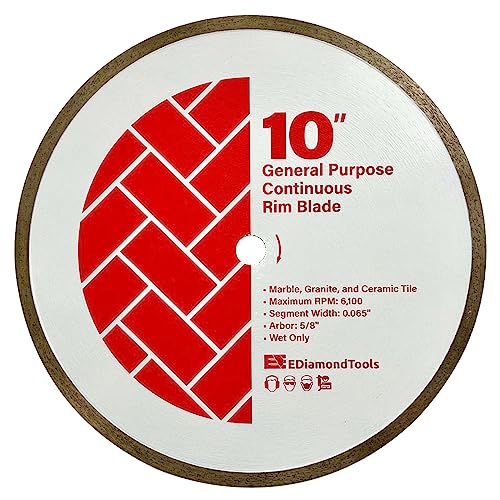
EDiamondTools Continuous Rim Blade
What We Like
- Continuous rim minimizes chipping on tile and stone.
- 3.75-inch depth handles standard tiles and many slabs.
- 3600 RPM rating suits most common wet saw motors.
Trade-offs
- At 1.0 pounds, it is lighter than some blades, potentially indicating less diamond material.
- Weighs 1.0 pounds, lighter than several comparable 10-inch blades.
With a continuous rim and 10mm segment height, this blade is designed to minimize chipping when cutting ceramic or stone tile. Its 3.75-inch cutting depth can handle most common wall and floor tiles, while the 3600 RPM rating matches the speed of many standard wet saws. The design focuses on clean cuts in the materials listed by the manufacturer.
The trade-off for its clean-cutting generalist design is that it won’t have the extreme longevity of a blade with a taller diamond segment when tackling dense stone daily. For a pure porcelain job, a specialized blade like the PEARL P4 Porcelain Diamond Blade is engineered for that harder material. But for mixed-use where chipping is the primary enemy, this EDiamondTools blade provides a straightforward, effective solution.
Product photos
PANFREET Super Thin Diamond Blade

What We Like
- Extremely thin 2.0mm kerf for efficient cuts.
- Turbo segment design for chip-free cutting.
- Suitable for both wet and dry applications.
- Cuts cool for increased blade life.
Trade-offs
- At 1.9 pounds, it is heavier than the 0.8-pound MK Diamond MK-225.
The 2.0mm segment thickness is the star here, creating a kerf so thin it wastes less material and puts less strain on your saw motor. This makes the PANFREET blade a smart pick for detail work on expensive tile or stone where every millimeter counts. It’s built for the installer who needs clean, precise cuts on porcelain and ceramic without chipping, and the flexibility to run it wet or dry adds to its shop utility.
Weighing 1.9 pounds, this blade has more heft than some other 10-inch options, which could be a consideration for users of very lightweight saws. Its 10mm rim height defines the maximum depth of a single cut. The blade is designed for dry or wet cutting on materials including porcelain tile, granite, marble, ceramic, and brick.
Product photos
How We Evaluated 10-Inch Wet Tile Saw Blades
This guide is based on an analysis of manufacturer specifications and engineering data to understand each blade’s intended use, from its diamond bond type to its arbor size. It also considers professional round-ups and aggregates common themes from user feedback to gauge real-world performance and durability.
Key criteria included the rim design (continuous for clean cuts vs. Turbo for speed), the specified material compatibility (porcelain, ceramic, stone), and the physical construction like weight and core strength. We prioritized blades that clearly state their purpose, as using a blade outside its design limits is the fastest way to ruin it. A good guide for choosing a tile blade emphasizes this match.
The main limit of a research-based guide is we cannot verify claimed cutting speeds or precise lifespan. We rely on documented specs and consistent reports from users. For practical steps, our guide to tile saw blades and tutorial on how to change a blade offer useful next steps.
What To Look For In 10-Inch Wet Tile Saw Blades
The blade is the business end of your wet saw. Its design dictates the quality of your cut, the materials you can tackle, and how long it will last. Ignoring the specs can lead to chipped tile and a prematurely dull blade.
Focus on the rim type for cut quality, the stated material compatibility, and the blade’s weight relative to your saw’s motor. A continuous rim gives the cleanest edge on tile, while turbo segments aid cooling and speed on stone.
Rim Design: Clean Cuts vs. Cutting Speed
The rim design is the most critical choice. A continuous rim has a smooth, unbroken edge of diamonds. This design provides the cleanest, most chip-free finish, making it the standard for porcelain and ceramic tile where the cut edge will be visible. It’s the recommended design in most professional guides for cutting porcelain tile.
Turbo or segmented blades have gaps or slots cut into the rim. These openings help clear debris and keep the blade cooler, allowing for faster cutting rates. This is beneficial for dense natural stone or masonry, but the trade-off is a slightly rougher edge more prone to chipping on delicate tile glazes. Some blades use a turbo-mesh design as a compromise for versatility.
Material Compatibility & Diamond Bond
Blades are engineered for specific materials. A blade marketed for “porcelain and tile” uses a harder diamond bond to withstand the abrasive, glass-like surface of fired porcelain. Using a general-purpose blade on porcelain will cause it to glaze over and dull rapidly. For dedicated work, seek out specialized porcelain cutting blades.
Conversely, a blade made for soft ceramic or brick uses a softer bond that wears appropriately. Glass tile requires its own ultra-fine, continuous rim blade to prevent shattering. Always match the blade to your primary material. If you frequently switch between materials like porcelain and stone, a versatile wet/dry blade like the YIJING may be a practical choice, but understand it’s a compromise.
Physical Build & Saw Compatibility
A blade’s weight and arbor size must suit your saw. Heavier blades, often over one pound, contain more diamond material and are built for durability, but they require a saw with a sufficiently powerful motor to spin them effectively. Lighter blades under a pound are easier on smaller saws.
The arbor hole is the center mounting point. The 5/8-inch arbor is the industry standard for 10-inch wet tile saws. Many blades include a reducer ring (like a 5/8-inch to 7/8-inch adapter) to fit less common saws. Always verify this fit before purchasing. Our research on blades for 8-inch saws follows the same principle.
- Check your saw’s manual for the correct arbor size.
- Ensure the blade’s maximum RPM rating exceeds your saw’s motor speed.
- For clean tile work, prioritize a continuous rim blade.
- Consider a dedicated porcelain blade if that’s your main material.
- A heavier blade suggests more diamond, but only if your saw’s motor can handle it.
10-Inch Wet Tile Saw Blades Compared
The table below compares key specifications across our top picks to help you see the differences at a glance.
| Product | Arbor Size | Rim Design/Type | Cutting Application |
|---|---|---|---|
| POWERTEC Continuous Rim Diamond Saw Blade | 7/8 inch | Continuous rim | Wet cutting only |
| PEARL P4 Porcelain Diamond Blade | 5/8 inch | Continuous rim | N/A |
| DEWALT DW4764 Premium Porcelain Blade | N/A | N/A | N/A |
| QEP Premium Diamond Blade | 5/8" & 1" | Thin continuous rim | N/A |
| DEWALT DW4762 Continuous Rim Blade | 5/8-Inch | Continuous Rim | Wet Cutting |
| MK Diamond MK-225 Hot Dog Blade | 5/8 inch | Continuous thin rim | N/A |
| SHDIATOOL Super Thin Turbo Blade | 1" with reducers | N/A | Wet and dry |
| YIJING Super Thin Diamond Blade | 7/8"-5/8" | Special turbo-mesh | Wet or dry |
| EDiamondTools Continuous Rim Blade | N/A | Continuous rim | N/A |
| PANFREET Super Thin Diamond Blade | 7/8"-5/8" | N/A | Dry or wet |
Frequently Asked Questions
What is the best 10″ wet saw blade for cutting porcelain tile?
For cutting porcelain tile, you need a blade with a hard diamond bond and a continuous rim design to prevent chipping. Our research points to the PEARL P4 Porcelain Diamond Blade and the DEWALT DW4764 Premium Porcelain Blade as top performers specifically engineered for this hard, dense material.
What is a good 10 inch wet tile saw blade?
A good all-around 10-inch wet tile saw blade offers broad compatibility, a clean-cutting continuous rim, and durable construction. The POWERTEC Continuous Rim Diamond Saw Blade is our best overall pick because it includes a 5/8-inch adapter ring for wide saw compatibility and is built for clean cuts on ceramic, porcelain, and stone.
What is the best wet tile cutting blade?
The “best” wet tile cutting blade depends entirely on your material. For a mix of ceramic and porcelain, a continuous rim blade like the POWERTEC is excellent. For hard porcelain specifically, choose a dedicated porcelain blade.
Can you use a wet tile saw blade for dry cutting?
Most wet tile saw blades are designed for wet use only. Using them dry generates extreme heat that can warp the steel core and destroy the diamond segments. Some blades, like the SHDIATOOL Super Thin Turbo, are rated for both wet and dry use, but dry cutting will always shorten their overall lifespan compared to wet use.
How do I change the blade on my tile saw?
Always disconnect power first. Follow your saw’s manual to loosen the arbor nut, which usually requires a wrench. These involve removing the water tray or guard for access. Ensure the new blade is mounted with the directional arrow facing correctly, and retighten it securely.
The Bottom Line
For most tile setters and serious DIYers running a standard wet saw, the POWERTEC Continuous Rim Diamond Saw Blade is the best overall choice. Its included adapter ring ensures wide compatibility, and its continuous rim design delivers the clean, chip-free cuts needed for ceramic, porcelain, and stone tile projects.
If your budget is tight but you need a versatile blade, look to the SHDIATOOL Super Thin Turbo Blade. For professionals focused exclusively on hard porcelain, invest in a dedicated blade like the PEARL P4 or the premium DEWALT DW4764. Ultimately, the single most important factor is matching the blade’s engineered purpose to your primary tile material.
