
Cordless vs Corded Power Tools: Which Should You Buy?
This post contains affiliate links. As an Amazon Associate, we earn from qualifying purchases.
Cordless power tools run on rechargeable batteries and offer complete portability, while corded tools plug into an outlet for unlimited, consistent power. For most homeowners and mobile professionals, modern cordless tools are the better buy, they handle the majority of tasks and eliminate cord hassles. Corded tools still win for stationary shop tools, continuous heavy-duty work like grinding concrete, and any job where runtime matters more than mobility.
The choice isn’t about raw power anymore. It’s about where and how you work. A cordless drill feels liberating on a ladder, but a corded angle grinder doesn’t quit halfway through a welding project. The debate often centers on cordless vs corded power tools.
What follows is a breakdown of real performance numbers, the hidden costs of battery platforms, and a clear guide on which tools to buy cordless and which to keep corded. By the end, you’ll know exactly where to spend your money.
Key Takeaways
- Modern 18V–60V brushless cordless tools match corded power for short, high-torque tasks like drilling and driving, but corded tools deliver 3–5 horsepower steady for continuous work without sag.
- Building a tool system piece-by-piece with bare tools is often cheaper than buying a kit with batteries you don’t need, avoiding brand ecosystem lock-in.
- For stationary tools (table saws, bench grinders) and applications demanding all-day runtime (professional grinding, demolition), corded is the rational, cost-effective choice.
- A hybrid approach, cordless for mobility, corded for the shop, saves money and guarantees you’ll never run out of power at the wrong moment.
Power & Performance: The Real Gap
A cordless circular saw’s RPM may sag under heavy load like cutting through thick oak, while a corded counterpart can maintain a steady speed. That’s the difference between marketing voltage and real-world power under load.
The specs tell two stories. Corded tools pull a consistent 15–20 amps from the wall, delivering 3–5 effective horsepower for as long as you need. Cordless tools on 18V or 60V platforms with brushless motors can hit 1,200 inch-pounds of torque, a staggering number for burst tasks.
According to some sources, for general work like building a deck, hanging drywall, or driving fasteners, premium cordless tools deliver performance that’s indistinguishable from corded equivalents in the cordless vs corded power tools comparison. Other sources note corded tools maintain consistent power where cordless tools may sag under continuous load. The gap appears in the sustained grunt work. A corded angle grinder doesn’t care if you’re smoothing welds for eight hours. A cordless grinder’s battery, and its motor’s thermal limits, absolutely do.
Where this goes sideways: Assuming “20V Max” means twenty volts of constant delivery. Those are marketing labels. Under heavy load, even a healthy battery sags, and the tool’s electronics throttle power to prevent overheating. You’ll feel the tool bog down, the sound will change from a whine to a strained groan, and your cut will slow.
| Task Type | Cordless Performance | Corded Performance | Winner for Most |
|---|---|---|---|
| Short, high-torque (driving lag bolts) | Matches or exceeds corded | Excellent, steady | Cordless (for convenience) |
| Continuous cutting (ripping plywood) | Good for 2-3 sheets per battery | Unlimited, consistent | Corded |
| Sustained high-load (grinding concrete) | Limited by battery & thermal cutout | Unlimited power envelope | Corded |
| Intermittent use (punch-list work) | Ideal, no cord to manage | Overkill, cord is a hassle | Cordless |
The verdict here is mechanical, not ideological. Cordless owns mobility and convenience. Corded owns the shop floor and the eight-hour shift.
The first figure is for the hardest continuous work, pressing a drill against dense material. The second covers the mix of driving, waiting, and repositioning in typical construction. For driving fasteners, that same battery lasts 60–90 minutes.
Common mistake: Planning a project with only one battery. Even a “5Ah” label doesn’t guarantee 60 minutes of grinding. The tool’s demand dictates the clock.
Three things murder battery life: 1. Heat: The motor and battery pack have thermal sensors. Hit the limit, and the tool shuts off until it cools. 2. Cold: Lithium-ion chemistry hates the cold. A battery that lasts 30 minutes at 70°F might last 15 at 30°F. 3. Age: A properly maintained lithium-ion battery degrades to 80% capacity after 500–1000 charge cycles, or about 3–5 years of typical use. That “5Ah” pack becomes a 4Ah pack, and your 20-minute window shrinks.
The solution isn’t buying the biggest battery. A compact 2.0Ah battery can reduce a tool’s weight significantly compared to a larger battery, reducing fatigue during overhead work. Save the larger, high-capacity batteries for the saws and grinders that need more current.
Cost & Ecosystem: The Hidden Math
The upfront price tag is a trap in the cordless vs corded power tools decision. Corded drills often have a lower upfront cost than comparable cordless drills, which require a separate investment in batteries and a charger. The cordless premium is real.
The long-term math is where it gets interesting. Over the long term, a corded tool may have lower operating costs as it requires no battery replacements, while a cordless tool’s total cost includes eventual battery replacements.
But that’s only half the story. The real cost is platform lock-in. Once you buy a Milwaukee M18 drill and battery, your cost-effective path for a circular saw is another M18 tool. You’re now invested in the M18 ecosystem. This isn’t inherently bad, these ecosystems are deep and capable, but it does mean your future decisions are guided by past purchases.
I fell into this expensive cordless trap years ago. I have eight or nine official 20V batteries scattered around, each representing a significant investment. I love the convenience, but I’ve also funded a small fortune in plastic and lithium that I need to manage, store, and eventually replace.
The “bare tool vs kit” decision is critical. A combo kit seems like a great value. Often, it includes a smaller, cheaper battery to hit a price point. For high-draw tools, that’s a problem. Buying a bare tool and a separate, larger battery suited to its needs is frequently the smarter play. It prevents the common mistake of choosing a brand for one tool and being locked into an ecosystem weak in other categories you’ll later need.
Portability vs. Unlimited Power: Choosing by Job
Your worksite decides the winner. Your worksite decides the winner.
Cordless tools dominate anywhere the worker moves more than the material. This includes:
- Roofing, framing, and outdoor construction.
- Working in attics, crawl spaces, or on ladders.
- Job sites with limited or no power access.
- Quick repairs and punch-list work.
The freedom from a cord isn’t just convenient; it’s a tangible safety and productivity boost. There’s no cord to trip over, snag, or cut through accidentally.
Corded tools are the gold standard for continuous power. They are the rational choice for:
- Stationary shop tools: Table saws, miter saws, bench grinders.
- Professional continuous-use: Running an angle grinder on concrete for an 8-hour day, operating a demolition hammer, or sanding large surfaces.
- Heavy-duty industrial tasks: Tasks with extreme, continuous power demands.
- Any task where runtime matters more than mobility.
The market agrees with this split. A report by the Fredonia Group noted that almost 70% of power tool sales in 2023 were cordless. But walk into any professional cabinet shop or metal fabrication shop, and you’ll see a forest of cords. Both types are thriving because they solve different problems.
Tool-by-Tool: What to Buy Cordless vs. Corded
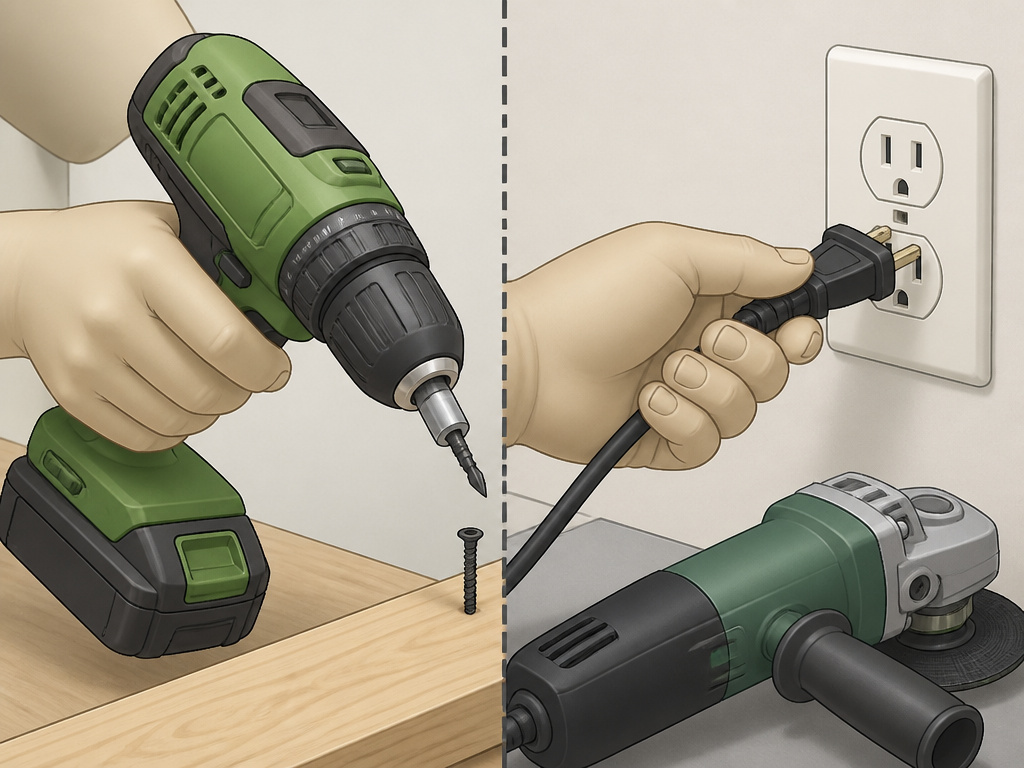
This is where we move from theory to your shopping list. Here’s a straightforward guide, grounded in the specs and real-world use.
Always Buy Cordless:
- Drill/Driver: The poster child for cordless success. Modern 18V/20V models have more than enough power.
- Impact Driver: Perfect for cordless. Its quick bursts of high torque are ideal for driving long screws without wrist strain.
- Oscillating Multi-Tool: Used in tight spaces where a cord is a constant nuisance.
- Reciprocating Saw: For pruning, light demolition, and cutting in awkward positions, cordless wins.
- Work Lights: Obvious win for cordless.
Almost Always Buy Cordless (for DIY/Pro-Mobile):
- Circular Saw: Modern cordless saws are phenomenal. For cutting a few sheets of plywood or doing deck framing, they’re brilliant. For all-day ripping in a shop, go corded.
- Angle Grinder: A tough call. Cordless is fantastic for quick cuts, notch work, or spot grinding. For sustained surface prep or cutting all day, you need a cord.
Usually Buy Corded:
- Table Saw/Miter Saw: Stationary, high-power demands. Unlimited runtime is essential.
- Bench Grinder/Sander: Stationary shop tools that often run for extended periods.
- Demolition Hammer/Rotary Hammer: The energy required for all-day breaking or drilling into masonry is immense.
- Air Compressor: The power draw is simply too high for battery technology at a reasonable cost.
The part nobody mentions: For tools you use once every few years, like a large miter saw for a single flooring project, consider renting or borrowing. Buying a corded version is often cheaper than investing in the cordless platform required to run it.
Safety & Longevity: More Than Just a Cord
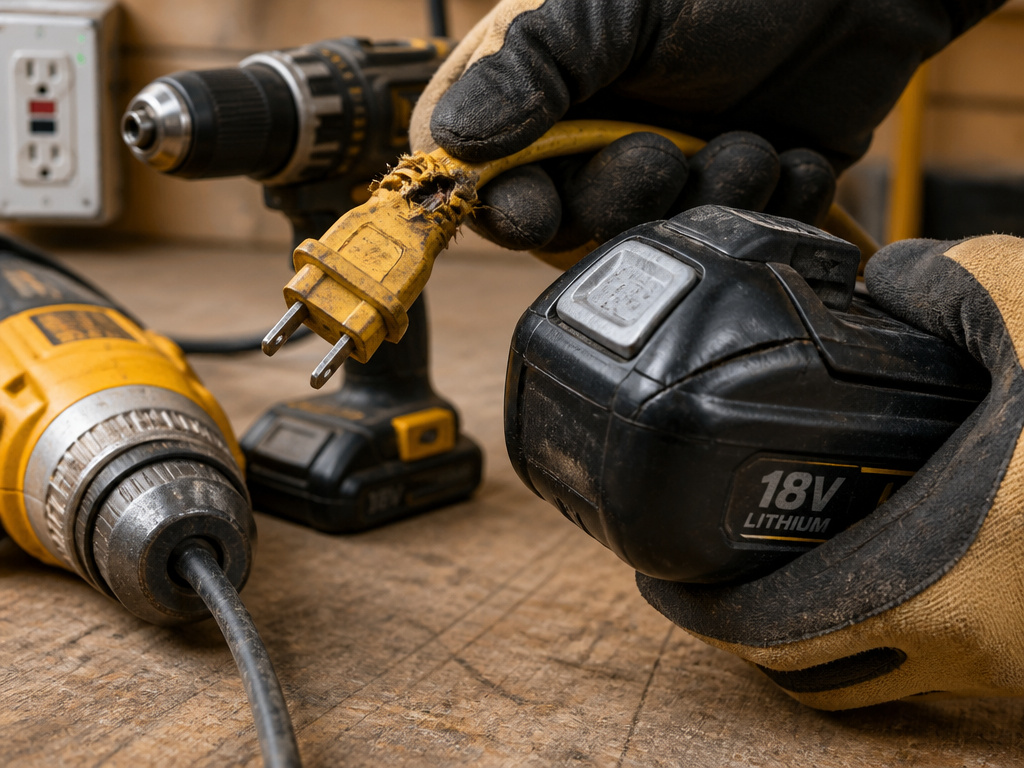
Both types have distinct safety profiles. Corded tools require vigilant cord inspection. Frayed insulation, damaged plugs, and improper grounding are real hazards. Always use GFCI-protected outlets on bench circuits. The cord itself is a tripping hazard on a busy site.
Cordless tools eliminate the cord hazard but introduce battery risks. Never use a swollen, cracked, or damaged battery pack. Store batteries in a cool, dry place. Modern smart chargers prevent overcharging, making overnight charging safe, but best practice is still to remove batteries once fully charged to maximize lifespan.
A well-maintained corded tool can last for decades. It’s just a motor, a switch, and a cord. A cordless tool’s lifespan is often dictated by its battery. After 3–5 years, you’ll be buying a new battery, not necessarily a new tool. The tool itself, if from a quality brand, will last just as long as its corded sibling.
The Hybrid Strategy: The Smart Way to Own Both
You don’t have to pick a side. The most efficient workshops run on a hybrid model. This is what the data supports and what savvy pros do.
Adopting high-performance cordless systems has been shown to improve labor efficiency by up to 15%, largely by eliminating time spent managing cables. Cordless platforms can increase worker productivity by up to 20% on mobile tasks.
The strategy is simple: 1. Build a mobile cordless ecosystem for your most-used, most-mobile tools (drill, impact, oscillating tool). Stick to one or two compatible voltage platforms (e.g., 18V and 12V). 2. Keep or buy corded tools for your stationary, high-demand shop tools. This is your table saw, your bench grinder, your stationary sander. 3. For high-draw portable tools (angle grinder, circular saw), evaluate your use. If it’s occasional, a cordless model on your main platform is fine. If it’s professional and continuous, the corded version will save you money and frustration.
This approach protects your budget and your sanity. You get cordless convenience where it pays off and corded reliability where you need it most.
Corded vs Cordless Power Tools Pros and Cons
Cordless tools offer unmatched mobility for work outdoors, in crawlspaces, or at job sites without power. They can increase productivity by eliminating time spent managing cables. For general tasks like driving fasteners or hanging drywall, premium cordless performance matches corded tools. The trade-off is runtime; a battery lasts a limited time under heavy use and will eventually degrade after years of typical use.
Corded tools are the gold standard for continuous power. They pull consistent current from the wall, making them ideal for grinding concrete, drilling masonry continuously, or running a shop saw all day. They don’t suffer from battery sag or thermal cutouts. The clear con is the tether to an outlet, which restricts movement and requires careful cord management on a busy site.
Are Corded or Cordless Tools Heavier?
The weight difference comes down to the battery. A corded tool body is often lighter since it doesn’t carry a battery pack. This can make a noticeable difference during overhead work or long sessions with a drill or saw. The weight is also consistently distributed, as it doesn’t change.
Cordless tools combine the weight of the tool and the battery, which can make them feel heavier in the hand. However, the lack of a power cord improves overall ergonomics and maneuverability significantly. You can move freely around a workpiece without wrestling with a cord. For tools carried around a job site, this trade-off usually favors cordless, as the productivity gain from cord-free movement outweighs the added battery weight.
Frequently Asked Questions
Are cordless power tools better than corded?
For most homeowners and professionals doing general construction, yes. The convenience, safety, and sufficient power of modern cordless tools make them the better all-around choice. Corded tools remain better for specific, heavy-duty stationary applications.
Sources disagree on power equivalence. Some note that for short, high-torque tasks, modern brushless cordless drills match corded performance. Others emphasize that corded drills maintain maximum power continuously without fade, making them stronger for sustained work.
Should I buy a corded or cordless hammer drill?
For drilling the occasional hole in masonry, a cordless hammer drill is fine. For drilling dozens of large-diameter holes in concrete or brick in a single day, the unlimited power and impact energy of a corded rotary hammer will finish the job faster and without battery anxiety.
Are plug-in tools more powerful?
They can deliver more consistent power under continuous, heavy load. A corded tool plugged into a 15–20 amp circuit has a much higher total power envelope than a battery. For short tasks, the difference is negligible. For long tasks, the corded tool’s power doesn’t sag.
Before You Go
One rule most guides skip: if you’re a homeowner, start cordless for your drill and driver, but rent the big corded tools for your first few major projects. You’ll learn your real usage patterns before dropping cash on a tool you might use twice.
The Europe power tools market is projected to grow at a CAGR of 3.7% from 2025 to 2030, driven by cordless adoption. But walk any jobsite, and you’ll still see cords where the work is hardest. That’s the reality no market report captures.
The bottom line isn’t cordless versus corded. It’s about matching the power source to the work’s location, duration, and demand. Buy cordless for movement and freedom. Keep corded for the shop and the grind. Your wallet and your projects will thank you for not forcing a single answer onto every job.
