
Helical vs Straight Knife Planer Cutterhead
This post contains affiliate links. As an Amazon Associate, we earn from qualifying purchases.
A helical cutterhead uses dozens of small, angled carbide or HSS inserts to shear the wood, reducing tear-out and noise. A straight knife cutterhead uses 2-4 long blades that chop the wood, offering a lower upfront cost. For most hobbyists working with figured hardwoods, the helical’s superior finish justifies its price; for general milling of softwoods, a straight knife planer is a capable, budget-friendly tool.
The physics behind those two sentences decides your shop’s sound level, your sanding time, and your long-term maintenance budget. The choice between a helical vs straight knife planer cutterhead is fundamental. The choice between a helical vs straight knife planer cutterhead is fundamentally about how the machine interacts with the wood grain at 10,000 RPM.
What follows is a breakdown of the measured decibel drops, the real cost of rotatable inserts, and the one specific trade-off (cutting depth) that catches aftermarket upgraders by surprise. By the end, you’ll know which cutterhead belongs in your shop.
Key Takeaways
- A helical head’s shearing cut reduces tear-out in figured wood by angling each insert, while straight knives chop at 90°, which can lift grain.
- Measured noise tests show helical heads run 5–8 decibels quieter than straight knives, a meaningful drop from 97 dB to 89–90 dB on a machine like the DEWALT DW735.
- Long-term, carbide inserts on a helical head cost less per board foot, as you rotate four edges before replacement; straight HSS knives require full resharpening or replacement.
- The biggest hidden costs are potential motor strain on lighter-duty planers and a possible reduction in maximum cutting depth with some aftermarket kits.
- For milling rough lumber fast, a straight knife planer like the JET JWP-12 can remove 2.4 mm per pass and gets the job done, even if it’s louder.
The Physics of the Cut: Shearing vs. Chopping
The difference starts with the angle of attack. A straight knife, such as those on a JET JWP-12, is usually mounted with its cutting edge at a right angle to the board’s surface and its direction of travel. The entire length of the blade smacks into the wood fiber at once, a direct 90-degree chop.
A straight-knife cutterhead engages the wood along the full width of each blade simultaneously. This creates high instantaneous resistance, limits maximum depth of cut, and produces the characteristic loud slapping sound, as measured at 102 dB on the JET JWP-12.
A helical head, like the spiral helical design on the IGM PS33, sets each small insert at a fixed angle that matches the helix of the shaft. Each insert meets the wood at a shear angle, slicing through the fiber instead of bludgeoning it. This is why they handle gnarly grain and burl without ripping chunks out, the cut is lateral, not vertical.
Where this goes sideways: Assuming a helical head is just a quieter straight knife. The mechanism is fundamentally different. That shear angle spreads the cutting load over time, which is why the IGM PS33 can take a 3.2 mm cut with an 1800W motor, while the straight-knife JET JWP-12 with a similar 1700W motor is limited to 2.4 mm. The resistance profile is smoother.
The Real-World Noise & Finish Numbers
The truth is. “Quieter” is a vague promise until you attach a decibel meter. In a controlled test of three benchtop planers, the straight-knife JET JWP-12 measured 102 dB. An unnamed planer with an HSS-insert helical head came in at 97 dB, and the IGM PS33 with a carbide spiral helical head registered 96 dB.
That’s a 5–6 dB difference, which is perceptible. For a more common model, a SpeTool blog test of a DEWALT DW735 showed a drop from 97 dB with stock straight knives to a lower level with a helical head.
| Cutterhead Type | Measured Noise (dB) | Perceived Difference |
|---|---|---|
| Straight Knives (JET JWP-12) | 102 | Baseline — very loud |
| Helical, HSS Inserts | 97 | Noticeably quieter |
| Spiral Helical, Carbide (IGM PS33) | 96 | Quietest of the three |
| Straight Knives (DEWALT DW735) | 97 | Baseline |
| Helical Head (DW735 Upgrade) | 89–90 | Substantially quieter |
Now, about that finish. The shearing action doesn’t just reduce noise; it reduces tear-out. On straight-grained pine, both heads will produce a decent surface. The helical head shines when the grain direction changes, in curly maple, oak burl, or any figured wood. The small, angled slices prevent the blade from digging in and lifting a chunk. An owner of a DW735 with a Byrd helical head noted it became a dedicated finish planer for this reason, often eliminating the need for sanding.
Cost Analysis: Upfront Price vs. Long-Term Edge Life
Here’s the financial fork in the road. A planer with a straight-knife cutterhead costs less upfront. A helical-head machine commands a premium, and an aftermarket retrofit like a Byrd Shelix or SpeTool H01001 can cost as much as a budget planer.
Straight knives, typically made of HSS (High-Speed Steel), dull. You then have options like professional sharpening or replacement, which cost money and downtime.
A helical head uses carbide inserts. Carbide’s hardness (HV10 1900 for the IGM PS33 vs. HV10 600 for HSS) means it stays sharp longer, especially in gritty wood. Each square insert has four cutting edges. When one edge dulls, you loosen a screw, rotate it 90 degrees, and retighten. You’re back in business in two minutes. Only after all four edges are spent do you buy a new insert for a few dollars.
| Cost Factor | Straight Knife Cutterhead | Helical Cutterhead |
|---|---|---|
| Initial Tool Cost | Lower | Higher (machine or upgrade) |
| Blade/Insert Material | HSS (Hardness ~HV10 600) | Carbide (Hardness ~HV10 1900) |
| Replacement Unit | Entire set of 2–4 knives | Individual inserts (e.g., 36 on IGM PS33) |
| Sharpening/Rotation | Full set must be removed & sharpened | Rotate insert 90° in place |
| Long-Term Cost Driver | Frequent sharpening/replacement cycles | Occasional insert purchase |
The part nobody mentions: Insert quality varies wildly. A true helical head has inserts fixed at a specific shear angle. Some cheaper “spiral” heads simply mount square inserts perpendicular to the head, they’re segmented, but they don’t shear. They’re quieter than straight knives but don’t deliver the same tear-out immunity. Know what you’re buying.
Helical vs. Straight: Motor Load and Cutting Capacity
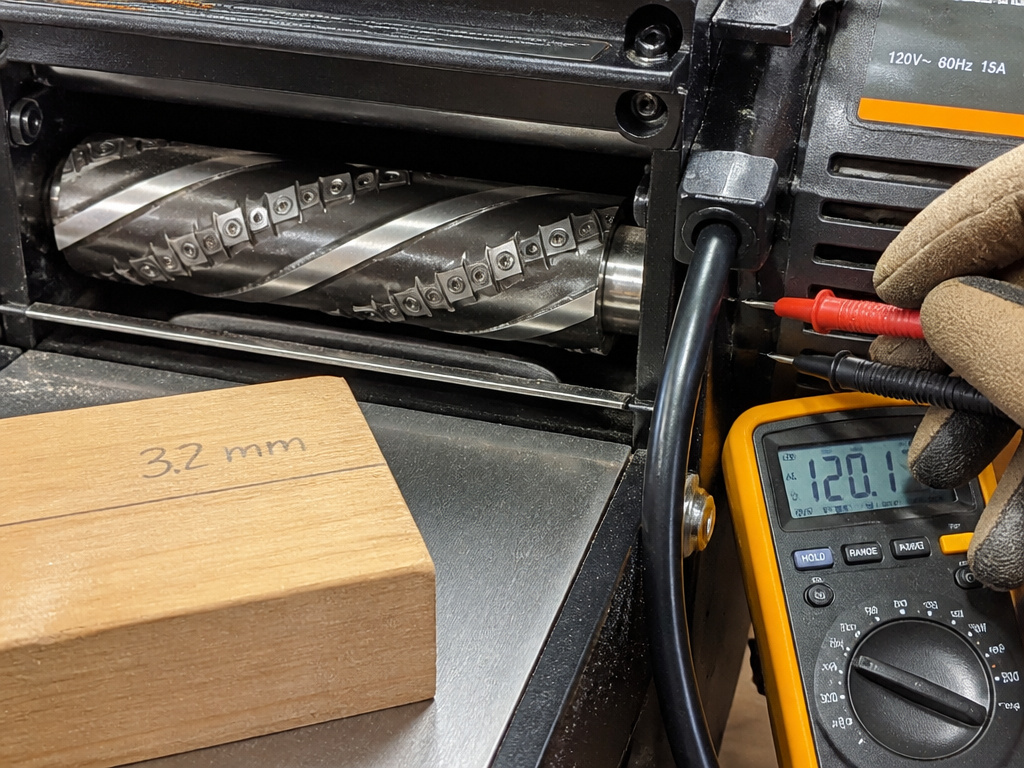
This is where owner forums reveal a genuine disagreement. On one hand, the design theory suggests a helical head should be easier on a motor. The IGM test concluded its spiral helical arrangement “reduces resistance significantly,” allowing that 3.2 mm cut with 1800W.
On the other hand, a user on Woodworking Stack Exchange reported that helical heads “seem to impose greater load on planer motors, at least on consumer grade machines,” while the IGM test concluded its spiral helical arrangement reduces resistance significantly, allowing for greater material removal with similar motor power. Also, carbide inserts, while harder, might cut with more resistance on some machines.
For the home woodworker, the practical takeaway from the helical vs straight knife planer cutterhead comparison is to know your machine’s limits. Upgrading a lighter-duty benchtop planer with a helical head might strain the motor during deep, wide cuts. It’s a consideration.
A more concrete drawback is reduced cutting capacity. The same DW735 owner reported his Byrd Shelix head reduced maximum cut per pass to 1/32″ because the aftermarket head had a slightly smaller cutting diameter than the OEM head. If you mill rough lumber, losing that depth means more passes, which eats into the time-saving benefit.
Which Cutterhead Is Right for Your Shop?
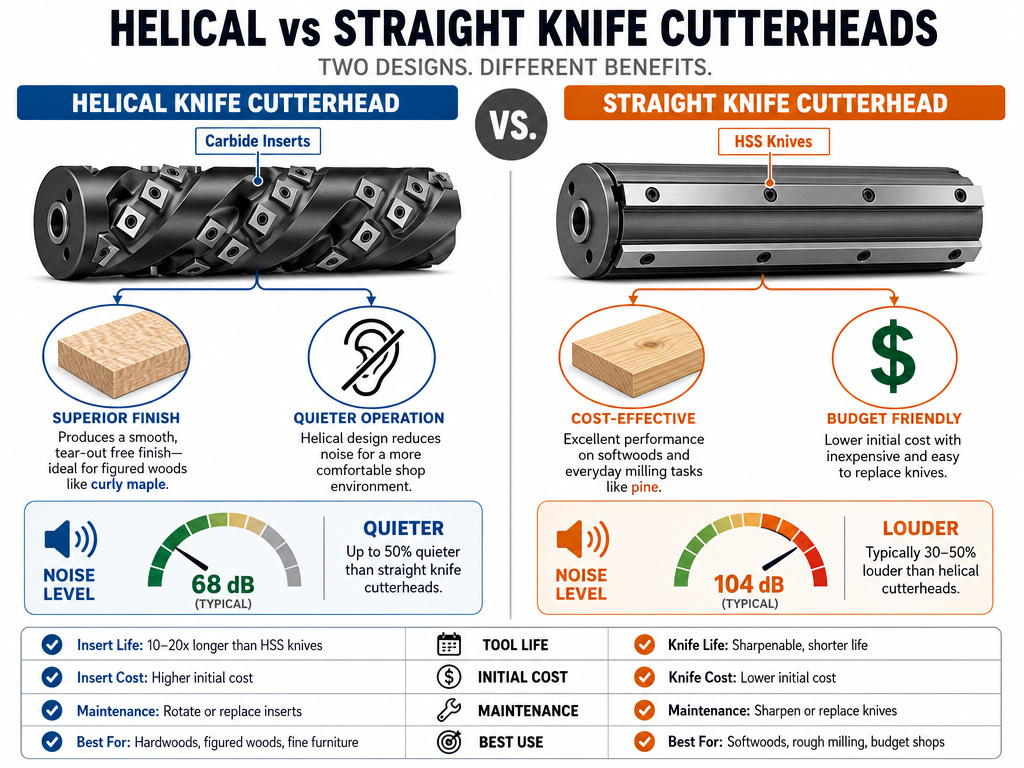
Don’t overthink it. Your wood, budget, and patience for noise will point the way.
Choose a Straight Knife Planer if:
- You primarily work with cooperative softwoods (pine, poplar, cedar).
- Your budget is tight and the tool will see occasional use.
- You don’t mind the roar (and always wear hearing protection).
- You need maximum depth of cut for efficient rough milling.
- You’re comfortable with the periodic task of changing your planer blades.
Models with straight knife cutterheads, like the JET JWP-12, are workhorses for many tasks.
Choose a Helical Cutterhead Planer if:
- You regularly work with figured hardwoods (curly maple, quilted sapele).
- Your shop is in a garage attached to your house or in a noise-sensitive area.
- You hate sanding and want the best possible surface off the tool.
- You process enough wood that long-term insert costs beat repeated blade sharpening.
- You’re ready for a significant investment, either in a new machine or an upgrade.
Look at machines like the IGM PS33, the RIKON 25-130H, or industrial models like the South Bend SB1118. For upgraders, aftermarket options like the SpeTool H01001 (56 inserts) and Byrd Shelix (40 inserts) are available for the DW735.
Remember, a planer is just one step in flattening lumber. It makes a board uniformly thick, but it doesn’t create a flat face or a straight edge, that’s a jointer’s job. And for final smoothing, you’ll still often reach for a sander, though the debate between a belt sander vs planer for surface correction is a topic for another day.
How does a helical cutterhead affect dust collection?
The fundamental cutting action of a helical head directly changes the debris it produces. A straight knife cutterhead takes a few large, continuous cuts, ejecting long, stringy shavings and heavier chips. These can be more challenging for a dust collection system to move and may clog hoses more easily. In contrast, a helical head takes many small bites, producing finer, more granular chips and sawdust. This smaller, lighter debris is typically easier for a standard dust collector to capture and transport, leading to less airborne dust in the shop and potentially reducing the load on your collection system.
Frequently Asked Questions
Is a helical planer head better than a straight knife planer head?
“Better” depends on your priority. For final surface quality on difficult woods and lower noise, yes, a true helical head is objectively better. For raw material removal speed and lowest upfront cost, a straight knife head is better. Most professional shops use helical heads for finish work because the reduction in sanding time pays for the upgrade.
Can you put a helical head on a DeWalt planer?
Yes. The DEWALT DW735 is one of the most commonly upgraded planers. Companies like Byrd Tool (Shelix B4725) and SpeTool (H01001) manufacture direct replacement helical cutterheads for it. The installation is a moderate DIY project requiring partial disassembly of the planer.
Do helical cutterheads last longer?
The cutterhead itself should last a lifetime. The carbide inserts last significantly longer than HSS straight knives before needing rotation or replacement. Since each insert has four edges, the total cutting life is massively extended, which is the source of the long-term cost savings.
What is the difference between spiral and helical cutterheads?
Terminology is muddy. Technically, a spiral head has square inserts mounted in a spiral pattern but with their faces perpendicular to the cut, offering segmented cutting but not a true shear. A helical head has inserts fixed at an angle to create a shear cut. Many manufacturers use the terms interchangeably. For the best tear-out reduction, verify the inserts are angled.
Should I upgrade my planer or buy a new one with a helical head?
If your current planer is a quality model like the DW735 and has years of life left, upgrading is cost-effective. If your planer is older, underpowered, or you want a wider capacity, put the upgrade money toward a new machine that includes a helical head from the factory. Reading planer reviews for models with integrated helical heads can help with this decision.
The Bottom Line
The helical vs straight knife planer cutterhead debate is about matching a tool’s fundamental cutting action to the work you actually do.
If your planer spends most of its life dressing 2x4s for shop projects, a straight-knife machine is the rational choice. It’s a sawmill in miniature. But if you find yourself holding your breath every time a board with wild grain enters the feed tray, a helical head is a necessity for preserving your sanity. The silence is just a bonus.
The data shows the helical head wins on measured noise and finish quality. Your wallet and your project list get the final vote. Either way, wear your hearing protection. At 97 dB or 90 dB, that motor is still shouting.
