
High Temp vs Low Temp Glue Gun: Which to Use?
This post contains affiliate links. As an Amazon Associate, we earn from qualifying purchases.
*High-temp glue guns melt adhesive around 380°F for a fast-setting, rigid bond on wood, metal, and ceramics, while low-temp guns run at about 250°F for a safer, more flexible bond on delicate materials like foam and ribbon.* Your project materials decide the winner before you even plug the gun in.
That significant temperature gap isn’t just a number. It’s the line between a mended wooden picture frame and a melted foam angel wing. Choosing the wrong side of that line in the high temp vs low temp glue gun debate is how projects fail before the glue even dries.
What follows: the exact temperature specs, a material-by-material match-up, the real story on wattage and dual-temp guns, and the one environmental factor that can undo your work weeks later.
Key Takeaways
- Match the gun to your material: use high-temp (380°F) for wood, metal, ceramics, and fabric; use low-temp (250°F) for foam, ribbon, and paper.
- Never use high-temp sticks in a low-temp gun, the glue won’t melt properly and jams the feed mechanism.
- A glue gun’s wattage (e.g., 20W vs 60W) determines heat-up speed and recovery, not the maximum temperature.
- Low-temp glue softens around 150°F, so avoid it for items that will sit in a hot car or sunny window.
- Cheap $5-7 guns often fail within months; the heating element and trigger are the common failure points.
The Core Temperature Difference (380°F vs 250°F)
We should look at the actual numbers. This isn’t marketing. A high-temperature glue gun operates at a scorching 380°F (193°C), while a low-temperature gun runs at a much gentler 250°F (121°C). That’s a difference you can feel in the air a foot from the nozzle.
High-temperature glue guns melt adhesive to a very fluid state at approximately 380°F, creating a fast-setting, rigid bond ideal for hard, non-porous surfaces. Low-temperature guns melt glue at around 250°F, producing a thicker bead with more working time, designed for heat-sensitive materials.
When you compare a high temp vs low temp glue gun, the higher heat allows the molten polymer to penetrate deeper into porous surfaces before it solidifies. That’s the mechanical reason a high-temp bond feels like it’s welded on. A low-temp bond is more of a surface grip, flexible, but without that deep bite. The glue itself is formulated to melt at these specific temperatures; they’re not arbitrary settings.
Material Match-Up: Which Gun for What?
Your material list is your shopping list. Get this wrong, and you’re buying a new project.
High-Temp Glue Guns are your heavy-duty partners.
- Wood: Picture frames, small furniture repairs, wooden toys.
- Metal: Bonding small decorative pieces, light metal-to-metal repairs.
- Ceramics & Glass: Mending a broken pot (for non-food use) or assembling a mosaic.
- Thick Plastic & Cardboard: Reinforcing a shipping box or repairing a plastic bin.
Low-Temp Glue Guns are your delicate craft specialists.
- Foam & Styrofoam: Building models, floral arrangements, school projects. High-temp will melt a hole straight through.
- Fabric & Ribbon: No-sew hems, attaching lace, making ribbon bows without scorching synthetics.
- Paper & Cardstock: Scrapbooking where you need more strength than a glue stick offers.
- Balloons: Creating arches and decorations without a single pop.
| Material | High-Temp (380°F) | Low-Temp (250°F) | Risk of Using the Wrong Gun |
|---|---|---|---|
| Wood | Excellent bond | Weak, may fail | Low-temp joint separates under light stress |
| Craft Foam | Melts instantly | Perfect bond | High-temp melts a crater, ruining the piece |
| Polyester Ribbon | May scorch/melt | Safe bond | High-temp discolors or burns the fabric |
| Ceramic | Strong, rigid bond | May not adhere | Low-temp glue pops off after curing |
The sensory clue is in the smell. High-temp glue on foam or thin plastic produces a sharp, acrid burn smell immediately. If you catch that scent, stop. You’re using the wrong tool.
Glue Stick Compatibility: A One-Way Street
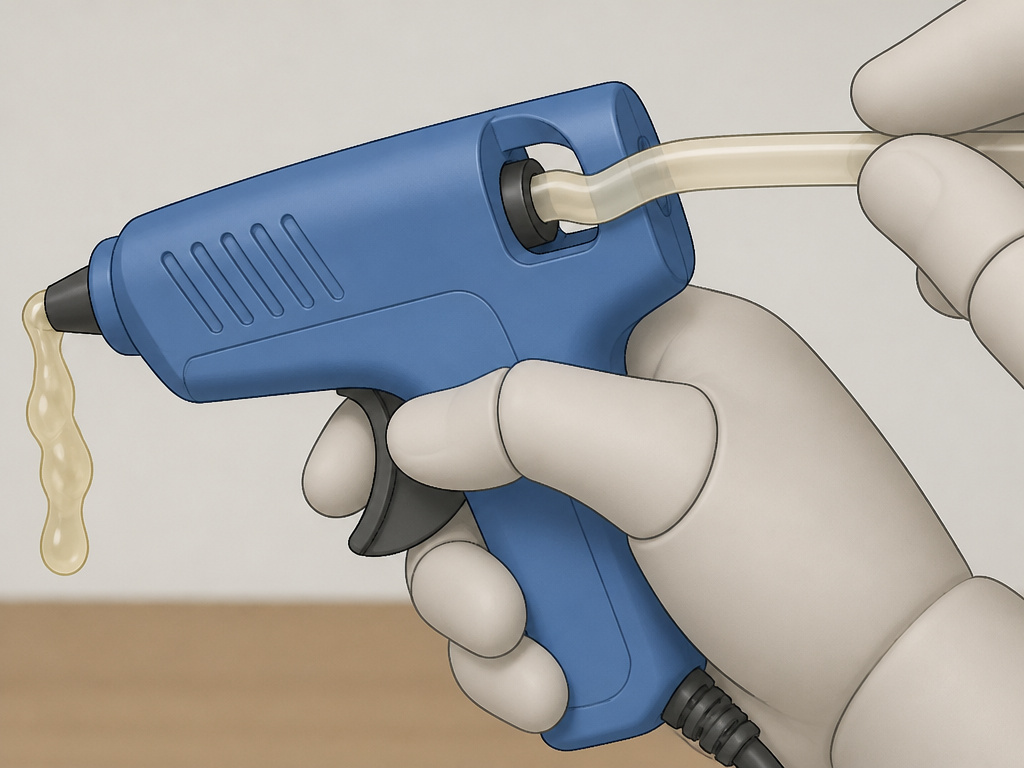
This is the rule with no exceptions: you must match the glue stick to the gun’s temperature rating.
Common mistake: Forcing a high-temp stick into a low-temp gun. The gun cannot melt it fully, resulting in a thick, globby mess that jams the feed mechanism and provides zero bond strength.
A low-temperature glue stick is formulated to become viscous at 250°F. In a high-temp gun burning at 380°F, it will become extremely runny and potentially smoke, but it will technically work, just with a much shorter working time. The reverse does not work. A high-temp stick in a low-temp gun will never fully liquefy. You’ll squeeze the trigger and get a semi-solid slug of warm adhesive that does not bond to anything.
How to tell them apart: Look at the packaging. Low-temp sticks are often labeled as “Low Temp,” “Low Melt,” or “Safe for Delicate Materials.” Some brands use color coding, like blue for low-temp. High-temp sticks are usually clear or tan and may say “All-Purpose” or “High Strength.” When in doubt, read the fine print on the bag.
Safety, Bonds, and Working Time
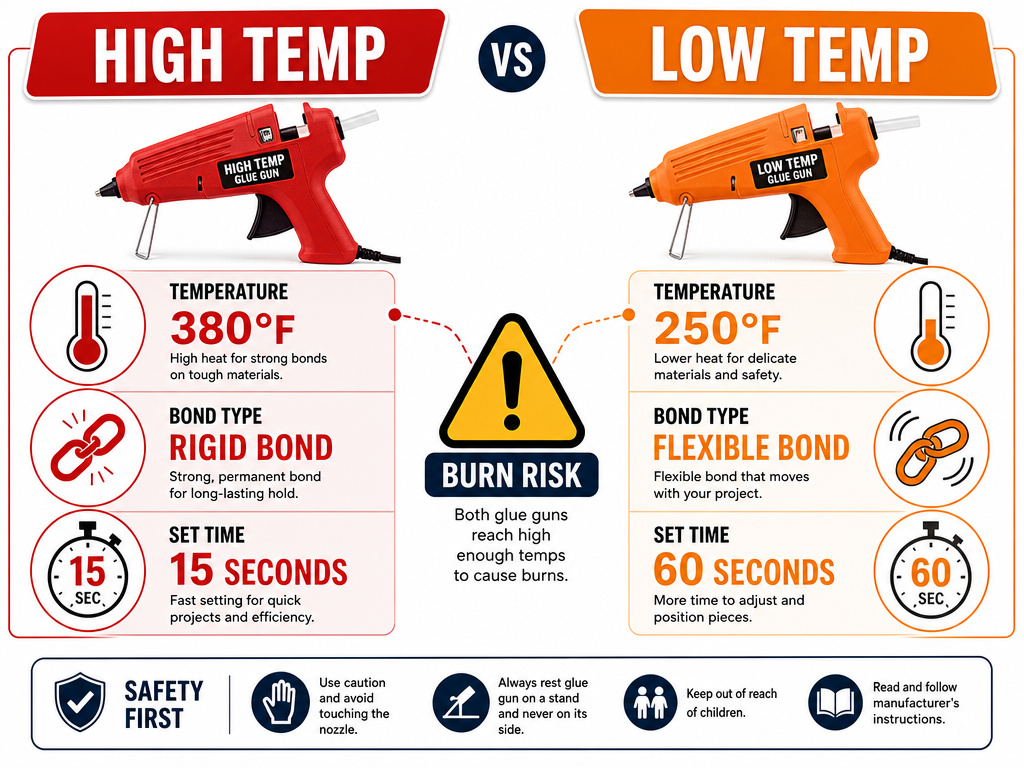
The temperature difference dictates the entire user experience.
Burn Risk: A high-temp glue gun delivers a serious burn. The glue comes out at 380°F and sets within 15-30 seconds. A low-temp gun reduces this risk significantly, which is why they’re the only type I’d recommend for supervised classroom use. Remember, the nozzle stays hot for over 10 minutes after unplugging, always use the stand.
Bond Strength: High-temp bonds are rigid and durable, meant for structural-ish holds (though for a true structural bond, you should use epoxy). Low-temp bonds are flexible. They’re perfect for a wreath that might get squished but will fail on a shelf meant to hold weight.
Working Time (Open Time): This is your window to adjust parts. High-temp glue gives you 15-30 seconds at most. Low-temp glue is more forgiving, offering 30-60 seconds. If you’re assembling something intricate, the extra time is a gift.
The Dual-Temp Dilemma and Wattage Truths
A dual-temperature gun seems like the perfect solution. Flip a switch for high, flip it for low. The reality is that most dual-temp guns are a compromise. The internal heating element is designed for a range, not optimized for two distinct peaks. They often do neither job as well as a dedicated tool. For a casual crafter who does a bit of everything, a dual-temp gun like the Gorilla Dual-Temp is a fine starting point. For anyone serious about either type of work, buy two dedicated guns. I have a Surebonder Pro2-220 for high-temp jobs and a basic AdTech low-temp gun. Each one excels.
We need to clear up the confusion about wattage. Wattage does not equal hotter temperature. A 100W gun does not get hotter than a 40W gun. Wattage is about power draw and recovery speed.
- A 20-40W gun is fine for short, intermittent craft sessions.
- A 60-100W gun heats up faster and, crucially, maintains its temperature if you’re laying down a continuous bead for several minutes. The heating element recovers faster, so you don’t get the frustrating heat dip that causes the glue to thicken and stop flowing mid-project.
Think of wattage like the engine in a truck. A bigger engine (higher wattage) doesn’t mean you can drive up a steeper hill (higher temperature), but it does mean you can get to the speed limit faster and haul a heavy load without slowing down.
Troubleshooting Common Glue Gun Problems
Even with the right gun, things go sideways. Here’s how to fix them.
-
Glue isn’t melting or is coming out chunky.
- Cause: You’re using a high-temp stick in a low-temp gun. Or, the gun hasn’t fully heated up.
- Fix: Verify stick compatibility. For a new stick, always give the gun an extra minute to heat it through, then purge a bit of glue before starting your project.
-
Weak bond that fails easily.
- Cause: Using low-temp glue on a material that needs high-temp strength (like wood). Or, not letting the gun reach full temperature.
- Fix: Switch to a high-temp gun and stick for dense materials. Ensure the glue flows freely and looks fully liquid, not stringy.
-
Gun is dripping constantly.
- Cause: This is often a design flaw in cheap guns with poor trigger mechanisms. It can also happen if you leave a stick in a hot, vertical gun.
- Fix: Use a gun with a precise trigger feed like the Surebonder. Always store the gun on its stand, and remove the glue stick for long-term storage.
Where this goes sideways: Using low-temp glue for an outdoor project. The bond will soften and fail on a warm day, as low-temp glue begins to weaken around 150°F (65°C), a temperature easily reached inside a car or in direct sunlight.
The One-Gun Recommendation
You want one answer. For most households that tackle occasional crafts, kids’ projects, and light repairs, start with a low-temp glue gun. It’s safer, works on 80% of common DIY materials, and teaches good habits. The AdTech Pro 200 in low-temp is a reliable, no-fuss choice.
When you graduate to building wooden birdhouses or need a bond that can handle some stress, add a dedicated high-temp gun like the Surebonder Pro2-220 to your kit. Skip the bargain-bin $5 guns; their heating elements burn out or their feeds jam within months. The small investment in a known brand pays off in consistency and longevity, saving you from the frustration of a scenario where the gun overheats and just quits.
And if you ever venture into tasks that require precise heat gun temperature control, like stripping paint or bending plastics, that’s a completely different tool. A hot glue gun, high or low temp, is an adhesive applicator, not a heat source.
Does Low Temp Glue Add More Weight to a Project?
Because low-temperature glue has a lower melting point and produces a thicker bead, it may not penetrate materials as deeply as high-temperature glue. Its cooler, thicker consistency doesn’t flow or penetrate materials as deeply as high-temperature glue. To compensate for this weaker surface grip, crafters frequently lay down a larger bead or use more glue dots to achieve the same holding power. This can add noticeable weight to lightweight materials like foam, ribbon, or paper. For projects where added bulk or weight is a concern, the stronger, deeper penetration of a high-temperature bond often means you can use less adhesive overall.
Frequently Asked Questions
Should I get a high temperature or low temperature glue gun?
Start with a low-temperature gun if you primarily work with crafts, foam, fabric, paper, or have kids. It’s safer and sufficient for most common tasks. Invest in a high-temperature gun only when you regularly need to bond wood, metal, or ceramics and require a stronger, more rigid hold.
Can you use low temperature glue sticks in a high temperature gun?
Yes, but with caution. A high-temp gun will melt a low-temp stick very quickly, making the glue extremely runny and giving you almost no working time. It can also cause smoking. It will bond, but it’s not ideal. The opposite (high-temp stick in low-temp gun) will not work at all.
How to tell if glue gun is high or low temperature?
Check the manufacturer’s label on the gun itself or its original packaging. It will state “High Temp,” “Low Temp,” or the specific temperature (e.g., 380°F). If the label is gone, the glue sticks it came with are a clue, low-temp sticks are often marked. As a last resort, a guide on how to use a hot glue gun or the manufacturer’s website can help identify the model.
Do low temperature hot glue guns work?
Absolutely. They create a perfectly strong bond for the materials they’re designed for, foam, fabric, paper, and other delicate items. Their bond is flexible, not rigid. The “work” question usually comes from someone trying to glue wood with one and being disappointed. That’s using the wrong tool for the job, not a failure of the tool itself.
The Bottom Line
The high temp vs low temp glue gun choice is a material checklist, not a personality test. Run down your project list. See foam, fabric, or kids? Buy the low-temp gun. See wood, metal, or heavy-duty repairs? Buy the high-temp gun. Trying to do both regularly leads to the dual-temp compromise.
One final, grounded rule: if your glued project will ever see the inside of a hot car or a sunny windowsill, you must use high-temp glue. That 150°F failure point for low-temp adhesive isn’t a guess, it’s the reason the wreath I made for my front door slid apart by July. The right temperature isn’t just about the bond today; it’s about the bond next month.
