
Lathe Safety Guide: Step-by-Step (Without Damage)
This post contains affiliate links. As an Amazon Associate, we earn from qualifying purchases.
A lathe safety guide covers the essential rules for using hand, metal, and wood lathes without injury, built around three principles: proper personal protective equipment (PPE), absolute control of rotating parts, and a verified, step-by-step pre-start checklist that locks out human error. The difference between a near-miss and a lost-time injury often comes down to a critical specification like a brake time or leaving a chuck key in the spindle.
That 10-second brake spec isn’t arbitrary. It’s a guideline from the UK’s Health and Safety Executive for wood turning lathes, stating automatic braking, if necessary, should stop the lathe within 10 seconds. This lathe safety guide moves past generic warnings to the sourced manufacturer specs and regulatory codes that form your actual legal and physical safety framework.
What follows: the PPE that actually works, the machine guarding standards most shops miss, and the essential pre-operation checks that catch common setup errors before you power on.
Key Takeaways
- Remove the chuck key immediately and make its absence a tactile habit, the NPS SafetyGram calls this out as a mandatory rule, and it prevents the single most common catastrophic error.
- ANSI Z87.1 safety goggles are not optional; for dusty woodturning, combine them with a face shield as mandated by the Craftsman 12-inch wood lathe manual.
- Never use compressed air to clean a lathe; both the NPS and Pro-Cut safety manuals explicitly ban it due to the risk of flying metal chips and brake dust.
- Automatic braking, if necessary and not affecting workpiece/machine integrity, should stop a wood lathe within 10 seconds per HSE WIS28, or in less than the machine’s run-up time if that exceeds 10 seconds.
- Operate within the machine’s environmental limits; a Haas CNC lathe, for example, has a strict operating range of 41°F to 122°F (5°C to 50°C).
The Gear You Actually Need (And What to Avoid)
It starts with what you put on your body. The lathe safety guide manuals are unanimous on the basics but diverge on the details, which is where most people guess wrong.
ANSI Z87.1 is the standard for impact-resistant safety glasses. The Craftsman wood lathe manual states it plainly: use goggles, not glasses, that comply. For operations that generate fine dust, like sanding on a wood lathe, they add a critical second layer: wear a face shield along with the goggles. The shield stops the larger debris, the sealed goggles stop the fine particulate. For metal lathes, the Haas and Sharp manuals recommend ANSI-approved impact safety goggles coupled with OSHA-approved ear protection, as emitted noise from some machines like Haas CNC lathes can exceed 85 dB.
Now, the disagreements. The YouTube transcripts point to a real shop-floor debate: to glove or not to glove. Some industrial settings handling rough castings mandate gloves to protect hands from sharp edges. Other training programs, like the one cited in a transcript, forbid them entirely because a loose glove can catch and pull a hand into a rotating part. Sources disagree on glove use: some industrial settings handling rough castings mandate gloves to protect hands, while other training programs forbid them entirely near rotation due to entanglement risk. Assess the specific task and proximity to rotation. The material can snag, and the drag is instant.
Where this goes sideways: Wearing the wrong footgear. McMaster University’s Boxford lathe SOP is absolute: no sandals or open-toed shoes are permitted. A dropped chuck or a hot, sharp chip doesn’t care about your comfort.
Your clothing is your first guard. Tie back long hair, remove rings and necklaces, and avoid loose sleeves or drawstrings. A page on common power tool injuries details how entanglement happens faster than you can react.
The Chuck Key: Your First and Last Move
This is the most ritualized, and most ignored, part of lathe safety. The rule from primary sources is mandatory.
The Naval Postgraduate School SafetyGram states it directly: “Always remove the key from the chuck. The Naval Postgraduate School SafetyGram states it directly: “Always remove the key from the chuck.”” McMaster University’s procedure echoes it: “The chuck key must be removed from chuck.” The reason is physical: a chuck key left in becomes a projectile if the spindle is accidentally engaged. It also creates a protruding lever that can catch clothing or strike your hand.
Yet, the YouTube transcripts reveal a common, if risk-laden, industry practice. In high-production shops changing identical parts, an operator might leave the key in the chuck while the machine is off or the clutch is disengaged, relying on strict situational awareness to speed up changes. One transcript recounts a friend who accidentally engaged the clutch while the key was in, crushing his hand.
Official sources like NPS and McMaster University state the rule is absolute: always remove the chuck key immediately after use. The experienced-shop shortcut is a calculated risk that presumes rigorous training and is not recommended for new users. For a home workshop or school setting, it’s a gamble with zero upside. Your pre-start check must include a visual and tactile confirmation that the chuck key is back on its designated hook. This discipline ties directly into broader rules for power tool safety.
Machine Guarding: Beyond the Manufacturer’s Shield
Guards aren’t suggestions; they are your primary barrier against rotating parts, flying chips, and coolant splash. The standards behind them give them teeth.
OSHA regulation 1910.212, the “General Requirements for All Machines,” is the broad umbrella. It mandates guarding against points of operation, nip points, and rotating parts. For lathes, a key standard is ANSI B11.6, the Safety Requirements for the Construction, Care, and Use of Lathes. This standard details what guarding is acceptable. Also, ANSI/NFPA 79 covers the electrical safety of industrial machinery, including interlocks on guards.
A new wood turning lathe sold in the UK, per the HSE WIS28 document, must be supplied with a Declaration of Conformity, an operator’s handbook, and a properly applied CE Mark. For older manual and semi-automatic rotary knife lathes, the HSE mandates specific, linked guarding: a rise-and-fall shutter guard linked with the saddle feed to enclose the cutter when not cutting, and an additional pivoting guard linked to prevent access during cutting.
| Guard Type | Purpose | Standard/Requirement |
|---|---|---|
| Chuck Guard | Prevents contact with rotating chuck/jaws | Expected per ANSI B11.6 |
| Splash Shield | Contains chips/coolant; often interlocked | Recommended add-on for manual lathes |
| Interlocked Door | Prevents operation with access open; common on CNC | Required per NFPA 79 for safety circuits |
| Fixed Enclosure | Guards gears, belts, and pulleys | Required per OSHA 1910.212 |
Don’t just bolt on a piece of plexiglass; ensure it’s rated for impact and properly secured.
The 10-Second Rule on Braking
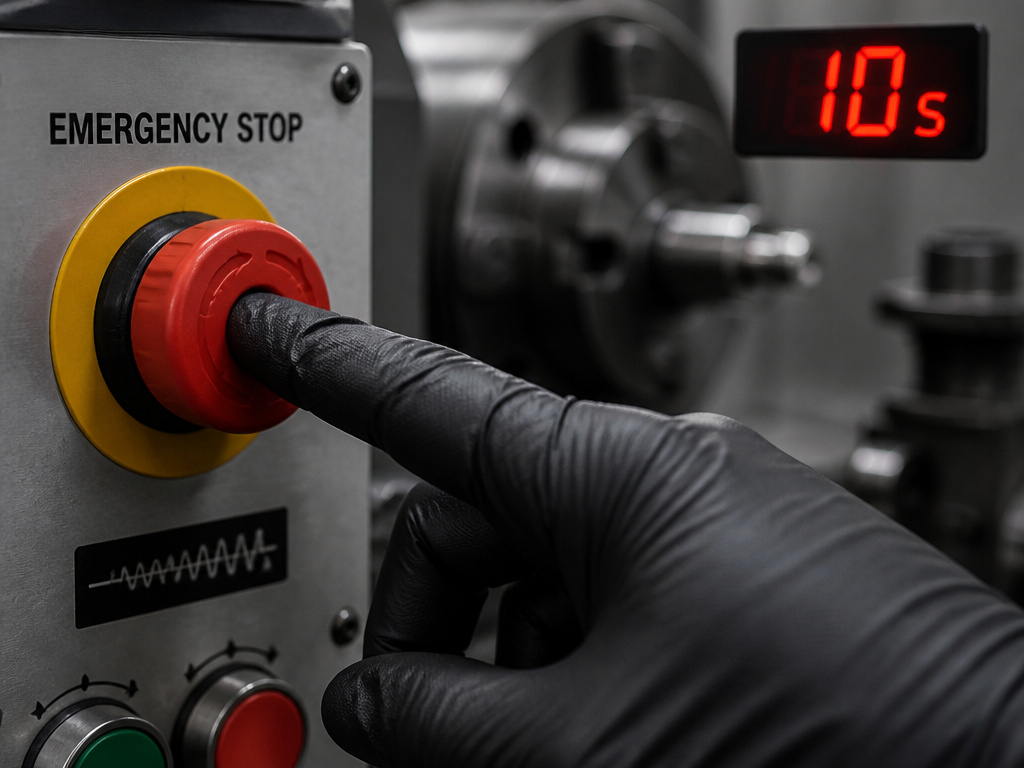
Stopping the machine is as critical as starting it correctly. Here, a specific number from a primary source changes a vague “brake quickly” into a measurable standard.
The HSE WIS28 document for wood turning lathes states: “Automatic braking, if necessary and not affecting workpiece/machine integrity, should stop the lathe within 10 seconds.” It then adds a critical nuance: if the machine’s run-up time (the time to reach full speed) exceeds 10 seconds, the braking time should be less than that run-up time, but in no case more than 30 seconds.
If run-up time exceeds 10 seconds, braking should stop it in less than the run-up time, but not exceed 30 seconds.
This isn’t just about convenience. It’s a calculated risk reduction. A lathe that coasts for a minute after power-off is a latent hazard for anyone assuming it’s safe to approach. Also, the NPS SafetyGram is emphatic about what not to do: “Under NO condition should a lathe be reversed to brake it to a stop.” On a lathe with a threaded spindle nose, this can unscrew the chuck entirely, turning it into a heavy, high-speed projectile.
For CNC machines like those from Haas, the emergency stop button is the primary braking tool. The manual specifies that pressing it “will instantly stop all motion of the machine, the servo motors, the tool changer, and the coolant pump.” This is your panic button, but it’s also part of a proper shutdown procedure.
Your Pre-Start Checklist: The 7-Step Ritual
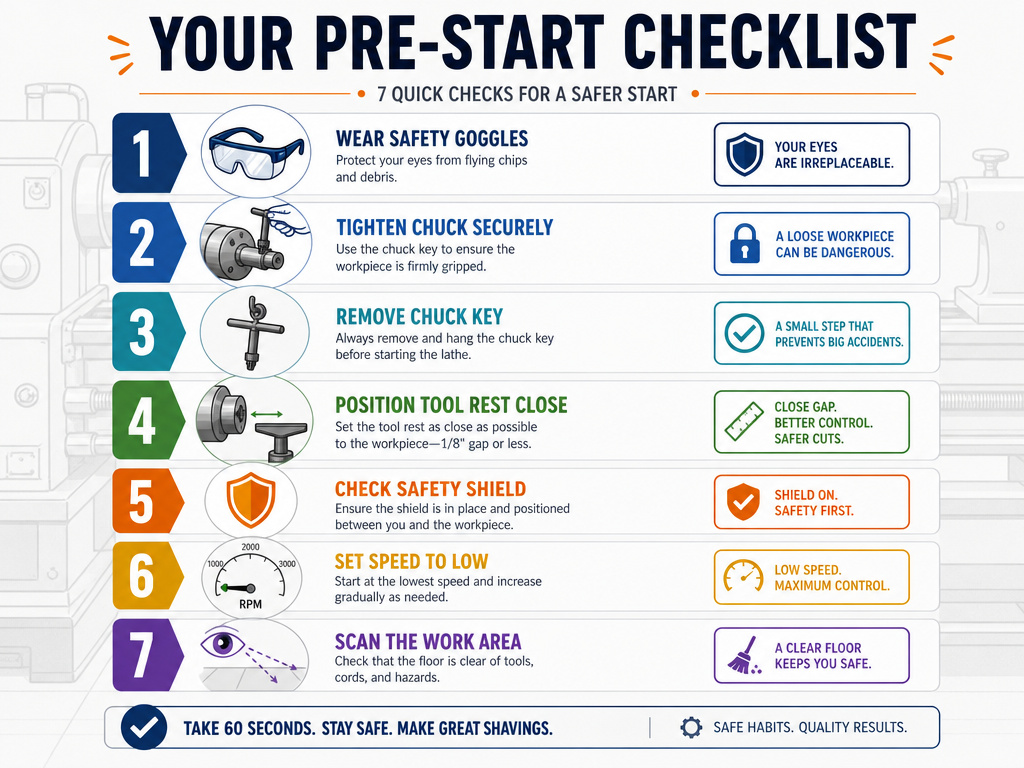
Most accidents happen during setup or adjustment, not during stable running. A disciplined checklist eliminates variables. Combine the steps from the McMaster University SOP, the Craftsman manual, and the NPS SafetyGram into this sequence.
- Secure PPE. Goggles (ANSI Z87.1), closed-toe shoes, no loose items. Add ear protection if needed.
- Mount and secure the workpiece. In a chuck, ensure jaws are tight and gripping correctly. Between centers, check tailstock tightness. Manually rotate the chuck one full revolution to confirm the workpiece doesn’t strike the tool rest or bed.
- Remove and stow the chuck key. Visually confirm the key is on its hook, away from the lathe.
- Set the tool rest. Position it close to the workpiece and lock it securely. For metal, ensure the tool holder is clamped tightly.
- Check guards and interlocks. Verify chuck guards, splash shields, and CNC doors are in place and functional.
- Select speed (RPM). Start at the lathe’s lowest speed for new or out-of-balance workpieces. The Sharp Industries manual warns: “only change speeds when the motor is completely stopped” to protect gears.
- Scan the area. Ensure tools are off the ways (NPS: “Tools must NOT be placed on the lathe ways”), the floor is clear of trip hazards, and you have a clear path to the emergency stop.
This checklist is your final gate. Skipping step 3 or 6 is how avoidable incidents occur. For more details on setup, see the guide on using a wood lathe chuck.
Filing, Sanding, and Measuring: High-Risk Moments
When the primary cutting is done, the risk perception drops, but the hazard level can actually increase. These finishing and inspection tasks bring your hands closer to the rotation.
Filing on a lathe is a known hazard. The NPS SafetyGram includes a specific rule: “When filing on the lathe, be sure the file has a securely fitting handle.” A bare tang can pierce your palm if the file catches. Always file left-handed (with your left hand on the handle) so your body is behind the file’s direction of travel. Use light pressure and move the file steadily along the tool rest.
Sanding or polishing a rotating workpiece, especially with emery cloth or abrasive tape, is one of the most dangerous lathe operations. The material can wrap around the workpiece in milliseconds, pulling your hand or glove into the rotation. Sanding or polishing a rotating workpiece is a known cause of entanglement. The only safe method is to use a hands-free sanding holder that mounts to the tool post, keeping your hands at a distance.
Measuring and cleaning require the spindle to be fully stopped. The NPS rules are absolute: “Stop the machine before attempting to wipe down a machine surface” and “Stop the machine before making measurements or cleaning out chips!” Reaching over a rotating workpiece with calipers or a brush is an invitation for caught sleeves or crushed fingers. For cleaning, use a brush or hook, never compressed air, as both NPS and Pro-Cut manuals explicitly forbid it due to the risk of blowing sharp chips into your eyes or a colleague’s path.
Environmental and Operational Limits
A lathe is designed to operate within specific physical conditions. Ignoring them can lead to premature failure, inaccurate work, and even safety system malfunctions.
The Haas CNC lathe operator’s manual provides a clear snapshot of these limits:
| Condition | Operating Range | Storage Range |
|---|---|---|
| Temperature | 41°F to 122°F (5°C to 50°C) | -4°F to 158°F (-20°C to 70°C) |
| Humidity | 20% to 90% relative, non-condensing | (Same as operating) |
| Altitude | Sea Level to 6000 ft (1829 m) | (Not specified differently) |
Operating outside these ranges can affect lubrication viscosity, electrical component cooling, and material dimensions. The Pro-Cut manual warns against use in explosive atmospheres or below grade level, and the Craftsman manual states its wood lathe is for indoor use only.
Noise is another operational limit. The Haas manual notes emitted noise at the operator’s position is greater than 70 dB and can exceed 85 dB, hence the recommendation for OSHA-approved ear protection. This is a physical hazard with cumulative effects, not just an annoyance.
What training is required to operate a lathe?
A lathe should never be operated without proper training. This is a fundamental rule stated in equipment manuals, such as the one for a Pro-Cut brake lathe. A lathe should never be operated without proper training, as stated in equipment manuals like the one for a Pro-Cut brake lathe. For new wood turning lathes, the operator’s handbook supplied with the machine is a critical training resource. Effective training ensures the operator understands how to use all guards, recognizes when to wear personal protective equipment like ANSI-approved goggles and OSHA-approved ear protection, and knows to stop the machine before making measurements or cleaning chips.
Frequently Asked Questions
What are the OSHA requirements for lathes?
Instead, lathes fall under the general machine guarding standard, 29 CFR 1910.212. This requires that operators be protected from hazards created by point of operation, nip points, rotating parts, and flying chips. The ANSI B11.6 standard provides safety requirements specific to lathes.
What is the single most important lathe safety rule?
While PPE and guarding are critical, the rule with the most immediate catastrophic potential is always remove the chuck key from the chuck immediately after use. This prevents the key from becoming a projectile or a point of entanglement if the spindle is accidentally engaged.
Is it safe to wear gloves when using a lathe?
It depends on the task. For handling rough, sharp raw materials or finished parts, gloves can protect against cuts. However, never wear gloves during any operation where your hands are near rotating parts, such as sanding, filing, or polishing. The glove material can catch and pull your hand in before you can react. There is no consensus; you must assess the specific task and proximity to rotation.
How do I safely clean chips from a lathe?
First, ensure the lathe is completely stopped. Then, use a stiff brush or a dedicated chip hook to remove swarf. Never use compressed air, as banned by the NPS SafetyGram and Pro-Cut manual, because it launches sharp chips at high speed, creating a severe eye and skin hazard for you and others in the shop.
The Bottom Line
Lathe safety isn’t a list of tips; it’s a system built from manufacturer specifications, regulatory standards, and disciplined human routine. The ANSI B11.6 and OSHA 1910.212 standards provide the framework, but the daily practice comes down to your checklist and your respect for rotation.
One threshold changes everything: if your lathe doesn’t brake to a stop within the HSE’s 10-second guideline, treat it as if it will coast indefinitely. That means a full lockout before any near-field work. The emergency stop is your ultimate control, but the chuck key ritual is your first-line defense.
Before you walk away, do this: locate your machine’s manual, the real one from Haas, Sharp, Craftsman, or the OEM, and find the environmental specs and guard requirements. That document, alongside the HSE wood turning lathe guide and the Naval Postgraduate School lathe safety sheet, contains the numbers that turn “be careful” into a measurable, actionable rule. Everything else is just background noise.
