
Common Power Tool Injuries and How to Avoid Them
This post contains affiliate links. As an Amazon Associate, we earn from qualifying purchases.
Common power tool injuries are predictable, not random. They arise from direct contact with moving blades (especially electric saws), unintended discharges from nail guns, and failure to use mandatory safety guards. Prevention is a system: match the tool’s safety mechanisms to the task, maintain mandatory guards, and treat PPE like a seatbelt, non-negotiable.
That predictability is the key. A 2019 study in the Archives of Plastic Surgery found that electric saws were the most common type of power tool causing hand and upper extremity injuries, with most happening in non-occupational settings. Understanding common power tool injuries and how to avoid them is where the numbers tell us to focus. The regulations, like OSHA Standard 1910.243, then give us the mechanical specifics: what a guard must cover, when a switch must shut off, and why a loose wheel cracks.
What follows is a breakdown of common power tool injuries and how to avoid them, using the injury data, the OSHA rules that address them, and the shop habits that make those rules automatic. We’ll cover electric saws, grinders, nail guns, and the critical first steps if an accident happens. This isn’t about fear. It’s about using the data we already have.
Key Takeaways
- Electric saws are the most common type of power tool causing hand and upper extremity injuries; the guard must cover the blade to the depth of the teeth and retract instantly.
- Two-thirds of nail gun injury claims involve unintended discharge; a sequential trigger eliminates the double-fire risk of a contact trigger.
- Always disconnect power before changing a blade or accessory. A plugged-in tool with a dead switch is still live.
- For grinders, perform the tap test before use, a sound wheel rings clear, but skip this test for wheels 4 inches or less in diameter.
- Have a tourniquet and sterile dressings in your shop first-aid kit. For a severe cut, apply direct pressure with a clean cloth and elevate the wound if possible.
The Most Common Injury: Electric Saws and Direct Contact
Forget the dramatic, freak accident. The most common severe injury is straightforward: a hand makes direct contact with a spinning saw blade. In that 2019 study of 261 hand and upper extremity power tool injuries, an electric saw was the most common type of power tool causing the injuries. The average patient was 53 years old, and more injuries happened in non-occupational settings like home workshops.
The guard is your primary defense, and its design isn’t a suggestion. OSHA Standard 1910.243 mandates that any circular saw with a blade over 2 inches must have guards above and below the shoe.
The upper guard shall cover the saw to the depth of the teeth, except for the minimum arc required for bevel cuts. The lower guard shall cover the saw to the depth of the teeth, except for the minimum arc required for retraction and contact with the work. When the tool is withdrawn, the lower guard shall automatically and instantly return to covering position.
That “automatically and instantly” clause is where field fixes fail. Tying the guard back with zip ties or removing it for a “better view” turns a predictable cut into a life-altering event. The mechanism must be clean and move freely. If it’s sticky, clean it before your next cut. If it’s broken, repair it. Full stop.
Where this goes sideways: Starting a cut with the lower guard manually held open. The blade is fully exposed during the most unstable part of the operation, the initial plunge. Let the guard retract against the workpiece naturally. If it won’t, the workpiece is too small or you’re using the wrong tool.
Grinders and Abrasive Wheels: The Wheel That Explodes
A grinding wheel stores immense kinetic energy. When it fails, it doesn’t just stop, it disintegrates. The OSHA portable power tool safety guide states you should never stand in the plane of rotation as the wheel accelerates. The fragments travel in that plane.
Your pre-use ritual matters. Visually inspect the wheel for cracks or damage. Then, perform the tap test: suspend the wheel with a finger through the arbor hole and tap it lightly with a non-metallic object. A sound, undamaged wheel gives a clear metallic ring. A dull thud means it’s cracked and must be discarded.
Easy to miss: The tap test is ineffective for wheels four inches in diameter or less, or for shaped wheels like plugs and cones. For these, your visual inspection is the only check.
Mounting is the other half. The wheel must fit freely on the spindle, forced fits create stress points. The spindle nut should be tight enough to hold the wheel without distorting the flange. And always let the tool reach full operating speed before applying it to the workpiece. Grinding on a wheel that’s still accelerating can cause it to grab and shatter.
| Grinder Safety Check | Correct Action | Risk If Skipped |
|---|---|---|
| Wheel Inspection | Tap test (if wheel >4″) & visual check for cracks. | Cracked wheel explodes on startup, sending high-velocity fragments. |
| Wheel Mounting | Wheel fits freely on spindle; nut tight but doesn’t distort flange. | Uneven pressure cracks wheel; can cause violent failure during use. |
| Guard Alignment | Adjust so angular exposure does not exceed 180 degrees. | Exposed wheel periphery can grab material or clothing, pulling hand in. |
| Personal Stance | Stand to the side, not in line with the wheel’s plane of rotation. | Direct line of fire if wheel fractures; fragments hit torso or face. |
Nail Guns: The Hidden Double-Fire Risk
A nail gun feels efficient until it fires twice. According to an OSHA nail gun safety guide, a study of workers’ compensation claims found two-thirds of nail gun injuries involved some type of unintended discharge. The trigger mechanism is the deciding factor.
There are two main types:
- Contact Trigger (aka Bump Fire): The tool fires when the safety contact tip is depressed and the trigger is squeezed. It can fire repeatedly as long as both are held.
- Sequential Trigger: The tool fires only when the safety contact tip is depressed first, then the trigger is squeezed. It requires a deliberate, two-step sequence for each nail.
The contact trigger is faster for production work but is susceptible to double firing, where the gun recoils and the tip bumps the workpiece again, driving a second nail before the user can react. It also poses a major risk if the trigger is held squeezed while carrying the tool; bumping the tip into anything fires a nail.
My rule is simple: For anything but high-volume professional framing, use a sequential trigger. It eliminates the double-fire hazard and forces a deliberate action for every nail. It’s slower, but your fingers and your co-worker’s safety are worth the delay.
The Mandatory Safety System: Guards, Switches, and PPE
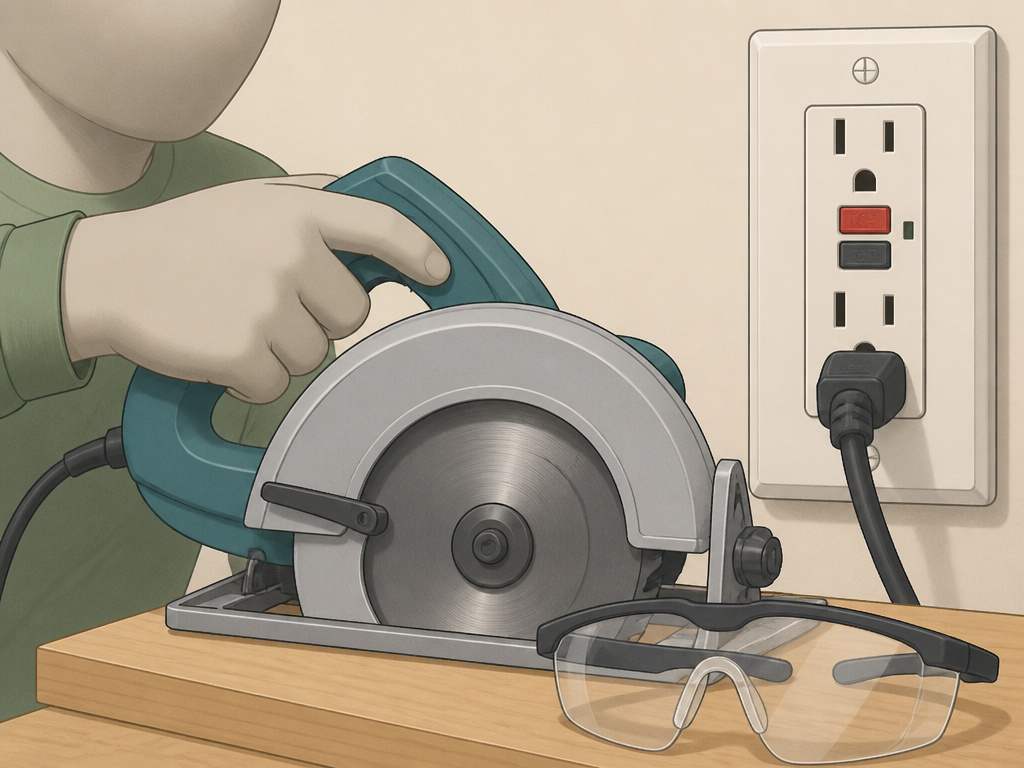
Safety isn’t a single item; it’s a stack of layers. The tool’s built-in mechanisms are the first and most critical layer, enforced by law.
Constant-Pressure Switches: OSHA regulation 1910.243 on tool guarding requires them on many tools. If you release your grip, the tool must stop. This includes circular saws (blade >2″), most grinders and sanders (wheel/disc >2″), and reciprocating saws. It’s a vital dead-man’s switch. Never disable it by clamping a grinder in a vise.
Personal Protective Equipment (PPE): This is your last line of defense. For grinders, eye protection is mandated by OSHA. It’s not optional. Hearing protection is just as critical for long-term health, a table saw generates significant noise, and hearing damage is cumulative.
Electrical Safety: Water and motors are a lethal combination. If you must work in a damp location, use a GFCI-protected outlet or extension cord. It will trip in a fraction of a second if current faults to ground, potentially saving your life. This is a core part of any power tool electrical safety practice.
First-Aid Fundamentals for the Workshop
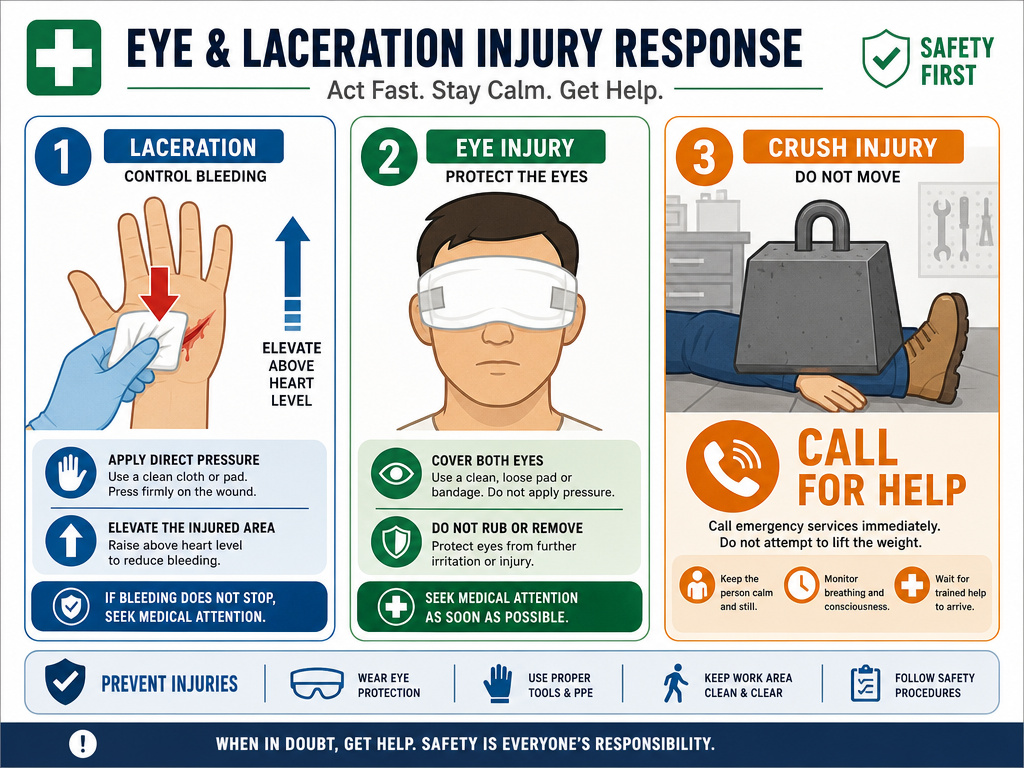
Most guides stop at prevention. But if something goes wrong, the first minutes determine the outcome. Your shop first-aid kit must be more than a box of band-aids.
- Severe Bleeding (Laceration/Amputation): Apply direct, firm pressure with a clean cloth or sterile dressing. Elevate the wound above the heart if possible. Do not use a tourniquet unless direct pressure cannot control the bleeding, but have one in your kit and know how to apply it. Then call for emergency help.
- Eye Injury: Do not rub the eye. If a foreign object is embedded, do not try to remove it. Loosely cover both eyes (to stop movement of the injured one) and seek immediate medical attention.
- Crush Injury: If a limb is trapped, call for help immediately. Do not try to release a heavy weight unless you are certain you can do so safely.
Keep your kit visible, stocked, and everyone in your household should know its location. It’s not paranoia. It’s the same logic as having a fire extinguisher.
Before You Go
The data gives us a clear map of common power tool injuries and how to avoid them. Electric saws and nail guns account for a massive share of severe injuries, and the fixes are mechanical: intact guards and sequential triggers. The fundamental safety practices, disconnecting power, using a GFCI, performing the tap test, are what turn a statistic into a near-miss.
One final, critical point: if you are tired, rushed, or distracted, put the tool down. The epidemiologic study of hand injuries showed the average age of injury was 53. That’s experience, not inexperience. Complacency is the final risk factor no guard can protect against. Your most important safety feature is between your ears.
Why you should use the correct tool for the task
Forcing a tool or using the wrong one for an application is a major cause of accidents and kickback. Manufacturer recommendations are your guide. Only use accessories recommended for your specific tool model. For example, do not exceed the maximum operating speed marked on a grinding wheel. Tools are also designed with specific safety controls. Hand-held circular saws, grinders with wheels over a certain size, and many other power tools are required to have a constant pressure switch that stops the tool when you release it. Never disable these switches or modify a tool to bypass its safety features. Using the proper tool for the job gives you control and keeps built-in protections active.
Frequently Asked Questions
What power tool causes the most injuries?
According to a peer-reviewed study, electric saws, including circular saws and table saws, cause the most serious hand and upper extremity injuries, accounting for 41.8% of cases. Direct contact with the blade is the primary mechanism.
How do you prevent kickback on a circular saw?
Kickback prevention starts with the tool: ensure the lower guard moves freely and the blade is sharp. Use a guide fence for straight cuts, don’t force the saw, and always position yourself to the side of the blade’s cutting line, not directly behind it. Our dedicated guide on preventing power saw kickback breaks down the techniques.
Are cordless tools safer than corded ones?
Not inherently. The safety mechanisms, guards, switches, and your practices, are what matter. Cordless tools eliminate trip hazards from cords and reduce the risk of cutting through a live line, but a cordless circular saw’s blade is just as dangerous as a corded one’s. The core safety rules apply equally.
What is the single most important safety habit?
Disconnect the power source before changing any accessory. This means unplugging the cord or removing the battery. It eliminates the risk of the tool accidentally starting, whether from a faulty switch, a bumped trigger, or simply forgetting it was on. This habit is the bedrock of safe grinder operation and all tool maintenance.
Should you wear gloves when using power tools?
It depends on the tool. Do not wear gloves when using rotating tools like table saws, drill presses, or angle grinders, the material can catch and pull your hand in. Do wear cut-resistant gloves when handling sharp materials like sheet metal or glass, but only when your hands are nowhere near the moving parts of the tool.
