
Orbital vs Random Orbital Sander: Which Should You Buy?
This post contains affiliate links. As an Amazon Associate, we earn from qualifying purchases.
The difference between an orbital sander and a random orbital sander comes down to one moving in tight, repetitive circles and the other adding a random spin to those circles. An orbital sander uses a square pad for light finish work and corners, while a random orbital sander uses a round pad for faster, swirl-free material removal on larger surfaces. Popular Mechanics recommends a random orbital sander if buying only one, while Mirka Tools suggests orbital sanders are ideal for small, detailed work and random orbital models for larger surfaces, implying a need for both depending on the task.
That’s the short answer. The long answer to the orbital vs random orbital sander question is about matching a tool’s specific motion to the job you’re doing. That motion isn’t just a spec; it’s the physical reason a sander can feather a drywall patch or ruin a tabletop.
Most guides list the features. When you compare an orbital vs random orbital sander, I’ll start with what the motors are actually doing inside the housing. That’s what decides whether you spend an afternoon smoothing a door or an evening repairing the scratches you just made.
What follows: a breakdown of the mechanical guts, the proven job each tool excels at, and the specs that actually matter when you’re holding it. By the end, you’ll know which sander to reach for, and why it works.
Key Takeaways
- An orbital sander’s pad moves in tight, repetitive circles; a random orbital sander’s pad spins and orbits simultaneously for a random, swirl-free pattern.
- Use an orbital sander for corners, edges, and light finishing; use a random orbital for faster material removal and large, flat surfaces.
- The round pad of a random orbital sander cannot reach inside square corners; the square pad of an orbital sander is its superpower for detail work.
- Random orbital sanders remove material faster than orbital sanders but can also dig in and damage work if held in one spot.
- For your first and only sander, a 5-inch random orbital model is the most versatile choice for a home workshop.
What’s the Mechanical Difference? (Orbit vs Spin)
The names sound similar, but the mechanisms are as different as a hammer and a mallet. One vibrates, the other spins and vibrates.
An orbital sander has a motor that drives an eccentric weight. This weight makes the entire square base plate vibrate in tiny, rapid circles, the “orbits.” It’s a simple, straight-line vibration transferred to the pad. There is no rotation.
The orbital sander’s pad vibrates in repetitive, microscopic circles. This motion scuffs the surface without significant rotation, which is why it’s less aggressive and prone to leaving a visible, patterned scratch if you’re not careful.
A random orbital sander’s motor does two things at once. It spins the circular pad on its central axis. At the same time, the entire drive mechanism is offset, causing the spinning pad to also orbit in a larger, elliptical path. The “random” part comes from the pad being allowed to free-wheel on its bearing. The combination of forced spin and free orbit means no single grain of abrasive follows the same path twice.
That dual-action is the whole game. It’s why a random orbital can strip paint efficiently without leaving the telltale swirl marks a simple spinning disc sander would create.
The Orbital Sander (Your Corner Specialist)
Think of this as your detail brush. It’s the older, simpler tool, and it’s built for finesse, not force.
Fine Homebuilding notes an orbital sander generally has a square foot that accepts a quarter of a 9×11 sheet of sandpaper. Its square shape allows it to reach into corners and sit flush against edges, unlike a round pad that would slide past. It’s perfect for the final pass on cabinet frames, sanding down window trim, or feathering the edge of a drywall patch.
Because the motion is just vibration, it’s not overly aggressive. Fine Homebuilding notes orbital sanders are perfect for prepping a surface for painting or sealing, or for knocking down a layer of paint. That lack of aggression is a safety net, it’s genuinely hard to sand through your workpiece unless you try.
The catch is the scratch pattern. Since the motion is repetitive, it can leave a uniform, cross-grain pattern that catches the light, especially on hardwoods. The performance and scratch pattern differ from brand to brand. You should test your sander on scrap before assuming it won’t leave visible marks.
Common mistake: Using an orbital sander like a random orbital. Holding it in one spot on a large, flat surface won’t speed things up; it just creates a localized dip and makes the scratch pattern more obvious.
When you need an orbital sander:
- Sanding inside corners of cabinets or furniture.
- Final finish sanding between coats of paint or polyurethane.
- Refinishing wood floors along baseboards and into corners.
- Lightly scuffing surfaces for paint adhesion.
| Spec | Typical Orbital Sander |
|---|---|
| Pad Shape | Square/Rectangular |
| Paper Type | 1/4-sheet (cut from standard sheets) |
| Motion | Orbital vibration only |
| Best For | Corners, edges, light finishing |
| Key Limitation | Slow material removal, visible scratch pattern |
The Random Orbital Sander (The Flat-Surface Workhorse)
This is your roller. It’s designed for speed and smoothness on open terrain.
The pad is round, usually 5 inches in diameter (with 6-inch models also available). It uses hook-and-loop sanding discs. The magic is in the dual-action spin-and-orbit, which makes it a beast for removing stock while leaving a finish ready for stain or clear coat. Popular Mechanics calls it the go-to for most woodworkers, versatile enough for stripping old finishes to prepping wood for paint.
It’s not just for wood. It’s a staple in construction for smoothing drywall compound and during renovations. Better models have variable speed control, so you can reduce the orbital speed for polishing or increase it for coarse grits.
The downside is its shape and power. The round pad can’t get into a 90-degree corner. And that power demands respect. As Fine Homebuilding warns, random orbital sanders can remove too much material if held in place too long. You can put a divot in a tabletop in three seconds if you zone out.
Here’s the data on what you’re actually holding, based on construction-grade specs:
| Tier | Motor (Corded) | Speed (OPM) | Weight | Dust Port |
|---|---|---|---|---|
| Entry-Level | 2.0 – 2.5 A | 6,000 – 10,000 | 2.5 – 3.0 lbs | 1 inch |
| Mid-Range | 2.5 – 3.3 A | 6,000 – 12,000 | 3.0 – 4.0 lbs | 1 – 1.25 in |
| Professional | 3.3 – 4.5 A | 4,000 – 12,000 | 3.5 – 5.0 lbs | 1.25 – 1.5 in |
When you need a random orbital sander:
- Sanding large, flat surfaces like tabletops or doors.
- Removing old paint or varnish quickly.
- Preparing wood for stain (swirl-free finish is critical).
- Sanding drywall compound smooth.
Orbital vs Random Orbital: Head-to-Head on the Bench

To be specific. When you line them up, the choice isn’t which is “better,” but which is better for this specific task right now.
Material Removal Rate
A random orbital sander removes material significantly faster. In a direct comparison, the random orbital sander removes material significantly faster. The orbital sander is for refining, not reshaping.
Finish Quality
The random orbital wins for a ready-to-finish surface. Its non-repeating pattern virtually eliminates swirl marks. An orbital sander’s consistent pattern can leave visible scratches unless you follow with a very fine grit by hand. For a final finish on visible wood, the random orbital is the default.
Access to Corners and Edges
This is the orbital sander’s domain. Its square pad can sand right into a 90-degree corner. A random orbital sander will leave a rounded, unsanded radius in the same corner. If your project has a lot of inside corners, think cabinet boxes or bookshelves, the orbital sander isn’t just helpful; it’s necessary.
Ease of Use and Cost
Orbital sanders are simpler, lighter, and cheaper. On average, a random orbital sander costs about twice as much. But for a beginner, the random orbital is paradoxically more forgiving on flat surfaces because its random pattern hides minor technique errors. The orbital sander’s visible pattern punishes a wandering hand.
Verdict: They are complementary. For a home workshop, I recommend starting with a 5-inch random orbital sander. It handles 80% of sanding tasks. Add a basic orbital sander later for the 20% of jobs that involve corners and fine detail work. Trying to force the round tool into a square corner is where projects go sideways.
Safety, Recalls, and What the Manuals Don’t Say
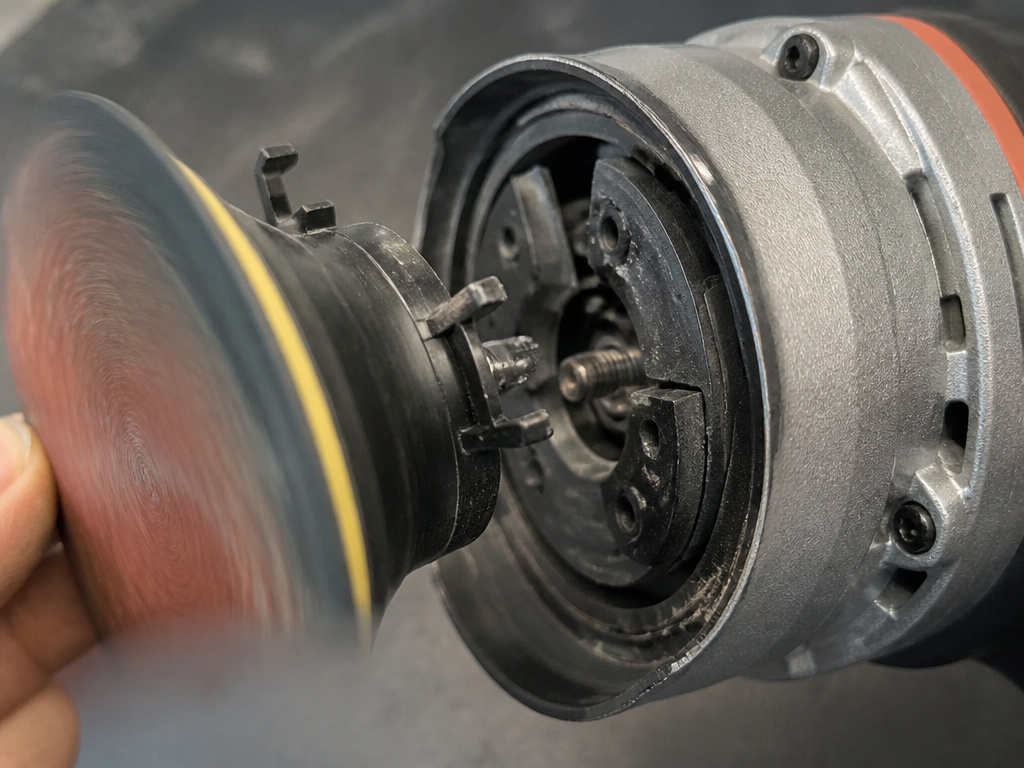
Power sanders are safe until they’re not. Two things get people hurt: ignoring basic safety and using a tool with a known defect.
The Non-Negotiables
Wear a respirator. Sanding dust, especially from old paint or pressure-treated wood, is not something you want in your lungs. Use safety glasses, a broken sanding disc or a fragment kicked up from your workpiece travels fast. Keep cords clear. And let the tool do the work. Pushing down harder doesn’t sand faster; it loads the paper, overheats the motor, and increases the chance of kickback.
A Real-World Recall
Safety isn’t just about your technique. In 2010, the Consumer Product Safety Commission (CPSC) recalled approximately 192,000 Black and Decker random orbital sanders (models RO400, RO400G, RO410, RO410K, RO410LW, FS3000ROS with date codes 200701 or 200929). The hazard? Platen separation during use. The rigid backing plate could detach at high speed, turning the sanding disc into a projectile laceration hazard. It was a manufacturing defect in a specific production run, not a design flaw. The lesson: register your tools and check for recalls. A $50 sander isn’t worth a trip to the ER.
Where this goes sideways: Skipping a grit to save time. Jumping from 80-grit to 220-grit on a random orbital sander seems efficient. What happens is the deeper 80-grit scratches simply get polished by the 220-grit paper, becoming shiny, embedded grooves that only reappear after you apply stain. You’ll spend more time sanding out those ghosts than you saved.
Sensory Reality Check
A healthy sander has a consistent, medium-pitched whine. A high-pitched scream means you’re pressing too hard or the paper is clogged. A grinding or knocking sound means stop, something’s loose inside. The sander should also vibrate in your hand, but not so much that your fingers go numb after five minutes. If it does, the pad might be unbalanced or the bearing is going.
How to Choose: A Project-Based Decision Guide
Don’t choose a tool. Choose the result, then pick the tool that delivers it. Here’s a quick guide based on common jobs.
| Your Project | Recommended Sander | Why It’s the Right Tool |
|---|---|---|
| Refinish a Wood Tabletop | Random Orbital | Removes old finish fast and leaves a swirl-free surface ready for new stain. |
| Sand Cabinet Interior Corners | Orbital | Square pad reaches where a round pad cannot. |
| Prep a Wall for Painting (drywall) | Random Orbital | Faster on large areas, but use light pressure to avoid creating divots. |
| Light Sand Between Paint Coats | Orbital | Less aggressive, perfect for knocking down dust nibs without cutting through. |
| Remove Paint from a Deck Railing | Random Orbital (with coarse grit) | Power and speed needed for a large, linear job. |
| Restore an Antique Frame (detailed molding) | Orbital | Ability to work into intricate corners and profiles. |
What About Other Sanders?
This comparison often overlooks where belt sanders, detail sanders, and palm sanders fit. A belt sander is for demolition-level stock removal, a different category entirely. A detail sander (with a triangular pad) is for even tighter spots than an orbital can handle. Knowing all the types of sanders shows where the orbital and random orbital fit.
Orbital vs random orbital sander cost
There is a clear price difference between the two tool types. On average, random-orbit sanders cost about twice as much as orbital sanders. This higher initial investment for a random orbit model reflects its more complex dual-action mechanism, increased power, and greater versatility for tasks like removing stock or stripping finishes. For a user on a tight budget or someone who primarily does light finish sanding and surface prep, a basic orbital sander presents a significantly lower cost of entry.
Frequently Asked Questions
Which sander is better for removing paint?
Random orbital sander is better for removing paint from large, flat surfaces. Its faster material removal and swirl-free action let you strip and prep in one go. An orbital sander can knock down loose paint flakes but will struggle with complete paint removal.
Can I use an orbital sander on drywall?
You can, but be careful. As Kreg Tool notes, orbital sanders can level small drywall patches. However, avoid using them on full drywall seams unless you’re experienced. The tool can create divots very quickly in the soft compound. A sander with a vacuum attachment is highly recommended.
What’s the difference between a 5-inch and 6-inch random orbital sander?
5-inch pad is the standard, offering a balance of control and sanding area. A 6-inch pad covers more surface per pass, speeding up work on big projects like floors or tabletops, but the tool is usually heavier and less maneuverable. For most DIYers, a 5-inch model is the more versatile starting point.
Are random orbital sanders worth the extra cost?
For anyone doing more than occasional touch-ups, yes. The speed, finish quality, and versatility justify the price. On average, random-orbit sanders cost about twice as much as orbital sanders, according to Fine Homebuilding. It’s the foundational tool for a best finishing sander setup.
How do I avoid swirl marks?
Swirl marks come from a repetitive sanding pattern and improper grit progression. With a random orbital sander, keep the sander moving and use overlapping passes. With any sander, never skip grits. If you start with 80-grit, move to 120, then 180, then 220. For a deep dive, see our guide on how to avoid swirl marks.
Before You Go
Here’s the one rule I’ve learned the hard way: buy the tool for the jobs you actually do, not the aspirational ones.
If your projects are mostly flat, tabletops, doors, decks, invest in a 5-inch random orbital sander. A corded model from a brand like Bosch or Makita will last decades. It will handle the bulk of your sanding. Learn proper technique for using a random orbital sander: let the weight of the tool do the work, move in straight lines, and change paper the moment it starts to lose its bite.
Then, when you inevitably build a bookshelf or refinish a cabinet and are cursating the unsanded corner, pick up a basic orbital sander. It’s a cheap addition that solves a specific, frustrating problem.
They’re not substitutes. One is for open fields, the other for the tight trails. Trying to make one do the other’s job is how you end up with a mediocre finish and a sore arm.
