
Pancake vs Twin Stack Air Compressor: How to Choose
This post contains affiliate links. As an Amazon Associate, we earn from qualifying purchases.
In the pancake vs twin stack air compressor decision, According to Pro Tool Reviews, a pancake model is a compact, lightweight unit best for intermittent tasks like brad nailing and inflation, while Tool Digest states twin stacks are better for sustained work like framing or spray painting. For most homeowners, a pancake compressor like the DeWalt DWFP55126 is sufficient, but for continuous tool use, a twin stack like the Makita MAC2400 is the better buy.
The real confusion in the pancake vs twin stack air compressor decision starts when you look at a spec sheet. You see two compressors with the same tank size but wildly different air output, or a pancake model rated for “framing” while a twin stack is called “quiet.” The labels don’t match the numbers, and the numbers don’t always match what happens in your garage.
What follows is a breakdown of the three specs that actually matter, a look at the noisy truth about pump types, and where each design fails in real use. By the end, you’ll be able to ignore the marketing and pick the compressor that matches the air your tools actually consume.
Key Takeaways
- The CFM at 90 PSI rating is your deal-breaker; match it to your most air-hungry tool’s requirement, not the tank size.
- Noise level (dBA) varies wildly by model, not tank shape; a specialized twin stack can be 60 dBA while a standard one hits 90 dBA.
- Oil-lubricated pumps (common in twin stacks) run quieter and last longer but require maintenance; oil-free pumps (common in pancakes) are maintenance-free but louder and have a shorter lifespan.
- A 6-gallon pancake compressor with sufficient CFM can run a framing nailer in short bursts, but sources like Tool Digest recommend a twin stack with higher CFM for sustained back-to-back nailing or roofing.
- Portability is a trade-off: pancakes are easier to carry, but twin stacks are often easier to roll on a jobsite with their lower center of gravity.
The 3 Numbers That Actually Decide
Forget the shape of the tank. Your choice hinges on three figures printed on the spec sheet: CFM, PSI, and dBA. If these don’t align with your tools and workspace, the compressor is just a noisy paperweight.
CFM at 90 PSI (Standard Cubic Feet per Minute): This is the compressor’s breath. It tells you how much air it can push continuously. A brad nailer might use 0.3 CFM, a finish nailer 0.9 CFM, but a framing nailer can demand 2.0 to 2.5 CFM. If your compressor’s CFM rating is lower than your tool’s requirement, the tool will work for a second, drain the tank, and then you’ll stand there waiting for the motor to catch up. That’s the scream you hear on a jobsite.
The CFM at 90 PSI is the only number that predicts whether your compressor can keep up with your tool’s appetite. A tank just stores air; the CFM is how fast you can refill it.
Maximum PSI (Pounds per Square Inch): This is the tank’s pressure ceiling. It’s important, but it’s not the primary limiter. Most tools run at 90 PSI or less. A higher max PSI (like 165 PSI on the DeWalt DWFP55126 versus 150 PSI on the Craftsman CMEC6150K) simply means a larger reserve of pressurized air in the tank before the motor kicks on. It gives you more shots from a nail gun between cycles, but it doesn’t increase the continuous airflow (CFM).
Noise Level (dBA): This is where online descriptions lie. A 78 dBA compressor (like the Craftsman CMEC6150K) is not “quiet.” It’s about the volume of a garbage disposal. You cannot have a conversation next to it. The difference between 75 dBA and 90 dBA is significant, as 90 dBA is a much higher noise level.
| Spec | Why It Matters | Pancake Example (DeWalt DWFP55126) | Twin Stack Example (Makita MAC2400) |
|---|---|---|---|
| CFM @ 90 PSI | Sustained tool operation | 2.6 SCFM | 4.2 SCFM |
| Max PSI | Shots between motor cycles | 165 PSI | 130 PSI |
| Noise (dBA) | Workspace comfort | 75.5 dBA | 79 dBA |
| Tank Size | Air reservoir | 6 gallons | 4.2 gallons |
Notice the twist: the Makita twin stack has a smaller tank (4.2 gal) than the DeWalt pancake (6 gal), but it delivers a higher continuous air output (4.2 vs 2.6 CFM). That’s why you choose based on CFM, not gallons.
Pancake Compressor Reality Check: Light-Duty Champion
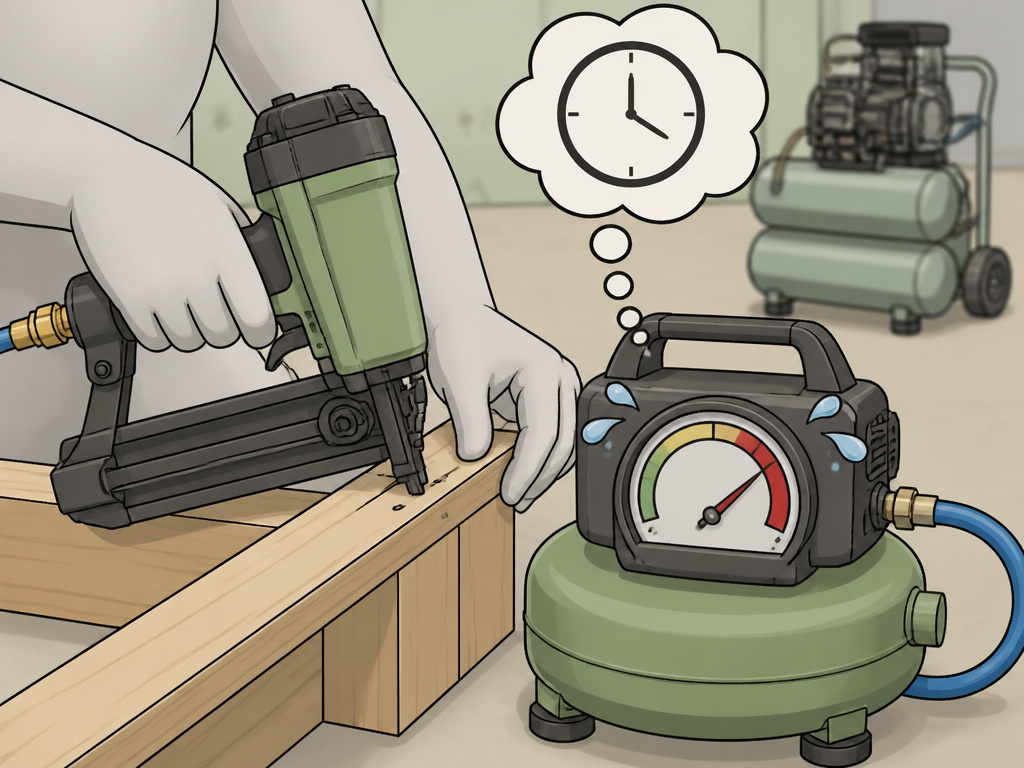
A pancake compressor wins on portability. At around 30 pounds, you can carry it upstairs, into the backyard, or to a neighbor’s house without a second thought. Its low, flat profile is stable on the ground. This design is the default for a reason: it solves the most common homeowner problems.
Its best-fit jobs are intermittent:
- Driving brad nails for trim.
- Inflating car, bike, and sports equipment tires.
- Operating a blow gun for cleaning.
- Short sessions with a finish nailer.
Where this goes sideways: Trying to run a tool that needs more CFM than the pump can supply. The motor will run almost continuously, which can lead to less efficient work.
Manufacturers sometimes stretch the truth. Technically true for one nail every ten seconds. But try to drive a sequence of framing nails for a wall, and the 2.6 SCFM output will leave you waiting. For actual framing, you’d be better served by a model from our list of best pancake compressors that prioritizes CFM over included accessories.
Twin Stack Compressor Reality Check: The Sustained Workhorse
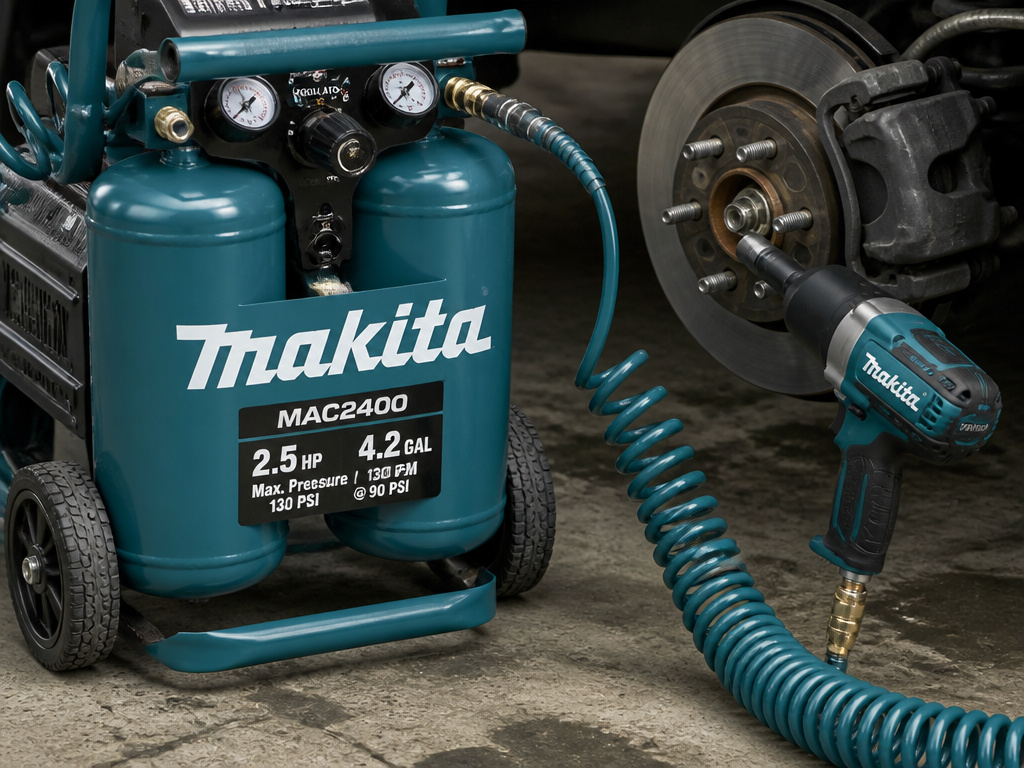
A twin stack compressor places two vertical tanks side-by-side, lowering the center of gravity. This makes it more stable and often easier to roll than to carry, given the weight (the Makita MAC2400 is 77 lbs). The design accommodates larger motors and pumps between the tanks, which is why they typically deliver higher CFM.
This is your tool for jobs that demand air for more than a few seconds at a time:
- Framing or roofing with a nail gun.
- Using an impact wrench for automotive work.
- Operating a die grinder or small sander.
- Spray painting (for smaller projects).
The Makita MAC5200 Big Bore, with its 6.5 SCFM, is engineered for exactly this. It’s not about carrying it; it’s about rolling it to the site and letting it work.
The noise reputation is a mess. One common blog claim is that twin stacks are quieter, but this is a point of disagreement among sources; specific twin stack models can be louder than specific pancake models. The oil-lubricated Makita MAC2400 is rated at 79 dBA, while the California Air Tools 8010DC twin stack hits an exceptionally quiet 60 dBA. The tank shape doesn’t dictate noise; the pump technology does.
Oil-Free vs. Oil-Lubricated Pumps: The Maintenance Trade-Off
This is the single biggest divider in compressor lifespan and noise, and it cuts across both pancake and twin stack designs.
Oil-Free Pumps are the standard in pancake compressors (Craftsman, DeWalt) and some twin stacks (California Air Tools). The piston rings run directly against the cylinder wall.
- Pro: Zero maintenance. No oil to check or change. Ready to use out of the box, forever.
- Con: They run hotter and are significantly louder. The piston-on-metal action creates more friction and noise. Their lifespan is generally shorter than a well-maintained oil-lubed pump.
Oil-Lubricated Pumps are common in professional-grade twin stacks (like the Makita MAC2400 and MAC5200). The piston is lubricated by a sealed oil bath.
- Pro: Quieter operation, better heat dissipation, and longer potential lifespan. The oil cushion reduces wear.
- Con: Requires periodic oil changes (like a small engine). You must check the oil level. They can be sensitive to cold weather if the wrong oil viscosity is used.
Choosing one is a philosophy. Do you want absolute convenience and accept shorter life and more noise? Or do you want a quieter, longer-lasting tool and accept a simple maintenance ritual twice a year? For a tool you’ll use for a decade, the oil-lubed pump is the smarter investment. Understanding this difference between portable and stationary compressors often hinges on the same maintenance question.
Portability, Stability, and Real-World Gripes
Beyond the specs, how the compressor lives with you matters.
Portability: Pancakes win on sheer carry-ability. Their integrated handle and 30-pound weight are unmatched. Twin stacks, due to their weight (54-88 lbs), are creatures of the wheel. Many have a roll cage or at least a wheel kit. They’re portable in the “move it around the garage or jobsite” sense, not the “carry it up a ladder” sense. This is a core part of the pancake pros and cons evaluation.
Stability: The twin stack’s vertical, dual-tank design is inherently harder to tip over, especially when you give the hose a tug. A pancake is low and wide, which is also stable, but its motor sits higher up, which can make it a bit tippier on uneven ground.
Owner Gripes (The Non-Commodity Truth):
- Noise vs. Rating: Users consistently call pancake compressors “loud” or “noisy,” even when the dBA rating (like the DeWalt’s 75.5) seems moderate. The sound is a sharp, penetrating brrrrrrap that’s more irritating than the decibel level suggests.
- Included Hoses: They’re almost always too short and cheap. Factor the cost of a 50-foot hose into your budget.
- CFM Optimism: Owners of the powerful Makita MAC5200 (6.5 CFM) still call it “loud,” confirming that high output doesn’t mean quiet operation.
How to Choose: A Simple Flowchart in Words
Stop overthinking the pancake vs twin stack air compressor debate. Answer these questions in order.
- What is your most air-hungry tool? Find its required CFM at 90 PSI. This is your target number.
- Does your compressor’s CFM at 90 PSI meet or exceed that target? If no, look at a different model. This step alone eliminates much of the confusion. Our guide on air compressor tank size explained dives deeper into why CFM is more critical than gallon capacity.
- Where will you use it? In a shared garage or house? Prioritize the lowest dBA you can afford (look at California Air Tools). In a detached workshop or jobsite? Standard noise levels (75-80 dBA) are tolerable.
- Are you willing to perform annual maintenance? If yes, an oil-lubricated twin stack (Makita) will be quieter and last longer. If no, stick with an oil-free model.
- How will you move it? If you need to carry it frequently, a pancake is your only rational choice. If it will live in one space or roll on a cart, a twin stack’s weight is irrelevant.
For many DIYers, a 6-gallon oil-free pancake compressor can be a suitable tool. It’s the multitool of compressors. The DeWalt DWFP55126, with its 2.6 SCFM and 165 PSI, is one popular option.
For the homeowner tackling a large framing project, the serious hobbyist with a sandblaster, or the mechanic using an impact wrench regularly, stepping up to a twin stack with 4+ CFM is a necessary investment. The Makita MAC2400, with 4.2 SCFM, is one example in this class.
How to Remove Moisture from Your Air Compressor
Compressed air naturally holds moisture that can damage tools and ruin paint jobs. The fact sheet doesn’t detail built-in dryers, so you must manage this yourself. For light-duty tasks with a pancake compressor, like short bursts of nailing, moisture is less critical. Draining the tank after each use is the first defense. For longer runs with a twin stack on jobs like spray painting, add an inline filter or dryer to your air hose. These devices trap water and oil before they reach your tool. Always check and drain the tank’s petcock valve regularly, as accumulated water promotes rust and reduces tank life.
Frequently Asked Questions
Are pancake air compressors any good?
Yes, for their intended purpose. A 6-gallon pancake compressor is excellent for many homeowner and light contractor tasks.: nail guns for trim and finish work, inflation, and cleaning. They are not good for continuous-operation tools like sanders or large spray guns.
Is a pancake compressor enough to run a framing nailer?
It depends on the compressor’s CFM and your pace. A pancake with 2.6 CFM, like the DeWalt DWFP55126, can drive a framing nailer that uses ~2.0 CFM, but only in a slow, deliberate rhythm. For rapid-fire nailing or sequencing multiple nails, the compressor will struggle to keep up. For dedicated framing, a twin stack with 4+ CFM is recommended.
Which is better, a hot dog or a pancake air compressor?
This is a finer distinction within the portable category. A “hot dog” compressor has a single, horizontal cylindrical tank, offering a middle ground in stability and sometimes air capacity. For a detailed breakdown, see our pancake vs hotdog comparison.
Will a pancake air compressor fill tires?
Absolutely. Filling car, truck, or tractor tires is a classic light-duty task perfectly suited to any pancake compressor. It uses very little CFM, so even the smallest model can handle it, albeit a bit slower than a larger compressor.
Before You Go
Ignore anyone who says one tank shape is universally better. The battle isn’t pancake vs twin stack; it’s your tool’s CFM demand versus the pump’s CFM supply. Buy for the air you need, tolerate the noise you must, and maintain the pump you choose.
If you only remember one thing, let it be this: that 2.6 CFM rating on a popular pancake model is its hard limit. If your dream project involves a tool that needs 3.0 CFM, you are not shopping for a pancake compressor. You are shopping for a twin stack, a vertical vs horizontal tank debate, or a larger stationary unit. Buy the compressor for the job you’re actually going to do, not the one you imagine doing someday.
