
Pancake Air Compressor Pros and Cons: The Real Trade-Offs
This post contains affiliate links. As an Amazon Associate, we earn from qualifying purchases.
A pancake air compressor is a compact, portable air tank with a motor on top, designed for mobility and light-duty tasks. The pros are unmatched portability and stability for jobs like finish nailing and inflation, while the cons are loud noise, limited air capacity, and a shorter lifespan under heavy use.
That flat, round tank design is a direct answer to one problem: where do you put the thing? It trades air volume for a footprint that slides under a workbench. The trade-off is real, and it decides what you can actually do with it. Understanding pancake air compressor pros and cons is key to evaluating this trade-off.
Be honest. You don’t buy a pancake compressor for its raw power. You buy it because you can carry it up a ladder. The rest of this guide walks through what that portability costs you in noise, air supply, and longevity when you compare a pancake air compressor pros and cons, with the specific numbers from the manuals that most reviews gloss over.
Key Takeaways
- The flat tank design makes a pancake compressor supremely portable and stable, but it limits air capacity, most hold 3 to 6 gallons.
- They are inherently loud; manuals like the Harbor Freight 58636 list a sound level of 83 dBA at 3 feet, which requires hearing protection for extended use.
- Oil-free pumps are standard for low maintenance, but they run louder and have a shorter functional lifespan (typically 5-10 years) than oil-lubricated models.
- Match the compressor’s CFM at 90 PSI (e.g., 2.6 to 4.2 SCFM) to your tool’s requirement; a pancake will run a finish nailer all day but will struggle with a framing nailer or die grinder.
- Tank corrosion is the primary killer; the U.S. CPSC warns tanks don’t last forever, and manuals mandate regular draining to prevent rupture.
The Core Pros: Portability and Light-Duty Power
Look at the business end of a job site, and you’ll see why the pancake shape won. It’s about getting air where you need it, not storing the most air possible.
The flat tank sits low to the ground. That gives it a rock-solid stance whether you’re on a plywood subfloor or uneven grass. You can’t say the same for a tall, tippy hot dog compressor. This stability matters when you’re connecting a hose or swapping a nail gun clip, the unit doesn’t wander. Its compact height also means it tucks away. A 6-gallon pancake like the Husky 6-gal or Porter-Cable C2002 slides right under a sawhorse or into a truck bed corner where a taller unit would block your view.
The pancake compressor’s low center of gravity and wide base provide exceptional stability during operation, a critical safety feature when using pneumatic tools that require two hands. This design directly enables its use in tight or elevated workspaces where a larger compressor would be impractical.
For the tasks it’s built for, the power is adequate. We’re talking about running a brad nailer, staple gun, or tire inflator. These tools use air in short bursts. The compressor fills the tank, you fire a dozen nails, and the motor kicks back on to refill. It’s a cycle that works. A model like the CPO Power Tools GWKN41522 delivers 2.6 SCFM at 90 PSI, which is enough to drive 16-gauge finish nails without constant waiting.
You’ll find this cycle is perfect for trim work, assembling furniture, or inflating sports equipment. The motor is designed for intermittent use, making it a capable partner in those situations. Just don’t ask it to be something it’s not.
The Inevitable Cons: Noise, Limited Air, and Lifespan
Now consider the trade-offs. The first thing you’ll notice is the noise. It’s a sharp, metallic rattle that fills a garage.
The Harbor Freight 58636 manual puts a number on it: 83 dBA at 3 feet. That’s well above the level where you need hearing protection for anything more than a quick tire fill. The noise is a characteristic of these compressors; the Harbor Freight 58636 manual lists a sound level of 83 dBA at 3 feet. That convenience costs you peace and quiet. The sound level of 83 dBA at 3 feet requires hearing protection for extended use.
The second, more mechanical limit is air capacity. A 6-gallon tank sounds okay until you start a tool that wants continuous air. Here’s where the numbers from the manuals tell the real story:
| Tool Type | Typical CFM Requirement @ 90 PSI | Can a 6-Gallon Pancake Handle It? |
|---|---|---|
| Finish Nailer (16-ga) | 0.3 – 0.5 SCFM | Yes – easily. |
| Framing Nailer | 2.0 – 2.5 SCFM | Maybe, briefly – will cycle constantly. |
| 1/2″ Impact Wrench | 4.0 – 5.0 SCFM | No – tank empties in seconds. |
| Die Grinder / Sander | 4.0 – 8.0+ SCFM | No – completely inadequate. |
Where this goes sideways: Trying to run an air sander or extended impact wrench sessions. The pump can’t replenish air as fast as the tool uses it. You’ll get about 30 seconds of work followed by a minute of waiting for the tank to refill. It burns out the motor and wastes your time.
Finally, there’s longevity. The oil-free pump is the culprit again. It uses sealed bearings and Teflon rings instead of a bath of lubricating oil. That means less maintenance, but more friction and heat. For a homeowner using it a few weekends a year, a 5-10 year lifespan is typical. If you push it into prosumer or light contractor duty, expect that window to shrink. The oil-free pump design contributes to a typical homeowner lifespan of 5-10 years.
Pancake vs. Hot Dog vs. Twin-Stack: The Shape of Your Air
The pancake isn’t the only portable shape. Choosing between them isn’t about brand loyalty; it’s about how you move air from point A to point B.
A hotdog compressor uses a horizontal cylindrical tank. It often holds the same 4-6 gallons as a pancake, but its taller, narrower profile makes it slightly less stable and harder to stash under a bench. A hotdog compressor uses a horizontal cylindrical tank, often holding a similar capacity, but with a different profile. The choice between a pancake vs hotdog often comes down to the pancake air compressor pros and cons, specifically which one fits in your vehicle or storage space better, the pancake usually wins.
A twin-stack compressor is a different beast. It vertically stacks two smaller tanks, giving you a similar footprint to a pancake but with a taller profile. The key advantage often includes a more powerful motor and pump between the tanks, which yields higher CFM in addition to total gallons. This design represents a middle ground.
For pure, grab-and-go stability, the pancake is still the king. But if your project list includes anything needing more than 3.0 SCFM continuously, you’re looking at the wrong category altogether.
Duty Cycle and Maintenance: What the Manuals Actually Say
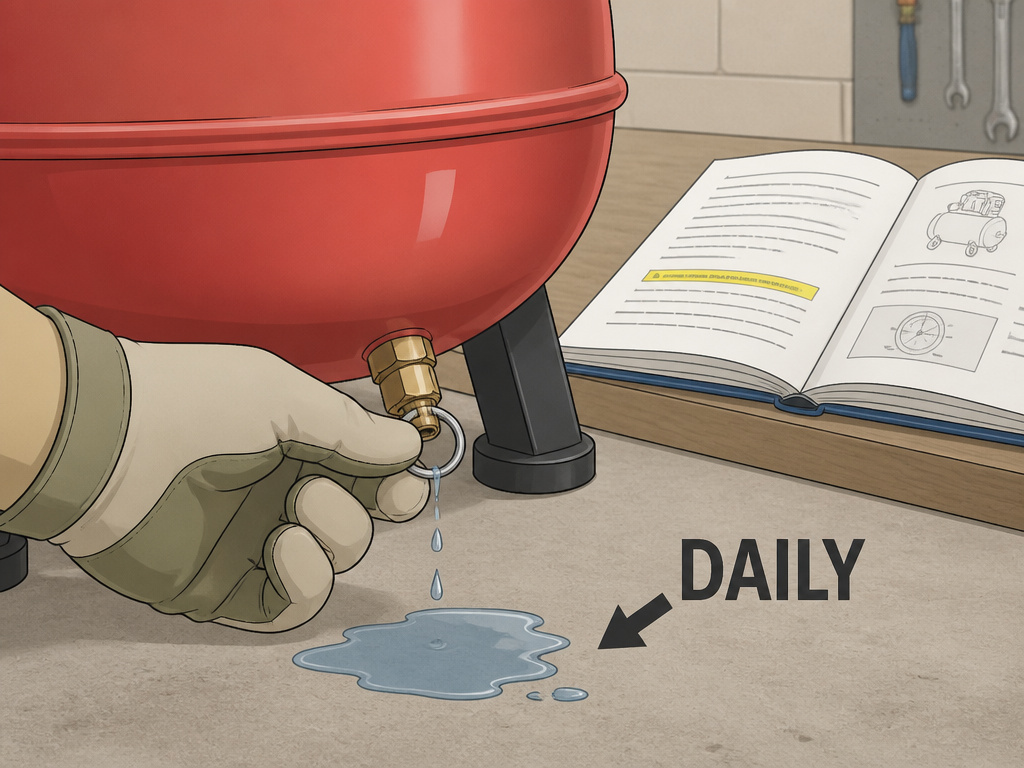
Manufacturers aren’t shy about the limits. They print them in the manual, but few people read that far. The most critical spec is the duty cycle, how long the compressor should run within an hour.
This is where sources disagree. The Porter-Cable C2002 manual recommends a 50%-75% average duty cycle (30-45 minutes of run time per hour). The The Home Depot S3GCOMP (3-gallon) manual is more conservative, recommending not more than 30 minutes run time in any given hour. The takeaway? Recommendations vary: Porter-Cable recommends a 50%-75% duty cycle (30-45 minutes per hour), while The Home Depot S3GCOMP manual recommends not more than 30 minutes per hour. It’s a start-and-stop machine.
Common mistake: Using an undersized extension cord. If you must use an extension cord, use the wire gauge recommended in the manual’s table for the length and amperage of your compressor.
Maintenance is essential and focused on one enemy: water. As air compresses, moisture condenses inside the tank. As air compresses, moisture can condense inside the tank. That water leads to rust, and as the U.S. Consumer Product Safety Commission has warned, air tank life is not infinite. Internal corrosion can lead to catastrophic tank failure.
- Drain the tank regularly to prevent corrosion. The Harbor Freight manual says daily and after use. The Home Depot S3GCOMP manual says daily and/or every hour depending on conditions. Pull the drain valve until you hear air, not water.
- Check the oil (if equipped). Some oil-lubed pancake models, like the The Home Depot 2275, exist. Its manual specifies maintenance every 6 months or 250 hours and to use only SAE 5W-30 motor oil.
- Inspect hoses and fittings. All components must be rated for at least 150 PSI or 150% of your max system pressure, per safety warnings. A blown hose is dangerous.
When a Pancake Compressor Is the Right (and Wrong) Choice
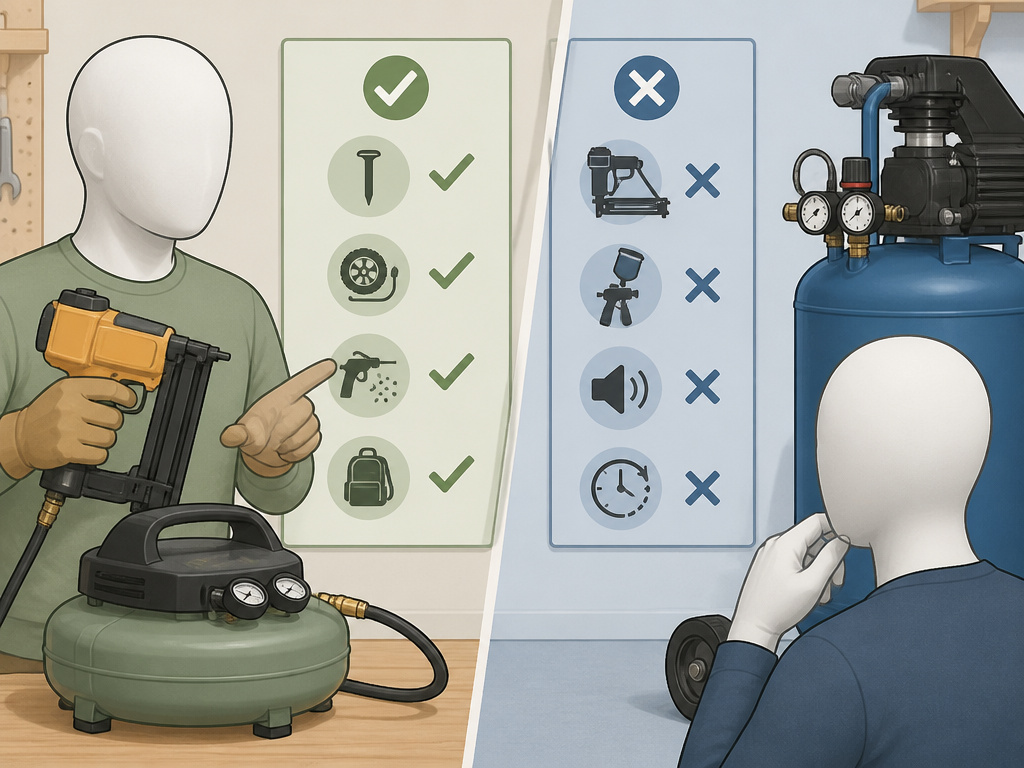
To be clear, a pancake compressor is a fantastic tool for a specific set of problems. A pancake compressor is a fantastic tool for a specific set of problems.
Choose a pancake if:
- Your primary tasks are intermittent nailing (trim, crown, baseboards), inflation (tires, toys, balls), or dust blowing.
- Storage space and portability are your top priorities, you need to carry it upstairs or haul it in a small car.
- You’re a homeowner or DIYer tackling weekend projects, not all-day production work.
- You want minimal maintenance and are okay with an oil-free pump’s trade-offs.
Avoid a pancake and size up if:
- You need to run a framing nailer for more than a few dozen nails at a time.
- Sanding, grinding, or spraying paint is on your project list. These are continuous-air tasks.
- Noise is a major concern in your workspace or neighborhood.
- You foresee daily or multi-hour continuous use, the pump and motor aren’t built for that life.
Frequently Asked Questions
Is a pancake air compressor worth it for a homeowner?
Absolutely, for the right homeowner. If your projects involve intermittent nailing, inflation, or dust blowing, a pancake compressor can be a high-utility tool. Its value is in its convenience and portability. Just know its limits before you try to run a demanding tool like an air sander.
How long do pancake air compressors last?
With proper maintenance, primarily diligent tank draining, a typical oil-free pancake compressor lasts 5 to 10 years under homeowner-level use. Heavier use shortens that lifespan. Tank corrosion from neglected draining is the other common killer.
Can a 6-gallon pancake run a framing nailer?
It can fire a framing nailer, but it can’t run one efficiently. A framing nailer might need 2.0-2.5 SCFM. While a 6-gallon pancake compressor might deliver 2.8 SCFM (like the Husky 6-gal), it will cycle on almost constantly to keep up. This strains the motor and turns a fast nailing job into a stop-and-go process. For a few dozen nails, it’s okay. For tasks requiring continuous high air flow, you need a compressor with a larger tank and higher CFM.
Are pancake compressors loud?
Yes. The oil-free pump design common to almost all pancake compressors is inherently louder than oil-lubricated pumps. Measured sound levels can be high; for example, the Harbor Freight 58636 lists 83 dBA at 3 feet. You should always wear hearing protection when operating one. Eye protection should meet standards like ANSI Z87.1.
What’s the most important maintenance task?
Draining the water from the tank. Every time. Moisture is inevitable, and rust weakens the steel tank from the inside. The U.S. Consumer Product Safety Commission has issued warnings about tank failure due to corrosion. Regularly draining the tank to remove moisture is a critical maintenance task for compressor longevity.
The Bottom Line
A pancake air compressor is a specific tool designed for a specific job. Its superpower is getting a useful amount of air into places a bigger compressor can’t go. Its weakness is that it can’t be that bigger compressor.
Check the required SCFM of your tool against the compressor’s delivered SCFM at the required pressure; if the tool needs continuous air flow near or above the compressor’s maximum output, a pancake may be inadequate. For everything below that line, the world of finish work, inflation, and light cleanup, a pancake is a brilliant, space-saving solution. Just remember to drain the tank. Every single time.
