
Ring Shank vs Smooth Shank Nails: Which Is Right for You?
This post contains affiliate links. As an Amazon Associate, we earn from qualifying purchases.
Ring shank nails have rings on their shank that mechanically lock into wood fibers, providing up to twice the withdrawal strength of smooth shank nails, which rely on friction. For most exterior, structural, or high-wind applications, ring shank nails are the required or recommended choice. Smooth shank nails are easier to drive and remove, making them ideal for interior framing, finish work, and temporary projects.
That gap in holding power is the whole game. It decides whether a deck board stays put for a decade or starts rattling in year three. It’s the difference between a roof that passes a wind-uplift test and one that doesn’t. This is the fundamental choice between ring shank vs smooth shank nails.
What follows is a breakdown of the mechanics behind each shank type in the ring shank vs smooth shank nails debate, the specific jobs they’re built for, and the building codes that sometimes mandate one over the other. We’ll also cut through the marketing noise about wind ratings and give you a straight comparison you can use at the lumberyard.
Key Takeaways
- Ring shank nails have twice the withdrawal strength of smooth shank nails, per the Forest Products Laboratory.
- Building codes, like those from the International Code Council, classify ring shanks as ‘deformed’ and often mandate them for high-wind zones and subfloor assemblies.
- Use smooth shank nails for fast installation and easy removal in interior framing, trim, and temporary projects.
- For roofing, check the shingle manufacturer’s spec; some, like IKO and CertainTeed, do not tie their wind rating to nail shank type when installed correctly.
- Always match the nail coating (galvanized, stainless) to the project’s environment, not just the shank type.
The Holding Power Showdown: Withdrawal vs. Shear
The ring shank vs smooth shank nails debate isn’t about which nail is “stronger.” It’s about what kind of strength you need. Nails face two main forces: withdrawal (pull-out) and shear (sideways snap). The shank design targets one far more than the other.
A smooth shank nail depends mostly on friction between its shank and the wood fibers. A ring-shank nail has raised rings that engage the wood more aggressively, creating mechanical resistance inside the wood. Source: Anawalt Lumber on Nail Withdrawal vs. Shear Strength
Smooth shank nails are a friction fit. They slide in easy and are suitable for applications where only moderate holding power is needed, but are not recommended for high-tensile applications like roofing, beaming, or decking. But wood moves. It expands with humidity, contracts when dry, and vibrates under load. Each cycle can loosen that friction grip. You’ve seen the result: popped subfloor nails that squeak, or fence pickets that work themselves loose over a few seasons.
Ring shank nails work differently. Those rings aren’t decoration. As you drive the nail, they force wood fibers to deform around and into the grooves. It’s a one-way mechanical lock. To pull the nail out, you have to shear or compress all those trapped fibers. That’s why studies show such a dramatic difference. The Forest Products Laboratory states ring-shank nails have twice the withdrawal strength of smooth-shank nails. Other testing, like that cited by Nailicy, shows ring shanks can exhibit up to 30% greater withdrawal resistance.
So, which one has higher shear strength? Honestly, it’s a tie. Shear strength, the nail’s resistance to snapping sideways, is governed mostly by the nail’s diameter (gauge) and steel quality, not the shank texture. Shear strength is governed mostly by the nail’s diameter (gauge) and steel quality, not the shank texture. The rings don’t make the steel itself stronger; they just make it much harder to pull back out.
The short answer is: if the force is trying to pull the nail straight out (withdrawal), ring shank wins every time. If the force is trying to snap it sideways (shear), the shank type is almost irrelevant, diameter is king.
| Force Type | Ring Shank Nail | Smooth Shank Nail | What Matters Most |
|---|---|---|---|
| Withdrawal (Pull-Out) | Excellent (2x strength) | Good (relies on friction) | Shank design |
| Shear (Snap/Sideways) | Good | Good | Nail diameter (gauge) & steel grade |
| Best For | Resisting uplift, vibration, wood movement | Applications where load is primarily shear | Matching the force to the fastener |
When Code and Climate Dictate Your Choice
You might pick a nail based on logic, but your local building department picks based on code. This is where the “deformed shank” classification comes in, and it directly limits where you can use smooth nails.
The International Code Council classifies smooth-shank nails as ‘common’ and screw- or ring-shank nails as ‘deformed.’ Their position is clear: Deformed nails are only really required in high-wind zones and in some subfloor assemblies. This is a minimum standard for structural integrity in those risk areas.
Common mistake: Using smooth shanks for roof sheathing in a high-wind zone. Sources disagree on this point: while the International Code Council states deformed nails are only really required in high-wind zones, New England Metal Roof reports many U.S. Codes mandate them for enhanced wind resistance, especially in hurricane-prone zones. An inspector will flag smooth shanks on a sheathing job in these areas every time.
This codified preference is a response to real-world failures. For pole barn construction, which presents a large surface area to wind, experts are blunt. Milmar Buildings states: “If you’re constructing a pole barn, you must use ring shank nails for added security to your exterior shell.” The stakes are too high for the friction-based hold of a smooth shank.
The climate beyond wind also matters. Any exterior application faces seasonal expansion and contraction. Deck boards swell in the summer heat and shrink in the winter cold. Siding does the same. Each cycle is a tiny pull on the fastener. A smooth shank can inch its way out over thousands of cycles. A ring shank’s mechanical lock resists that creep. That’s why recommendations are so uniform: use ring shanks for decking, siding, and exterior sheathing.
The Roofing Debate: Wind Rating vs. Fastener Style
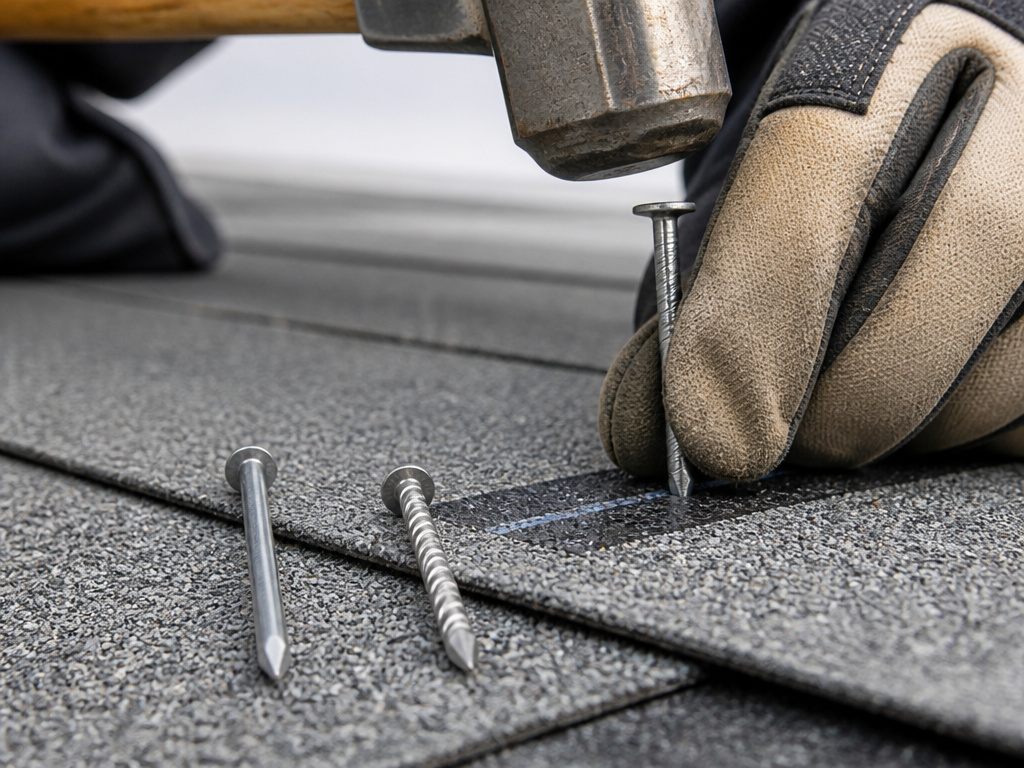
Here’s where things get interesting, and where a lot of well-intentioned advice overshoots the mark. There’s a persistent myth that using a ring shank nail automatically increases your roof’s wind rating. For some specific asphalt shingles, the manufacturers themselves say that’s not true.
Camel City Roofing analyzed the specs for IKO Dynasty and CertainTeed Landmark Pro shingles. Their finding was clear: “For IKO Dynasty and CertainTeed Landmark Pro shingles, the type of nail (smooth shank or ring shank) does not change the manufacturer’s wind rating when installed correctly.” The wind resistance is determined by the entire system performance, shingle adhesive strip activation, nailing pattern, and penetration, not by the shank style alone.
Where this goes sideways: Assuming ring shanks are a magic bullet for roofing. If you nail outside the marked area, use too few nails, or don’t achieve proper penetration, even a ring shank won’t save the installation. The shingle material or seal strip will fail before the nail withdraws.
This doesn’t make ring shanks useless for roofing. Far from it. They provide a massive safety factor against the gradual loosening that weather cycles cause. Many codes still mandate them, especially in high-wind regions. The key is to follow the shingle manufacturer’s installation instructions first. If they specify a nail type and length, use it. Their warranty depends on it.
If the manufacturer is silent or allows either, here’s my pragmatic take: For roofing in high-wind zones or where maximum durable hold is desired, many sources recommend ring shank nails. The peace of mind is worth it.
A Quick Decision Guide: Which Nail for Which Job?
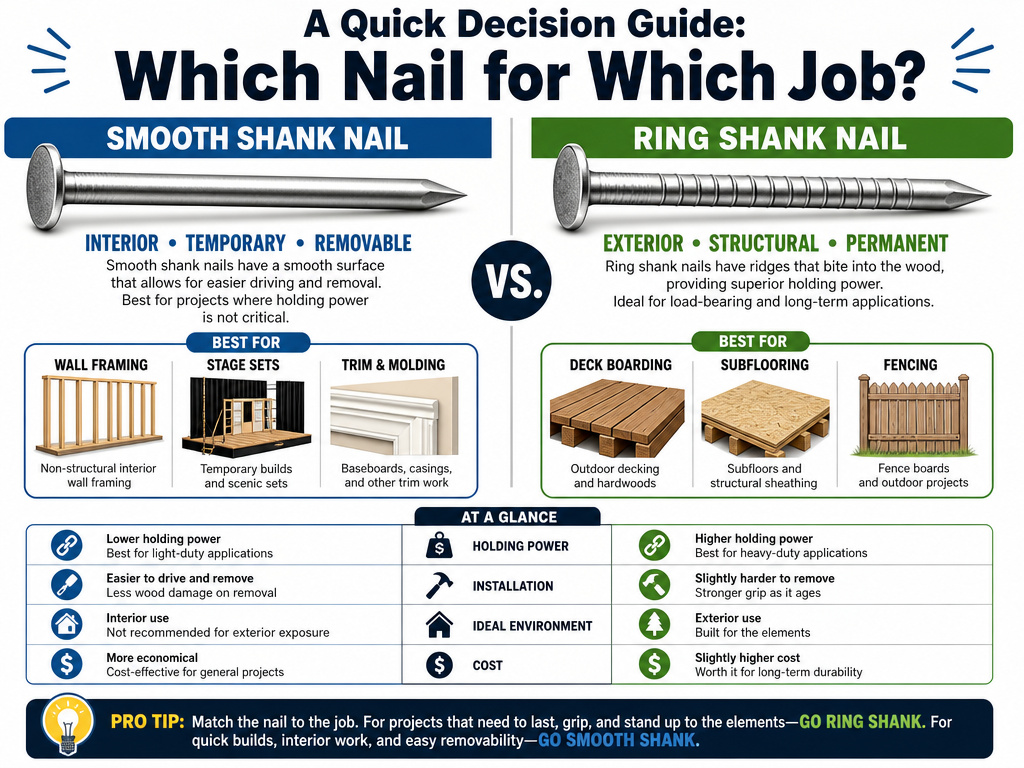
Now, apply the theory to your own tools. When you’re standing at the hardware store, this is the breakdown you need.
Use Smooth Shank Nails When:
- You’re doing interior framing (walls, non-structural partitions).
- The project is temporary or might need disassembly (stage sets, concrete forms).
- You’re installing interior trim (baseboards, crown molding) and need easy, clean removal later.
- Speed of installation is the top priority, and only moderate holding power is needed.
- JakeSales.com sums it up: when you need fast installation, the nail might be removed later, and only a moderate level of holding power is needed.
Use Ring Shank Nails When:
- The application is exterior (decking, siding, fencing).
- Structural integrity is critical (subflooring, roof/wall sheathing, nailing plywood to floor joists).
- The project is in a high-wind zone or must meet specific building codes.
- The materials will experience seasonal movement (wood decks, cedar siding).
- You are installing hardwood flooring and need to resist squeaks.
- JakeSales.com again: when you need maximum holding power and are working outdoors.
I learned the hard way that a framing nailer is a terrible tool for trim. The power and nail size are all wrong. That’s why we have different classes of tools, and different classes of fasteners. Matching them is the whole job.
What about other shank types? Screw-shank (spiral) nails are a great middle ground. They turn as they drive, like a threaded fastener, which gives them better withdrawal resistance than smooth shanks and reduces the risk of splitting hardwoods. They’re a classic choice for squeak-free hardwood flooring.
Installation Reality: Driving Force and Tool Compatibility
The holding power of a ring shank nail comes at a physical cost: it takes more effort to drive it. Those rings create tremendous friction on the way in.
With a hammer, you’ll feel the difference immediately. A smooth shank sinks with a series of solid whacks. A ring shank often feels like it’s fighting you, especially in dense lumber. You need a more deliberate, powerful swing to set it flush.
The difference is even more pronounced with nail guns. Not all nailers are created equal for this job. A low-powered, clipped-head framing nailer might struggle to fully seat a ring shank, leaving it proud and useless. You need a tool with sufficient driving force. Ring shank nails create more friction, so a nail gun must have sufficient driving power to set them flush. Always check that your framing nailer is rated for the specific collated nails you’re using, especially if they’re ring shank.
Removal is the other side of the coin. Pulling a smooth shank nail is a standard, if tedious, task. Pulling a ring shank is a demolition event. The rings are designed not to let go. You will almost certainly damage the surrounding wood, and you might not get the nail out intact. This is a feature, not a bug, it means your structure is secure, but it’s a final reminder that these nails are for permanent installations.
The Coating is Non-Negotiable
We’ve talked shank, but the shank’s material is just as critical. The best ring shank nail is worthless if it rusts away in two seasons. On this point, my view is firm: always use galvanized or stainless-steel nails for any exterior application.
The Fact Sheet from New England Metal Roof is blunt: “Avoid using plain steel nails, which will rust quickly and cause damage to the entire roofing system.” That rust doesn’t just make the nail weak; it stains your siding or deck and can corrode into the surrounding wood, causing decay.
For exterior applications, use galvanized or stainless-steel nails to prevent rust. Hot-dipped galvanized nails provide rust resistance for exterior applications. For areas with high corrosion risk, such as coastal zones, stainless steel nails are recommended. Yes, it costs more. But replacing a stained, failing deck costs infinitely more.
This rule holds for choosing a trim nailer for exterior siding or for nailing shiplap in a bathroom. If moisture is present, protect the fastener. The shank holds the wood together; the coating holds the nail together.
Cost comparison
Smooth shank nails are often chosen for cost-sensitive applications where enhanced pull-out resistance is not needed. Their simpler manufacturing and classification as ‘common’ nails make them the default, budget-friendly choice for many basic framing and construction tasks. Ring shank nails, classified as ‘deformed’, involve a more complex manufacturing process to create the ridges that provide superior grip. This extra step translates to a higher price per nail. Use smooth shank nails when you need fast installation, the nail might be removed later, and only a moderate level of holding power is needed. Choose ring shanks when the project demands maximum holding power for outdoor applications or where building codes specifically require them.
Nail diameter vs. Shank type trade-off
Choosing a nail involves balancing its diameter (or gauge) with its shank type. A thicker smooth shank nail provides more shear strength but doesn’t solve pull-out problems. A ring shank nail of the same diameter offers significantly greater withdrawal resistance than a smooth shank nail. This is why building codes often specify ring shanks for sheathing and subfloor assemblies; the deformed shank compensates for the typical gauge used in these applications to prevent nails from working loose. For maximum security, especially in outdoor or high-wind applications, the combination of an adequate diameter with a ring shank is the standard recommendation to resist both shear and withdrawal forces effectively.
Frequently Asked Questions
Are ring shank nails required for roofing?
It depends on your local building code and the shingle manufacturer’s instructions. Many codes, especially in high-wind zones, mandate ring shank nails for roof sheathing and often for the shingles themselves. However, some manufacturers (like IKO and CertainTeed for specific product lines) state that a correct installation with smooth shank nails can still achieve their published wind rating. Always check the manufacturer’s spec sheet first.
Can I use ring shank nails in a nail gun?
Yes, but you must ensure your nail gun has sufficient driving power. Ring shank nails create more friction, so a underpowered or worn nailer may not set them flush. Use the correct collated nails designed for your specific framing nailer model, and consider a tool with a higher driving force rating for all-ring-shank work.
What are ring shank nails best for?
Ring shank nails are best for any application where maximum withdrawal resistance is needed and the installation is permanent. This includes decking, siding, fencing, roof sheathing, subflooring, and securing plywood to floor joists. They excel outdoors and in situations subject to wind, vibration, or wood movement.
When should I not use ring shank nails?
Avoid ring shank nails for temporary work, interior framing where disassembly might be needed, and delicate trim work where you might need to remove the fastener later without destroying the wood. They are also harder to drive, so for large-volume interior framing where speed is key, smooth shanks are more efficient.
How much stronger are ring shank nails?
Sources disagree on the magnitude of improvement: the Forest Products Laboratory states ring-shank nails have twice the withdrawal strength, while Nailicy reports up to 30% greater withdrawal resistance. Both numbers point to a substantial, code-worthy improvement in holding power.
The Bottom Line
Forget the generic advice. Your nail choice boils down to one question: is this a permanent, structural, or weather-exposed joint? If yes, the answer is almost always a ring shank nail. The cost increment over smooth shanks is trivial compared to the cost of a repair or failure.
If you’re working indoors, on non-structural walls, or on anything temporary, smooth shanks are the efficient, correct choice. They’re easier on your tools, your arms, and the wood if you ever need to take things apart.
One final, practical step: before you buy any box, read the label. It should tell you the shank type, the coating, the length, and the gauge. Matching all four to your project, not just length, is how you build something that lasts. Everything else is just hammering.
