
Siphon vs Pressure Sandblaster: Which Should You Buy?
This post contains affiliate links. As an Amazon Associate, we earn from qualifying purchases.
Siphon sandblasters (also called suction blasters) pull abrasive from an open hopper using a vacuum, while pressure sandblasters force media from a sealed, pressurized tank. For most DIY and hobby work, a siphon blaster like the LE LEMATEC AS118-2C is the practical choice, running on 4 CFM at 90 PSI from a typical garage compressor. For heavy-duty, continuous work like auto restoration, a pressure pot like the VEVOR 5 Gallon model is faster and more aggressive, but needs at least 6-25 CFM. VEVOR recommends a 5.5 kW (~7.5 HP) compressor, though some users report needing larger units for optimal performance.
That gap between 4 CFM and 25 CFM is the whole story, it’s not about power alone, it’s about what your air supply can actually sustain. A pressure pot promises a deeper clean, but only if your compressor can feed it without stalling. A siphon system trades some speed for simplicity, forgiving smaller compressors but demanding patience on big jobs. The core choice often comes down to a siphon vs pressure sandblaster.
What follows: the real-world specs that decide it, a clear guide to matching blaster to compressor, and the safety gaps most guides skip. You’ll know which one fits your projects by the end, and you’ll understand why the wrong choice ends in a cloud of frustration, not a clean surface.
Key Takeaways
- Pressure sandblasters deliver a much higher material flow than siphon systems, stripping rust or paint in minutes instead of hours, but demand large, expensive compressors.
- Match your air compressor’s CFM output to the blaster’s requirement. According to a general guide, a gravity-fed sandblaster needs 6+ CFM for uninterrupted work (or 4-5 CFM for short bursts), while a pressure pot like the VEVOR 5 Gallon model can pull 6-25 CFM.
- For DIY, hobby glass etching, or light rust removal, a siphon-fed system is the smarter buy. For prosumer auto work or large-scale surface prep, a pressure pot justifies its cost and compressor demands.
- Always wear a NIOSH-approved respirator and use aluminum oxide or glass beads instead of silica sand, silica dust is a known carcinogen and clogs equipment faster.
- The critical accessory is an oil-water separator. Moisture in your air line turns abrasive media into wet cement inside the blast gun, stopping work instantly.
Performance, Speed, and Aggressiveness
The difference hits you in the first ten seconds. A pressure pot sandblaster delivers a dense, roaring stream of abrasive. A siphon system feels like a focused, gritty spray. One is a fire hose, the other a garden hose. This isn’t just a feeling, it’s physics.
A pressure system pressurizes the entire media tank, forcing abrasive out with the compressed air. Every particle is accelerated, resulting in higher impact force. A siphon system relies on the Venturi effect; air rushing past a pickup tube creates a vacuum that sucks media into the airstream.
A VEVOR 5 Gallon pressure blaster can demand up to 25 CFM depending on nozzle size, delivering a dense, high-impact stream ideal for stripping heavy rust. A LE LEMATEC AS118-2C siphon blaster uses 4 CFM at 90 PSI, producing a lighter, more controlled spray perfect for etching or light cleaning.
The numbers tell the story. In practical terms, a pressure pot will strip a car fender to bare metal significantly faster than a siphon blaster, with less media waste. The trade-off is cost and complexity. That aggressive power requires a compressor that can keep up, which we’ll get to next.
Bottom line: If your definition of “job” is a weekend project on a patio set or some decorative glass, siphon is fine. If “job” means stripping a boat hull or prepping a steel beam for industrial coating, only a pressure pot has the muscle.
Compressor Requirements: The Deal-Breaker Spec
This is where projects fail before they start. Buying a sandblaster without checking your compressor is like buying a trailer without checking your vehicle’s tow rating. The mismatch leaves you stranded.
Here’s the main point: your compressor’s tank size (gallons) matters less than its CFM delivery (cubic feet per minute). A large tank only allows you to blast for more time between compressor cycles. It’s the CFM that determines if you can blast at all without constant stalling.
| Blaster Type | Typical CFM Range | Compressor Equivalent | What Happens If Underpowered |
|---|---|---|---|
| Siphon/Gravity | 4–7 CFM | 20+ gallon portable | Blasting stops frequently as compressor struggles to refill; media flow becomes inconsistent and weak. |
| Small Pressure Pot | 6–15 CFM | 5.5kW / ~7.5 HP stationary | Pressure in the pot drops, media flow sputters, and you’ll spend more time waiting than working. |
| Heavy-Duty Pressure Pot | 15–25 CFM | Industrial 10+ HP two-stage | The compressor cannot maintain pressure, the blast stream dies, and you risk overheating and damaging the compressor motor. |
The VEVOR 5 Gallon Pressure Blaster’s manual recommends a 5.5 kW (about 7.5 HP) compressor. That’s a serious, stationary unit, not a portable pancake compressor. The LE LEMATEC AS118-2C sips just 4 CFM, which a 20-gallon shop compressor can handle.
Where this goes sideways: Assuming your 6-gallon “portable” compressor (outputting ~2-3 CFM) can run any sandblaster. It can’t. You’ll burn out the motor trying, and you’ll never finish the job.
Your first step in choosing an air compressor for sandblasting is to find the CFM spec for the blaster you want. Then, find a compressor whose continuous CFM output at your working PSI meets or exceeds that number. Tank size is your second concern. This single check saves hundreds on wasted equipment.
Cost, Setup, and Operational Complexity
A siphon kit wins on simplicity and upfront cost. You get a gun, a hose, and a pickup tube. Hook it to your compressor, stick the tube in a bucket of media, and you’re basically ready.
The price gap reflects this. A pressure pot like the Northern Tool + Equipment 10-gallon model requires a larger investment than a basic siphon kit. But the real cost isn’t just the sticker price, it’s the total system cost, including the required compressor.
Operational costs diverge too. Pressure pots are more efficient with media, meaning you use less abrasive to remove more material. Siphon systems waste more media into the environment (and onto your floor). Over many projects, that media cost adds up. However, pressure pots have more wear parts, ceramic nozzles erode faster under high pressure and volume, and seals need more frequent replacement.
For a detailed look at the ongoing costs of abrasive, see our guide to sandblasting media, which covers the price and performance of everything from walnut shells to aluminum oxide.
The setup time surprise: Unboxing and setting up a pressure pot for the first time can easily take an hour, assembling the cart, connecting hoses, testing valves, and learning the pressurization sequence. A siphon gun is a ten-minute job. Factor that into your decision if you only blast occasionally.
Best Applications and Use Cases
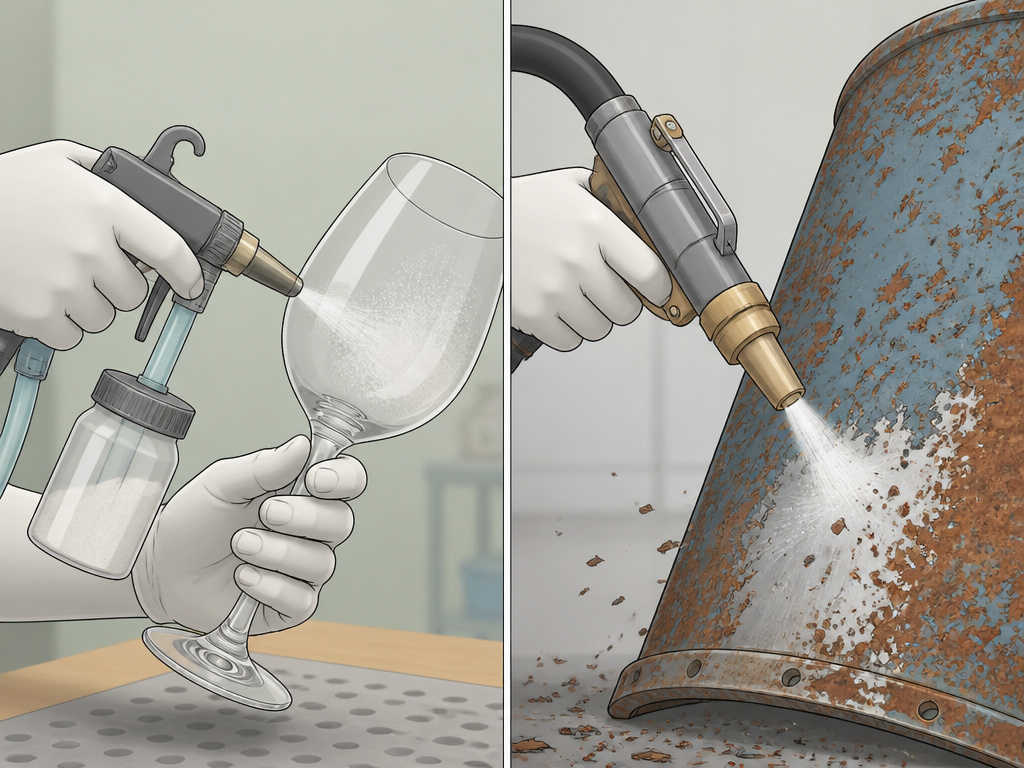
Don’t choose a tool based on what it can do; choose it for what it’s best at. Here’s how they break down in the real world.
Choose a Siphon Sandblaster if you:
- Etch glass, frost mirrors, or create decorative designs.
- Clean light rust or old paint from small metal items (tools, brackets, patio furniture).
- Work in a home garage with a standard 20-30 gallon air compressor.
- Value portability and simple storage.
- Are new to the sandblasting process and want a low-risk learning curve.
The dual-feed LE LEMATEC AS118-2C is a classic example here. Its gravity feed is perfect for delicate glass etching, while switching to siphon mode gives you more power for small metal parts.
Choose a Pressure Pot Sandblaster if you:
- Strip auto frames, boat hulls, or large architectural metalwork to bare metal.
- Run a small commercial shop doing restoration work daily.
- Need to profile concrete or prepare large steel surfaces for industrial coating.
- Already own or are willing to invest in a large, stationary air compressor (7.5 HP or larger).
The VEVOR 5 Gallon or the Northern Tool 10-gallon models fit this profile. Their sealed tanks let you work for extended periods without refilling, which greatly improves productivity.
The wrong pairing in the siphon vs pressure sandblaster choice is painful. Using a siphon gun on a car frame will make you question your life choices after the first hour. Using a pressure pot to etch a wine glass is like using a chainsaw to carve a toothpick, overkill, messy, and likely destructive.
Safety, Maintenance, and Media Control
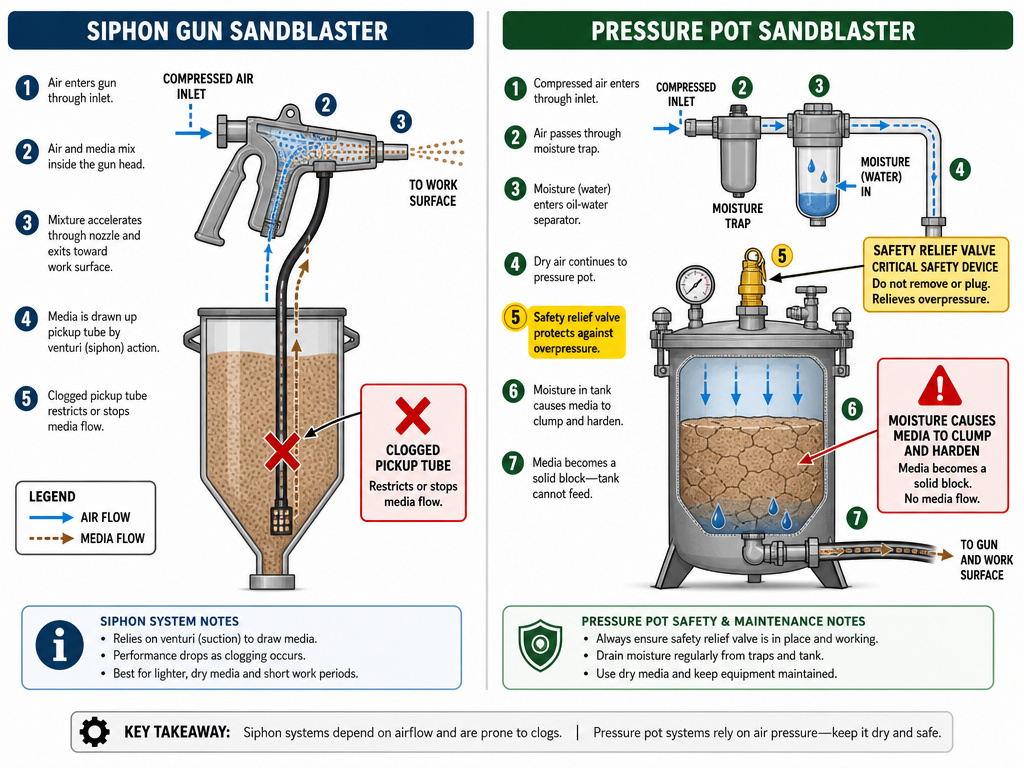
All abrasive blasting is messy and hazardous. But pressure pots introduce specific, higher-stakes risks. The tank is a pressure vessel. While they have safety relief valves, improper use or modification can lead to catastrophic failure. You must follow the manufacturer’s pressurization and depressurization sequences exactly.
Both types share the universal rule: respirator, respirator, respirator. Silica dust from common sand is a serious health hazard. Even with other media, a cloud of fine particulate is terrible for your lungs. A NIOSH-approved respirator with P100 filters is absolutely essential. This is the core of any essential sandblasting safety protocol.
Maintenance differences:
- Siphon guns clog more often, especially if media is damp. The fix is usually just clearing the pickup tube or nozzle. Ceramic nozzles still wear, but slower due to lower pressures.
- Pressure pots have more valves and seals to maintain. The oil-water separator is critical; if it fails and moisture enters the tank, your entire load of media can turn into a solid, rock-hard block. Cleaning that out is a multi-hour nightmare.
Media control is another key difference. Pressure pots offer superior control over the media stream’s density and consistency. You can dial in the pressure for a lighter etch or an aggressive strip. Siphon feed is more binary, it’s either flowing or it’s not, and the flow is inherently less dense. For fine art or detailed work, this can be a benefit, as it’s harder to over-blast and damage a substrate.
The Siphon vs Pressure Decision Flowchart
You’ve seen the specs, the costs, and the use cases. Now, confirm your choice by following a direct path. Answer these questions in order.
-
What is your primary project?
- Glass etching, light rust, small DIY items → Strong lean toward Siphon.
- Auto restoration, large-scale rust/paint removal → Proceed to question 2.
-
What is your air compressor’s continuous CFM output at 90 PSI?
- Less than 6 CFM → Your choice is made: Siphon is your only viable option. Consider our recommended sandblaster models for options.
- Between 6 and 15 CFM → You can run a small pressure pot (like a 5-gallon unit) effectively, but monitor for stalling.
- Over 15 CFM → You have the air for a heavy-duty pressure pot. This is where they shine.
-
What is your budget for the total system (blaster + capable compressor)?
- Tight budget → Siphon.
- Significant investment possible → Pressure Pot.
This flowchart cuts through the noise. It forces you to confront the limiting factor, your air supply, before you get seduced by the power of a pressure system you can’t actually run.
Frequently Asked Questions
Are pressure washer sandblasting attachments any good?
They are a different tool category entirely. Pressure washer sandblasters use water to propel a small amount of media. They are messy, use media extremely inefficiently, and are best for very light cleaning on soft surfaces like wood or brick. For metal, glass, or any serious surface prep, a true air-powered siphon or pressure sandblaster is vastly superior.
What is the best type of sandblaster for a beginner?
Siphon-fed sandblaster kit is the best starting point. It’s affordable, works with common garage compressors, and has a gentle learning curve. The LE LEMATEC AS118-2C is often a top pick because its dual gravity/siphon feed allows you to learn both techniques. Start with a forgiving media like crushed glass or plastic beads.
What is the most aggressive blast media?
For cutting speed on hard metals, aluminum oxide is the benchmark. For heavy rust and paint stripping on steel, steel grit is extremely aggressive but will rapidly wear out equipment not designed for metallic media. Never use steel grit in a siphon system designed for softer abrasives.
Which compressor is best for sandblasting?
There is no single “best”, it depends entirely on your blaster. For siphon systems, a compressor delivering the required CFM (e.g., 4 CFM for the LE LEMATEC at 90 PSI) is essential. For pressure pots, you need to match the blaster’s CFM demand, often requiring a 5.5 kW (7.5 HP) or larger stationary compressor. Always prioritize the CFM rating over the tank size.
The Bottom Line
Here’s the one rule that decides it: match the tool’s appetite for air to your compressor’s ability to supply it. Ignore this, and you own an expensive paperweight.
For the vast majority of DIYers and hobbyists tackling weekend projects, a siphon sandblaster is the right tool. It gets the job done without forcing a four-figure compressor upgrade. The LE LEMATEC AS118-2C covers both delicate and moderate work.
If your work is commercial, or if your idea of a DIY project is restoring a classic car in your home shop, you’ve graduated to pressure pot territory. The VEVOR 5 Gallon model is the entry point. Accept that it comes with a significant compressor requirement, a 5.5 kW unit is the starting line, not the finish.
Before you buy anything, open your compressor manual. Find its true, sustained CFM output at 90 PSI. That number, more than any brand name or feature list, tells you which sandblaster you can actually use. Everything else is just marketing until you turn the air on.
