
Types of Drills Explained: How to Choose
This post contains affiliate links. As an Amazon Associate, we earn from qualifying purchases.
A power drill’s job is to rotate a cutting tool, but the best way to deliver that rotation depends entirely on what you’re drilling or fastening. Drill drivers rotate the bit smoothly, hammer drills pound while spinning for masonry, impact drivers deliver sudden rotational hits for high torque, and rotary hammers use a separate piston mechanism for serious concrete work.
That basic distinction decides your project’s success or failure. A standard drill can’t sink a lag bolt into a deck joist without stripping, and an impact driver will turn a ceramic tile into powder. The key is matching the tool’s mechanism to the material you’re fighting, which is why understanding the different types of drills explained is so crucial.
What follows is a breakdown of each drill type by how it actually works, the material it’s designed for, and the common mistake that breaks it, building on the types of drills explained earlier. By the end, you’ll be able to listen to a tool’s sound and know what job it was built for.
Key Takeaways
- A drill driver rotates a chuck smoothly and is your go-to for drilling clean holes in wood, plastic, and metal.
- A hammer drill adds a pulsing, axial pounding motion to its rotation, intended for drilling into brick, concrete block, or stone, but it struggles with solid concrete.
- An impact driver delivers sudden, rotational torque impacts, making it the best tool for driving large screws and bolts, not for drilling precision holes.
- For drilling into structural concrete, a rotary hammer with its separate piston mechanism is the only correct tool; a hammer drill will burn out prematurely.
- The most common drill buying mistake is prioritizing extreme torque ratings over chuck quality and clutch feel, which leads to poor hole accuracy and control.
What’s a Drill Driver (or Standard Drill)?
Think of the tool in most home workshops. This is the drill driver.
It uses an electric motor to turn a chuck, the gripping mechanism at the front, in a smooth, continuous rotation. That rotation drives a drill bit through wood, plastic, or metal. For most DIYers, a cordless drill driver is the more useful daily tool.
The drill driver is defined as a tool equipped with a typical three-jaw chuck designed to bore holes in materials like metal, plastics, and wood, consisting of a drill unit and a stand. This is the baseline for rotary cutting power.
A drill driver has a two-speed gearbox. Low gear provides high torque at lower RPM for driving screws or drilling large holes. High gear gives you high speed with less torque for smaller bits. The clutch, that numbered collar behind the chuck, is critical. It disengages the motor when a preset torque is reached, preventing you from over-driving a screw head or stripping threads. I see people leave the clutch on the drill setting for all operations, which is a recipe for a dangerous kickback if the bit binds.
Where this goes sideways: Using the drill’s highest torque setting for drilling holes. The clutch is meant for driving screws. For drilling, you need the clutch disengaged entirely (usually marked with a drill bit icon) to deliver full, direct power to the bit. Using a torque setting means the drill will stall or slip the instant the bit meets serious resistance, often right as it’s about to break through the material.
What’s a Hammer Drill?
A hammer drill looks like a beefier drill driver. It adds a second mechanical action: as the chuck spins, a set of toothed, ratcheting plates inside the tool slam it forward in a rapid, pounding motion.
This axial percussion helps fracture brittle materials like brick, concrete block, and stone as the rotating bit scrapes away the debris. You can usually switch the hammering action off, turning it into a standard drill driver. These tools use special SDS-plus, SDS-top, or SDS-max fitting bits (like those from Bosch), which have a slotted shank that allows for this back-and-forth motion while transferring rotation.
Common mistake: Believing a hammer drill is the right tool for drilling into a concrete foundation or slab. It’s not. The mechanism is too light, generating impact through gear teeth rather than a dedicated piston. You’ll burn through bits, overheat the tool, and make painfully slow progress. For anything more than a few shallow holes in soft masonry, you need a different machine.
What’s an Impact Driver?
This tool is often confused with a hammer drill because of the word “impact,” but its mechanism is completely different. An impact driver delivers its power in sudden, rotational impacts.
Inside, a heavy spring-loaded hammer rotates and strikes an anvil connected to the chuck. These repeated, high-torque “hits” happen dozens of times per second, allowing the tool to drive large screws or loosen stubborn bolts that would stall a standard drill. It doesn’t have a three-jaw chuck; it uses a 1/4-inch hex quick-release chuck that accepts screwdriver bits and socket adapters.
I won’t recommend an impact driver for any drilling operation that requires a clean, precise hole. The impact mechanism introduces a tiny rotational lag at the start of each blow, which can cause the bit to “walk” or chip the material edge. It’s a fastener tool, not a hole-making tool.
It also sounds completely different. A drill driver hums. A hammer drill makes a rapid, grinding brrrrr sound. An impact driver produces a distinctive, loud brrrrt-BAP-BAP-BAP as the impacts engage under load. You can diagnose a tool’s type by ear from across the workshop.
What’s a Rotary Hammer (or SDS Rotary Hammer)?
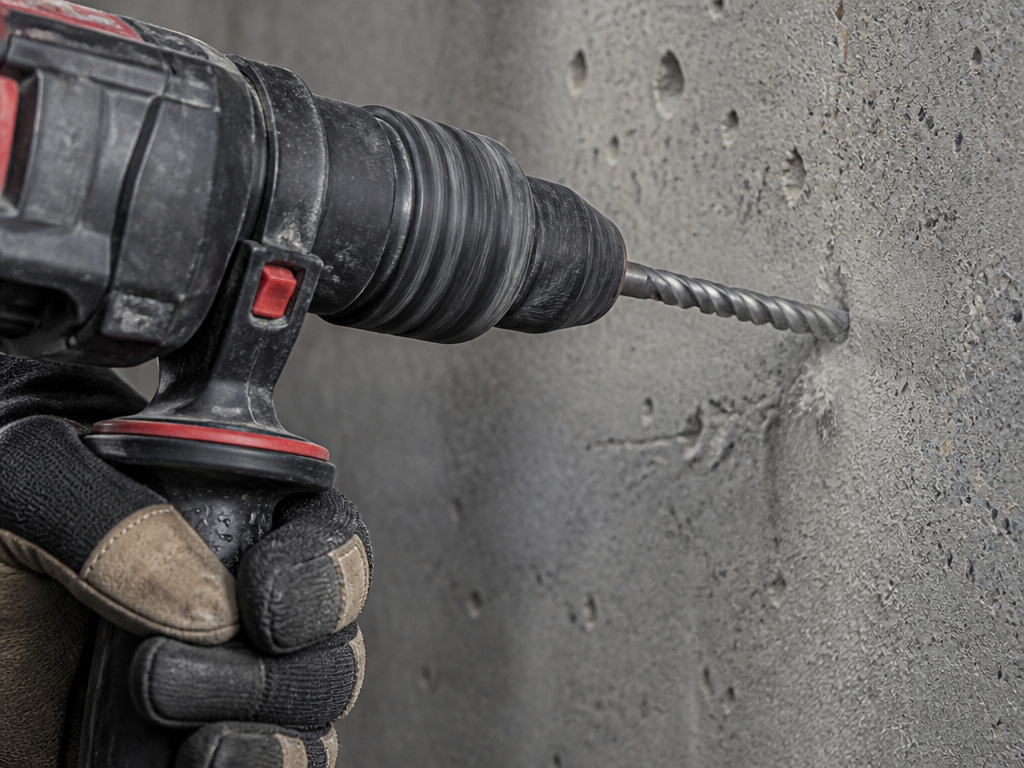
This is the tool you actually need for drilling into poured concrete. A rotary hammer uses a true electro-pneumatic or electro-mechanical piston. When you pull the trigger, a piston drives a striker that impacts the bit directly, separate from the rotation mechanism. This delivers far more impact energy per blow than a hammer drill’s ratcheting plates.
They use the same SDS shank system for bits but are in a different power class entirely. A hammer drill is for light masonry; a rotary hammer is for structural work. The difference isn’t academic. Try drilling a 1/2″ hole 4 inches deep into a foundation wall with a hammer drill. You’ll be there all day, and the drill motor will smell like burnt wiring by the second hole. Switch to a rotary hammer, and the same hole is done in under thirty seconds with a cool-running tool.
The Big Decision Matrix: Which Drill When?
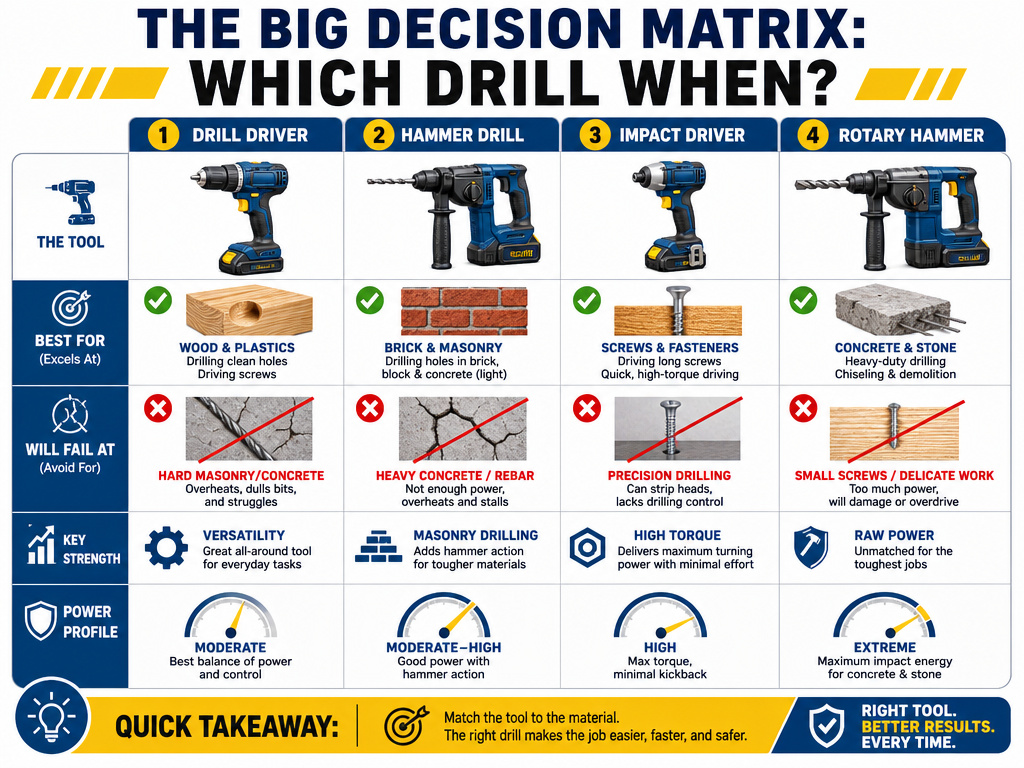
Most jobs fit neatly into one of these four categories of the types of drills explained. Your choice is simpler if you match the primary action to the task.
| Drill Type | Primary Action | Best For | Will Fail At |
|---|---|---|---|
| Drill Driver | Smooth rotary torque | Drilling clean holes in wood/metal/plastic, driving small screws | Driving large lag bolts, drilling into masonry |
| Hammer Drill | Rotary + axial pounding | Drilling into brick, block, soft stone | Drilling into structural concrete, driving screws (impractical chuck) |
| Impact Driver | High-torque rotational impacts | Driving/deck screws, lag bolts, loosening stubborn fasteners | Drilling precise holes, drilling into any masonry |
| Rotary Hammer | High-energy piston impacts + rotation | Drilling anchor holes in concrete, chiseling, core drilling | Any task requiring finesse or a standard round-shank drill bit |
Drill Bit Compatibility: It’s All in the Chuck and Shank
You can’t talk about drill types without mentioning what goes in the end. The chuck, how it grips, and the bit shank, how it’s held, must match exactly.
- Keyed & Keyless 3-Jaw Chucks: The standard on drill drivers and many hammer drills. They grip round-shank twist bits, spade bits, and hole saws. A keyless chuck is convenient; a keyed chuck often provides a tighter, truer grip with less bit wobble.
- 1/4″ Hex Quick-Change Chuck: Found on impact drivers and some compact drill drivers. Only accepts bits and adapters with a hex shank. You can’t put a standard round twist drill bit directly into an impact driver.
- SDS Chuck System: Used by hammer drills and rotary hammers. The bit has special grooves that lock into the chuck, allowing it to slide back and forth for the hammer action while still transmitting rotation. You cannot put an SDS bit into a standard 3-jaw chuck.
Beyond the Basics: Specialized Drill Types
Once you move past the core four, specialized tools solve specific access or precision problems.
Drill Press: This is a stationary drill where the workpiece is brought to the tool. It provides absolute precision, perfect right-angle holes, and repeatability that a hand drill can’t match. It’s essential for metalworking, fine woodworking jigs, and any operation where hole placement is critical.
Right-Angle Drill: The motor and chuck are set at a 90-degree angle, allowing you to drill in tight corners, between studs, or close to a floor. It’s a lifesaver for plumbers and electricians running lines in finished walls.
Corded vs. Cordless: The eternal debate. A corded drill provides unlimited runtime and consistent top-end power, ideal for a shop or extended, heavy-duty tasks like mixing drywall mud. A cordless drill offers ultimate portability and convenience for 90% of jobs around the house. For most DIYers, a quality 12V or 18V/20V Max cordless drill driver is the more useful daily tool.
Maintenance & Troubleshooting: What Breaks and Why
Drills are mechanical, and they fail in predictable ways. The Leitz Lexicon drilling techniques guide details common issues specific to drilling operations.
| Problem | Likely Cause | Fix |
|---|---|---|
| Chuck wobble / hole oversize | Worn chuck jaws, debris in chuck, bent spindle | Clean chuck, replace if worn. Check spindle runout. |
| Motor overheats, smells burnt | Overloading (bit too large/dull), poor ventilation, binding in cut | Use sharper bit, apply steady pressure, don’t block air vents. |
| Clutch slips prematurely | Wrong torque setting, worn clutch plates | Set clutch higher, service tool if slipping occurs at high settings. |
| Hammer action stops working | Worn or broken hammer mechanism gears (hammer drills) | Internal repair; often not cost-effective on cheaper models. |
The part nobody mentions: The auxiliary handle isn’t just for big bits. Using it for all drilling operations, even with a 1/4″ bit, drastically improves control, reduces wrist strain, and gives you a fighting chance if the bit suddenly grabs.
How does a manual hand drill work?
A manual hand drill, like a brace or eggbeater, is powered entirely by your arm. You turn a crank or handle to rotate a chuck, which grips the drill bit. This direct mechanical action bores holes in materials like wood or plastic. Since there’s no motor, control and feel are paramount. The tool’s effectiveness relies on your steady pressure and consistent turning speed. To prevent issues like a broken drill bit or an uneven hole, maintain a straight, aligned pressure and avoid forcing the bit. Let the tool’s designed mechanical advantage do the work.
What is a core drill used for?
A core drill is designed for creating large-diameter holes. Unlike a standard drill that removes all the material, a core drill cuts only the perimeter, leaving a solid cylindrical core in the center. This method is efficient for big holes in masonry, concrete, or other tough materials. Drills with indexable inserts are often used for holes with a diameter of 12 mm and larger, including deep drilling. For successful use, ensure the drill is securely mounted and use a steady feed rate to prevent binding and excessive wear on the cutting edges.
What is the difference between a drill and a screwdriver?
While a drill rotates to bore holes, a screwdriver or drywall screwgun is optimized for driving and setting fasteners. Its primary function is to provide high torque at a lower speed to sink screws flush with a surface without stripping the head. A drywall screwgun often includes a clutch mechanism to prevent over-driving and breaking the material’s paper face. For clean results, match the tool’s bit precisely to the screw head and adjust the clutch setting for the material’s density. Let the tool’s torque do the work instead of applying heavy pressure.
Frequently Asked Questions
What are the five main types of drills?
The five core types are the Drill Driver (standard rotary drill), the Hammer Drill (rotary + axial hammering), the Impact Driver (high-torque rotational impacts), the Rotary Hammer (dedicated piston for concrete), and the Drill Press (stationary precision tool). Each uses a fundamentally different mechanism to solve a specific material problem.
Can I use a hammer drill as a regular drill?
Yes. Every quality hammer drill has a selector switch to turn the hammering action off, turning it into a standard rotary drill driver. However, hammer drills are often heavier and less balanced than a dedicated drill driver, making them less comfortable for extended use on wood or metal.
Is an impact driver better than a drill?
It’s not better; it’s different. An impact driver is better for one specific task: driving and removing screws and bolts, especially large ones. A drill is better for the other specific task: drilling clean, accurate holes. For a complete home toolkit, you often want both, which is why combo kits containing a drill driver and an impact driver are so popular.
What drill should a beginner buy first?
For a first-time buyer tackling general home projects, a cordless drill driver is the unequivocal starting point. A cordless drill driver will handle most tasks like assembling furniture, hanging shelves, and basic woodworking. Once you start building a deck or installing a bathroom, you add an impact driver. Leave the hammer drill purchase until you face a masonry project; rent a rotary hammer if it’s more than a few holes.
The Bottom Line
Forget the marketing about “maximum torque” or “most powerful.” The drill you need is determined by the material you’re attacking and the fastener you’re driving.
Start with a capable cordless drill driver, it’s the workshop workhorse. Add an impact driver when your projects involve driving more than a dozen screws at a time. Only buy a hammer drill if you know you’ll be drilling into brick or block; for actual concrete, rent or buy a rotary hammer. This progression saves money and ensures you have the right mechanical advantage for the job, which is the whole point of having the tool in the first place.
