
What Is Silica Dust Exposure From Power Tools?
This post contains affiliate links. As an Amazon Associate, we earn from qualifying purchases.
Silica dust exposure from power tools happens when cutting, grinding, or drilling materials like concrete, brick, or stone releases fine, respirable crystalline silica particles into the air. Inhaling this dust can cause irreversible lung diseases, including silicosis, lung cancer, and COPD. OSHA sets a strict permissible exposure limit (PEL) of 50 micrograms per cubic meter of air over an 8-hour average.
That 50-microgram limit isn’t an arbitrary number. It’s the line where the law says your risk of developing a named, debilitating disease becomes unacceptable. For a homeowner doing a one-time patio project, the stakes are just as real as for a pro cutting countertops daily, the dose just accumulates slower. Understanding what is silica dust exposure from power tools is critical for anyone using them.
What follows breaks down exactly which tools and tasks are the worst offenders, translates the key OSHA tables into plain language you can use today, and walks through the specific combination of wet methods, vacuum attachments, and the right respirator that actually moves the needle from dangerous to controlled.
Key Takeaways
- OSHA’s Permissible Exposure Limit (PEL) for respirable crystalline silica is 50 µg/m³ as an 8-hour average, with an action level at 25 µg/m³.
- Chronic silicosis typically develops after at least 10 years of exposure, but acute silicosis can be fatal within months under extreme conditions.
- For handheld power saws used outdoors for ≤4 hours with integrated water, OSHA Table 1 requires no respiratory protection; indoors or for longer shifts, an APF 10 respirator is mandatory.
- A handheld spray bottle or garden hose is not adequate for dust suppression; you need a tool-designed system with sufficient water flow to minimize visible dust.
- After any job generating silica dust, clean yourself, your clothes, and the workspace with a HEPA-filtered vacuum to prevent secondary exposure.
Where Silica Dust Comes From in Your Shop
It starts with the material, not the tool. Concrete, brick, stone, and mortar contain crystalline silica. When your blade or bit tears into it, the friction pulverizes the material. The coarse stuff falls to the ground. The fine, respirable fraction, particles smaller than 10 micrometers, stays airborne.
That’s the dust you can’t always see. A cloud around a cutoff saw is the obvious sign, but the real danger often floats invisibly for hours after you’ve stopped cutting. Grinding and drilling are especially bad because they abrade the material surface, creating a higher proportion of these fine particles versus cutting. A 2017 study on stone countertop fabrication found the mean silica content in respirable dust from grinding operations was 53%. That means over half the invisible dust you might inhale is pure, lung-scarring crystalline silica.
Common mistake: Assuming dust is just a nuisance. With silica, it’s a carcinogen. Treat every cloud, visible or not, as a direct health threat.
The tool itself dictates the exposure profile. A high-RPM angle grinder with a cup wheel creates a concentrated, violent plume. A hammer drill on concrete sends a stream of fine powder up the flutes and into the air around the hole. Even a basic circular saw on pavers will coat everything downstream of the blade in a fine layer. Your first question with any of these tools should never be “How fast will this cut?” It should be “Where is the dust going, and how do I stop it?” after you understand what is silica dust exposure from power tools.
The Three Types of Silicosis and Their Timelines
Silicosis isn’t one disease. It’s a spectrum of lung scarring, and the speed of onset tells you everything about the level of exposure you’ve faced. This is where the vague “bad for your lungs” warning gets concrete, and frighteningly specific.
Chronic Silicosis is the most common form. It usually appears after at least 10 years of exposure to lower levels of silica dust. The damage accumulates slowly. You might notice shortness of breath during a task you used to handle easily, or a persistent, dry cough. Because it develops over a decade or more, it’s easy to dismiss as aging or being out of shape. By the time an X-ray shows the classic “eggshell” calcification patterns on the lymph nodes, the lung impairment is permanent.
Accelerated Silicosis is the red flag for serious occupational exposure. It generally occurs within 5 to 10 years of working with high dust levels. The progression is faster, and symptoms like fatigue, weight loss, and severe breathlessness become disabling much sooner. This is the pattern seen in industries like stone countertop fabrication before modern controls were enforced.
Acute Silicosis is rare, rapidly progressive, and almost always fatal. It develops after a few months to less than 2 years of exposure to extremely high concentrations of silica dust. The lungs essentially flood with proteinaceous fluid, leading to rapid respiratory failure. It’s a stark reminder that intensity of exposure matters as much as duration.
Exposure to respirable crystalline silica is associated with silicosis, lung cancer, chronic obstructive pulmonary disease (COPD), and the activation of latent tuberculosis infections. Medical surveillance for exposed workers includes a detailed history of silica exposure, respiratory symptoms, and smoking status.
The timeline is the most non-commodity fact here. Most safety sheets list “silicosis” as a risk. Few spell out that your exposure level decides whether you have a decade-long warning window or almost none at all, which is central to the what is silica dust exposure from power tools question.
OSHA’s Rules: The PEL, Action Level, and What They Mean For You
The regulatory framework isn’t bureaucracy, it’s a quantified risk threshold. For respirable crystalline silica, OSHA’s standard (29 CFR 1926.1153) sets two critical numbers.
The Permissible Exposure Limit (PEL) is 50 micrograms per cubic meter of air (50 µg/m³), calculated as an 8-hour time-weighted average. If your average exposure over a full workday exceeds this, your employer is in violation. Engineering controls (like water or vacuums) must be used to bring exposure to or below this level.
The Action Level is 25 µg/m³. If exposure remains below this level under foreseeable conditions, the full OSHA standard does not even apply. It’s the regulatory green zone.
How do those numbers translate to your garage? A single dry cut on a concrete paver with a circular saw can produce airborne silica concentrations many times higher than the permissible exposure limit in seconds. You’d exceed the 8-hour PEL in a fraction of a minute. That’s why the rules don’t just set a limit; they prescribe specific methods to meet it, outlined in OSHA’s construction silica permissible limits Table 1.
| Tool / Task | Key Control Method | Respiratory Protection Required (Outdoors, ≤4 hrs) | Respiratory Protection Required (Indoors/Enclosed or >4 hrs) |
|---|---|---|---|
| Handheld Power Saw | Integrated water delivery system | None | APF 10 |
| Handheld Power Saw (cutting fiber-cement, blade ≤8″) | Dust collection system | None | N/A (outdoors only) |
| Walk-Behind Saw | Integrated water delivery system | None | APF 10 |
| Handheld Drill (with shroud) | Shroud + dust collection system (99%+ efficient filter) | None | None |
| Jackhammer / Chipping Tool | Water system at point of impact OR shroud + dust collection | APF 10 | APF 10 |
APF stands for Assigned Protection Factor. An APF of 10 means the respirator reduces your exposure to one-tenth of the outside air level. It typically means a half-mask respirator with P100 filters. For tasks requiring an APF of 10, OSHA’s Table 1 specifies respiratory protection; a tight-sealing half-face respirator with appropriate filters is needed.
Your First Line of Defense: Engineering Controls
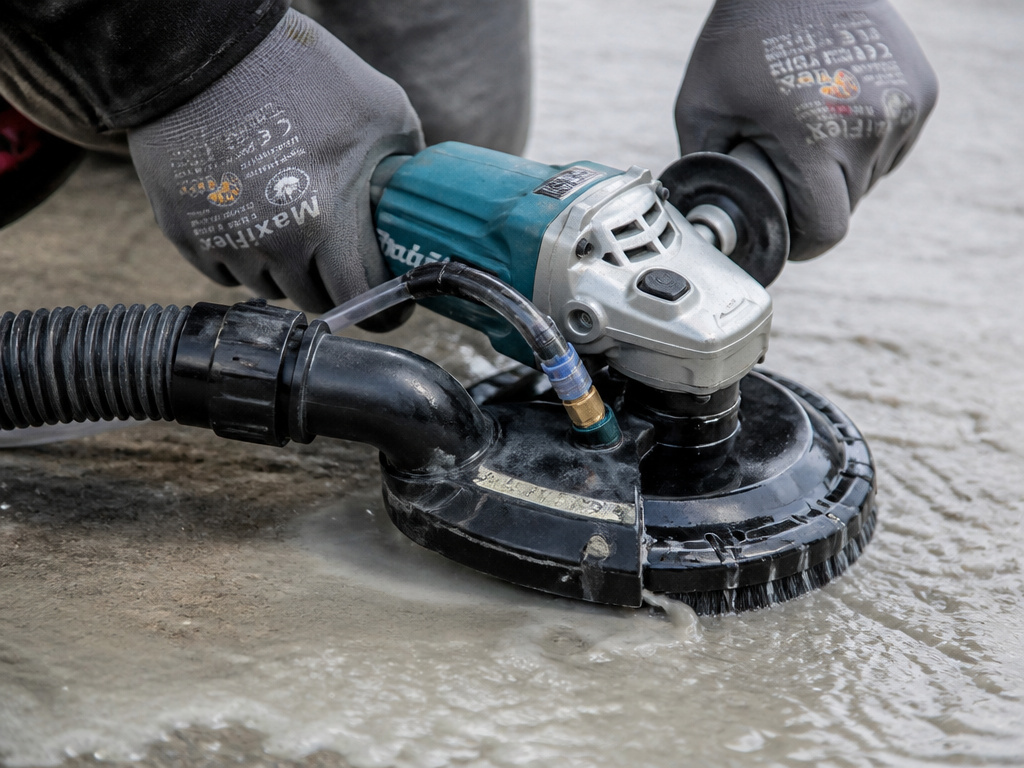
PPE is your last resort. The hierarchy of controls says to eliminate the hazard first, then use engineering solutions to isolate you from it. With silica dust, that means keeping it out of the air you breathe altogether. You have two main weapons: wet methods and vacuum attachments.
Wet Cutting and Grinding seems straightforward: add water. The situation is more complex. OSHA’s rule is that water flow must be “sufficient to minimize release of visible dust.” A trickle isn’t enough. The water flow must be sufficient to minimize release of visible dust, as specified by OSHA. The goal is a slurry, not a dampening.
The tool must be designed for it. Using a garden hose sprayed at a grinding wheel doesn’t cut it, literally. It creates a contaminated mist and leaves dry spots that still aerosolize silica. An integrated water delivery system feeds water directly to the blade-cutter interface. There is a disagreement in the data: the Tsai et al. (2017) study found typical water-spray-wetting on a grinding cup was less effective when combined with LEV, while Safe Work Australia’s guide states properly designed water suppression and local exhaust ventilation may be required in combination.
Local Exhaust Ventilation (LEV) means capturing dust right at the source. This is your dust collection system or a shop vac connected directly to the tool. For a drill, that’s a shroud that seals against the surface. For a grinder, it’s a dust shroud that surrounds the wheel. The vacuum must have a HEPA filter (99.97% efficient at 0.3 microns); otherwise, you’re just blowing the finest, most dangerous particles back into the room. When you connect a power tool to a shop vac for dust collection, you’re building an engineering control.
Where this goes sideways: Using a standard shop vac without a HEPA filter for silica dust. It exhausts the respirable fraction right back into your breathing zone, making the problem worse.
The most effective method, according to the same 2017 study, combined sheet-flow-wetting (saturating the work surface) with LEV, reducing geometric mean exposures by as much as 95%. That’s the gold standard. It’s also why simply slapping on a mask isn’t a plan.
PPE: Choosing and Using the Right Respirator
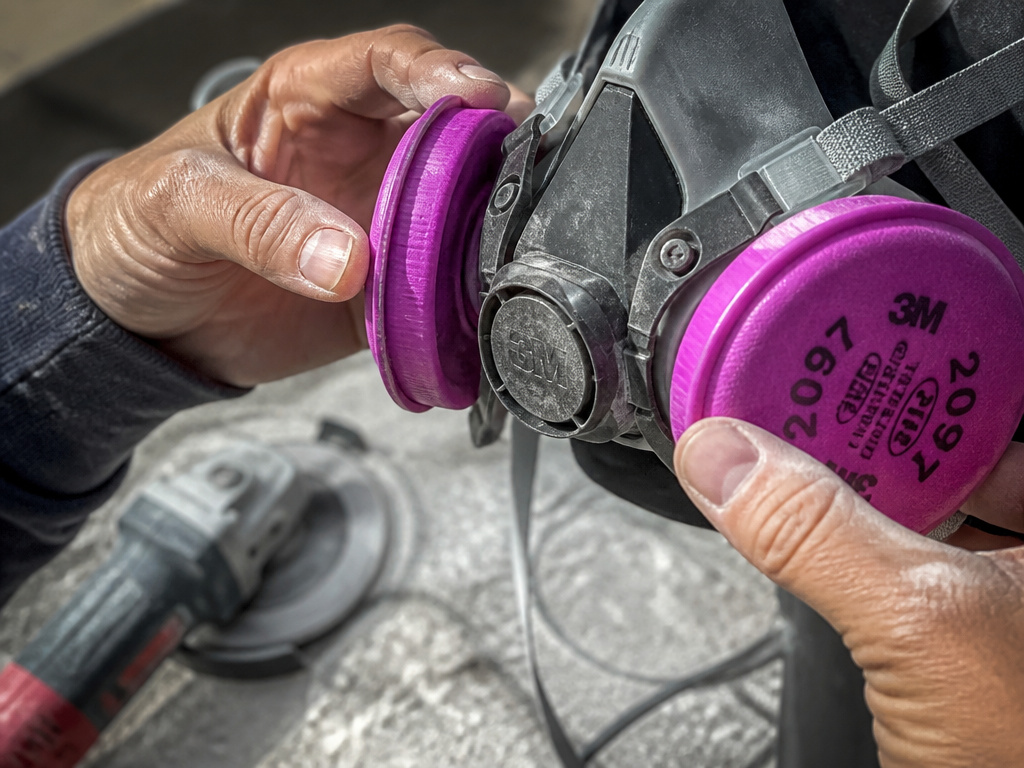
When engineering controls can’t lower exposure below the PEL, you need respiratory protection. This is where most DIYers grab the wrong thing. A bag of N95 dust masks from the hardware store is not adequate for silica dust unless it’s part of a formal, fit-tested program.
For the tasks in OSHA Table 1 that call for an APF of 10, you need a tight-sealing half-face respirator with P100 filter cartridges. The “100” means it filters 99.97% of particles. An N95 filters 95%. That 4.97% difference is where the highest concentration of the most damaging, finest silica particles lives. Don’t bargain-shop here.
Fit is everything. A respirator with a perfect filter is useless if air leaks in around the edges. You need a clean-shaven face where the seal sits. For occasional use, a quality elastomeric half-mask from 3M or MSA with P100s is the baseline. If you’re doing this daily, a fit test is required. This isn’t just another piece of PPE; it’s the final seal on a system designed to keep a known carcinogen out of your lungs.
The Immediate Aftermath: Clean-Up and Decontamination
The job isn’t over when the tool stops. Wet methods leave a slurry. Dry methods leave settled dust. Both can dry out and become airborne again later, a process called secondary exposure. Your clean-up routine is a control in itself.
First, clean yourself. Avoid using compressed air to blow dust off your clothes or skin. That just re-aerosolizes it. Use a HEPA-filtered vacuum to remove dust from your clothing, hair, and skin before taking off your respirator. Then wash your hands and face thoroughly.
Second, clean the area. For wet slurry, shovel it up while wet. For dry dust, use a HEPA-filtered wet/dry vacuum. Never dry sweep. The goal is to capture the dust, not redistribute it. After vacuuming, wet-wiping surfaces can catch the residue.
Finally, handle contaminated clothes separately. If you have dedicated work clothes, remove them before entering living spaces and wash them separately from other laundry. This prevents bringing silica dust into your home.
What To Do If You Think You’ve Been Overexposed
Maybe you drilled a few holes in a concrete foundation without a vacuum. Perhaps you cut a stack of pavers and saw the cloud hang in the air. The worry sets in later. Here’s your action plan.
First, stop the exposure immediately. Don’t finish the job “just to get it done.” Implement controls before continuing.
Second, see a doctor and tell them exactly what happened. Mention “respirable crystalline silica exposure.” There is no specific treatment to remove silica particles already lodged in your lungs, but a doctor can establish a baseline with a chest X-ray and pulmonary function tests. This is critical for future monitoring.
Third, report the exposure if you’re on a job site. Under OSHA’s respirable crystalline silica rule, employers must offer medical surveillance to employees exposed at or above the action level for 30 or more days per year. Even for a DIYer, creating a medical record of the incident is a prudent step.
The most important action is preventive. Treat every project involving masonry, concrete, or stone with the assumption that it will generate silica dust. Plan your dust control before you pick up the tool.
Frequently Asked Questions
Can a little bit of silica dust harm you?
Yes. There is no known safe level of exposure to respirable crystalline silica. While the risk of developing silicosis is generally dose-dependent (linked to the concentration and duration of exposure), any inhalation carries some risk. OSHA’s PEL of 50 µg/m³ is a legal limit, not a health-based “safe” threshold. The goal should always be to reduce exposure as low as possible.
Is silica just as bad as asbestos?
Both are classified as known human carcinogens and can cause fatal lung diseases. Silicosis and asbestosis are both scarring diseases. A key difference is that asbestos fibers can also cause cancers in the lining of the lungs (mesothelioma). Both require the same level of serious engineering controls and respect, neither is a dust you can ignore.
How long does it take for silica dust to affect you?
It depends on the exposure level. For chronic silicosis, symptoms typically appear after at least 10 years of lower-level exposure. Accelerated silicosis can develop in 5-10 years under high exposure. Acute silicosis, from extreme exposure, can be fatal within months to less than two years. The time from first exposure to a diagnosable disease is called the latency period.
How do I know if I have been exposed to silica dust?
Short-term, you won’t “feel” the particles. There’s no immediate cough or irritation like with chemical fumes. The only way to know is to monitor the air or, more practically, to assume exposure occurred if you used a power tool on silica-containing material without proper dust controls. If you have a history of such work and develop a persistent dry cough, shortness of breath, or fatigue, see a doctor and mention your silica exposure history.
Are some power tools worse than others for silica dust?
Absolutely. Tools that abrade or pulverize material create the finest, most respirable dust. An angle grinder is typically the worst offender, followed by handheld masonry saws, jackhammers, and hammer drills. Even a simple circular saw on concrete can generate significant dust. The tool’s RPM, the material, and the absence of on-tool controls determine the severity.
Before You Go
The data here isn’t theoretical. The 50 µg/m³ PEL, the 53% silica content in grinding dust, the 95% reduction from combined controls, these are measured, published facts. Your choice is whether to treat them as background noise or as the operating manual for using power tools on concrete and stone.
Your one action this week: before your next project involving these materials, identify the single biggest dust gap. Is it the missing shroud on your grinder? The lack of a HEPA filter on your shop vac? Using a basic dust mask instead of a sealed respirator? Close that one gap. It’s how you move from knowing the risk to actually managing it.
Silica dust exposure is a cumulative, irreversible hazard. But it’s also a completely controllable one. The controls exist, they’re spelled out in black and white by OSHA, and they work. Your lungs don’t get a do-over. Plan the dust first, then make the cut.
