
What Is Soft Start on a Power Tool?
This post contains affiliate links. As an Amazon Associate, we earn from qualifying purchases.
Soft start on a power tool is an electronic control feature that gradually increases the voltage supplied to the motor at startup, reducing the initial inrush current that can trip breakers, strain components, and cause a violent mechanical jerk.
That inrush spike isn’t just an electrical nuisance. It’s the main reason your shop lights dim when you fire up a table saw, and it’s the mechanical shock that slams the gear train inside your drill every time you pull the trigger. A soft start circuit tames that spike. This is what is soft start on a power tool.
What follows is a breakdown of the two main ways it’s done, electronically with thyristors or mechanically with resistors, the specific tools and motors that benefit, the surprising edge cases where it can cause problems, and a straight answer on the what is soft start on a power tool question for your workshop.
Key Takeaways
- According to US Patent 8022654, in-rush current in motors of four horsepower and above can trip a 20 amp circuit breaker, which soft start can help prevent.
- The feature works by gradually ramping voltage, such as by delaying a thyristor’s turn-on point each AC cycle.
- Load-adaptive soft start, like in Hitachi’s patent, changes the ramp rate based on motor load, starting at an initial rate of 0.3%/ms and switching to 1.2%/ms if the motor speed passes a threshold of 4000 RPM.
- Aftermarket modules are a viable fix for tools without built-in soft start, but they void warranties and are not suitable for tools with momentary switches and mechanical direction selectors.
The Core Problem Soft Start Solves
Flip the switch on a powerful universal motor tool, and for a split second, it acts like a dead short. The motor’s stationary armature presents almost no resistance, so it gulps a massive surge of current, the inrush current, to get moving. US Patent 8022654 from Black & Decker notes this inrush in motors of four horsepower and above can trip a standard 20-amp circuit breaker.
You feel this electrically as dimming lights. You hear and feel it mechanically as a loud THWACK and a violent jerk. That jerk isn’t just noisy. As Hitachi Koki’s patent 8931576 states, a significantly large starting current causes a temperature rise that can lead to burnout in the motor or other circuit components. The mechanical shock also hammers the gearbox, brushes, and bearings, shortening the tool’s life.
Common mistake: Assuming all motors need soft start. Induction motors, common in table saws and dust collectors, have a different starting characteristic and often don’t benefit from add-on soft start modules.
A soft start circuit, which answers what is soft start on a power tool, inserts itself between the wall outlet and the motor to manage this violent handshake. Its sole job is to make the introduction gentler.
How Soft Start Works: The Technical Breakdown
There are two primary methods, both outlined in patents: electronic phase control and mechanical series resistance.
Electronic (Thyristor) Control: This is the most common method in modern tools. It uses a component called a thyristor (or silicon-controlled rectifier, SCR) which acts like a high-speed gatekeeper on the AC power line. Instead of letting the full sine wave through immediately, the circuit delays the thyristor’s “turn-on” point by a few degrees each cycle. Patent 8022654 mentions a delay of thirty degrees during each half cycle. Over successive cycles, the turn-on point is gradually advanced, allowing more and more of the waveform to pass through to the motor. The result is a smooth, stepped increase in effective voltage and current until the motor reaches its target speed, at which point the thyristor is fully on.
Mechanical (Series Resistor) Control: An older, simpler method uses a power resistor wired in series with the motor windings at startup. This resistor acts as a current limiter. Once the motor reaches a predetermined speed, a relay or switch bypasses the resistor, delivering full power. It’s less elegant and generates heat in the resistor, but it’s effective and cheap.
| Control Method | How It Works | Best For | Drawback |
|---|---|---|---|
| Electronic (Thyristor) | Delays turn-on point of thyristor each AC cycle, gradually increasing voltage. | Modern tools with variable speed control; precise control. | More complex circuitry. |
| Mechanical (Resistor) | Places a resistor in series to limit current, then bypasses it at speed. | Cost-sensitive designs, high-power applications. | Generates heat, less efficient. |
A more advanced version is load-adaptive soft start, detailed in Hitachi’s patent. Here, the tool monitors motor speed. It starts with a slow voltage ramp (say, 0.3% per millisecond). If the motor speed quickly passes a threshold (like 4000 RPM), the system knows the load is light and switches to a much faster ramp rate (1.2% per millisecond). This means driving a small screw doesn’t feel sluggish, but the system still protects against a jam.
Universal Motors vs. Induction Motors: Who Needs It?
This is the most important filter. Soft start is primarily for universal motors (also called AC/DC motors). These are the workhorses in most handheld power tools: drills, circular saws, routers, and angle grinders. They’re compact, powerful, and have a high starting torque, which makes them prone to that damaging inrush current.
Induction motors are different. They’re the large, heavy motors in your stationary shop tools, table saws, band saws, dust collectors. By design, they have a lower starting current relative to their full-load current. While they still draw a surge, it’s less severe, and the motor windings are built to handle it. Adding an aftermarket soft start to an induction motor tool often provides minimal benefit for the cost and complexity. The real issue with these tools tripping breakers is usually undersized circuit wiring, not the motor’s inherent start.
Where this goes sideways: Installing a soft start module on a tool with an induction motor. You spend $100 and an afternoon wiring it in, only to find your 15-amp circuit still trips because the real problem was a 100-foot run of 14-gauge wire.
So, before you buy anything, identify your motor. Universal motors have brushes you can often service; induction motors do not. If your tool is handheld and under 15 lbs, it’s almost certainly a universal motor and a candidate for soft start help.
Benefits Beyond Saving Your Circuit Breaker
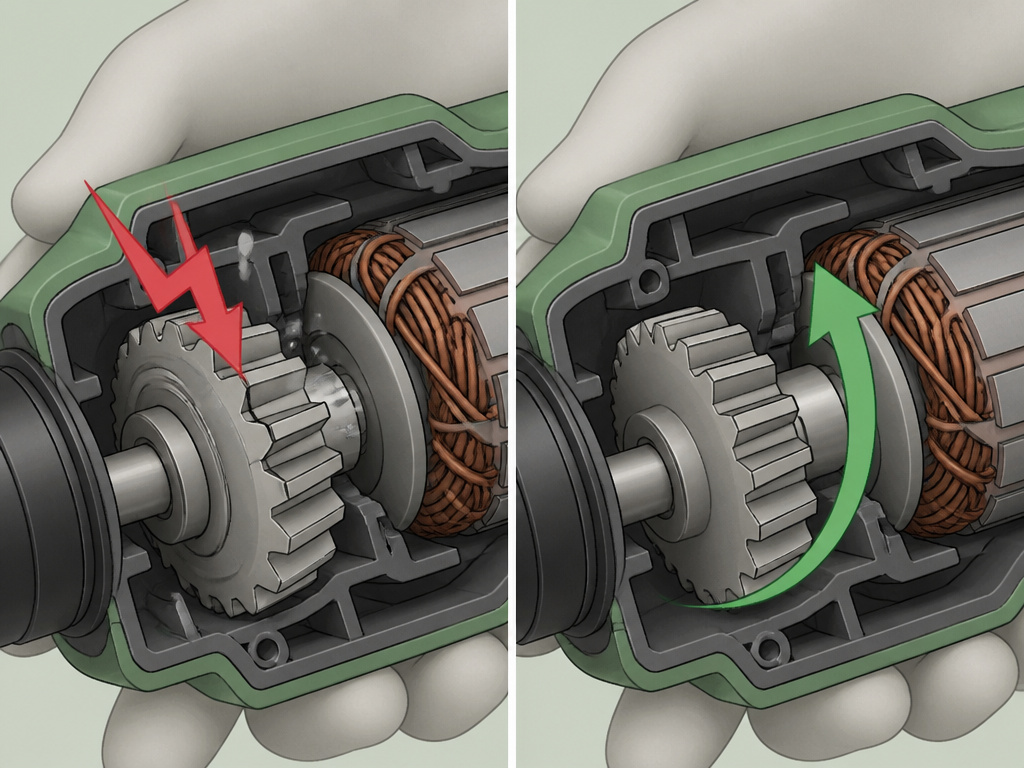
Preventing breaker trips is the headline, but the benefits run deeper into the tool’s longevity.
First, reduced mechanical stress. You’ll hear the difference, the tool starts with a rising whine instead of a bang. This directly translates to less wear on bearings, gears, and even the chuck or blade arbor.
Second, improved control. A tool that leaps from zero to full torque is harder to manage, especially at the start of a cut or drill. Soft start gives you a half-second of ramp-up to stabilize your grip and position the tool accurately.
Third, protection for other electronics. If your tool has built-in variable speed electronics or a delicate brushless motor controller, a soft start circuit shields those components from the power supply’s worst spike.
The Downsides and Where Soft Start Can Fail
It’s not a universal fix. There are specific scenarios where soft start is ineffective or even creates new problems.
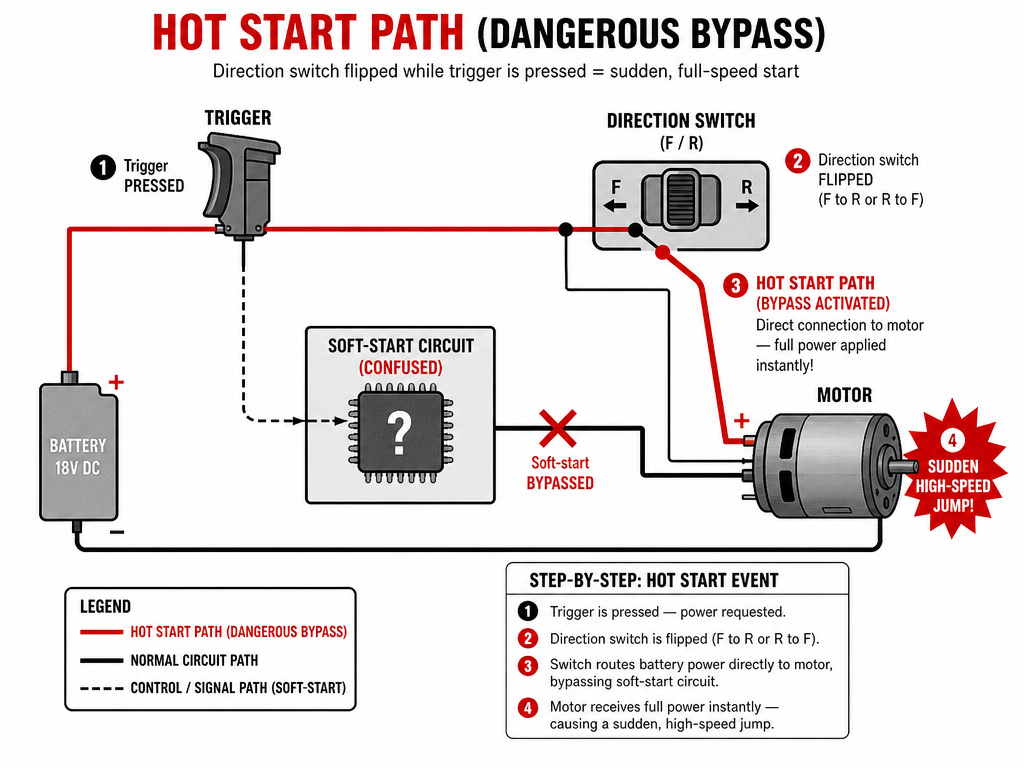
The “HOT Start” Problem: Ridge Tool Company’s patent 12088222 highlights an issue with tools that use a momentary switch (like a trigger) paired with a separate mechanical direction switch (forward/reverse). A conventional soft-start circuit can be confused by this setup. If the direction switch is changed while the trigger is held, or if there’s a “blocked condition,” the tool can experience a “HOT start”, jumping to high speed unexpectedly. The patent states this is not acceptable under IEC62481 and IEC61000:3-3 standards. This is a critical edge case for threading machines and some industrial tools.
Button Switch Annoyance: Hilti’s patent 6882127 describes a nuisance with button-style power switches (not triggers). If your grip accidentally bumps the button, it disconnects power for an instant. Many soft-start circuits interpret this as a new “off” command and will re-initiate the full soft-start ramp when you re-engage, leaving you waiting for full power again. Advanced circuits use a timing capacitor with a discharge constant of 0.1 to 1.0 seconds to ignore these brief interruptions.
Power and Feel: Some soft start implementations, especially cheaper aftermarket ones, can limit the peak power available. You might notice the tool feels slightly “soft” or underpowered at the very beginning of a heavy cut. The trade-off is protection versus instantaneous torque.
Aftermarket Soft Start Modules: A DIY Solution?
For a tool you love that lacks this feature, add-on modules are widely available. They’re essentially a small box containing the thyristor circuit you wire in between the tool’s power cord and its internal motor.
Worth knowing before you start: Wiring in an aftermarket module voids the tool’s warranty permanently. It also introduces new points of failure, solder joints, additional wiring, inside a high-vibration environment.
They work, but with caveats. The YouTube teardowns show these modules often use a triac (a type of thyristor) rated for 20 amps, mounted on a small metal tab meant to be heatsinked to the tool’s casing. In a confined tool housing with poor airflow, that triac can overheat if you’re consistently running the tool near its limits.
Compatibility is key. These modules are designed for universal motors. Don’t try to fit one to an induction motor tool. Also, be wary of the “HOT start” issue if your tool has a separate mechanical direction switch.
Is it worth it? If you have a vintage, powerful router that trips your breaker and you’re comfortable with basic wiring, a module can extend the tool’s life. For a modern tool, you’re often better off trading up to a newer model with soft start built in, where the electronics are integrated and properly cooled.
Can I Add a Soft Start Module to My Tool?
Adding an aftermarket soft start module is a complex modification that should only be attempted by those with advanced electrical skills. The internal circuitry of a power tool is designed as a complete system. Patents describe modules that use components like timing resistors and capacitors, with specific discharge time constants, integrated into the tool’s control logic. A module designed for one tool type may not function correctly with another, especially on tools with specific switch configurations like momentary or direction switches. Incorrect installation can damage the motor or create a safety hazard. For most users, purchasing a tool with built-in soft start is the safer and more reliable choice.
Frequently Asked Questions
What are the downsides of using a soft starter?
The main downsides are potential cost (for aftermarket modules), added complexity, a slight reduction in instant-on torque, and compatibility issues with certain switch types (like momentary buttons with mechanical direction selectors). It also adds another component that can fail.
What’s better, hard start or soft start?
These solve opposite problems. A “hard start” kit (with a start capacitor and relay) is for induction motors (like in air conditioners) that struggle to get spinning under a heavy load. A “soft start” is for universal motors that start too violently. They are not interchangeable. For power tools, you want soft start.
When should you use a soft starter?
Use a soft starter (or buy a tool with one built-in) if you have a universal motor tool that dims lights, trips breakers, or starts with a severe jerk. It’s most beneficial for high-power tools like large routers, angle grinders, and circular saws used on shared or long household circuits.
Which is better, soft start or easy start?
“Easy start” is often a marketing term for the same soft-start technology. There’s no technical distinction in patents or industry standards. When comparing, ignore the label and look for a description of how it works, such as a gradual voltage ramp-up.
Before You Go
The need for soft start boils down to a simple checklist. Does your tool have a universal motor? Does it dim lights or trip a breaker? Does it start with a harsh jerk that feels abusive? If you answered yes, then soft start, either built-in or added, is a solution that pays for itself in reduced wear and fewer frustrating trips to the electrical panel.
For everyone else, particularly owners of induction-motor shop tools, the money and effort are better spent elsewhere: ensuring you have a dedicated, properly gauged circuit. That 20-amp line run with 12-gauge wire to your table saw will do more for reliable operation than any add-on module.
And if you’re shopping for a new tool, let this be one of your filters. That gentle ramp-up isn’t just a luxury; it’s a signal of more considered engineering that protects your investment. In the long run, a tool that starts quietly is a tool that lasts.
