
What Is Variable Speed on a Power Tool?
This post contains affiliate links. As an Amazon Associate, we earn from qualifying purchases.
Variable speed on a power tool gives you a dial or trigger to adjust the motor’s rotational speed, measured in RPM (Revolutions Per Minute). It is a control system that matches the tool’s power to the material, preventing damage to your work, the accessory, and the tool itself. A DeWalt grinder manual puts it bluntly: accessories running faster than their rated speed can break and fly apart, which is why the variable speed dial exists.
That control turns one tool into several. A rotary tool set to a lower speed handles delicate polishing on plastic, while the same tool at a higher speed can carve hardwood. The trick isn’t in having the feature; it’s in knowing which of the two main types you’re dealing with and what its limits are. Understanding what is variable speed on a power tool is the first step.
What follows is a breakdown of the electronics and mechanics behind the dial, a clear guide to picking speeds for wood, metal, and plastic, and the one spec from the manual that decides whether your accessory is safe at full throttle.
Key Takeaways
- Variable speed is mandatory for material-specific tasks, running a wood carving bit in metal at high RPM shatters the bit within seconds.
- The rated speed of your accessory (found on its label) must at least equal your tool’s maximum speed, per DeWalt’s safety warning, regardless of where you set the dial.
- Electronic (PWM) controls are now standard for cordless tools and most corded models, offering precise triggers, while mechanical systems (Reeves drives) are durable but lack fine control.
- According to the Aircraft Spruce (WEN) manual, all brushing applications and delicate polishing require slow rotary speeds at 15,000 RPM or less.
- As a general rule, the Aircraft Spruce (WEN) manual states that larger attachments should be used at a lower speed to prevent violent vibration.
How Does a Variable Speed Trigger Actually Work?
Modern variable speed works through electronics, not magic, which is the core answer to what is variable speed on a power tool. Inside the tool’s handle, pressing the trigger doesn’t just complete a circuit; it sends a signal to a tiny computer called a Pulse Width Modulation (PWM) controller.
This controller rapidly switches the full power from the battery or wall outlet on and off, thousands of times per second. The speed you feel is the average of these pulses: a half-pressed trigger might have power flowing 30% of the time, while fully depressed runs it at 100%. This method is efficient, generates less heat than old resistor-based systems, and gives you that smooth, proportional control from a dead stop to full blast.
That’s why a cordless drill can start a screw without stripping the head and then power through dense lumber. The Harbor Freight rotary tool manual lists specific RPMs for each dial setting, 4,500 RPM on setting 1, scaling up to 20,000 RPM on setting 5. You’re not changing voltage; you’re programming a duty cycle.
The part nobody mentions: This electronic control is why most variable speed tools now work with universal brush-type motors. The old mechanical systems needed specific motor windings; a PWM controller can manage a standard AC or DC motor, which is why you see the feature on budget tools today. The limitation is heat, cheap controllers can overheat and fail under sustained load, which is the trade-off.
Mechanical vs. Electronic Variable Speed: What’s the Difference?
Before PWM, we had pulleys and clever gears. Understanding the difference isn’t just history; it tells you what you’re buying and how it might fail.
| System Type | How It Works | Common In | Failure Mode / Wear |
|---|---|---|---|
| Electronic (PWM) | A controller chip switches power on/off rapidly. Speed set by dial or trigger pressure. | Almost all modern cordless tools, routers, rotary tools. | Controller overheats; trigger potentiometer wears out, causing erratic speed. |
| Mechanical (Reeves Drive) | Two variable-diameter pulleys connected by a belt. Moving handles changes the drive ratio. | Older drill presses, lathes, some stationary sanders. | Belt slips or glazes; pulley springs lose tension; requires physical adjustment. |
| Multi-Speed Transmission | A gearbox with 2-3 fixed gear ratios (e.g., speed 1, speed 2). Not truly variable. | Heavy-duty drills, hammer drills, impact wrenches. | Gear teeth wear or break; requires lubrication and is noisy. |
The electronic system is what gives you the variable speed trigger on a drill or the infinite dial on a rotary tool. The Benchmark 1.6 Amp Rotary Tool manual specifies a “speed control wheel” for a range of 5,000–35,000 RPM.
The mechanical Reeves drive is a beast of a different sort. You’ll find it on older equipment, and it has a distinct feel, a heavy, deliberate thunk when you change speeds, not the silent glide of a dial. It’s durable but imprecise. You get a range, but not the fine, thumb-controlled increments of an electronic system.
Here’s the rub: if a tool advertises “variable speed” but only has a 2-speed gearbox, that’s marketing. True variable speed means a continuous range, not a choice between two fixed options.
When to Use Low vs. High Speed: A Material Guide
The dial isn’t for show, which is a key lesson when you compare a what is variable speed on a power tool explanation to actual use. Turn it wrong, and you’ll ruin your work or your bit. The manuals are specific about this, but the advice is often buried.
Be honest about plastic. The Aircraft Spruce (WEN) rotary tool manual explicitly says to “use slow speeds for plastics, ceramics, precious metals and low-melting point materials to prevent damaging the material.” Why? Friction generates heat. A high-speed bit in acrylic doesn’t cut, it melts, gums up, and cracks the piece. You’ll smell a faint, sweet burning odor a second before the plastic deforms.
For wood, metal, and glass, higher speeds are the rule. Drilling, carving, and routing happen more efficiently with faster rotary speed. But “high” is relative. A 1/8-inch bit in softwood can handle a high RPM. That same speed on a larger sanding drum creates an unbalanced, shuddering monster that’s hard to control.
Where this goes sideways: Using a cutting or grinding accessory on a tool not designed for it. The Harbor Freight rotary tool manual directly states that operations like grinding or cutting-off “are not recommended… As it was not designed for them and may create hazards.” The motor and bearings aren’t built for side-loading, and the accessory can shatter.
This table translates manual advice into actionable settings. The numbers come straight from the source material.
| Material / Task | Recommended Speed Range | Why This Speed | Tool Example |
|---|---|---|---|
| Plastic, Acrylic | 5,000 – 12,000 RPM | Prevents melting and gumming. Low friction heat. | Rotary Tool, Drill |
| Delicate Polishing, Brushing | ≤ 15,000 RPM | Gives control, avoids throwing compound. Prevents burning. | Rotary Tool, Polisher |
| Hardwood Carving/Drilling | 18,000 – 30,000 RPM | Clean cuts without burning. Enough speed to clear chips. | Rotary Tool, Drill |
| Softwood Sanding/Shaping | 10,000 – 20,000 RPM | Aggressive enough for stock removal, controllable. | Random Orbital Sander, Router |
| Metal Drilling/Cutting | Medium-High (Tool Dependent) | Maintains cutting pressure without work-hardening metal. | Drill, Angle Grinder (with guard) |
| Larger Diameter Accessories | LOWER Speed | Reduces centrifugal force and vibration for safety. | All Tools |
The Critical Role of Accessory Speed Ratings
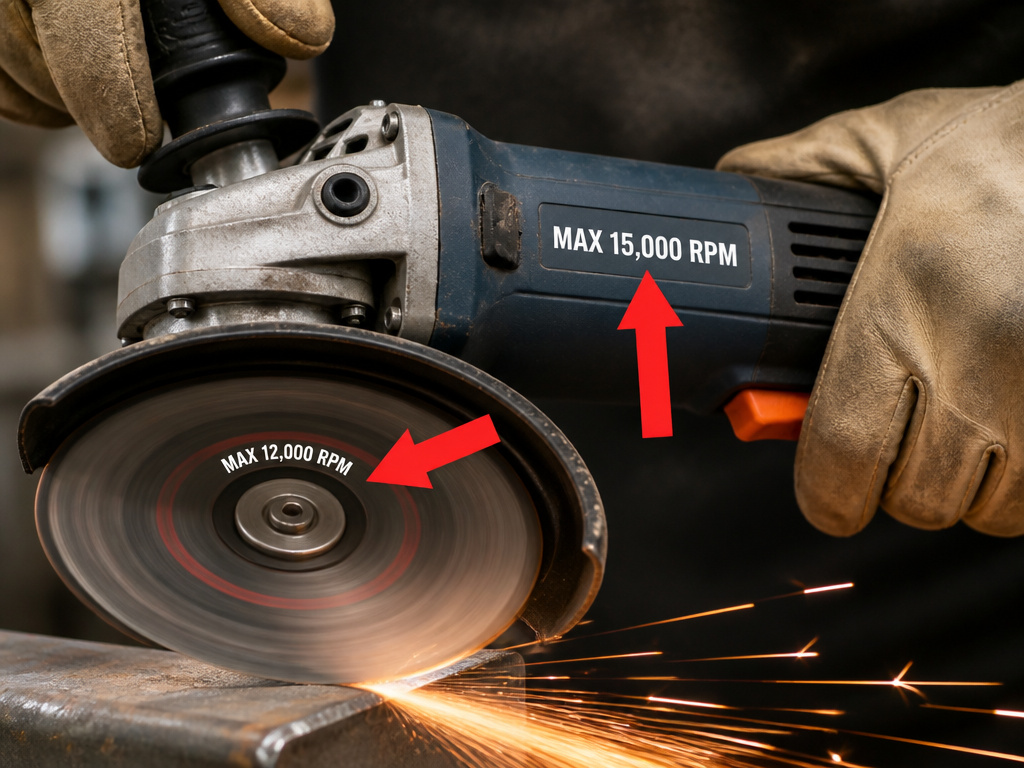
This is the most skipped step, and it’s the one that turns a tool into a hazard. Variable speed gives you control, but it doesn’t override physics.
Every quality accessory, a grinding wheel, a sanding drum, a cut-off blade, has a maximum rated speed printed on it. It’s often in tiny text on the side or the center hub. That number is not a suggestion. According to the DeWalt grinder manual, “the rated speed of accessories must at least equal the maximum speed marked on the power tool, regardless of the speed setting.”
Think of it like a speedometer. If your tool’s top speed is, for example, 2,800 RPM, you must use accessories rated for at least that speed. Using an accessory rated for a speed lower than your tool’s maximum is asking for it to disintegrate. At full throttle, the centrifugal force can exceed the material’s strength.
You’ll find this warning in nearly every professional manual. It’s there because a failed accessory is explosive. Pieces can be ejected at high speed. This is why you never use a damaged or dropped accessory, and always use the guard. The variable speed dial allows you to stay under the accessory’s limit, but the tool’s maximum capability is the real test.
What Tools Commonly Have Variable Speed?
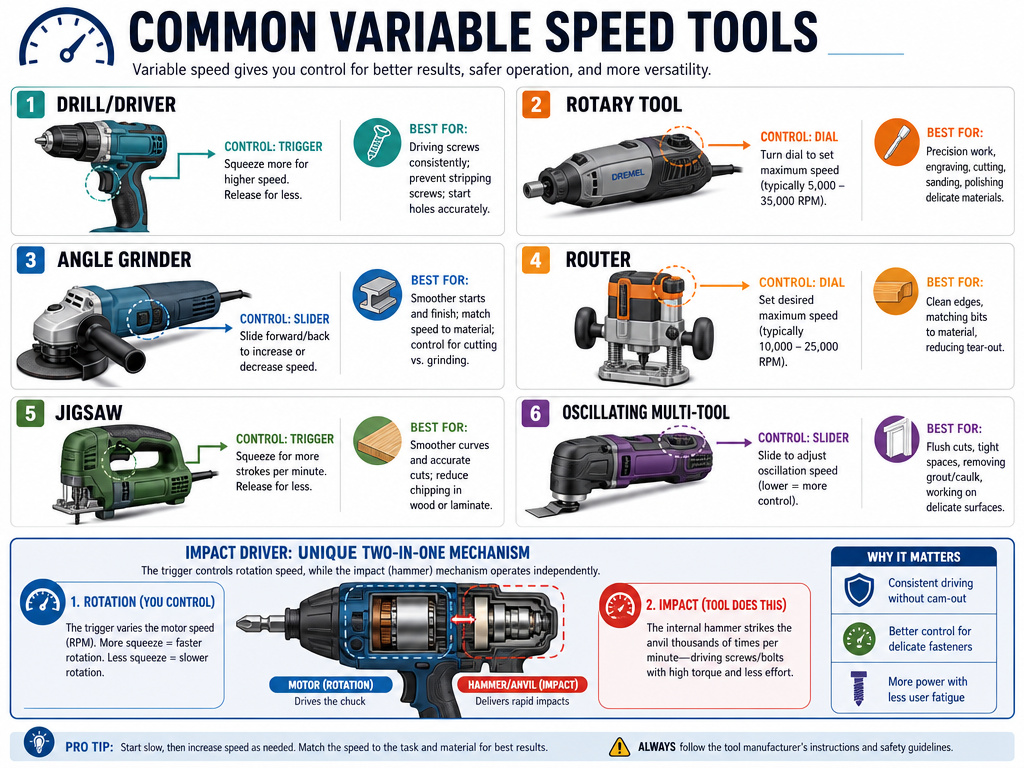
It’s easier to list the tools that don’t. For the rest, variable speed is either standard or a critical upgrade.
- Drills/Drivers: The classic example. A variable speed trigger is essential for driving screws without stripping them.
- Rotary Tools (Dremel-type): Defined by their dial. The Harbor Freight model goes 4,000-20,000 RPM; the Aircraft Spruce (WEN) model ranges 10,000-32,000 RPM.
- Angle Grinders & Sanders: For blending finishes versus aggressive stock removal. The DeWalt DWE4997VS is a variable speed grinder/sander.
- Routers: Controlling plunge and edge quality. A fixed-speed router is a one-trick pony.
- Jigsaws: Slower speeds for metal, faster for wood to improve cut quality and blade life.
- Oscillating Multi-Tools: Newer models like the Bosch GOP18V-40 have electronic controls. Its “Adaptive Speed Control” even automatically adjusts oscillation speed based on how hard you press the tool into the work.
The outlier is the impact driver. It has a variable speed trigger, but the impacting mechanism (the hammer and anvil) operates independently at a very high frequency (IPM). You control the rotation speed before the impacts begin, which is different from controlling the tool’s primary action.
Variable Speed vs Adjustable Speed: What’s the Difference?
In the context of power tools, ‘variable speed’ and ‘adjustable speed’ are often used interchangeably by users and manufacturers to describe the same core function: the ability to change the tool’s operating speed. The term is typically applied to a trigger or dial that gives you control over the rotation or oscillation rate. For example, one tool’s manual refers to a ‘variable speed dial’ for adjusting speed, while another lists a ‘no load speed’ range like 0 to 2800 revolutions per minute, indicating the span of speeds you can select. The key practical point is that both terms refer to your ability to match the tool’s output to the task, whether you’re using a slow speed for delicate work on plastic or a high speed for cutting metal.
Frequently Asked Questions
Can I add variable speed to a fixed-speed tool?
Sometimes, with an external router speed controller for universal brush-type motors. It’s not recommended for induction motors (like in most table saws or stationary tools) or tools with electronic feedback. You risk burning out the motor by starving it of power under load. It’s usually better to buy a tool with the feature built in.
Is variable speed the same as a soft-start?
No. A soft-start is a specific feature that ramps the motor up to speed over a second or two, preventing a sudden jerk. It’s often paired with variable speed. You can have variable speed without soft-start (the tool jumps to the set speed), and you can have soft-start on a single-speed tool. They are related but separate concepts of motor control.
Do I need variable speed on a drill press?
For metalworking and plastics, absolutely. Different metals and drill bit sizes require specific RPM settings to cut cleanly and avoid hardening the material. Consulting a drill press speed chart is essential. For wood-only shops, a fixed-speed or pulley-change model might suffice, but variable speed adds massive versatility.
Why does my variable speed tool sometimes surge or slow down on its own?
This is often a load-response feature, not a defect. Under heavy load (like drilling into hard steel), the motor draws more current. To protect itself from overheating, the electronics may temporarily reduce power, causing a slowdown. If it happens under no load, the trigger potentiometer or electronic controller might be failing.
Are there power tools that shouldn’t be variable speed?
Yes. Reciprocating saws and demolition hammers typically have fixed speeds or 2-speed options. The violent, jarring action doesn’t benefit from fine speed control in the same way. Also, some high-torque applications like the speed settings on an impact driver are less about material and more about controlling the drive before the impacts kick in.
Before You Go
Variable speed is the interface between raw power and precise work. The takeaway isn’t just to buy tools with a dial; it’s to use that dial with intent.
Match the speed to your material, but first, match your accessory to your tool’s maximum capability. That one line in the DeWalt manual, about the accessory rating needing to meet or exceed the tool’s top speed, is the rule that makes the variable speed feature safe. Ignore it, and you’re not using a power tool; you’re managing a risk.
For your next project, start low. Dial in just enough speed to get the job done cleanly. You’ll find you have more control, make fewer mistakes, and your bits and blades will last longer. That is the real purpose of the feature: it makes the tool work for you, not the other way around.
