
12V vs 18V Power Tools: Key Differences Explained
This post contains affiliate links. As an Amazon Associate, we earn from qualifying purchases.
In the 12V vs 18V power tool choice, 18V tools deliver more torque for driving large fasteners and drilling into hard materials, while 12V tools are lighter and more maneuverable for precision work in tight spaces, for most homeowners, a modern 12V brushless system handles the majority of everyday tasks.
The weight difference of just over 11 ounces between a Milwaukee M18 and M12 impact driver is the physical reality of that power trade-off. It’s the difference between finishing an overhead cabinet install with a sore shoulder or not. That gap determines which system you’ll actually reach for when the job is annoying, not just impressive on paper.
What follows: a breakdown of where each voltage genuinely excels, the cost and ecosystem traps, and the one question that decides the whole purchase before you look at a single spec sheet.
Key Takeaways
- The 11-ounce weight difference between comparable Milwaukee M18 and M12 impact drivers is felt immediately during overhead or extended use.
- A well-designed 12V brushless tool can outperform an older 18V model for light-duty tasks, meaning raw voltage isn’t the only performance factor.
- 18V tools are necessary for sustained high-demand applications like angle grinding, driving 6-inch lag bolts, or repeated concrete drilling.
- The Milwaukee M12 drain snake exemplifies the 12V niche: it clears most household clogs with less bulk, but its cable is too small for clearing anything under the ground.
- Investing in a battery platform is a long-term commitment; 18V systems offer a broader range of future tools (saws, grinders) while 12V excels within a narrower, precision-focused set.
Power and Performance Comparison: Not Just a Number
Voltage directly affects the power output of cordless tools. A higher voltage typically means greater torque, improved speed, and the ability to handle more demanding applications, while lower voltage tools prioritize portability and ease of use for precision tasks.
This isn’t a subtle difference you measure with a gauge. It’s the difference between a tool that strains and one that doesn’t, which is central to the 12v vs 18v power tools debate. For driving a 6-inch lag bolt into a beam or boring a large hole through pressure-treated lumber, the 18V tool wins every time. The higher voltage provides the sustained torque needed to push through without stalling, which protects the motor and gets the job done faster. This is why angle grinders and large cutting tools are almost exclusively found in 18V platforms, they demand continuous high output.
Conversely, the power profile of a modern 12V system is perfect for its domain. As noted in our research, these tools are ideal for installing cabinets or shelves, hanging curtain rods, assembling furniture, and driving screws. The power is sufficient, but the benefit is control. You’re less likely to over-drive a fastener or crack delicate material. For the majority of DIY tasks, hanging a picture, building a bookshelf, tightening a loose deck board, a 12V driver has more than enough power according to some sources, while others argue 18V tools have broader utility. One source contends that a well-designed 12V brushless tool can outperform an older 18V model in light-duty applications.
The performance question ultimately maps directly to your material list, a key factor in the 12v vs 18v power tools decision. Are you mostly working with hardwoods, masonry, or thick metal? The 18V’s extra power is essential. Are your projects centered on sheetrock, softwood, pre-drilled holes, and assembly? The 12V tool will feel like a better, more precise fit.
The Weight and Size Reality
The spec sheets tell one story; your wrist after 30 minutes of overhead work tells the real one. Using the concrete comparison from our fact sheet: the Milwaukee M18 Compact Impact Driver with a 2.0Ah battery weighs 2.69 pounds. The Milwaukee M12 Fuel Impact Driver with a 1.5Ah battery weighs 1.98 pounds. That’s a difference of just over 11 ounces.
Eleven ounces is a can of soup. It doesn’t sound like much until you’re holding your arm above your head to install a ceiling light or working inside a cramped cabinet. The lighter tool reduces fatigue, which directly improves accuracy and safety. This makes 12V tools the better choice for long sessions or one-handed use, especially in tight spaces or for overhead tasks.
The size advantage extends beyond the scale, a major practical consideration in the 12v vs 18v power tools comparison. 12V tools are inherently more compact. The battery pack is smaller, and the motor housing can be designed closer to the tool’s axis. This gives you better balance and access. You can fit a 12V drill into spots where an 18V drill’s battery pack would be knocking against a wall or a joist. For finish work, electrical work, or any task inside a confined space, the physical form factor of a 12V tool is a tangible benefit that a spec sheet about torque can’t convey.
| Scenario | 12V Advantage | 18V Disadvantage |
|---|---|---|
| Overhead Work (e.g., installing shelves) | Reduced arm fatigue, better control. | Faster muscle fatigue, harder to control precisely. |
| Confined Spaces (e.g., under sink, between joists) | Compact size allows better maneuverability. | Battery pack or motor housing can obstruct. |
| Extended Use (e.g., assembling furniture) | Lighter weight feels less burdensome over time. | Increased weight becomes noticeable, encouraging breaks. |
| One-Handed Operation (e.g., holding workpiece) | Easier to manage with a single hand. | Often requires more support from the other hand. |
Battery Life, Runtime, and the Amp-Hour (Ah) Factor
Sources disagree on runtime: one states 12V tools have ‘shorter runtime’ compared to 18V, while another notes that a well-designed 12V brushless tool can outperform an older 18V model, implying runtime isn’t solely dictated by voltage. It’s more nuanced. Runtime is determined by battery capacity (Amp-hours, or Ah) and the tool’s power demands. Runtime is determined by battery capacity (Amp-hours, or Ah) and the tool’s power demands. The key is that 18V platforms can support higher-capacity batteries (5.0Ah, 8.0Ah, 12.0Ah) because they have more physical space in the pack. This makes them suited for jobsites or workshop use where endurance is critical and you can’t afford to stop and swap batteries often.
For a homeowner, the calculus is different. A single 2.0Ah or 4.0Ah battery in a 12V system often provides enough runtime for an afternoon project. The batteries charge quickly, and if you do run out, having a second compact battery isn’t a major expense or a burden to store. The runtime debate often misses the point: it’s about sustained load. An 18V tool will maintain its power output under heavy load (like drilling into concrete) longer before the battery management system steps in, whereas a 12V tool might slow down sooner. For repeated drilling into hard materials or long cutting sessions, the 18V system’s ability to handle sustained loads more reliably is a clear advantage.
Where this goes sideways: Comparing a 12V 2.0Ah battery to an 18V 5.0Ah battery and declaring the 18V the “runtime winner.” Capacity matters, but you must compare the tool’s efficiency and the actual work being done. A 12V brushless motor is highly efficient for its designed tasks.
If runtime is a primary concern, your focus should be less on volts and more on the Ah rating and investing in a second battery. Our guide on understanding battery amp hours dives deeper into what those numbers really mean for your work.
Cost Analysis: Initial Price and Long-Term Investment
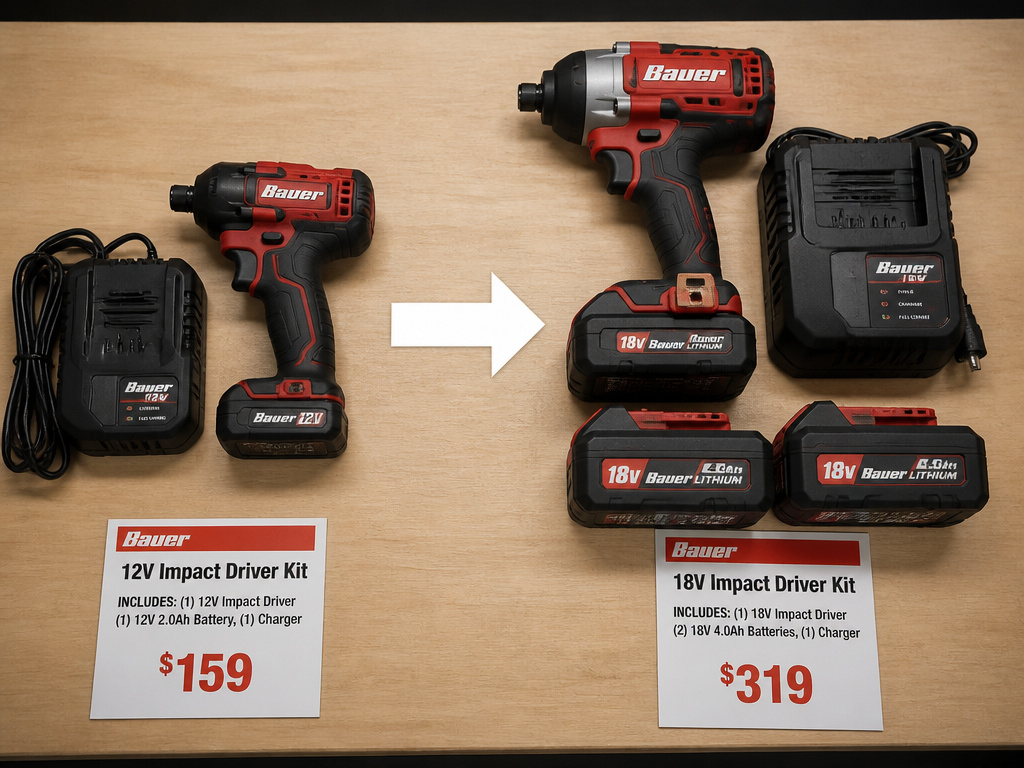
The upfront price tag is the most straightforward comparison. Citing our fact sheet’s Milwaukee example: the M18 Fuel 18V brushless impact driver kit with two 5.0Ah batteries lists for $319.00. The comparable M12 fuel 12V brushless impact driver kit with a 2.0Ah battery lists for $159.00. In the Milwaukee example, the 18V system starts at double the initial investment. This pattern generally holds across brands: the initial cost of an 18V tool is typically higher due to more powerful motors, larger batteries, and often more robust construction.
However, the real cost is the long-term battery platform lock-in. When you buy a 12V drill, you’re buying into the 12V ecosystem. If you later decide you need a circular saw or angle grinder, you’ll likely find those tools in 18V (or larger) platforms, as 12V systems are more limited in variety. You’d then need to start a second, more expensive battery system. Conversely, if you start with 18V, you have a much broader range of tools available, from saws and grinders to high-torque impact wrenches, all running on the same batteries and charger.
This is where the “most people don’t actually need 18V” argument from one of our sources collides with future-proofing. If you’re confident your needs will never exceed light-duty DIY, a 12V system is the more cost-effective heart. If you anticipate tackling larger projects, building a deck, finishing a basement, extensive carpentry, the 18V platform avoids the cost of a second system down the line. It’s worth reading our comparison of cordless and corded power tools to understand where a corded tool might be a cheaper, more powerful solution for rarely-used tools, bypassing the battery question entirely.
Tool Selection and Ecosystem Lock-In
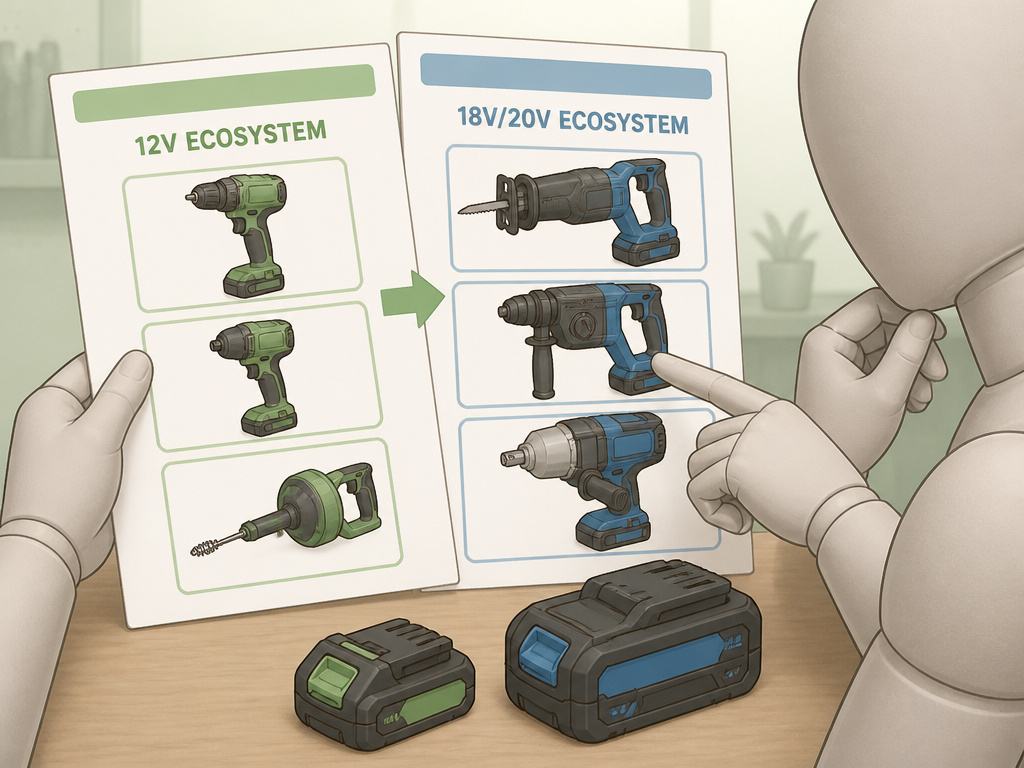
Your choice of voltage is a choice of future tools. The Bosch 18V system, as described in our sources, includes a broader range of tools, from saws and grinders to high-torque impact wrenches. The 12V system is more limited in variety, focusing on drills, drivers, and smaller specialty tools. This is universal across major brands. Milwaukee’s 12V line includes tools like the M12 drain snake, but 12V systems generally focus on drills, drivers, and smaller specialty tools.
The Milwaukee M12 drain snake is a perfect case study. It’s a pro-grade tool that uses the 12V platform brilliantly for its intended job: clearing household clogs. It’s lightweight, compact, and as one reviewer noted, its battery lasted for three weeks of professional use. But the review also clearly stated: It’s probably not going to clear anything under the ground because the cable is too small for those jobs. For that, you need a bigger, more powerful tool from an 18V or corded platform. The tool exists to cover the majority of common jobs with maximum convenience, not all jobs.
Before choosing a voltage, scan the manufacturer’s full catalog. Do you see yourself eventually wanting a reciprocating saw, a rotary hammer, or a lawn tool? These almost always require an 18V or higher platform. If your vision ends at a drill, driver, flashlight, and maybe a small oscillating tool, 12V covers you. This ecosystem decision is more important than any single tool’s specs. Our reviews of the best 12V impact drivers and best 20V cordless drills can help you evaluate the top options within each camp.
18V vs. 20V Max: Clearing the Confusion
A major point of confusion is the difference between 18V and 20V Max batteries. As one source plainly states: You can include 20V power tool batteries with 18V varieties since they deliver the same power. Here’s the simple breakdown: 20V Max (used by DeWalt, Craftsman) and 18V (used by Milwaukee, Makita, Bosch) are marketing terms for the same underlying lithium-ion cell technology.
A typical lithium-ion cell has a nominal voltage of 3.6V and a maximum voltage of 4.0V. Five cells in series (5 x 3.6V) give you 18V nominal. The same five cells at their peak charge (5 x 4.0V) give you 20V. “20V Max” advertises the peak voltage, while “18V” advertises the nominal voltage. In practice, they are the same, and the tools deliver equivalent performance. You cannot use a DeWalt 20V Max battery in a Milwaukee 18V tool, not because of voltage, but because of proprietary physical and electronic designs. Our article on volts and amps in power tools explains this electrical engineering in more detail.
The Verdict: Which System Should You Choose?
To be honest,. For most people asking this question, homeowners, hobbyists, casual DIYers, a high-quality 12V brushless system is the correct starting point. It handles the vast majority of tasks without the bulk, weight, or upfront cost. You’ll use it more because it’s easier to grab, and you’ll do better work because it’s easier to control. The argument that “18V can do everything a 12V can do” is technically true but practically misleading. It’s like recommending a full-size pickup truck to someone who just needs to commute and occasionally haul bags of mulch.
Choose 18V if:
- Your projects regularly involve driving large lag bolts or drilling into masonry/concrete.
- You need tools for continuous, high-demand applications like grinding, cutting thick material, or demolition.
- You are a professional or serious enthusiast who already knows you will want a wide range of heavy-duty tools (saws, grinders, rotary hammers) and want a single battery platform.
- You work primarily in a workshop or jobsite where tool weight is a secondary concern to raw power and runtime.
Choose 12V if:
- Your work is primarily furniture assembly, light carpentry, hanging items, or general home maintenance.
- You frequently work in tight spaces, overhead, or need one-handed operation.
- You value light weight and easy handling to reduce fatigue.
- Your budget is a primary concern and you don’t foresee needing heavy-duty industrial tools.
The sweet spot for many is owning both: a 12V drill/driver for most work, and a corded or 18V tool for the occasional heavy job. That avoids battery platform lock-in for the rare task. The best system is the one you’ll use confidently and comfortably for the work you actually do.
How Long Do 12V and 18V Batteries Take to Charge?
The fact sheet does not provide specific data on charge times for 12V versus 18V batteries. In practice, charging speed depends more on the charger technology and battery capacity than on voltage alone. A modern fast charger can replenish a smaller 12V battery very quickly, while a larger, high-capacity 18V battery on a basic charger will take longer. For planning your work, consider having at least one spare battery for your system. This allows you to swap and continue working while the depleted battery charges, minimizing downtime regardless of the voltage platform you choose.
Frequently Asked Questions
Is 12V or 18V better in Milwaukee?
It depends on the job. For impact drivers and drills used in general DIY, the Milwaukee M12 Fuel line offers outstanding power in a lightweight package. For sustained heavy-duty work, concrete drilling, or using tools like saws, the M18 Fuel platform is necessary. Many Milwaukee users own both, using M12 for finesse and M18 for power.
Can I use an 18V battery in a 12V tool?
No. The battery platforms are physically and electronically incompatible. The tool’s motor and electronics are designed for a specific voltage range. Using a higher voltage battery would damage the tool and void the warranty. They are separate, locked ecosystems.
Which is better for a power drill, 18V or 12V?
For a general-purpose home drill, a modern 12V brushless drill is often better. It’s lighter, easier to handle, and has more than enough power for drilling wood, metal, and driving screws. An 18V drill is better if you frequently drill into concrete or thick metal, where the extra torque is needed.
Why are 20V and 18V batteries the same?
As explained in our 18V vs 20V Max article, they represent different measurements of the same battery chemistry. A “20V Max” battery (like DeWalt’s) has a peak voltage of 20V but operates at a nominal 18V, identical to Milwaukee’s 18V platform. The performance is comparable; the difference is marketing and physical design.
Do professionals use 12V tools?
Yes, extensively. Professionals in electrical work, cabinetry, and light-duty assembly often prefer 12V tools for their compact size and precision, especially for overhead work or in confined spaces. They typically pair them with 18V tools for heavier tasks. The Milwaukee M12 drain snake is a professional-grade tool designed for a specific, common pro task.
Before You Go
Ignore the hype about raw power. The right choice isn’t about getting the strongest tool; it’s about matching the system to your most frequent, most annoying tasks. A tool that’s a chore to use is a tool that stays in the box. For most, that means a 12V system gets more real work done. But if your project list has “build a deck” or “frame a wall” on it, bite the bullet and go 18V from the start, the ecosystem cost is cheaper than buying twice.
