
8 Best Wet Tile Saws in 2026
This post contains affiliate links. As an Amazon Associate, we earn from qualifying purchases.
Our research points to the DeWalt D24000S 10-Inch Wet Tile Saw as the best overall, thanks to its powerful motor and accurate cutting system. For large-format tile, the DeWalt D36000 excels, while the VEVOR 7-Inch model is the top compact and portable pick. Choosing the right saw means matching its capabilities to your specific tile job and workspace.
A wet tile saw makes clean cuts in ceramic, porcelain, and stone, but the wrong one can waste material or prove too cumbersome. Key differences in motor power, cutting capacity, and physical size determine which saw fits your projects and storage space.
We built this guide by analyzing manufacturer specifications, expert round-ups, and patterns in owner feedback. You’ll find eight picks, each suited to a different priority, along with clear advice on what to look for.
Top 8 Wet Tile Saws in the Market
Certain content that appears on this site comes from Amazon. This content is provided "as is" and is subject to change or removal at any time.
The Best Wet Tile Saws, Reviewed
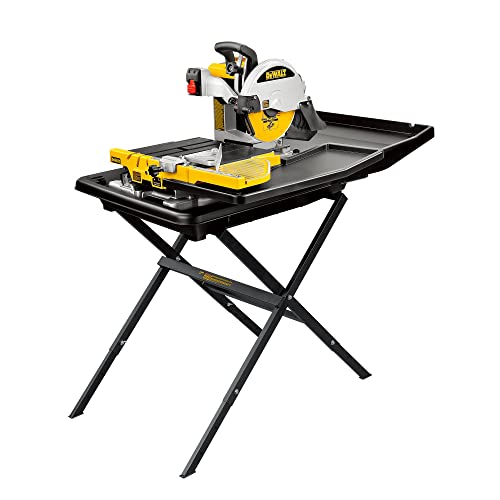
DeWalt D24000S 10-Inch Wet Tile Saw
What We Like
- 1.5 HP motor and 10-inch blade handle tough materials
- Cutline indicator and stainless rollers ensure precise cuts
- Compact frame aids transport and vehicle storage
- Includes stand, extension, and multiple guides
Trade-offs
- 36-inch length demands significant workshop floor space
- 69-pound tool weight limits casual portability
With a diagonal capacity for 18-inch tiles and accuracy within a thirty-second of an inch over that span, this saw delivers the repeatable precision that professional tile setters and serious DIYers need for flawless installations. The integrated stand and side extensions create a stable, complete workstation right out of the box. It’s built for users who tackle large bathroom floors or kitchen backsplashes regularly and can’t afford guesswork in their cuts.
At 69 pounds, this saw is a workshop fixture rather than a portable tool, though its compact frame is designed to fit in a vehicle for transport between jobs. The included stand makes it a complete cutting station, but the total weight reflects its substantial build. Compared to a cordless option like the 34.1-pound CRAFTSMAN V20, this model is significantly heavier.
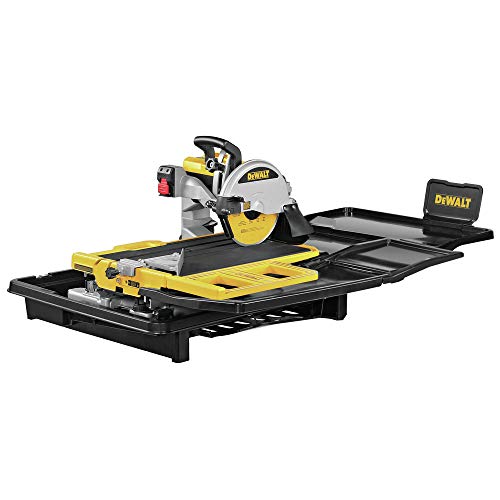
DeWalt D36000 High Capacity Wet Tile Saw
What We Like
- Massive 37-inch rip capacity for large tiles
- Excellent cutting accuracy to within 1/32 inch
- Integrated storage for accessories during transport
Trade-offs
- At 91 pounds, it's a substantial machine to move.
- Its size demands significant workshop or jobsite space.
- The power and capacity are overkill for small bathrooms.
A 37-inch rip capacity means you can cleanly slice a 36×36-inch tile in half, a task that stymies most saws. This is the core reason the D36000 is the default choice for pros and serious DIYers regularly tackling large-format porcelain or stone. Its rigid frame and stainless steel rollers deliver that promised 1/32-inch accuracy over long cuts, so your expensive tile fits perfectly without chipping or waste.
You pay for that capability with bulk and heft. While it rolls through a standard doorway and has built-in storage, this is a 91-pound shop workhorse, not a lightweight you’ll haul up a flight of stairs for a single backsplash. For a more balanced mix of jobs, the lighter DeWalt D24000S offers similar durability in a more portable package, though it can’t match the raw cutting breadth.
RUBI DC-250 Python 48-Inch Tile Saw

What We Like
- Patented ZERO DUST system reduces respirable particles
- C3 Python cooling system for efficient water delivery
- Foldable legs with wheels for easy transport
- Motor on sliding bearings for precision and reliability
Trade-offs
- No listed weight suggests a substantial, less portable build
- The 48-inch length requires significant workshop floor space
A 48-inch cutting capacity means this saw handles large format tiles and slabs with room to spare, making it a serious contender for professional shop work. Its certified ZERO DUST system is the real headline, capturing fine silica particles at the source to protect your lungs. The adjustable C3 Python cooling directs water exactly where the blade meets the material, which boosts cutting efficiency and keeps the mess contained. This is a saw built for the tradesperson who values long-term health and needs a durable, precise machine for daily use on demanding stone and porcelain.
A 48-inch cutting capacity means this saw handles large format tiles and slabs that smaller benchtop units cannot, anchoring it as a stationary workshop tool. Its steel plate structure and motor mounted on sliding bearings prioritize unwavering stability and precision over easy transport. The foldable legs with wheels aid movement within a shop, but the machine’s design focuses on maximum resistance to demanding working conditions rather than frequent job-site relocation.
Hoteche 8-Inch Benchtop Wet Tile Saw

What We Like
- Tilting saw body for 45-90° bevel cuts
- Spacious table provides stable cutting platform
- Includes a durable stand for operation
- Adjustable cutting depth for precise work
Trade-offs
- At 60 pounds, it's heavy for a benchtop model
- Maximum cutting width is 500mm
With an 8A motor and a 3550 RPM blade, this saw is built to cut tile and masonry efficiently. The included stand and its 785mm by 385mm table create a stable platform, which helps ensure cuts are accurate. This power and stability make it a versatile option for various project scales.
The trade-off for that stability is portability. At 60 pounds, this isn’t a saw you’ll want to haul up a ladder or carry across a jobsite every day. Its 500mm maximum cutting width handles most common tiles, but for larger format materials, you’d need to look at a model like the DeWalt D24000S with its wider capacity. For garage workshops or kitchen remodels where you set up once, the Hoteche’s heft becomes an asset, not a drawback.
Product photos
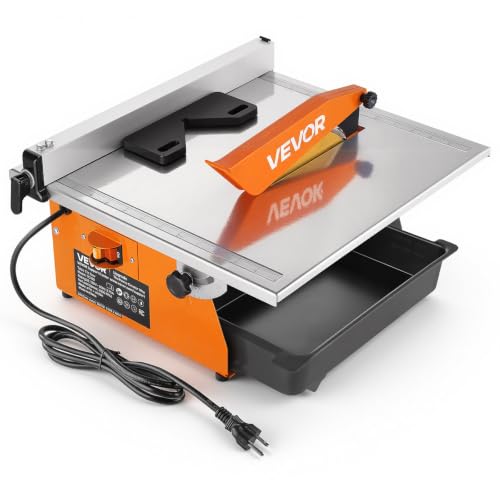
VEVOR 7-Inch Compact Wet Tile Saw
What We Like
- Compact 17.3-inch length for easy transport.
- Galvanized worktable resists scratches and cleans easily.
- Detachable water reservoir keeps the work area dry.
- Reset switch prevents unexpected motor startups.
Trade-offs
- 1.2-inch cut depth limits thick stone or tile.
It’s the kind of tool you can carry from the truck to a bathroom remodel without a second thought. The galvanized table and detachable water tank are smart touches for a clean, simple job site setup. For a DIYer tackling backsplashes or floor tiles in a tight space, this compact design removes a major logistical hurdle.
The trade-off for that portability is capacity. Its 1.2-inch maximum cut depth won’t handle thick natural stone slabs, and the work surface is necessarily smaller than a dedicated shop saw like the DeWalt D24000S. That’s the calculated compromise. It’s a tool for everyday DIY projects on materials like ceramic tile and marble, where its size is its greatest feature, not a limitation.
Product photos
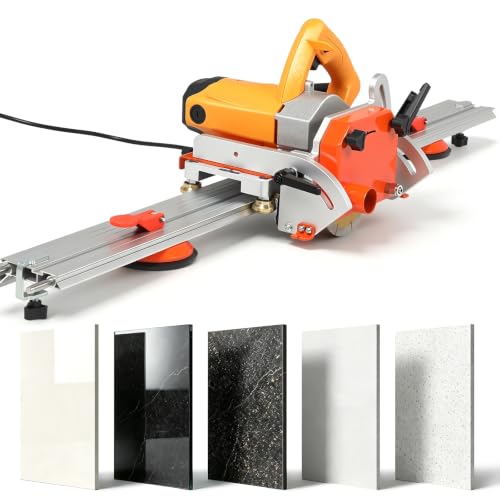
SUPVOX 71-Inch Electric Rail Track Saw
What We Like
- 71-inch rail track secures large slabs for long cuts
- 2300W motor provides power for dense materials
- Water-cooled system suppresses dust and extends blade life
- Portable 34.7-pound design for job site mobility
Trade-offs
- 80.1-inch length demands significant storage and transport space
- 20mm max thickness limits it to standard countertop slabs
A 71-inch rail track is the defining feature here, allowing you to make straight, chip-free cuts across full slabs of porcelain or marble without shifting the material. This makes it a natural fit for stone fabricators, landscape crews, or any renovator tackling large-format tile or countertop projects. The 2300W motor and water-cooled cutting handle dense materials, while the 34.7-pound weight keeps it relatively portable for a saw of this capability.
Its 71-inch rail track allows for long, straight cuts on large slabs, a clear advantage for tile installers and stone fabricators working with full-size materials. The trade-off is a substantial footprint, with the saw’s length requiring ample workspace. While it handles slabs up to 20mm thick, professional shops needing to cut very thick stone blocks might consider a dedicated high-capacity saw like the DeWalt D36000. The SUPVOX excels where long, precise cuts on large, standard-thickness slabs are the priority.
Product photos
CRAFTSMAN V20 Cordless Wet Tile Saw

What We Like
- Cordless operation for complete jobsite freedom
- Innovative sliding cart for improved cutting accuracy
- Excellent water containment for clean indoor use
- Roll cage handle for easy carrying and maneuverability
Trade-offs
- 17-inch capacity limits it to standard tiles, not large-format slabs
- Cordless design requires battery management on long jobs
Cordless operation means you can move freely around a job site without hunting for an outlet. Its 17-inch cutting capacity and a sliding cart are designed for improved accuracy, while the contained water system with fill-lines helps maintain a clean workspace indoors.
The saw’s compact size and 34.1-pound weight make it easier to carry than larger, corded models like the 91-pound DeWalt D36000. This portability comes with a smaller frame, which may limit its use compared to saws built on a larger scale for different project requirements.
QEP 22900Q 7-Inch Power Tile Saw

What We Like
- Direct-drive motor handles large tile projects
- Pre-set miter angles for accurate bevel cuts
- Interior water baffle reduces spray and refills
- Includes rip and angle cutting guides
Trade-offs
- Smaller 7-inch blade limits depth on thick materials
- Fixed cutting width versus sliding table designs
A table that tilts to 15, 30, and 45 degrees makes this saw a natural choice for anyone tackling baseboard tile, shower niches, or decorative borders. That miter system, combined with the included angle guide, lets you lock in repeatable cuts without fussing with a protractor. The 1 HP direct-drive motor has the grunt for porcelain, and the water baffle is a thoughtful touch to contain the inevitable splash. This is a straightforward benchtop saw built for the DIYer who needs precision angles more than massive tile capacity.
You trade some cutting depth for that focused miter functionality. The 7-inch blade and fixed table mean you can’t handle slabs like the DeWalt D36000, and it lacks the rail system of a dedicated track saw. It’s a wet saw, so research confirms you’ll still be dealing with water, not the clean, dust-free operation of a manual snap cutter. For intricate trim work and standard floor tiles, however, its dedicated angle stops deliver professional-looking results without a professional-grade price tag.
Product photos
How We Evaluated Wet Tile Saws
Our evaluation is based on thorough research of product specifications, manufacturer documentation, and professional tool round-ups. We also studied consistent patterns in user feedback to understand real-world performance and common trade-offs. This approach identifies which features truly matter for cutting tile accurately and efficiently.
The most important criteria were motor power and cutting capacity, which determine the materials a saw can handle. We also prioritized cutting accuracy features like rip guides and sliding tables, along with practical concerns like portability and water management. Understanding the balance between these factors is key to finding the best professional wet tile saw for contractors or a capable budget-friendly tile saw for DIYers.
A limitation of this research-led method is we cannot verify long-term durability through hands-on stress testing. However, by focusing on design fundamentals and aggregated owner experiences, our research-based recommendations can identify tools suited to specific project types, from basic budget wet tile saws to high-capacity premium rail saws.
What To Look For In Wet Tile Saws
Selecting a wet saw requires matching its core specs to your typical tile materials and project scale. A saw that’s underpowered will struggle with dense porcelain, while one that’s too large becomes a storage headache.
Key criteria are motor power (1 HP or more for tough materials), cutting capacity (length and depth), and design (sliding table vs. Rail). Portability and water containment also affect daily usability.
Motor Power and Blade Size
Motor horsepower directly impacts a saw’s ability to cut dense materials like porcelain or natural stone without stalling. Look for at least 1.5 HP for demanding professional work; many capable DIY models offer 1 HP. The blade size, typically 7 or 10 inches, determines maximum cutting depth. A 10-inch blade can handle thicker stone slabs, while a 7-inch blade is sufficient for most wall and floor tiles. The right diamond blades for wet saws are also crucial for clean cuts on specific materials.
Cutting Capacity and Accuracy
Cutting capacity is measured by rip capacity (the length of a straight cut) and diagonal capacity. For large-format tiles, a 24-inch or greater rip capacity is essential. Accuracy is provided by features like a sliding table, adjustable rip fence, and miter guides. A sliding table offers more control than moving the tile by hand, and a sturdy fence ensures straight, repeatable cuts. For intricate work, understanding how to use a wet tile saw properly is as important as the tool itself.
Portability and Water Management
Consider where you’ll use the saw. Contractors moving between job sites need a lighter, more compact saw, perhaps even a handheld wet tile saw. For a dedicated workshop, a heavier stationary saw with a stand offers stability. Water management systems keep the work area clean; look for a well-designed reservoir and pump or a direct-fed system to cool the blade. The benefits of using a wet tile saw include dust suppression, but a messy setup can negate that advantage.
- Check the saw’s assembled length and weight against your vehicle’s storage space.
- Ensure the water pump is accessible for cleaning to prevent clogs from slurry.
- Look for a stand or folding legs if you’ll be working at a comfortable height.
- Verify the power cord length for your workspace layout.
Choose a saw whose maximum cutting capacity exceeds your largest common tile by a few inches for a safety margin.
Wet Tile Saws Compared
The table below compares the key specifications of our eight picks to help you see the differences at a glance.
| Product | Motor Power/Speed | Max Cut Depth | Weight |
|---|---|---|---|
| DeWalt D24000S 10-Inch Wet Tile Saw | 1.5 HP | 3 1/8" | 53.6 pounds |
| DeWalt D36000 High Capacity Wet Tile Saw | 15 Amp, 1220 MWO | N/A | 91.0 pounds |
| RUBI DC-250 Python 48-Inch Tile Saw | 2790 RPM | 2 1/8 inches | N/A |
| Hoteche 8-Inch Benchtop Wet Tile Saw | 8A, 3550 RPM | 30mm at 90° | 60.0 pounds |
| VEVOR 7-Inch Compact Wet Tile Saw | 3600 RPM | 1.2" at 90° | 22.5 pounds |
| SUPVOX 71-Inch Electric Rail Track Saw | 2300W | 20mm | 34.7 pounds |
| CRAFTSMAN V20 Cordless Wet Tile Saw | Cordless | N/A | 34.1 pounds |
| QEP 22900Q 7-Inch Power Tile Saw | 1 HP, 3600 RPM | 1-1/8 inches | N/A |
Frequently Asked Questions
Which wet tile saw is best rated?
Based on our research of expert assessments and owner feedback patterns, the DeWalt D24000S is consistently highly regarded for its blend of power, precision, and included accessories. It is a common choice for professionals and serious DIYers needing a reliable, all-around performer.
Which wet tile saw is better, DeWalt or Ridgid?
Both brands offer quality tools, but the best choice depends on the model’s specifications for your project. We recommend comparing the motor power, cutting capacity, and features of individual saws that fit your budget and needs.
What is the best 7 inch wet tile saw blade for porcelain tile?
For cutting hard porcelain with a 7-inch saw, you need a continuous-rim diamond blade designed for that material. These blades have a bonded diamond edge that provides a smoother, chip-free cut on porcelain and ceramic tile compared to segmented blades meant for masonry.
Are Harbor Freight tile saws any good?
Harbor Freight sells several models that can be suitable for light, occasional DIY use, offering an entry point for those on a strict budget. For frequent use or professional work, our research indicates that investing in a saw with a more powerful motor and sturdier construction from brands like DeWalt or QEP often leads to better accuracy and longevity.
What size wet tile saw do I need for 24×24 tile?
To cut a large tile diagonally, you need a saw with a diagonal cutting capacity greater than the tile’s diagonal measurement. Look for a model with sufficient rip capacity and a sliding table or rail system that can accommodate the tile’s full size.
The Bottom Line
For professional tilers and dedicated DIYers tackling a variety of materials, the DeWalt D24000S is the best overall wet tile saw. Its 1.5 HP motor, precise Cutline indicator, and included stand create a complete, accurate cutting station.
If you’re on a tight budget, the Hoteche 8-Inch Benchtop model provides a stable platform for typical jobs, while those needing maximum portability should consider the VEVOR 7-Inch Compact saw. Ultimately, matching the saw’s motor power and cutting capacity to your specific tile materials is the most important factor for a successful purchase.
