
Hammer Drill vs Rotary Hammer: Which Should You Buy?
This post contains affiliate links. As an Amazon Associate, we earn from qualifying purchases.
A hammer drill is a versatile tool that combines rotation with a light, rapid hammering action for brick and light concrete, while a rotary hammer uses a pneumatic piston to deliver fewer, much more powerful blows for heavy-duty concrete drilling and chiseling. For most homeowners doing occasional anchor holes, a hammer drill is sufficient. For regular work on slabs or holes over 1/2 inch, you need a rotary hammer.
The difference isn’t academic. It’s a line drawn by impact energy, a few hundredths of a joule versus multiple full joules, and that number decides which tool burns out and which powers through. Understanding the hammer drill vs rotary hammer distinction clarifies this: a hammer drill is a drill first; a rotary hammer is a breaker that also rotates.
What follows is a breakdown of the mechanisms, the hard numbers from spec sheets, and the specific jobs where each tool earns its keep. By the end, you’ll know exactly which one to rent, buy, or walk away from.
Key Takeaways
- The internal mechanism is the deciding factor: hammer drills use wearing cam plates, while rotary hammers use a durable pneumatic piston.
- Impact energy separates them: hammer drills deliver a fraction of a joule; even a modest rotary hammer like the DeWalt DCH273B hits with 2.1 Joules.
- Know the limits: A hammer drill is for holes up to about 1/2 inch in concrete; for anything larger or for chiseling, step up to an SDS-Plus rotary hammer.
- Listen to the tool: A high-pitched, frantic buzzing means a hammer drill; a deeper, rhythmic thud-thud-thud means a rotary hammer is working.
- Rent the big gun: For a one-time project needing a dozen 3/4-inch anchor holes, renting an SDS-Max rotary hammer is smarter than burning up a $150 tool.
The Core Difference: It’s All About the Hit
You can feel it in your hands before you even turn the tools on. A hammer drill is compact, with bare tool weights around 3-4 pounds for some models. A rotary hammer has a heftier, longer body to house a different kind of engine. That engine changes everything.
A hammer drill generates percussion through two ridged metal discs (cam plates) that ratchet against each other as the chuck spins. This produces a very high frequency of light blows, with some models delivering over 30,000 blows per minute. A rotary hammer uses an electro-pneumatic piston: a motor drives a piston that compresses air in a cylinder, slamming a free-flying striker into the bit. This delivers fewer blows per minute (e.g., 0–4,600 BPM on the DeWalt DCH273B) but with massively more force per hit.
This isn’t just a spec-sheet trivia. It dictates the tool’s lifespan and its best use. The cam plates in a hammer drill experience direct metal-on-metal friction with every blow. One source notes this directly: “The hammer action of the drill will fail after repeated use” due to this wear. A rotary hammer’s piston and striker never actually touch the chuck mechanism, leading to the claim it “can be used continuously for heavy-duty hammer drilling without internal components failing.”
So a hammer drill isn’t a light-duty rotary hammer. It’s a different tool for a different job, with a built-in expiration date for hammering work.
Impact Energy: The Number That Doesn’t Lie
This is the single most telling spec in the hammer drill vs rotary hammer debate, and most hammer drill product pages tellingly omit it.
- Hammer Drill Impact Energy: Cited as “a few hundredths of a joule.” It’s not a published rating because the cam mechanism isn’t built for high-energy impacts.
- Rotary Hammer Impact Energy: Always published in Joules. It’s the benchmark. The cordless DeWalt DCH273B delivers 2.1 Joules. The more powerful DCH293B hits 3.5 Joules. For heavy work, corded models like the Makita HR4003C can exceed 11 Joules.
The Hart HPHD25B hammer drill illustrates the BPM-focused design: it boasts up to 31,000 BPM, but no impact energy rating is given. That high BPM is great for buzzing through brick, not for pounding through aggregate.
When to Use a Hammer Drill (And When to Stop)
A hammer drill is your go-to for light masonry and the occasional concrete anchor. It’s the multitasker.
Its best-fit jobs are hanging pictures on brick, installing curtain rods into mortar, or driving a handful of 1/4-inch Tapcon screws into a basement floor for a bottom plate. Sources point to a maximum hole diameter ranging from about 3/8 inch to 5/8 inch in concrete, with many citing 1/2 inch as a common limit. The Ryobi support page is more conservative, suggesting it’s “typically suited for hole sizes up to 10–13 mm” (about 3/8 to 1/2 inch).
Where this goes sideways: Using a hammer drill on dense, old concrete or for holes larger than 1/2 inch. The cam plates slip, the motor whines, and the bit spins without biting. You’ll smell the faint scent of hot electronics long before the tool finally seizes. This is how you turn a $150 drill into a paperweight in an afternoon.
Here’s the sensory reality: a hammer drill at work sounds like a high-pitched, angry insect.
Its killer feature is versatility. With the hammer mode off and a clutch adjusted, it drives screws into wood and drills metal. For the DIYer whose masonry work is a rare event, this one-tool solution makes sense.
| Best For | Tool | Typical Specs | Stop When You Need… | | :— | :— | :— | :— | | Brick, block, mortar, occasional small concrete anchors | Hammer Drill | ~30,000 BPM, a fraction of a joule, 3-5 lbs | Holes >1/2″, chiseling, more than 10 holes in a session | | Solid concrete, repetitive anchor holes, light demolition | SDS-Plus Rotary Hammer | ~4,500 BPM, 1.7-3.5 J, 6-9 lbs | Holes >1-1/4″, full-day demolition, core drilling | | Foundation work, large anchors, heavy chiseling | SDS-Max Rotary Hammer | ~2,000 BPM, 5.0+ J, 10+ lbs | Anything less—these tools are overkill for small jobs |
When to Use a Rotary Hammer (It’s Not Just for Pros)
The rotary hammer is for when the hammer drill starts to struggle. Its domain is poured concrete slabs, foundation walls, and hard stone.
You need one if you’re running electrical conduit through a foundation, setting a dozen 3/4-inch wedge anchors for a deck ledger, or chipping away old tile mortar. The Ryobi support guide states it’s “designed for solid concrete and reinforced concrete” and can drill holes “typically up to 26 mm” (just over 1 inch).
The switch to an SDS chuck (either SDS-Plus or SDS-Max) is a major upgrade. The bit locks in with a positive click and can slide back and forth, allowing the piston’s full energy to transfer to the tip without loss. This is a key part of how to use a rotary hammer safely and effectively.
The experience is different. The sound is a deeper, rhythmic pounding. The tool does more of the work; you guide it rather than force it. The vibration is lower-frequency but can be more intense in larger models, the DeWalt DCH293B registers 7.5 M/S² at full power. This is why anti-vibration handles and using the side handle are essential.
SDS-Plus vs. SDS-Max: The Next Decision
If you’ve settled on a rotary hammer, you now choose the bit system. This is a permanent choice, the tools are not compatible.
- SDS-Plus: The standard for heavy-duty DIY and professional trade work. It handles bits for holes typically up to about 1 inch in diameter, according to some sources. Cordless models like the DeWalt DCH273B dominate here.
- SDS-Max: For industrial and demolition work. It drives larger core bits (over 1-1/2 inches), demolition chisels, and ground rods. These are almost always corded and significantly heavier.
Our dedicated SDS Plus vs SDS Max guide breaks down this choice further, but for most readers, SDS-Plus is the answer. The larger demolition hammer is a separate, more specialized tool category entirely.
Hammer Drill vs. Rotary Hammer: The Practical Choice
We’ll apply the hammer drill vs rotary hammer decision to your garage. This table cuts through the marketing.
| Factor | Hammer Drill | Rotary Hammer (SDS-Plus) |
|---|---|---|
| Primary Mechanism | Cam plates (direct friction) | Pneumatic piston (air-driven) |
| Impact Energy | Fraction of a Joule (unrated) | 1.7 – 3.5+ Joules (published) |
| Blows Per Minute (BPM) | Very High (e.g., 31,000 on Hart HPHD25B) | Lower (e.g., 0–4,600 on DeWalt DCH273B) |
| Chuck Type | Standard 3-jaw keyless/keyed | SDS-Plus (requires specific bits) |
| Best Material | Brick, block, mortar, light concrete | Poured concrete, stone, heavy masonry |
| Efficient Hole Size (Concrete) | Up to 1/2 inch (sources disagree up to 5/8″) | 1/2 inch to 1 inch |
| Additional Functions | Drill-only mode, screwdriving | Drill-only, hammer-drill, hammer-only (chisel) |
| User Fatigue | High-frequency vibration, requires push | Heavier tool, more low-frequency vibration |
| Typical Weight | 3-5 lbs (e.g., Hart HPHD25B is 3.38 lbs bare) | 6-8.2 lbs (e.g., DeWalt DCH273B is 6 lbs bare) |
The Brand & Model Landscape
You can’t talk tools without names. Here’s how some popular models stack up in the real world.
For hammer drills, brands like Hart offer capable entry points. The Hart HPHD25B is a brushless model that shows what the category aims for: it’s compact (3.38 lbs bare), has a 2-speed gearbox, and delivers high BPM for its size. It’s a classic example of a hammer drill vs regular drill upgrade. For more options, our best hammer drills list digs deeper.
The rotary hammer conversation often starts with DeWalt. The DeWalt DCH273B is a benchmark cordless SDS-Plus tool. Its 2.1 Joules of impact energy, 6 lb weight, and anti-vibration tech make it a pro favorite. Need more power? The DeWalt DCH293B bumps that to 3.5 Joules. For the corded and mighty, the Makita HR4003C delivers up to 11.4 Joules of impact force. Check our best rotary hammers guide for a full comparison.
Common mistake: Buying a hammer drill for a large, one-time concrete project. You’ll spend more on burnt-up bits and frustration than the cost of a weekend rental. For a one-off slab project, renting a pro-grade rotary hammer from a tool library or home center is the smartest financial and practical move.
Safety, Noise, and the Wear on You
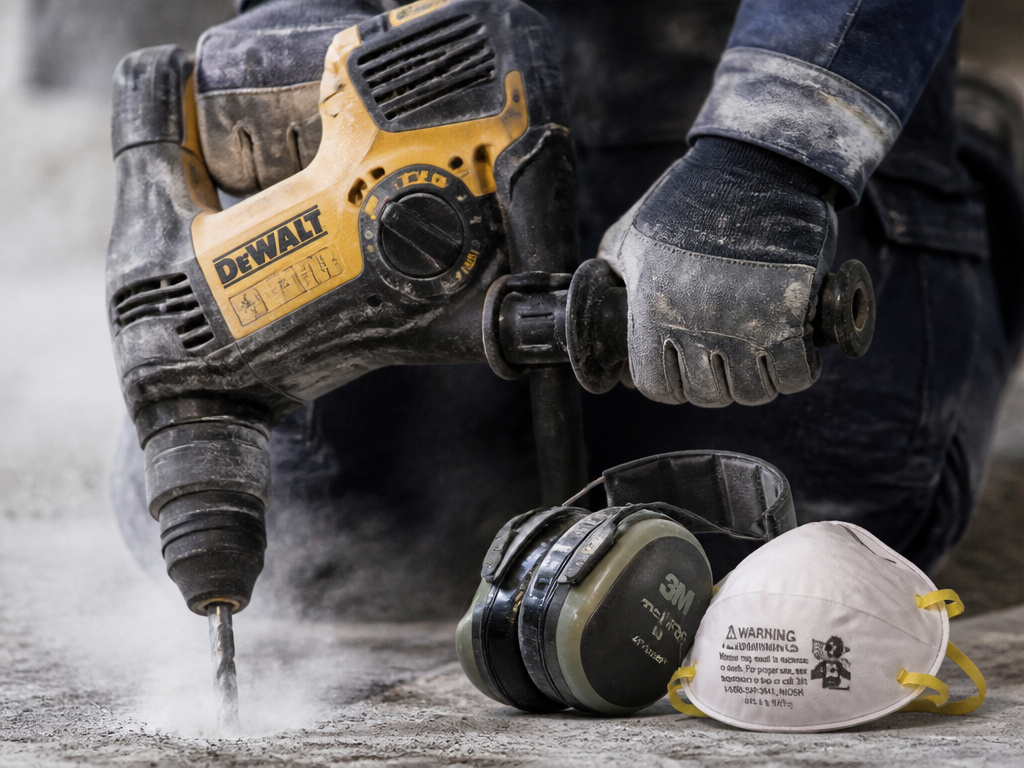
This is the part that doesn’t get enough airtime. Concrete and masonry work is hard on the tool, but it’s also hard on you.
- Hearing Damage: A hammer drill operates at 100–105 dB at the operator’s ear. OSHA exposure limits are exceeded in under 15 minutes. Wear earmuffs.
- Silica Dust: Concrete and brick dust contains crystalline silica, a known carcinogen. An N95 respirator is the bare minimum; a dust extractor that makes the DeWalt DCH273B OSHA Table 1 compliant is the gold standard.
- Eye Protection: Flying carbide fragments and dust require ANSI Z87.1-rated safety glasses or a full face shield.
- Vibration: Long-term exposure leads to hand-arm vibration syndrome (HAVS). Rotary hammers with anti-vibration handles (like DeWalt’s SHOCKS system) aren’t a luxury; they’re a health requirement for frequent use.
The physical toll is real. A hammer drill’s high-frequency vibration leaves your hands and forearms feeling numb and tingling after a dozen holes. A rotary hammer’s heavier blows transfer more shock through your skeleton if you’re not braced correctly. Always use the side handle.
Corded vs Cordless options
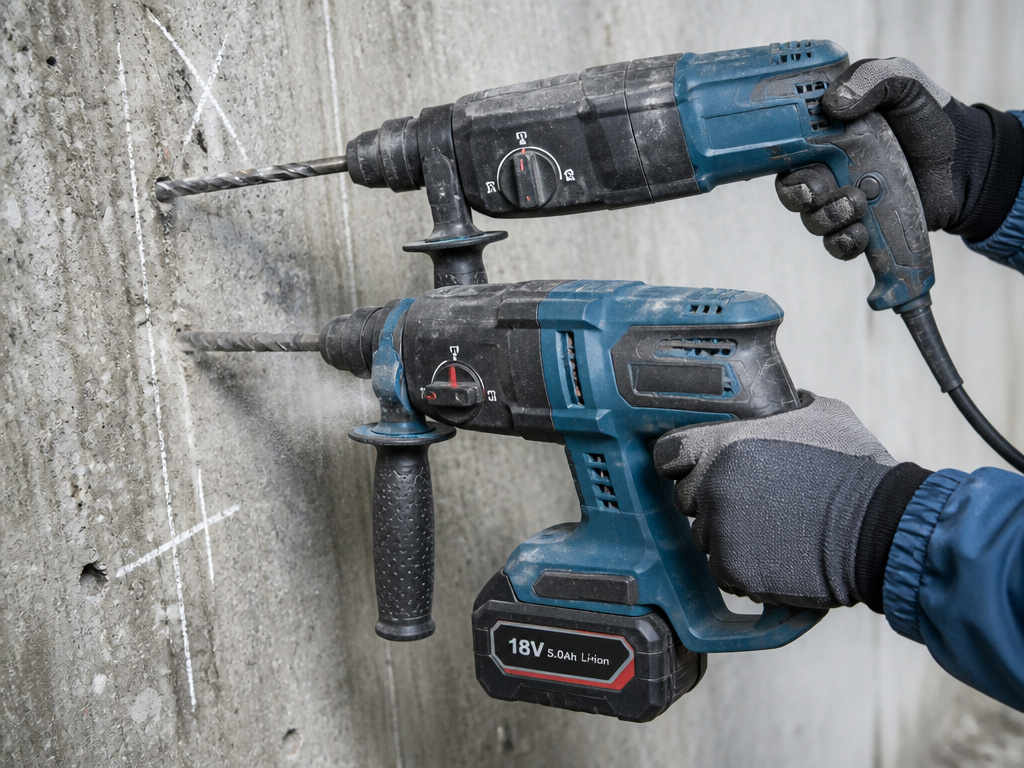
The choice between corded and cordless models is a trade-off between power and portability. Corded tools draw consistent power from an outlet, which is beneficial for heavy, continuous work like drilling many large holes in concrete. Cordless models offer complete freedom from extension cords, making them ideal for job sites without easy power access or for overhead work. Modern cordless rotary hammers can deliver significant impact energy, with some SDS-Plus units landing in the 1.7–3.5 J range suitable for recurring work. Your decision hinges on whether you prioritize unlimited runtime and maximum power or the convenience of cord-free movement.
Maintenance and care
Proper care extends the life of your tool. After each use, clean dust and debris from the chuck, vents, and body with a dry brush or cloth. For hammer drills, be aware that the hammering mechanism relies on friction plates that will wear out after repeated heavy use. The pneumatic mechanism in a rotary hammer is more robust for continuous drilling. Regularly check for loose parts or damaged cords. Always use the correct SDS or standard chuck for your bits to prevent damage. Store the tool in a dry place, and if it’s cordless, follow the battery manufacturer’s guidelines for charging and storage to maintain battery health.
Frequently Asked Questions
Can a rotary hammer be used as a regular drill?
Yes, but it’s a bad idea for most tasks. Rotary hammers have a “drill-only” mode that disengages the hammer mechanism. However, they are heavier, less balanced, and lack an adjustable clutch for screwdriving. The Ryobi support guide explicitly states they are “not recommended for driving screws.” You can, but you shouldn’t. Use a dedicated hammer drill vs impact driver for driving fasteners.
Is a hammer drill enough for concrete?
It depends on the concrete and the hole size. For a few small anchors (1/4″ to 1/2″) in standard 3,000-5,000 PSI concrete, a hammer drill is enough. For dense, old aggregate concrete or holes larger than 1/2 inch, it will struggle, overheat, and wear prematurely. That’s when you need one of the best drills for concrete, which are almost always rotary hammers.
What is SDS?
SDS stands for Slotted Drive System (or Steck-Dreh-Sitz from its German origin). It’s a specialized chuck that allows bits to slide back and forth while being locked from rotating. This allows the pneumatic piston in a rotary hammer to transfer its full impact energy directly to the bit. SDS-Plus is for mid-size tools; SDS-Max is for heavy demolition.
When should you NOT use a hammer drill?
Do not use a hammer drill for:
- Chiseling or demolition. It lacks a hammer-only mode.
- Drilling large holes (>1/2″) in solid concrete. You’ll destroy the tool.
- Extended, daily concrete drilling. The cam mechanism will wear out.
- Fragile materials like hollow tile or thin brick. The aggressive hammering can blow out the back side.
The Bottom Line
Choosing between a hammer drill and a rotary hammer comes down to material and frequency.
If your masonry work is occasional and involves brick, block, or holes under 1/2 inch in concrete, buy a hammer drill. It’s a versatile addition to your kit. Look at the hammer drill vs drill comparison if you’re upgrading from a basic model.
If you’re drilling into poured concrete slabs, need holes over 1/2 inch, or see chiseling in your future, you need an SDS-Plus rotary hammer. It’s a harder initial investment but saves time, bits, and your other drills from an early death.
For the one-off project, installing a dozen 3/4-inch anchors for a pergola, rent. Don’t let a $300 tool purchase be dictated by a $50 job. Your future self, with un-jangled nerves and a functional drill, will thank you.
