
10 Best Table Saw Blades For Ripping Hardwood in 2026
This post contains affiliate links. As an Amazon Associate, we earn from qualifying purchases.
For ripping thick hardwoods, the Ridge Carbide Tool Co. TS21024-5 Table Saw Blade is our best overall for its aggressive flat-top grind and 20-degree hook angle designed for maximum material removal. We also highlight the CMT ORANGE TOOLS 250.024.10 as the best thin-kerf option for less powerful saws and the Ridge Carbide TS21030GL-5 for glue-line finishes.
Ripping hardwood demands a blade that can power through dense grain without bogging down your saw or leaving a torn edge. This guide is based on research into blade specifications, manufacturer data, and patterns in owner feedback to help you find the right match for your saw’s horsepower and your project’s finish requirements.
Top 10 Table Saw Blades For Ripping Hardwood in the Market
Certain content that appears on this site comes from Amazon. This content is provided "as is" and is subject to change or removal at any time.
The Best Table Saw Blades For Ripping Hardwood, Reviewed
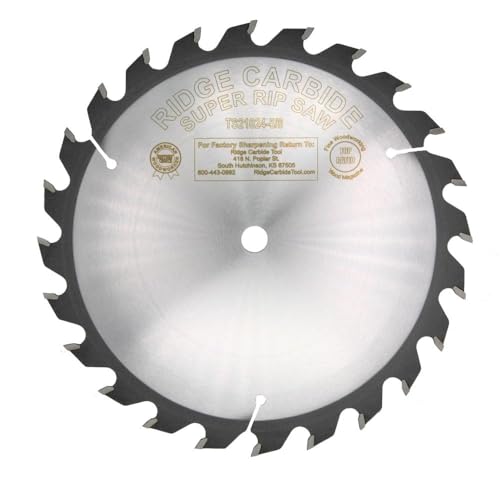
Ridge Carbide Tool Co. TS21024-5 Table Saw Blade
What We Like
- FTG grind for maximum material removal.
- Aggressive 20° hook angle for fast feed.
- Full 0.125" kerf for stability in thick stock.
- Designed specifically for ripping hardwood.
Trade-offs
- Full kerf design requires a powerful table saw.
- 24-tooth FTG grind leaves a rougher cut surface.
A 24-tooth Flat Top Grind is built for one job: hogging out wood. Each tooth acts like a tiny chisel, tearing through long grain in thick hardwood with exceptional speed. That aggressive +20° hook angle pulls the material in, letting you push stock through efficiently. This blade is for the woodworker who values raw ripping performance above all else, especially when dealing with dense oak or maple up to two inches thick. It’s a specialist that excels at its core task.
The Ridge Carbide TS21024-5 is a dedicated rip blade, designed to cut with the grain for fast stock removal. Its 24-tooth flat top grind makes every tooth a full-width cutter, which aggressively plows through wood but requires a powerful table saw to drive it. This blade is recommended for 1-1/2″ to 2″ thick hardwood, where its design prioritizes speed over a finished surface.
CMT ORANGE TOOLS 250.024.10 Table Saw Blade
What We Like
- Suitable for hardwoods, plywood, and pressure-treated lumber.
- 0.102-inch kerf for less material waste.
Trade-offs
- Not a glue-line blade like the Ridge Carbide TS21030GL-5.
- ATB grind, not a dedicated glue-line grind.
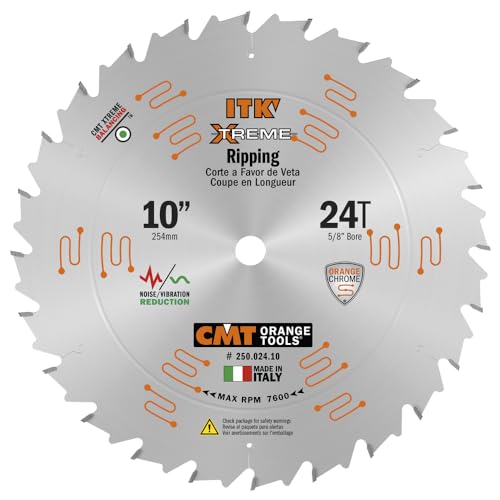
That 0.102-inch kerf is the star of the show. It removes less material than a full-kerf blade, so your saw motor works less and you get more usable lumber from every board. This makes it a fantastic choice for anyone ripping a lot of hardwood on a contractor-style or portable saw where power conservation is key.
Its plate is the main compromise. At just 0.071 inches thick, it’s not as rigid as a full-kerf blade. When pushing very dense, thick hardwoods, you might notice some deflection, which can affect absolute straightness. For the ultimate in straight-line ripping on a powerful cabinet saw, a heavier blade with a full 0.125-inch kerf and thicker plate will track more predictably through the toughest grain.
Forrest Woodworker II 8-1/4" 40-Tooth Saw Blade
What We Like
- Hand-straightened for .001/.002 inch runout
- Heavy plate and negative hook for stability
- 40-tooth design replaces multiple blades
- Cuts 1/16 inch oversize for resurfacing
Trade-offs
- 8-1/4 inch diameter limits depth on 10-inch saws
- 3/32 inch kerf requires more power than thin-kerf blades
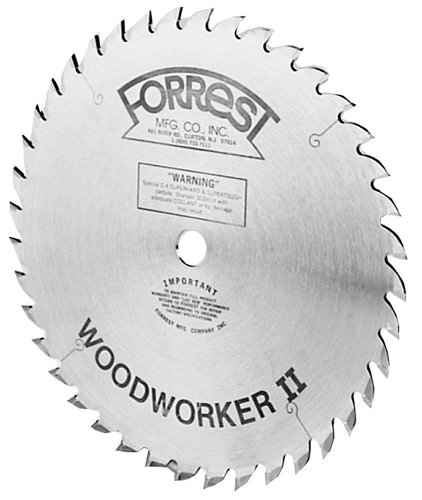
The hand-straightened plate with a runout of just .001 to .002 inches delivers a level of cut smoothness that makes sanding almost optional. That precision, combined with a heavier steel plate and a negative hook angle, gives you a blade that simply doesn’t wander or chatter in dense hardwoods. This makes it a fantastic choice for the woodworker who demands a finished-ready cut straight off the saw and wants one blade to handle ripping and crosscutting duties with exceptional quality.
This 8-1/4 inch blade won’t give you the maximum cutting depth on a standard 10-inch table saw. For dedicated, high-volume ripping where speed is the only goal, a 10-inch super ripping blade with 24 teeth will clear material faster. The Forrest Woodworker II, however, excels as a meticulous all-rounder for smaller saws or for the craftsman who values a flawless, multi-purpose cut over raw speed.
Product photos
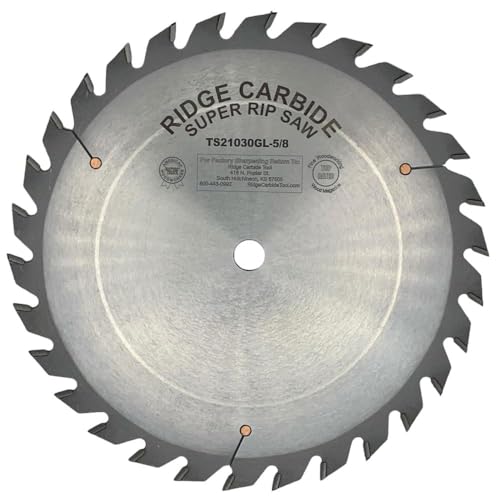
Ridge Carbide Tool Co. TS21030GL-5 Table Saw Blade
What We Like
- Triple Chip Grind for clean cuts in hard materials
- Specifically designed for glue-line ripping
- 30-tooth TCG grind for harder materials
Trade-offs
- 0.145" full kerf demands more power from your saw
- Not recommended for crosscutting natural wood
The 30-tooth Triple Chip Grind is the key to this blade’s purpose. It’s the right choice for a woodworker whose primary goal is producing furniture-grade panels and table tops where the seam needs to disappear. The full 0.145″ kerf adds rigidity, which is crucial for that final pass where tear-out is not an option.
That stiffness means the blade requires a saw with ample power. If your saw struggles under load, a thinner 0.125″ kerf blade is an alternative for ripping. This blade is a specialist, so keep a general-purpose blade on hand for crosscuts and plywood. Use this one when the task requires a ripping blade designed for glue-line joints.
Amana Tool 12" Glue Line Ripping Circular Saw Blade
What We Like
- Leaves glue-ready edges without sanding or jointing.
- Thick, laser-cut plate minimizes vibration for stable cuts.
- Micrograin carbide tips provide extended edge life.
- 22-degree hook angle supports fast feed rates.
Trade-offs
- 12-inch diameter requires a compatible table saw.
- 1-inch bore may need a reducer bushing for common saws.
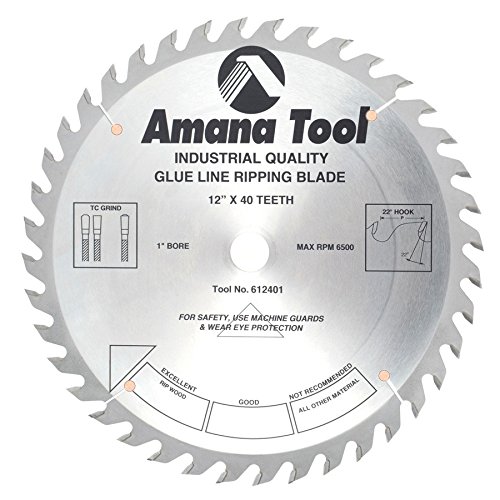
The Amana Tool 12″ Glue Line Ripping blade leaves edges ready to glue with no sanding or jointing, so you can assemble panels directly from the saw. Its 22-degree hook angle and Triple-Chip Grind support fast feed rates while maintaining a polished edge on both hardwood and softwood. A thick, laser-cut plate minimizes vibration and deflection, which helps deliver stable and accurate cuts.
Its large diameter and 1-inch arbor hole make this a specialized tool, as it won’t fit every table saw and its full kerf requires a saw with solid power. A more universal option for 10-inch saws is the Ridge Carbide TS21030GL-5, which offers a similar glue-line rip in a smaller package. You do give up some cutting depth and feed rate with that smaller blade, however.
Product photos
CMT Orange Tools 285.624.10 Ripping Saw Blade

What We Like
- Full 0.126-inch kerf for stable cuts in hardwood.
- Flat-top tooth grind optimized for ripping grain.
- Standard 5/8-inch arbor fits most cabinet saws.
Trade-offs
- Full kerf requires a saw with ample power.
- Only 24 teeth, leaving a rougher cut surface.
The 24 flat-top teeth are built for one job: ripping hardwood fast and straight. This grind acts like a series of chisels, plowing through long grain with minimal resistance and heat. That full 0.126-inch kerf provides a rigid blade body, which fights deflection in dense material to keep your cuts dead-on. It’s the straightforward choice when your primary task is breaking down thick oak or maple, and you need a blade that won’t wander or bog down under load.
That rigidity comes with a trade-off. The wider kerf removes more material and demands more from your saw’s motor compared to a thin-kerf blade. For glue-up-ready edges, you’ll need a follow-up pass with a jointer or a dedicated glue-line ripping blade. Think of this CMT as your dedicated rough-ripping workhorse. It excels at the heavy lifting but leaves the finish work for another tool in your stack.
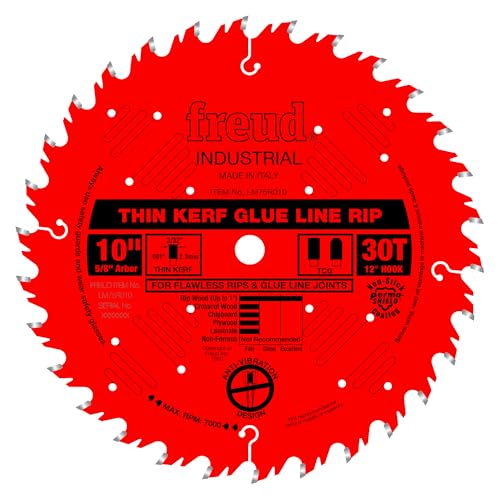
Freud LM75R010 Thin Kerf Glue Line Ripping Blade
What We Like
- Laser-cut anti-vibration slots reduce sideways movement.
- Perma-Shield coating reduces drag and pitch buildup.
- TCG grind and 30 teeth designed for glue-line ripping.
Trade-offs
- A 12-degree hook angle is less aggressive for fast ripping than a 20-degree blade.
Designed for glue-line ripping, the Freud blade’s thin kerf removes less material. This reduces strain on a saw motor and creates more usable lumber from each board, which matters when working with expensive hardwoods. Its TCG tooth grind and Perma-Shield coating are engineered for a clean, splinter-free edge ready for glue-up.
While the laser-cut slots fight vibration, this blade demands a perfectly tuned saw with a flat, clean arbor washer to prevent any wobble. It’s a precision instrument. For the ultimate in stability on a powerful cabinet saw, you’d look at a full-kerf glue-line ripping option. But for most contractor and hybrid saws, this Freud’s design efficiently balances cut quality with reduced load.
Product photos
WEN BL1032-2 Table Saw Blade
What We Like
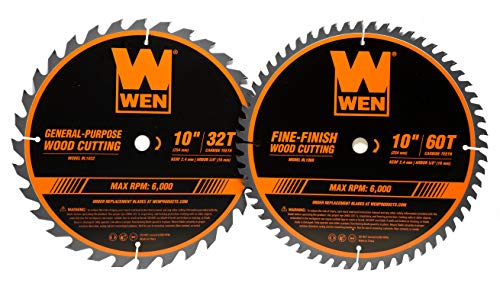
- Includes two specialized blades in one set
- Ultra-thin kerf for efficient material use
- Rated for hardwoods and softwoods
- Wide compatibility with common 10-inch saws
Trade-offs
- 32-tooth blade is for general, not dedicated, ripping
- Maximum RPM rating of 6000
This two-pack delivers both a 32-tooth blade for general cutting and a 60-tooth blade for fine finishes, offering notable versatility for a woodworker who wants to cover multiple tasks with one purchase. The ultra-thin kerf puts less strain on your saw’s motor and wastes less wood to sawdust. It’s a practical choice for the hobbyist or occasional user who needs to rip hardwood but also wants a ready solution for crosscuts and finish work without swapping to a dedicated finish blade.
Think of this WEN set as a capable starter kit rather than a specialized ripping champion.
Innomesh 10 Inch 24-Tooth Rip Blade
What We Like
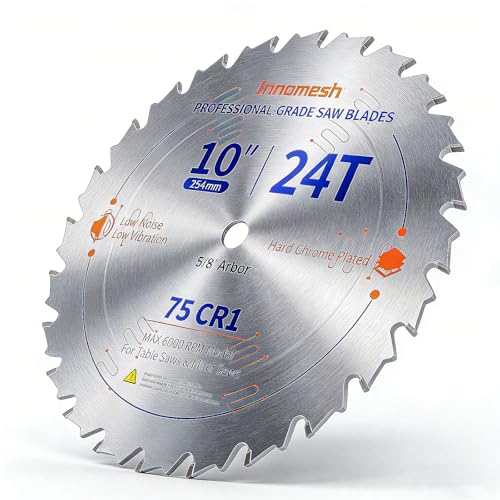
- 75Cr1 steel plate for reduced deflection and rigidity.
- Hard Chrome + UV coating reduces friction and pitch buildup.
- 12 filled damping slots lower noise and vibration significantly.
- 24-tooth rip geometry is optimized for fast, aggressive cuts.
Trade-offs
- No specified kerf width or plate thickness.
- No specified tooth grind or hook angle.
A 24-tooth rip geometry and a 75Cr1 steel plate are built for one job: fast, aggressive ripping through hardwoods and softwoods with minimal deflection. The blade is a straightforward workhorse, lacking the specialized grinds or ultra-thin kerfs of premium options, but its core construction is solid. It’s the right choice for a woodworker who needs a dedicated, no-frills blade for breaking down framing lumber or processing sheet goods without a major investment. The Hard Chrome and UV coating is a practical touch, aiming to extend life by fighting corrosion and gunk.
Crafted from 75Cr1 professional-grade steel, the Innomesh blade offers rigidity for smooth ripping in hardwoods and softwoods. Its 12 resin-filled slots reduce vibration and noise during operation. This design is intended for aggressive ripping tasks like processing lumber and sheet goods on a table saw or miter saw.
Product photos
Freud P410 Premier Fusion General Purpose Blade

What We Like
- Fusion Trio design for polished rips and crosscuts
- Laser-cut slots reduce vibration for cleaner cuts
- TiCo carbide stays sharp for hardwoods and laminates
- Non-stick coating resists pitch and corrosion
Trade-offs
- 40-tooth design not optimized for fast, heavy ripping
- 2.0-pound weight adds to saw's rotational mass
Freud’s Fusion Trio tooth design combines three separate grinds to produce a polished finish on both rip and crosscut operations, a real benefit when working with visible surfaces on veneered plywood or melamine. Its versatility covers a listed range of materials from wood and hardwoods to laminates, handling crosscuts from three-eighths to three and a half inches and rips from three-quarters to one and a half inches.
For dedicated, high-volume ripping of thick hardwoods, the 40-tooth configuration will require more feed pressure and generate more heat than a specialist ripping blade with a 24-tooth FTG grind.
How We Evaluated Table Saw Blades For Ripping Hardwood
Our evaluation focused on research, analyzing manufacturer specifications and expert round-ups to understand how blade design affects ripping performance. We prioritized tooth grind and hook angle for cutting efficiency, kerf width for compatibility with saw power, and carbide quality for edge retention in hard materials.
We also looked for consistent patterns in user feedback regarding cut quality, durability, and vibration. To form our recommendations, we rely on detailed specifications and documented user experiences. For a broader look at options, our detailed reviews of ripping blades and our blade buying guide provide more context.
What To Look For In Table Saw Blades For Ripping Hardwood
Choosing the right blade means matching its specifications to your table saw’s power and the demands of hardwood. A blade that excels in a powerful cabinet saw may stall a jobsite saw, and a blade optimized for speed may leave a surface needing extra work.
Focus on tooth grind and hook angle for cutting aggression, kerf width for saw compatibility, and carbide quality for longevity. A full kerf blade offers stability in thick stock but demands more power, while a thin kerf blade is easier on underpowered motors.
Tooth Grind and Hook Angle
The tooth geometry dictates how the blade attacks the wood. For ripping, a Flat-Top Grind (FTG) is ideal as it acts like a series of chisels to efficiently remove material along the grain. Hook angle is equally critical; a higher positive angle, like 20 degrees, pulls the workpiece into the cut for a faster, more aggressive feed rate. A lower hook angle, around 10-15 degrees, provides more control and a smoother finish but feeds slower.
Kerf Width
Kerf is the width of the cut the blade makes. A full kerf, typically .125″ or wider, uses a thicker plate for greater stability and reduced vibration in deep cuts, but it removes more material and requires a saw with ample horsepower. Thin kerf blades create less drag and are better suited for portable or underpowered saws, though they can be more prone to deflection.
Understanding the differences between thin and full kerf blades is key to matching the blade to your motor. Our guide to the best thin-kerf table saw blades highlights specific models for lower-powered saws.
Carbide Quality and Plate Design
High-quality micro-grain carbide tips resist wear from abrasive hardwoods, extending the time between sharpenings. The blade plate itself should be laser-cut for precise balance, which minimizes vibration for a smoother, more accurate cut. Look for features like damping slots or a non-stick coating, which further reduce noise, vibration, and pitch buildup. For those seeking ultimate precision for furniture work, our review of the best blades for fine woodworking covers options that prioritize a flawless finish.
–
- Check your saw’s manual for recommended blade diameter and arbor hole size.
- Ensure the blade’s maximum RPM rating exceeds your saw’s no-load speed.
- For a ready-to-glue edge, look for a Triple Chip Grind (TCG) or a dedicated “glue-line” blade.
- A higher tooth count (e.g., 30-40) within a rip blade design will yield a smoother cut than a 24-tooth blade.
The most important rule: match the blade’s kerf and aggression to your saw’s available power.
Table Saw Blades For Ripping Hardwood Compared
The following table compares key specifications of our top picks to help you see the differences at a glance.
| Product | Diameter | Tooth Count | Tooth Grind |
|---|---|---|---|
| Ridge Carbide Tool Co. TS21024-5 Table Saw Blade | 10" | 24 teeth | Flat Top Grind (FTG) |
| CMT ORANGE TOOLS 250.024.10 Table Saw Blade | 10 inches | 24 teeth | ATB |
| Forrest Woodworker II 8-1/4" 40-Tooth Saw Blade | 8-1/4 inches | 40 teeth | N/A |
| Ridge Carbide Tool Co. TS21030GL-5 Table Saw Blade | 10" | 30 | Triple Chip Grind (TCG) |
| Amana Tool 12" Glue Line Ripping Circular Saw Blade | 12 inches | 40 | Triple-Chip Grind (TCG) |
| CMT Orange Tools 285.624.10 Ripping Saw Blade | 10 inches | 24 | FLAT |
| Freud LM75R010 Thin Kerf Glue Line Ripping Blade | 10 inches | 30 | TCG |
| WEN BL1032-2 Table Saw Blade | 10-inch | 32-tooth and 60-tooth | N/A |
| Innomesh 10 Inch 24-Tooth Rip Blade | 10 inches | 24 teeth | N/A |
| Freud P410 Premier Fusion General Purpose Blade | 10 inches | 40 teeth | Hi-ATB |
Frequently Asked Questions
What is the best table saw blade for ripping hardwood?
For most woodworkers with a powerful cabinet saw, the best blade is a dedicated rip blade with a flat-top tooth grind and an aggressive hook angle, like our best overall Ridge Carbide TS21024-5. It’s designed specifically for fast, efficient material removal in thick hardwoods.
What is the best blade to use for ripping wood?
A rip blade is designed for cutting with the grain. Look for one with a low tooth count (24-30 teeth for a 10-inch blade) and a positive hook angle. The best choice depends on your saw’s power; a thin-kerf rip blade is better for underpowered saws, while a full-kerf blade offers more stability for powerful saws.
How many teeth for ripping hardwood?
For a 10-inch blade dedicated to ripping hardwood, 24 teeth is a common and effective count for fast, aggressive cuts. Some blades designed for a smoother “glue-line” rip cut may have 30 or 40 teeth, which will feed more slowly but leave a better surface finish directly from the saw.
What is the best table saw blade for ripping 2×4 wood?
Ripping construction lumber like 2x4s is less demanding than hardwoods. A general-purpose combination blade with around 40 teeth can handle this task efficiently. For frequent, dedicated ripping of framing lumber, a budget-friendly 24-tooth rip blade like the Innomesh will provide the fastest feed rates.
Can I use a combination blade for ripping hardwood?
You can, but it’s not ideal. A combination blade is a compromise, designed for both ripping and crosscutting. For serious hardwood ripping, a dedicated rip blade with a flat-top grind will cut faster, with less strain on your saw, and typically run cooler than a combination blade attempting the same cut.
The Bottom Line
The Ridge Carbide Tool Co. TS21024-5 is the best overall rip blade for woodworkers with powerful saws who prioritize raw speed and efficiency in thick hardwoods. For those with portable or underpowered saws, the CMT ORANGE TOOLS 250.024.10 thin-kerf blade is the smarter choice to prevent motor strain.
If your projects demand a joint-ready edge straight from the saw, look to the Ridge Carbide TS21030GL-5 or other dedicated glue-line blades. Ultimately, ensuring your blade’s kerf and cutting aggression are matched to your table saw’s horsepower is the single most important factor for successful, safe hardwood ripping.
