
10 Best Oscillating Belt Sanders in 2026
This post contains affiliate links. As an Amazon Associate, we earn from qualifying purchases.
For a workshop tool that handles both edge finishing and curved shaping, the WEN 6524 Oscillating Belt and Spindle Sander is our best overall choice for its versatile combo design. We also highlight picks for heavy-duty stability and compact shops. Oscillating sanders are indispensable for smoothing curves without grooves, but choosing between a benchtop combo, a dedicated edge sander, or a heavy floor model depends on your shop’s space and your typical project scale.
This guide distills research on specifications, expert insights, and owner feedback into concise comparisons to help you match a machine to your real-world needs.
Top 10 Oscillating Belt Sanders in the Market
Certain content that appears on this site comes from Amazon. This content is provided "as is" and is subject to change or removal at any time.
The Best Oscillating Belt Sanders, Reviewed
WEN 6524 Oscillating Belt and Spindle Sander
What We Like
- Combines 4×24 inch belt and five spindle sizes in one unit
- Onboard storage for all accessories and sandpaper
- Includes a beveling work table and multiple throat plates
- Oscillating action on both belt and spindle for cleaner finish
Trade-offs
- Fixed oscillation speed of 58 times per minute
- Includes only 80-grit sandpaper; other grits require separate purchase
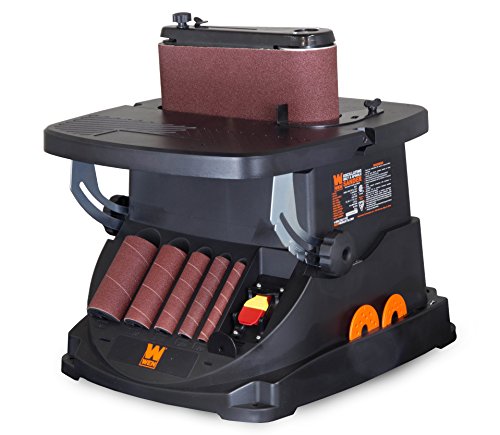
A complete five-size spindle set and a 4-inch belt on one oscillating platform means you can handle detailed curves and long edges without needing two separate machines. The 3.5-amp motor oscillates the belt and spindle, and onboard storage keeps all the included sleeves and plates organized for a tidy workspace. This combination of functions in a single unit makes it a practical choice for a small or medium shop where space is limited.
You do trade some heft for that all-in-one design. Compared to a dedicated unit like the 280-pound JET OES-689, the WEN’s 27-pound frame will benefit from being bolted down to a bench for vibration-free operation. The oscillation speed is fixed at 58 cycles per minute, so you cannot adjust the stroke for different materials. For a hobbyist tackling furniture projects, however, the convenience of having both spindle and belt functions ready to go can outweigh those compromises.
JET JOSS-S Oscillating Spindle Sander

What We Like
- Large tilting table with 90° quick index
- Oil-bath gear mechanism for long-term durability
- Integrated dust collection chamber with 4" port
Trade-offs
- Heavy 216 lb cabinet requires permanent floor space
- Large 44.5" height may not fit under low ceilings
- No belt sanding function like some combo models
The JET JOSS-S arrives with ten separate spindle assemblies, from 1/4″ to 4″. That dedicated selection means you can swap between grits or sizes in seconds without fiddling with adapters or sleeves on a single spindle. For a shop that frequently tackles complex curved work on everything from small craft pieces to large cabinet components, this is a massive time-saver. The 1-1/2″ oscillation and 1 HP motor handle aggressive material removal without bogging down, while the large, tilting table provides solid support for big workpieces.
Weighing 216 pounds with a cabinet base, this is a stationary machine designed for a dedicated shop space. The cabinet provides designated slots for storing the spindles and table inserts. An integrated paddle switch includes a safety key. Compared to benchtop combo units like the 27-pound WEN 6524, the JET occupies more floor space but offers greater capacity and a comprehensive set of dedicated spindles.
JET OES-689 Oscillating Edge Sander
What We Like
- 90-degree tilting sanding head for bevels and angles
- Adjustable outer drum support for contour sanding
- Quick-release lever simplifies belt changes
- Integrated storage cabinet with hanging hooks
Trade-offs
- At 280 pounds, it requires a permanent, sturdy shop floor.
- Its 51-inch length demands significant dedicated floor space.
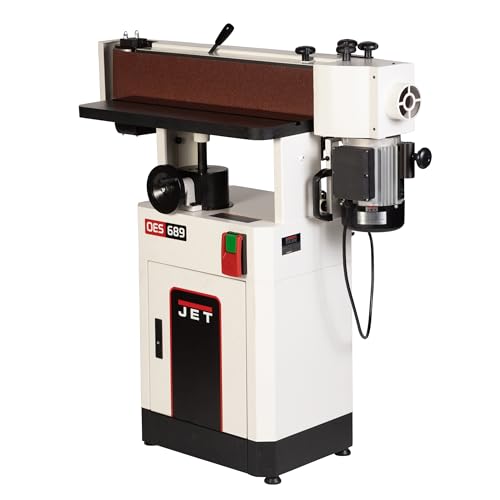
An 89-inch sanding belt is the key here, giving you the capacity to finish the full length of doors, tabletops, and cabinet sides in a single, uninterrupted pass. This is a machine built for serious volume and precision, with a cast-iron construction that stays dead flat and a tilting head that handles complex joinery. It’s for the workshop that processes large stock regularly and needs industrial-grade consistency and dust collection hooked up to a serious system.
The trade-off is its substantial footprint and heft. This isn’t a benchtop tool you can tuck away. For a shop needing both edge and spindle sanding in a more compact form, the WEN 6524 offers a combined function, but you sacrifice the massive belt length and cast-iron rigidity of this dedicated edge sander.
Shop Fox W1730 Oscillating Edge Sander

What We Like
- Massive 443-pound weight ensures zero vibration
- Long 89-inch belt provides extensive sanding surface
- Graphite platen reduces friction and heat buildup
- Quick lever simplifies belt changes and tensioning
Trade-offs
- At 443 lb, it requires a permanent, reinforced shop floor
- Its 49-inch height demands significant vertical clearance
At 443 pounds, the Shop Fox W1730’s weight provides rock-solid stability, eliminating chatter even under heavy pressure on its long 89-inch belt. This is a machine for the serious woodworker who demands flawless edges on large panels. Its substantial footprint requires a shop with space for a dedicated, stationary tool.
That immovable nature is its main trade-off. You’re not lifting this onto a bench or rolling it into a corner. It commands a permanent, substantial footprint in your workspace. If you need occasional edge sanding or have limited floor space, a benchtop unit like the WEN 6524 is a more practical choice. But if you have the room and need industrial-grade steadiness, the W1730’s heft delivers a uniquely stable sanding experience.
Product photos
RIKON Power Tools 50-300 Oscillating Belt Sander
What We Like
- All-steel and cast iron construction
- Powerful 1/2 HP motor
- Includes 5 spindle sizes and 6 table inserts
- Heavy-duty build for stability
Trade-offs
- At 80 pounds, it's a permanent benchtop fixture
- Oscillation is fixed at 29 cycles per minute
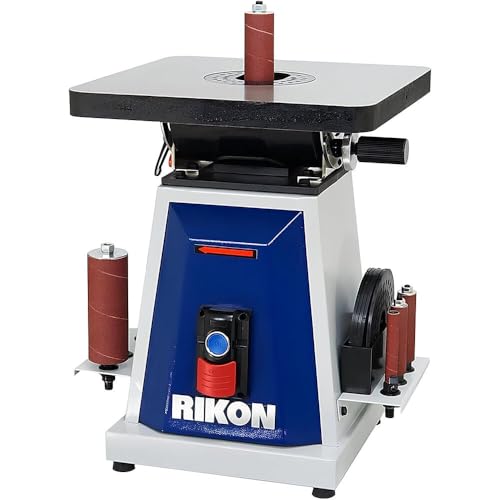
The Rikon 50-300 is built from all steel and cast iron, giving it a vibration-dampening mass that lighter sanders lack. That solidity leads directly to cleaner, chatter-free finishes on curved work like chair legs or guitar bodies. This design suits a woodworker who values precision over portability and needs a dedicated, reliable machine.
You pay for that durability with a substantial 80-pound footprint, so plan for a dedicated shop space. Compared to a lighter combo unit like the WEN 6524, the Rikon sacrifices versatility for specialization, it’s a spindle-only tool. But if your projects regularly demand smooth, complex curves, this sander’s heavy-duty construction provides a rock-solid foundation you can trust for years.
Triton TSPS450 Oscillating Spindle Sander

What We Like
- On-board storage keeps all six sleeves and accessories organized
- Oscillating and rotating action delivers a precise finish on curves
- Compact 18.5" x 16" footprint fits easily on a benchtop
Trade-offs
- Spindle-only design lacks a belt sander for flat edges
- No variable speed control for the spindle
A 3.5-amp motor driving a cast iron table makes this a uniquely stable platform for a machine in its size class. That mass absorbs vibration, so your workpiece stays put for cleaner sanding on contours and irregular shapes. It’s a perfect fit for a home workshop where space is tight but you refuse to compromise on a rigid, precise sanding surface. The included set of six sleeves covers most common curve work right out of the box.
This is a dedicated oscillating spindle sander, so sanding flat edges requires a separate tool. Models like the Triton TSPST450 or WEN 6524 combine spindle and belt sanding in one unit. For large-scale edge sanding, a dedicated machine like the JET OES-689, which is over 50 inches long, would be necessary.
Woodskil Variable Speed Oscillating Sander

What We Like
- Dual oscillating belt and spindle sanding modes
- Variable speed control for diverse tasks
- Integrated dust collection port and cover
- Integrated storage for spindles and plates
Trade-offs
- Smaller 4-inch belt limits wide edge work
Its variable speed control, ranging from 1000 to 1800 RPM, is the standout feature, letting you dial in the right aggression for everything from delicate veneer to shaping hardwoods. This, combined with both a belt and a spindle, makes it a remarkably versatile single station for a smaller workshop. The compact footprint and clever built-in storage mean it can be tucked away when not in use, which is a major perk for space-conscious DIYers and hobbyists who need precision more than brute force.
Combining both oscillating spindle and belt sanding into a single benchtop unit, the Woodskil OSM-2V handles complex curves and flat surfaces. Its 4-inch-wide sanding belt is smaller than the 6-inch belt on a JET OES-689, limiting work on very wide edges. For furniture-scale projects in a space-conscious shop, this dual-function design offers clear versatility.
Product photos
VEVOR Oscillating Belt and Spindle Sander
What We Like
- High 2400 RPM speed for fast material removal
- Comes with five sleeves and five table inserts
- Integrated storage slots for sleeves and inserts
- Tilting worktable for angled sanding tasks
Trade-offs
- Lacks variable speed control for different materials
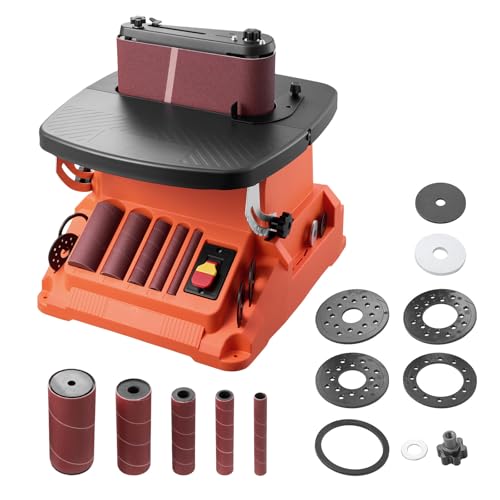
A 2400 RPM motor speed allows for efficient sanding on flat, curved, and contoured surfaces, suitable for furniture finishing and DIY woodworking projects. This benchtop sander includes five sanding sleeves and a tilting worktable, providing flexibility for different workpiece sizes and angles.
Weighing 37.5 pounds, this sander requires a sturdy benchtop for stable operation. Its dimensions of 16.5 by 18.1 by 17.3 inches give it a smaller footprint than the larger JET JOSS-S, making it a space-saving choice for a home workshop.
Product photos
Triton TSPST450 Oscillating Sander

What We Like
- Cast aluminum table tilts 0-45 degrees for accuracy
- Combined spindle and belt sander in one unit
- On-board storage for included accessories
- Vented plates and dust channel for extraction
Trade-offs
- Belt unit is fixed, not a separate edge sander like the JET OES-689
- At 28.4 lb, it's a bench-top tool, not a heavy-floor-model alternative
- 5 included sleeves cover intricate work, not large-diameter curves
The 450-watt motor and dual sanding action deliver a practical balance of work rate and control for a compact workshop. This is a tool for the woodworker who needs to smooth inside curves and shape edges but doesn’t have the space or budget for two dedicated machines. The cast aluminum table provides a solid, flat reference surface, and having five sanding sleeves ready to go means you can tackle most small to medium projects right out of the box.
You trade dedicated, industrial capacity for this combination versatility. The integrated belt sander handles straight edges and outside curves, but it doesn’t oscillate over a long platen like a true edge sander such as the Shop Fox W1730.
Product photos
LuckyNote Oscillating Spindle & Belt Sander
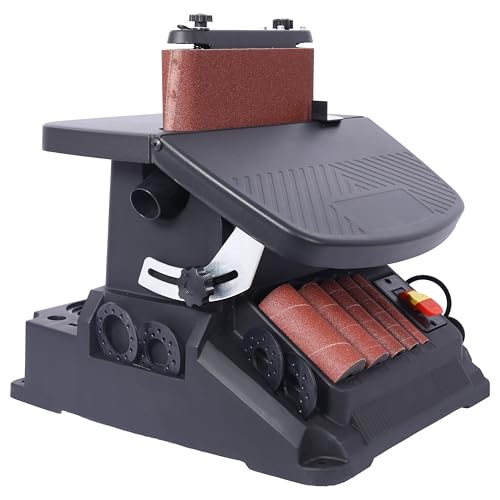
What We Like
- Quick-change dual spindle and belt function
- Includes five sanding sleeves and a 4" x 24" belt
- Built-in 1-17/32" dust port for extraction
- Compact 16.7" x 17.4" footprint fits small shops
Trade-offs
- 38-pound weight is heavier than some compact models like the Triton TSPST450
- 5/8" stroke limits oscillation depth for very deep contours
- Fixed 1575 FPM belt speed lacks variable control
A 500W motor driving both a belt and a spindle is the core appeal here. It delivers genuine two-in-one capability without monopolizing your bench, making it a logical centerpiece for a small or mobile workshop. The quick-change system and included set of sleeves mean you can tackle a curve with the spindle and then flatten an edge on the belt without clearing space for a second machine. This design prioritizes space efficiency and task versatility above all else.
That compact design does involve some trade-offs. The 38-pound weight gives it solid heft for its size, but it’s notably heavier than other combo units like the Triton TSPST450, which weighs 28.4 pounds. You also get a fixed belt speed instead of a variable one. For the woodworker who needs to handle detailed spindle work and straight belt sanding in tight quarters, however, this machine consolidates functions effectively.
Product photos
How We Evaluated Oscillating Belt Sanders
Our evaluation is based on detailed research of manufacturer specifications, expert round-ups from woodworking publications, and patterns in long-term owner feedback. We prioritized features that impact real workshop use: the versatility of combination belt and spindle functions, the stability determined by weight and construction, and the practicality of built-in storage and dust collection. For example, a heavier cast iron machine reduces vibration for a cleaner finish, while a tool-free changeover between belt and spindle modes saves valuable shop time.
A research-based guide has inherent limitations. Long-term durability claims, real-world noise levels, and dust collection efficiency under various shop conditions cannot be verified. Recommendations are based on documented specifications and consistent user feedback.
What To Look For In Oscillating Belt Sanders
Whether you need to smooth a long table edge or shape intricate chair legs, the right sander combines power, stability, and workflow efficiency for your shop.
Key factors are the machine’s primary function (belt, spindle, or combo), its weight and footprint for stability, and practical features like dust ports and onboard storage.
Function & Versatility
The first decision is whether you need a dedicated edge sander, a spindle sander, or a combination unit. A dedicated oscillating belt sander like the JET OES-689 excels at long, straight edges and bevels with a wide sanding surface. A dedicated oscillating spindle sander is specialized for internal curves and complex contours. For many home shops, a combination sander that offers both belt and spindle functions in one footprint, like our top pick, provides maximum versatility without sacrificing floor space.
Stability & Footprint
Stability is critical for a smooth finish and is directly tied to a machine’s weight and construction. Benchtop models like the Triton TSPS450 offer cast iron stability in a compact 18.5″ x 16″ footprint, ideal for limited space. For zero vibration during aggressive material removal, a heavy floor model like the 443-pound Shop Fox W1730 is unmatched, but it demands permanent, reinforced floor space. Consider not just the machine’s dimensions but also its height, as some floor models require significant vertical clearance under shop ceilings.
Practical Features
Look for features that streamline your workflow. A tilting table, common on models like the JET JOSS-S, allows for accurate angled sanding. An integrated dust collection port, sized for a standard shop vac hose, is essential for maintaining visibility and a clean shop. Onboard storage for spindles, throat plates, and wrenches, as seen on the WEN 6524 and Triton TSPST450, keeps accessories organized and at hand. For those learning to use a belt sander, a quick-release belt tension lever is a valuable safety and convenience feature.
- Check the included spindle size range to ensure it matches the radii of your typical projects. Verify the belt size if edge work is a priority; a standard 4″ x 24″ belt suits most benchtop work, while larger industrial wide belt sanders handle panels.
- Confirm the oscillation stroke length; a longer stroke, like the 3/4″ on some models, spreads wear and reduces heat buildup on the abrasive.
Ultimately, your shop’s available space and your most common sanding tasks should guide your choice between a compact combo, a dedicated spindle sander, or a versatile hybrid.
Oscillating Belt Sanders Compared
The following table compares key specifications to help you quickly weigh these factors side-by-side.
| Product | Motor Power | Belt Size / Spindle Sizes | Weight |
|---|---|---|---|
| WEN 6524 Oscillating Belt and Spindle Sander | 3.5-amp | 4 x 24 inch belt | 27.0 pounds |
| JET JOSS-S Oscillating Spindle Sander | 1 HP | 1/4" to 4" spindle | 216.0 Pounds |
| JET OES-689 Oscillating Edge Sander | 1-3/4 HP | 6 x 89 inches | 280.0 Pounds |
| Shop Fox W1730 Oscillating Edge Sander | N/A | 6" x 89" | 443.0 Pounds |
| RIKON Power Tools 50-300 Oscillating Belt Sander | ½ HP | ½" – 2" spindles | 80.0 Pounds |
| Triton TSPS450 Oscillating Spindle Sander | 3.5 Amp (450W) | 1/2 inch to 3 inches | N/A |
| Woodskil Variable Speed Oscillating Sander | 2/3 HP | 1/2" to 2" sleeves | N/A |
| VEVOR Oscillating Belt and Spindle Sander | N/A | 24" x 3.86" belt | 37.5 pounds |
| Triton TSPST450 Oscillating Sander | 450W / 3.5 Amp | 1/2" – 2" dia sleeves | 28.4 pounds |
| LuckyNote Oscillating Spindle & Belt Sander | 500W | 4" × 24" belt | 38.0 pounds |
Frequently Asked Questions
Which oscillating spindle belt sander is the best?
Our research points to the WEN 6524 as the best overall oscillating belt and spindle sander for most workshops. It successfully combines a 4×24 inch belt sander with a five-spindle sander in one unit, includes a beveling table, and offers onboard storage for all accessories, providing exceptional versatility in a single footprint.
Is an oscillating drum sander better?
An oscillating drum sander, often called a spindle sander, is not universally “better”, it’s specialized. It is superior for sanding internal curves and complex contours without leaving scratch lines, thanks to its vertical oscillation. For sanding long, straight edges or flattening surfaces, a dedicated oscillating belt sander or a benchtop belt sander is the more effective tool.
What is the best belt sander on the market?
The “best” belt sander depends entirely on your application. For large-format edge sanding on furniture, the JET OES-689 is a top-tier oscillating edge sander. For a heavy-weight, vibration-free experience, the Shop Fox W1730 is exceptional. For general woodworking that includes both edge and curve work, a versatile oscillating belt and spindle sander like the WEN 6524 is often the most practical choice.
Which brand of sanding belts is considered the best?
Our research did not focus on consumable brand comparisons for sanding belts. For any oscillating sander, it is crucial to use belts and sleeves specified for the machine’s size and intended use. Quality can vary widely, so consulting owner feedback for your specific model on belt longevity and finish results is a prudent step.
How does an oscillating action improve sanding?
The oscillating (up-and-down) movement of the spindle or belt is what defines these machines. It prevents the abrasive from cutting grooves or lines into the workpiece, which is critical for a flawless finish on curves. This action also reduces friction and heat buildup, minimizing the chance of burning the wood and extending the life of the sanding sleeve or belt.
The Bottom Line
The WEN 6524 Oscillating Belt and Spindle Sander earns our best overall pick for woodworkers who need both edge and contour sanding capabilities without dedicating space to two separate machines. For those with a strict budget or very compact shops, look to the Budget Combo Pick, Triton TSPST450, or the Best Compact Combo, LuckyNote sander.
For professional shops requiring maximum stability for large panels, the Shop Fox W1730 is a substantial and heavy-duty option. Regardless of your choice, accurately assessing your available floor space and primary project types is the most important step before investing in one of these core workshop tools.
