
10 Best Belt Grinders For Knife Finishing in 2026
This post contains affiliate links. As an Amazon Associate, we earn from qualifying purchases.
We selected the Jinlida Professional 2×72 Belt Grinder as the best overall for its industrial-grade versatility that handles everything from rough shaping to fine polishing. For superior bevel control, the KFMK 1×30 is the Best for Bevel Control, while the Bucktool Low Speed 1×30 offers the best budget entry point. Each of our ten picks solves a different problem in the knife finishing workflow.
Finding the right belt grinder is about matching power and features to your specific projects and shop space. A machine that’s too large or underpowered can stall progress, while the wrong belt size can limit your finishing quality.
This guide is built from deep research into specifications, manufacturer data, and patterns in owner feedback from knifemaking communities. We compare motor power, belt sizes, speed control, and chassis design to help you invest confidently in the tool that fits your needs.
Top 10 Belt Grinders For Knife Finishing in the Market
Certain content that appears on this site comes from Amazon. This content is provided "as is" and is subject to change or removal at any time.
The Best Belt Grinders For Knife Finishing, Reviewed
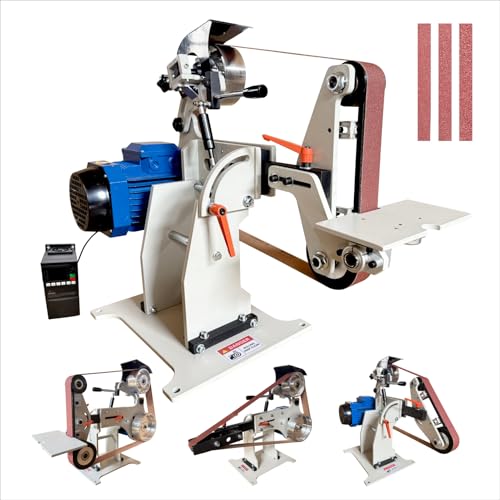
Jinlida Professional 2×72 Belt Grinder
What We Like
- Includes two kits for three grinding methods
- Industrial-grade, one-piece steel frame resists vibration
- Three grit belts cover coarse to fine finishing
Trade-offs
- Large footprint at 30 by 24 inches requires dedicated space
- Heavy steel construction limits portability
A 2×72 belt driven by a 1500-watt motor and a smooth VFD gives you the control and power to handle everything from heavy stock removal on a knife blank to the final, delicate finish. This Jinlida grinder is built for the serious maker who needs one machine to do it all, thanks to its included kits for flat, circular, and arc grinding. The industrial steel frame keeps things rock-solid, so your precision doesn’t waver during long sessions.
The trade-off for that capability and stability is a substantial machine. You’ll need to commit a permanent spot on your bench for it, unlike a compact 1×30 sander like the Bucktool Low Speed model you could tuck away. For a dedicated knife shop, however, that’s a small price for a tool that can efficiently progress a blade from rough shape to polished edge with just a belt change.
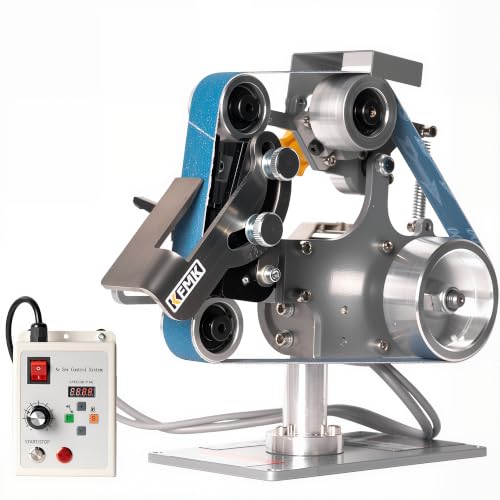
KFMK 1×30 Variable Speed Belt Sander
What We Like
- Forward and reverse rotation for better control
- Includes KSAG-5 guide for precise bevel grinding
- Variable speed VFD for multiple finishing tasks
- Heavy-duty steel construction for stability
Trade-offs
- 1×30 belt size offers less surface area than 2×72 models
The forward and reverse belt direction is the key feature here, letting you instantly switch rotation to reduce burr formation and improve visibility on tricky bevels. This, combined with the dedicated KSAG-5 angle guide, makes this sander a focused tool for knifemakers who prioritize repeatable angles and clean edge geometry. It’s built for the workshop, with a heavy-duty all-steel frame that minimizes vibration, so your hand can focus on the blade, not fighting the machine. The variable speed VFD gives you the finesse needed for everything from aggressive stock removal to a final polish.
Forward and reverse belt rotation lets you switch direction instantly during grinding operations, which improves visibility and reduces burr formation for tasks like sharpening blades. This KFMK sander includes a dedicated angle guide for precise, repeatable bevel grinding on knives. Its variable speed VFD control allows smooth adjustment for everything from stock removal to final polishing.
Product photos
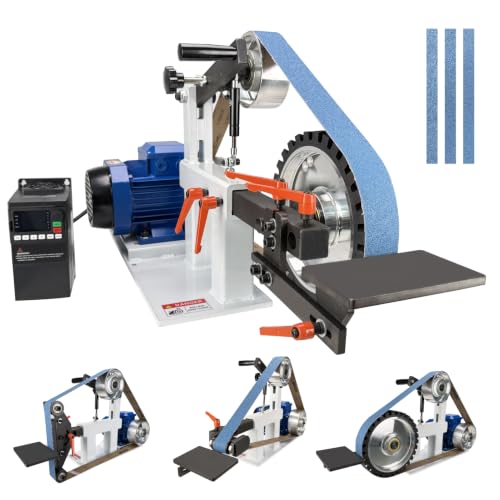
Goldsand 1500W 2×72 Belt Grinder
What We Like
- 1500W pure copper motor for strong, quiet grinding
- VFD allows precise speed adjustments for finishing
- Rugged steel frame ensures stability during use
Trade-offs
- Requires a 220V power source or included transformer
- At 110.7 pounds, it is a heavy, permanent shop fixture
- Only includes three specific grit belts (100, 180, 240)
With a 1500W pure copper motor, this belt grinder delivers the power for demanding grinding and polishing tasks on metal, wood, or glass. Its variable frequency drive allows precise speed control, so you can switch from high-speed material removal to low-speed fine finishing without changing machines. The 2×72 inch belt platform provides a large, continuous work surface for handling sizable pieces.
The main compromise is its substantial 110-pound steel frame, which demands a dedicated, sturdy bench. It’s not a tool you’ll move around. Compared to a more compact model like the VEVOR 1×30, the Goldsand provides a vastly larger grinding surface and more power, but it occupies a permanent footprint in your shop. For anyone ready to step up from a hobbyist sander to a true knife-making workhorse, this grinder brings the essential features to the bench.
Product photos
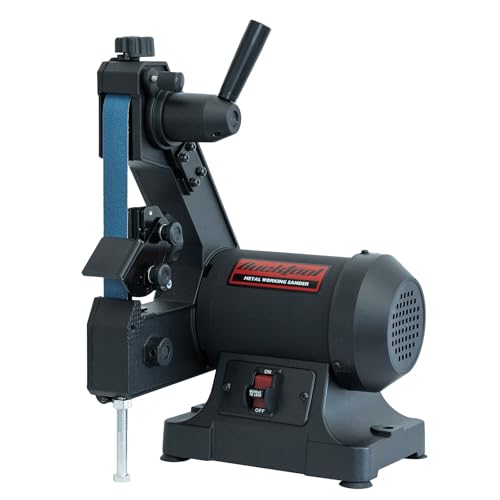
Bucktool Low Speed 1×30 Belt Sander
What We Like
- Low 1790 RPM speed for controlled grinding
- Stable induction motor reduces vibration
- Precision adjustable knife sharpening guide
- Quick belt change with one-button cover
Trade-offs
- Fixed 1790 RPM speed lacks variability for fine finishing
- 1×30 belt size limits contact area for large surfaces
The 1790 RPM low speed is the key here, giving you the control to avoid overheating a knife’s edge during sharpening and finishing. This makes the Bucktool a practical entry point for a hobbyist knife maker or someone restoring old tools who needs predictable, consistent material removal. The adjustable angle guide helps lock in a bevel, and the induction motor runs smoothly enough to keep your work steady. It’s a straightforward machine built for fundamental tasks without overwhelming a beginner or a tight workspace.
A single speed of 1790 RPM provides consistent, controlled grinding for tasks like knife sharpening and tool restoration, but limits adaptability. This fixed rate works well for general metalwork where maintaining a steady pace is key, yet it cannot be adjusted for materials requiring different approaches. Unlike variable-speed sanders such as the VEVOR 1×30, this model operates at one preset rotation.
VEVOR 1×30 Variable Speed Belt Polisher
What We Like
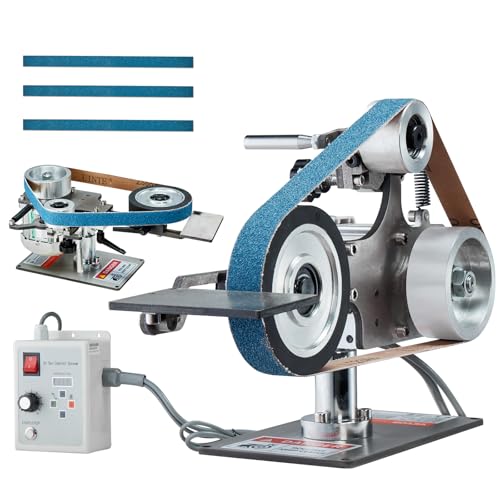
- Variable speed VFD for both rough grinding and fine finishing.
- Converts between vertical and horizontal grinding modes.
- Includes two grinding moulds for flat and circular work.
Trade-offs
- 550W motor lacks power for heavy stock removal on large blades.
- 1-inch belt width limits contact area for flattening long knife bevels.
Weighing 17.4 pounds, this grinder is light enough to relocate on a workbench or store in a cabinet. Its variable-speed control allows for stepless regulation, so you can adjust the belt’s 26m/min line speed for different tasks. The kit includes three sanding belts of varying grits and two grinding moulds for circular or flat work on materials like metal, wood, or plastic.
With a 550W motor and a 1×30 inch belt, this model operates on a smaller scale than industrial units like the 1500W Jinlida Professional 2×72 Belt Grinder. The reinforced steel body supports both vertical and horizontal use, letting you position it for different angles. A detachable workbench aids in finding a suitable setup for grinding or polishing.
OBM DOMINATOR 2×72 Belt Grinder
What We Like
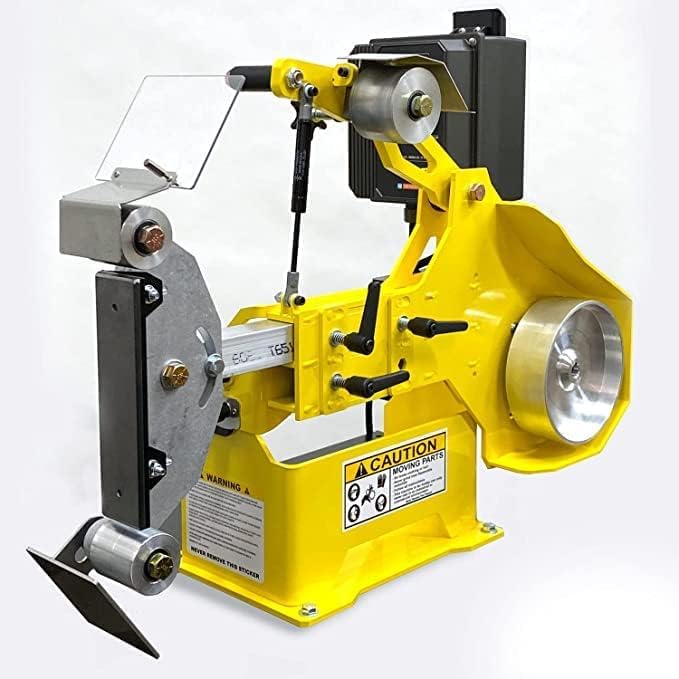
- Fully welded steel frame for consistent alignment
- 2HP motor with VFD for controlled speed adjustments
- Bolt-free design reduces vibration during operation
Trade-offs
- Weighs 45 lbs, requiring a permanent, sturdy bench
A fully welded steel chassis and a 2HP motor paired with a VFD mean this grinder is built to handle hours of heavy stock removal without flexing or losing alignment. That solid foundation makes it a natural fit for a knifemaker who spends long sessions at the grinder, demands precise control for finishing bevels, and values a system that won’t chatter under pressure. This is a premium, professional-grade platform designed for serious workshop integration, not occasional tinkering.
Industrial-grade stability comes with a substantial 45-pound footprint that needs a dedicated, solid stand. For a knifemaker ready to build a permanent, heavy-use grinding station, the OBM Dominator provides that critical foundation. If your shop space is limited or your grinding is more intermittent, a more compact, all-in-one unit like the Jinlida Professional might be a more practical starting point.
Bucktool 2×42 Belt and Disc Sander Combo

What We Like
- Belt tilts 0-90° for multi-angle sanding.
- Quick-release tension for fast belt changes.
- Two dedicated worktables for metal and wood.
Trade-offs
- Fixed speed motor lacks variable control for fine finishing.
- At 24.5" tall, it requires a sturdy, dedicated bench.
A belt that tilts from zero to ninety degrees and a housing swiveling from horizontal to vertical define this machine’s flexibility. The combination allows sanding at various angles and accommodates long workpieces. Its induction motor provides 1/3 horsepower and a belt speed of 4480 feet per minute, giving it the power to run under load for general sanding on metals, wood, and plastics. Two cast worktables, one iron and one aluminum, offer different support surfaces, and a 6-inch grinding wheel with a light adds another function.
You trade some specialization for that versatility. Compared to a dedicated variable-speed machine like the Jinlida Professional 2×72, you’re locked into one speed, which can be a drawback for delicate finishing passes on hardened steel. It’s a capable, well-built machine for general grinding and shaping, but the fixed speed and belt size mean it’s not a dedicated finishing strong performer.
Blissthrill Mini Belt Sander Sharpener
What We Like
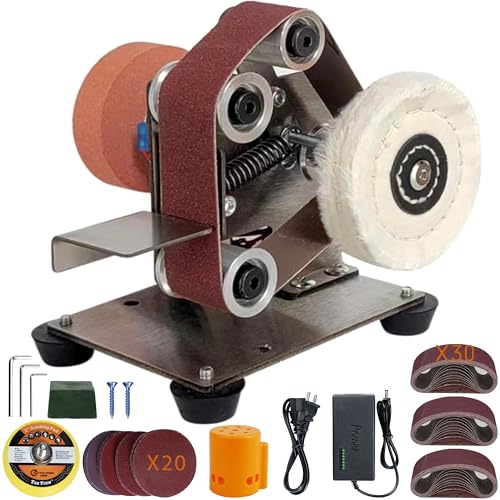
- 775 motor offers seven-speed control and reverse.
- Comprehensive kit includes 30 sanding belts.
- Four rubber pads reduce vibration for stability.
Trade-offs
- 13-inch belt length
- Weighs 3.8 pounds
For the hobbyist working on small knives, jewelry, or tools in a tight apartment workshop or at a folding table, that compact 304 stainless frame is the main event. The seven-speed motor and reverse function provide surprising control for fine polishing and light shaping. The generous bundle of belts and discs means you can start working right out of the box without an extra trip to the store.
Its portability does limit the working scale. The 13-inch belt is shorter than the 30-inch belts on models like the Bucktool 1×30, which means less abrasive surface contacts your work. For final knife finishing, sharpening, and small craft projects, it’s a capable machine. Its design prioritizes compact size over the large build of a full-sized 2×72 grinder.
Product photos
Goldsand 1500W 2×72 VFD Belt Grinder
What We Like
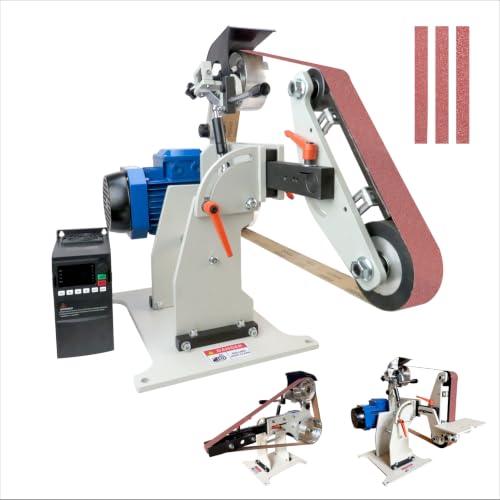
- Powerful 1500W motor for heavy-duty grinding
- Precise VFD allows stepless speed adjustment
- Industrial-grade frame minimizes vibration
- Two kits enable three grinding methods
Trade-offs
- At 17.4 pounds, it's a substantial bench-top unit
- Requires dedicated shop space due to its size
- The included three belts are a starter set
A 1500W motor paired with a 2.2KW VFD gives you the core of a professional shop grinder. You get smooth, stepless control from a dead stop up to 2800 rpm, which is the critical feature for knife finishing. That control lets you dial in the perfect speed for everything from hogging off steel on a blank to putting a fine, clean finish on a bevel without burning the edge. The industrial-grade steel frame ensures it stays solid and vibration-free during those long sessions, making this the complete package for a maker ready to invest in a serious, versatile foundation for their craft.
The trade-off for that capability is a real footprint. This isn’t a tool you tuck away on a shelf; it demands a permanent, sturdy spot in your workspace. For a professional or a dedicated hobbyist building a proper knife shop, that’s an easy compromise for the performance. It stands apart from a more compact model like the KFMK 1×30, which might suit occasional touch-ups, by offering the power, stability, and speed control needed for creating knives from scratch, not just maintaining them.
Product photos
KFMK 2×42 Belt & Disc Sander Combo

What We Like
- Dual-function belt and disc sander
- Belt pivots between vertical and horizontal
- Includes tool rest and miter gauge
- Large 6-3/4 x 9 in. belt work table
Trade-offs
- Fixed-speed motor lacks variable control
- 2" belt width is narrower than 2×72 models
Combining a 2×42 belt and a 6-inch disc, this sander provides two essential finishing tools in a single unit. Its 1/2HP induction motor is described as powerful for metalworking tasks, and the belt sander can be positioned vertically or horizontally to suit different project requirements. The included work tables and accessories, like the miter gauge and tool rest, support detailed work for knife making and sharpening.
The fixed speed and 2-inch belt width offer less control and surface area than a dedicated 2×72 grinder like the Jinlida Professional, which is designed for heavy stock removal. However, as a combo unit, it delivers the utility of both a belt and disc sander. This makes it a pragmatic solution for workshops where versatility and space consolidation are priorities.
Product photos
How We Evaluated Belt Grinders For Knife Finishing
Our evaluation focused on specifications from manufacturers and verified patterns in owner feedback from professional and hobbyist forums. We prioritized criteria that directly impact the precision and efficiency of knife finishing, rather than general woodworking performance.
The key factors were motor power and speed control for handling different steels, belt size and platen versatility for contact area and bevel work, and chassis rigidity to minimize vibration during fine finishing. We also considered the practical footprint and weight for shop integration, as a permanent, sturdy station is often preferred for consistent results.
A research-based approach has limits; we cannot replicate years of shop wear or measure subtle differences in platen flatness. Our goal is to highlight the proven design choices that correlate with reliable performance in knifemaking contexts, helping you narrow the field to models that deserve a closer look.
What To Look For In Belt Grinders For Knife Finishing
Choosing a belt grinder for knife work means balancing raw power with fine control. The right machine should feel like an extension of your hands, removing material efficiently without sacrificing the precision needed for a perfect edge or finish.
For most knife finishing, prioritize a 2×72 belt size for its cooler running surface and accessory support, a motor of at least 1 horsepower, and variable speed control. A rigid, welded steel frame is non-negotiable for vibration-free work on fine bevels.
Motor Power & Speed Control
Adequate horsepower prevents the belt from stalling under pressure, which is crucial for consistent bevels. For 2-inch wide belts, community guidelines often suggest 1.5 to 2 HP for professional work. Equally important is speed control; a variable frequency drive (VFD) lets you run fast for hogging off steel and slow for delicate finishing or sharpening, protecting the steel’s temper from heat buildup. Fixed-speed models are more affordable but limit your technique.
Belt Size & Versatility
Belt dimensions dictate your machine’s capability. The 2×72-inch size is the professional standard because the long belt runs cooler and lasts longer, while the 2-inch width is ideal for flattening knife blades. Smaller belts, like 1×30 or 2×42, save space and cost but heat up faster and offer less smooth contact.
Versatility comes from a grinder’s ability to accept different attachments, a flat platen for straight grinds, contact wheels for convex curves, and small-diameter wheels for detailed plunge lines. Our research into popular 2×72 belt grinders shows this modularity is a key reason they dominate pro shops.
Frame Rigidity & Footprint
A grinder’s frame must absorb vibration to achieve a clean, chatter-free finish. A one-piece, fully welded steel chassis is superior to bolted assemblies, which can loosen over time. This mass and stability, however, creates a trade-off: a professional 2×72 grinder often requires a permanent, sturdy bench and significant floor space.
Consider if your shop can accommodate a machine with a 30-inch footprint, or if a more compact belt sander for knives is a better starting point. For those exploring other metalworking tools, understanding the role of a stable platform is just as critical when selecting bench grinders or disc grinders.
- Check the product weight; a heavier machine (over 45 lbs) typically indicates a more vibration-resistant frame.
- Measure your available bench space against the machine’s length and depth.
- Ensure your electrical supply matches the motor’s voltage requirements (110V vs. 220V).
- Look for models with a well-reviewed tool rest system for repeatable angle control.
- Confirm the availability and cost of replacement belts in the machine’s specific size.
Invest in the most rigid frame and largest motor you can fit and afford; you can upgrade accessories later, but you cannot easily fix a chassis that flexes.
Belt Grinders For Knife Finishing Compared
The following table compares the core specifications of our top picks to help you see the key differences at a glance.
| Product | Belt Size | Motor Power | Speed Control |
|---|---|---|---|
| Jinlida Professional 2×72 Belt Grinder | 2×72 inches | 1500W | 0-2800 rpm VFD |
| KFMK 1×30 Variable Speed Belt Sander | 1×30 inch | N/A | VFD control |
| Goldsand 1500W 2×72 Belt Grinder | 2 x 72 inch | 1500W / 2HP | VFD Variable Speed |
| Bucktool Low Speed 1×30 Belt Sander | 1 x 30 inch | 2.3A induction motor | 1790 RPM |
| VEVOR 1×30 Variable Speed Belt Polisher | 1 x 30 inch | 550W pure copper | VFD variable frequency drive |
| OBM DOMINATOR 2×72 Belt Grinder | 2"x72" | 2HP electric motor | variable frequency drive (VFD) |
| Bucktool 2×42 Belt and Disc Sander Combo | 2" x 42" | 1/3 HP, 3.5 Amp | 4480 FPM |
| Blissthrill Mini Belt Sander Sharpener | N/A | 775 motor | 4000-9000 RPM |
| Goldsand 1500W 2×72 VFD Belt Grinder | 72 x 2 inches | 1500W pure copper | 0-2800 rpm VFD |
| KFMK 2×42 Belt & Disc Sander Combo | 2"x42" | 1/2 HP induction | N/A |
Frequently Asked Questions
What is the best belt grinder for making knives?
For serious knife making, a 2×72 belt grinder is widely considered the best. It offers the ideal combination of power, a cool-running belt surface, and extensive support for accessories like different platens and contact wheels, which are essential for profiling, beveling, and finishing. Models like our best overall, the Jinlida Professional, exemplify this versatile, industrial-grade standard.
What type of grinder is best for knife making?
A belt grinder is the primary tool for knife making, specifically one with a 2-inch wide belt. The length (72 inches is ideal) affects how smoothly and coolly the belt runs. For detailed guidance on selecting the right model, our resource on 2×72 belt grinders breaks down the options. Other types, like disc grinders, serve secondary roles for flattening or handle work.
What are the best belts for knife sharpening?
For sharpening on a belt grinder, you progress through a series of grits. Start with a medium grit to set the bevel, move to a fine grit for refinement, and finish with a very fine or polishing belt for a razor edge. Using a leather strop belt with compound is the final step. Always use sharpening-specific belts to avoid overheating the thin edge.
What is the best budget 2×72 belt grinder for knife making?
The Goldsand 1500W 2×72 Belt Grinder represents strong value in the 2×72 category, offering a powerful motor and variable speed control at a mid-range price point. It’s a stationary, heavy-duty option for those ready to step up from smaller sanders. True budget entries, like our Bucktool pick, are typically 1×30 models, as quality 2×72 grinders are a significant investment.
Can I use a bench grinder for knife making?
A standard bench grinder with coarse stones is not suitable for precision knife making, as it removes too much material too quickly and generates excessive heat. However, a bench grinder is a shop staple for sharpening other tools. For knives, a dedicated belt system or a slow-speed wet grinder is the appropriate tool for controlled bevel work and finishing.
The Bottom Line
The Jinlida Professional 2×72 Belt Grinder is the best overall choice for any workshop ready to commit to a single, versatile machine. Its industrial construction and included kits for multiple grinding methods make it a true workhorse for everything from rough profiling to final polish.
If your budget is tight, start with the capable Bucktool Low Speed 1×30. For those who prioritize precise angle control above all, the KFMK 1×30 with its dedicated bevel guide is the tool to choose. Each award winner addresses a specific need within the craft.
Ultimately, the single most important factor is matching the grinder’s power and size to your actual projects and shop space. A properly sized, rigid machine will serve you for years, while an underpowered or overly bulky one will frustrate your progress every time you turn it on.
