
10 Best 10 Inch Saw Blades For Table Saw in 2026
This post contains affiliate links. As an Amazon Associate, we earn from qualifying purchases.
Our top pick for woodworkers who need a powerful, controlled rip cut is the CMT Orange Tools ITK XTreme Ripping Saw Blade. Our best value for a versatile all-around blade goes to the Diablo 10-Inch Combination Saw Blade, while the Freud P410 Premier Fusion is the clear winner for polished finishes.
Choosing the right blade for your 10-inch table saw is about matching its teeth, kerf, and grind to your projects and your saw’s power. A good blade makes cleaner cuts, puts less strain on your motor, and saves material. Our research, based on specifications and patterns in expert and owner feedback, sorts through a crowded market to help you find a blade that fits your work.
Top 10 10-Inch Saw Blades For Table Saw in the Market
Certain content that appears on this site comes from Amazon. This content is provided "as is" and is subject to change or removal at any time.
The Best 10-Inch Saw Blades For Table Saw, Reviewed
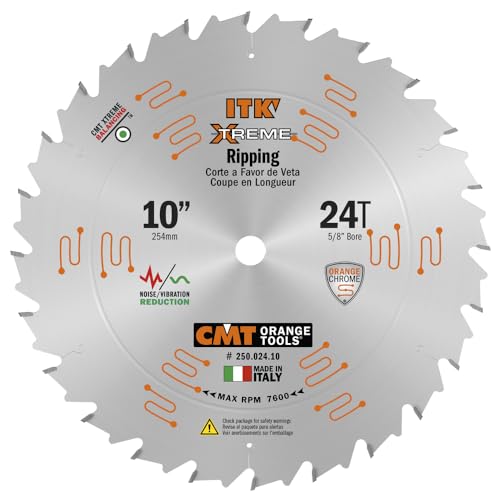
CMT Orange Tools ITK XTreme Ripping Saw Blade
What We Like
- Optimized 24-tooth design for aggressive ripping.
- 10-degree hook angle for controlled feed on hardwoods.
- ATB grind handles plywood and OSB cleanly.
- Sturdy 0.071-inch plate resists deflection.
Trade-offs
- The 0.102-inch kerf removes more material than a thin-kerf blade.
- 24-tooth count leaves a rougher finish than a fine-finish blade.
A 10-degree hook angle combined with just 24 teeth makes this blade a dedicated ripping specialist. It pulls material through the cut with authority, yet the moderate hook keeps the work from launching forward on your table saw. That balance of power and control is why it excels at turning hardwoods and pressure-treated lumber into strips with minimal fuss. It’s the go-to for anyone who needs to break down stock quickly and efficiently before moving to a finishing cut.
This blade is designed for stationary table saws and portable tables, cutting softwoods, hardwoods, plywood, OSB, and pressure-treated lumber. Its 24-tooth ATB grind and 10-degree hook angle are configured for fast material removal along the wood grain. The 0.102-inch kerf is wider than some dedicated thin-kerf ripping blades, which removes more material during each cut.
Diablo 10-Inch Combination Saw Blade

What We Like
- Super thin kerf for fast, clean cuts
- Perma-SHIELD coating resists heat and gumming
- TiCo carbide teeth for sharp, durable edge
- Tri-metal shock resistant brazing for impact
Trade-offs
- Thin kerf may deflect on very hard materials
- 50-tooth design is a compromise, not a specialist
The super thin laser cut kerf reduces resistance, allowing saws to cut with less strain on the motor. Research concluded thin kerf blades are a good choice even on 3 HP saws, effectively maximizing available power. With 50 teeth and high-performance TiCo carbide, this blade is designed for both rip cuts and crosscuts in various wood materials, serving as a solid all-rounder. The hardened steel body provides longevity and consistent performance for remodeling and demolition needs.
You are getting a generalist, though. For dedicated, glue-line ripping, a blade like the Freud Thin Kerf Glue Line Ripping Blade is designed for that specific task. Similarly, the ultra-fine finish from an 80-tooth blade like the Diablo 10-Inch 80-Tooth Ultra-Finish Blade isn’t this combination blade’s primary design. The Perma-SHIELD non-stick coating protects from heat and corrosion, extending the blade’s life. The tri-metal shock resistant brazing allows carbide tips to withstand extreme impact, meaning it’s built for durability across a wide range of applications.
Freud P410 Premier Fusion General Purpose Blade

What We Like
- Fusion Trio tooth design for polished finishes
- Laser-cut anti-vibration slots reduce chatter
- TiCo carbide stays sharp for clean cuts
- Perma-Shield coating resists pitch and corrosion
Trade-offs
- 2.0 lb weight demands a well-tuned saw motor
- General-purpose 40T count is not a dedicated ripper
- Polished cut focus may be overkill for rough lumber
Freud’s Fusion Trio tooth design combines three grinds to shear wood fibers cleanly, which is why it leaves a polished finish in both rip and crosscuts. That makes it the blade you grab when working with veneered plywood, melamine, or hardwoods where the cut face will be visible. The laser-cut anti-vibration slots reduce sideways movement during the cut, providing a crisp, splinter-free finish. It’s a premium general-purpose blade built for the woodworker who values a ready-to-finish surface straight off the saw.
The trade-off is its heft and purpose. At two pounds, it needs a table saw with enough power to spin it without bogging down. And while versatile, its 40-tooth configuration is geared for finish quality, not pure speed. For breaking down stacks of rough lumber, a dedicated ripping blade with fewer teeth might be a better choice. But for the single blade that stays in your saw for cabinetry and fine furniture projects, the P410 delivers a clean cut across a wide range of sheet goods and solid wood.
Diablo 10-Inch 80-Tooth Ultra-Finish Blade

What We Like
- Triple Chip Grind design for burr-free cuts
- TiCo carbide teeth for extreme cutting life
- Laser-cut stabilizer vents reduce vibration
- Tri-Metal brazing withstands extreme impact
Trade-offs
- Heavier than the 1.0 lb Diablo combination blade
- TCG tooth geometry is specialized, not for general ripping
With its 80-tooth Triple Chip Grind design, this Diablo blade delivers clean, burr-free finishes on materials like aluminum, copper, plastics, brass, and fiberglass. The TiCo carbide teeth and specialized tooth geometry are formulated to virtually eliminate rework, which is crucial when the cut quality is paramount. Suggested applications from the manufacturer include remodeling, demolition, electrical work, and plumbing.
This blade’s construction focuses on durability and precision for its intended materials, not on speed for wood. Features like the Perma-SHIELD Non-Stick Coating protect against heat and corrosion during extended use, while Laser-Cut Stabilizer Vents reduce vibration for greater accuracy. Its Tri-Metal brazing is built to withstand the impact of cutting metals, making it a dedicated tool for those specific tasks.
Product photos
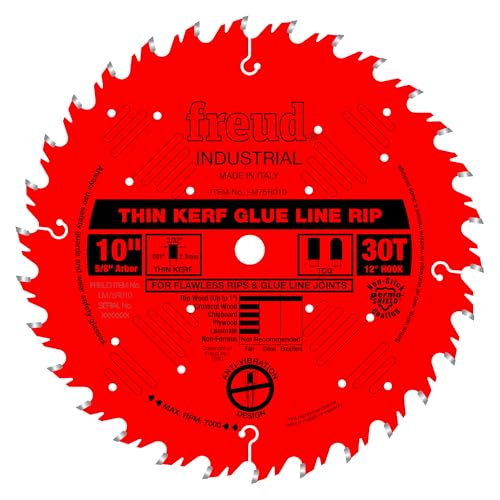
Freud Thin Kerf Glue Line Ripping Blade
What We Like
- Laser-cut anti-vibration slots for a stable, smooth cut
- Perma-Shield coating reduces drag and pitch buildup
- Thin kerf for reduced motor strain
Trade-offs
- 30-tooth TCG grind is specialized for ripping, not crosscuts
- Not a general-purpose blade for diverse project work
It pulls wood through the cut efficiently while putting less demand on your saw’s motor, which is exactly what you want for repeated, long rips on a 1.75 HP cabinet saw. The laser-cut slots and Perma-Shield coating are the industrial touches that translate to a smoother feed and a cleaner, glue-line ready edge straight off the saw. This is the blade you reach for when your primary task is dimensioning lumber, not making finish cuts.
Its 30-tooth TCG grind is configured for ripping, which means surfaces from crosscuts will be rougher than those from a blade with more teeth. According to research, some owners view table saws as dimensioning tools rather than finishing tools. For dedicated ripping tasks, this blade’s design prioritizes a stable and efficient cut.
Product photos
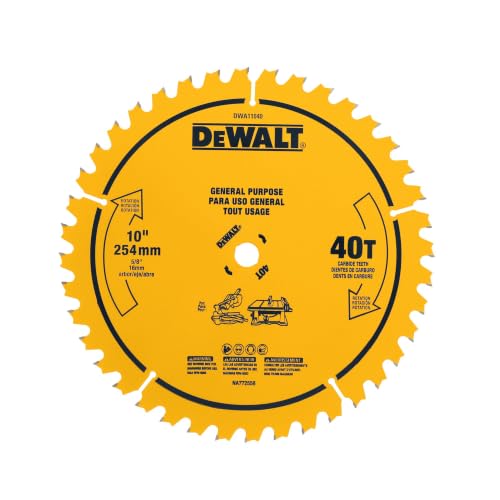
DEWALT 10-Inch 40-Tooth Fine Finish Blade
What We Like
- Ultra Sharp Carbide for clean cuts
- Optimized tooth geometry for increased accuracy
- Engineered for up to 3X blade life
Trade-offs
- 40-tooth design is a compromise, not a specialist ripper or ultra-finish blade
- Draws noticeably on the saw motor when plowing through thick hardwoods
Priced at just a fraction of other blades, this DeWalt offers the best deal we could find for outfitting a table saw in its test group. It’s engineered for up to 3X life, which means it’s built for woodworkers who want a solid, long-lasting performer without a premium price tag. The 40-tooth fine-finish design and ultra-sharp carbide are optimized for accuracy and clean cutting.
The trade-off for that extended life and value is in specialization. While it can power through a 2×4, it asks more from your saw motor than a dedicated thin-kerf ripper like the Freud LM75R010. For marathon ripping sessions in thick stock, you’ll feel the difference. But for general cabinetry, trim work, and sheet goods, this DeWalt blade delivers clean, accurate cuts mile after mile, living up to its durability claim.
Product photos
CMT Orange Tools General Purpose Saw Blade

What We Like
- Laser-cut heat expansion and polymer-filled sound dampening slots
- Tri-metal brazing for durable tooth attachment
- Industrial chrome carbide teeth with mirror finish
- Suitable for both crosscutting and ripping operations
Trade-offs
- Full 0.110-inch kerf demands more power than a thin-kerf blade
- Only 15 teeth, so cuts will be fast but relatively coarse
A 15-tooth ATB grind on a full-kerf plate is built for aggressive material removal. This blade is designed to plow through hardwoods, pressure-treated lumber, and sheet goods without bogging down, making it a solid choice for rough dimensioning and construction work where speed matters more than a polished edge. The laser-cut steel plate and tensioning ring are features aimed at reducing vibration and maintaining cut accuracy under load, which is exactly what you need when feeding thick stock across a table saw.
That rugged performance results in a noticeably heavier cut and a surface that will likely need sanding. For a workshop focused more on finish carpentry than framing, the Diablo 10-Inch Combination Saw Blade is a better fit. Its 50 teeth and thinner kerf leave a smoother finish with less effort from your saw’s motor. This CMT blade is a specialist in making quick, strong cuts, not in delivering ready-to-assemble edges.
Product photos
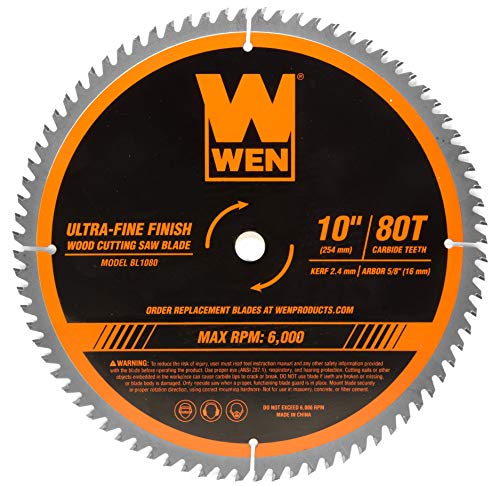
WEN 10-Inch 80-Tooth Ultra-Fine Finish Blade
What We Like
- 80 carbide teeth for ultra-fine finish cuts
- Ultra-thin kerf reduces waste and strain
- Compatible with most 10-inch miter and table saws
- Cuts both hardwoods and softwoods
Trade-offs
- Thin kerf can deflect on dense material or thick stock
- 80-tooth design is slower for general-purpose cutting
- Weighs 1.6 lb, heavier than some thin-kerf competitors
With an ultra-thin 1/10-inch kerf, this blade removes less material for more efficient cuts and reduced strain on a saw motor. Its 80 carbide-tipped teeth are designed specifically for ultra-fine finish work on both hard and softwoods. This combination aims to produce a clean surface directly from the cut, which can minimize the need for additional sanding on shop projects where appearance matters.
That thin kerf, while efficient, demands a well-tuned saw and a steady feed rate to prevent deflection, especially on harder materials. For dedicated finish work, it holds its own, but if your projects mix fine cuts with heavier ripping, a blade like the Diablo 10-Inch Combination Saw Blade with its 50-tooth design offers more versatility. This WEN blade excels in its specific role, providing the essential features for fine finishing at an accessible point.
Product photos
POWERTEC 10" 40T ATB Saw Blade
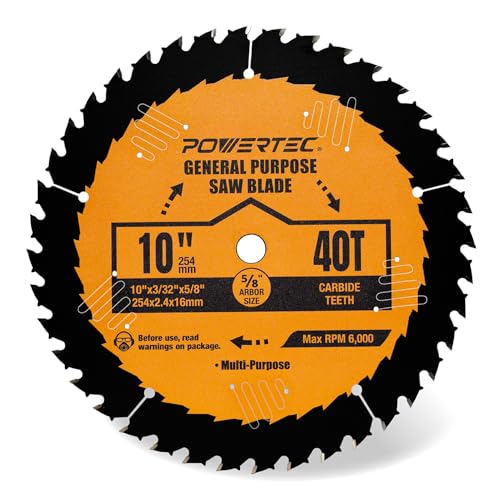
What We Like
- Titanium tungsten carbide teeth for exceptional wear resistance
- Teflon coating reduces friction and heat buildup
- Anti-kickback shoulder design enhances safety
- Stabilizer vents minimize vibration and noise
Trade-offs
- General-purpose design lacks ultra-fine finish of high-tooth-count blades
A 40-tooth ATB grind is the classic setup for a reason, it handles crosscuts and rips in solid wood and sheet goods with reliable competence. This blade’s build is focused on endurance, with a high-carbon steel body and carbide teeth designed for wear resistance. The Teflon non-stick coating and expansion slots are practical features that directly combat gumming and warping, aiming to keep it cutting cleanly longer. It’s a solid choice for the workshop that needs one blade on the saw for the majority of tasks, from breaking down plywood to trimming dimensional lumber.
This 40-tooth blade is a general-purpose design, so it handles both crosscuts and rips without needing a swap. Its ATB tooth form provides clean cuts with minimal splintering across a variety of materials. The blade’s 3/32″ kerf and 6,000 RPM max speed make it suitable for everyday wood cutting tasks on a table or miter saw.
Product photos
WEN 10-Inch 60T Fine-Finish Blade
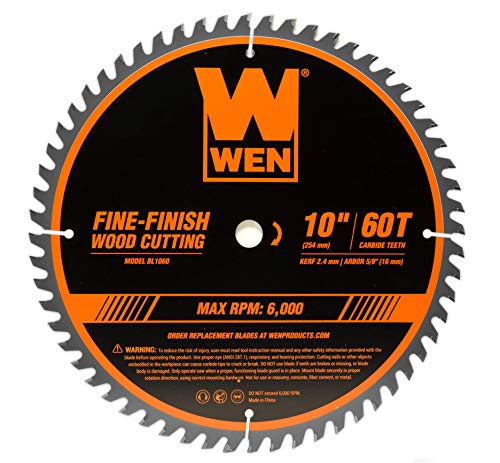
What We Like
- Ultra-thin kerf for efficient, clean cuts
- 60-tooth design for fine-finish woodworking
- Compatible with most 10-inch table and miter saws
- Cuts both hard and softwoods
Trade-offs
- Thin kerf may deflect in dense, thick stock
- Fine-finish focus limits its speed for heavy ripping
With a 1/10-inch kerf, this blade removes less material per cut, which means you get more usable wood from each board. Its 60 carbide-tipped teeth are designed specifically for fine-finish wood cutting, making it suitable for final crosscuts and trim where a smooth surface is important. The blade is rated for up to 6000 RPM and fits most 10-inch miter saws, jobsite saws, and table saws.
While its thin kerf is efficient, it can deflect if you force it through warped or exceptionally hard material. This design prioritizes precision over brute force. For dedicated, high-volume ripping tasks, a blade like the CMT ITK XTreme Ripping Saw Blade with its fewer, more aggressive teeth would be more suitable. The WEN blade excels in its specific role: delivering a clean finish while being easy on your tool.
How We Evaluated 10-Inch Saw Blades
We evaluated these blades by analyzing manufacturer specifications and studying round-ups from woodworking publications to understand performance claims. Our key criteria were kerf width, tooth count and grind, and features like blade coatings and stabilization, as these directly impact cut quality, material waste, and motor strain.
We also prioritized patterns in owner feedback regarding durability and cut finish across different materials. This research-based approach identifies the blades best suited for specific tasks, but it cannot replicate the feel of a blade in your own saw, which can be influenced by arbor alignment and fence setup.
What To Look For In 10-Inch Saw Blades
Picking the right blade means finding the balance between your saw’s power and the finish your project demands. The main factors are kerf, tooth design, and the features that extend a blade’s working life.
Look for a blade whose kerf matches your saw’s horsepower, with a tooth design (ATB, TCG) suited to your primary cutting task. Features like laser-cut stabilizers and anti-corrosion coatings add precision and longevity.
Kerf (Blade Thickness)
Kerf is the width of the cut a blade makes. A full kerf, typically one-eighth of an inch thick, offers maximum stability and resists deflection, making it ideal for powerful cabinet saws. A thin kerf removes less material and requires less motor effort, which is a better match for contractor or jobsite saws. The choice directly affects both your saw’s performance and your lumber yield.
Many of our 10-inch table saw blade reviews note that matching kerf to horsepower is the first step to smoother cutting.
Tooth Count & Grind
Tooth count determines cut speed and smoothness. For fast ripping with the grain, blades with 24 to 30 teeth are common. For clean crosscuts, look for 80 teeth or more. Combination blades, usually 40 to 50 teeth, offer a versatile middle ground. The tooth grind is equally important; an Alternate Top Bevel (ATB) is common for general-purpose and finish blades, while a Triple Chip Grind (TCG) excels in ripping hard materials and provides durable edges. Understanding these types of saw blades helps you specialize your cuts.
For tasks like ripping hardwood, a dedicated ripping blade with fewer, specially-ground teeth will outperform a general-purpose blade.
Blade Features & Coatings
Modern blades include features to enhance performance. Laser-cut expansion slots reduce heat warp and vibration, leading to a quieter, more accurate cut. Coatings like Perma-SHIELD or Teflon reduce friction, resist resin buildup, and help prevent rust. While these features add to a blade’s lifespan and ease of use, they don’t replace the need for a sharp, properly installed blade on a well-tuned saw. A guide to kerf can help explain the stability trade-offs between thin and full kerf designs.
- Check for laser-cut slots or stabilizer vents to minimize chatter.
- A non-stick coating helps with sticky woods and sheet goods.
- Consider tooth brazing (tri-metal is a premium feature) for impact resistance.
- Match the arbor hole size (commonly 5/8-inch) to your saw.
A blade with anti-vibration features and a protective coating will stay cleaner and cut more accurately over its lifespan.
10-Inch Saw Blades For Table Saw Compared
The following table compares the key specifications of our top picks at a glance to help you see the differences in kerf, tooth count, and primary use.
| Product | Tooth Count | Arbor Size | Kerf Thickness |
|---|---|---|---|
| CMT Orange Tools ITK XTreme Ripping Saw Blade | 24 teeth | 5/8 inches | 0.102 inches |
| Diablo 10-Inch Combination Saw Blade | 50 teeth | 5/8 inch | .098" |
| Freud P410 Premier Fusion General Purpose Blade | 40 teeth | 5/8 inches | N/A |
| Diablo 10-Inch 80-Tooth Ultra-Finish Blade | 80 TCG teeth | 5/8 inch | N/A |
| Freud Thin Kerf Glue Line Ripping Blade | 30 | 5/8" | .091" |
| DEWALT 10-Inch 40-Tooth Fine Finish Blade | 40 teeth | N/A | N/A |
| CMT Orange Tools General Purpose Saw Blade | 15 teeth | 5/8 inch | 0.110 inch |
| WEN 10-Inch 80-Tooth Ultra-Fine Finish Blade | 80 carbide-tipped | 5/8 inch | 1/10 inch |
| POWERTEC 10" 40T ATB Saw Blade | 40 | 5/8 inch | 3/32 inch |
| WEN 10-Inch 60T Fine-Finish Blade | 60 carbide-tipped | 5/8-inch | 1/10-inch |
Frequently Asked Questions
What is the best 10 inch table saw blade for finish work?
For the smoothest, ready-to-finish surfaces on veneers and hardwoods, the Freud P410 Premier Fusion is our top choice. Its Fusion Trio tooth design and laser-cut anti-vibration slots are engineered to produce polished cuts with minimal sanding. This is an excellent example of a blade designed for fine woodworking and final dimensioning.
Who makes the best table saw blades?
Several manufacturers produce excellent blades for different needs. Brands like Freud, CMT, and Diablo (Freud’s value line) are consistently highlighted in expert reviews and owner feedback for their quality carbide and thoughtful engineering. The “best” brand depends on your specific need, whether that’s long life, a polished finish, or efficiency on a lower-powered saw.
What is a good 10-inch ripping blade for a table saw?
The CMT Orange Tools ITK XTreme is our top ripping blade for its aggressive 24-tooth design and controlled 10-degree hook angle. For saws with less power, the Freud Thin Kerf Glue Line Ripping Blade reduces motor strain while still delivering smooth rips. Choosing between them depends on your saw’s horsepower and whether you prioritize maximum speed or motor efficiency.
What is the best type of blade for a table saw?
There is no single best type; it depends on your common tasks. A general-purpose combination blade, like our Diablo pick, is the most versatile for mixed project work. For dedicated tasks, a ripping blade is fastest for long cuts with the grain, a high-tooth-count crosscut blade delivers the cleanest edges, and a thin kerf blade is ideal for maximizing a lower-horsepower saw’s capability.
How do I choose between a full kerf and a thin kerf blade?
Let your saw’s motor guide you. Full kerf blades (about 1/8-inch thick) are for saws with 3 horsepower or more, offering maximum stability. Thin kerf blades (often under 0.1-inch) are better for saws under 2 horsepower, as they require less effort to spin and waste less material. Using a full kerf blade on an underpowered saw can lead to bogging down and motor strain.
The Bottom Line
The CMT Orange Tools ITK XTreme Ripping Saw Blade is our best overall pick for its perfect balance of aggressive cutting and controlled feed, ideal for woodworkers who frequently rip thick hardwoods. If you’re on a budget or need a single do-it-all blade, our Best Value Pick, the Diablo 10-Inch Combination Saw Blade, delivers reliable performance for a mix of tasks.
Before choosing any blade, honestly assess your table saw’s horsepower and your most common projects. Matching the blade’s kerf and tooth design to your saw’s power is the single most important step to achieving cleaner cuts and protecting your tool.
