
10 Best Benchtop Sanders in 2026
This post contains affiliate links. As an Amazon Associate, we earn from qualifying purchases.
Our best overall benchtop sander is the VEVOR Oscillating Belt and Spindle Sander because it combines two essential sanding functions in a compact, well-organized station. For those prioritizing value, the WEN Benchtop Belt and Disc Sander is our top combo pick, while woodworkers focusing on wide panels should see the JET Benchtop Drum Sander.
Choosing the right stationary sander means matching its strengths to your most frequent tasks. A mismatch can lead to frustration and subpar results on your projects. We built this guide by researching specifications, manufacturer data, and patterns in expert reviews and owner feedback to help you find the perfect tool for your bench.
Top 10 Benchtop Sanders in the Market
Certain content that appears on this site comes from Amazon. This content is provided "as is" and is subject to change or removal at any time.
The Best Benchtop Sanders, Reviewed
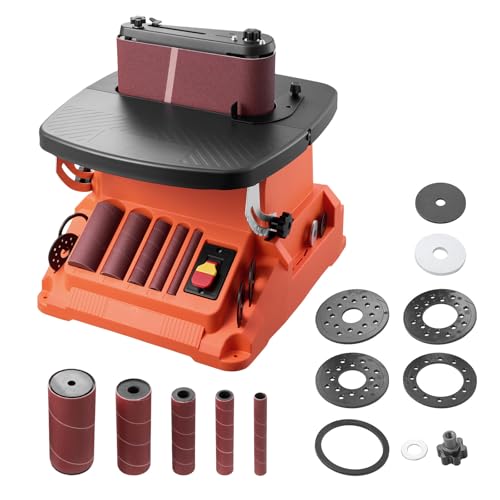
VEVOR Oscillating Belt and Spindle Sander
What We Like
- Complete kit with five spindle sleeves and table inserts
- Oscillating 5/8" stroke for efficient material removal
- Integrated storage for sleeves and inserts reduces clutter
- 35mm dust port connects to a shop vacuum
Trade-offs
- At 37.5 lb, it's heavier than the 27 lb WEN oscillating model
- Belt size is narrower than 4" or 6" models like the DEWALT
- No disc sander function like the BUCKTOOL bench combo
A single benchtop station combines an oscillating spindle sander with a 24-inch belt, which means you can handle both inside curves and long edges without switching tools. The 2400 RPM motor speed delivers efficient sanding on flat, curved, and contoured surfaces, ideal for furniture finishing and DIY projects. This setup, with its five spindle sleeves ranging from 1/2 inch to 2 inches and a tilting worktable, provides the flexibility a serious DIYer or small shop needs for complex tasks.
You trade some specialization for that versatility. The sanding belt is under four inches wide, so flattening large panels will take more passes than on a 6×48 sander like the JET. It’s also a solid 37.5-pound unit, meaning your bench needs to be sturdy. For a shop focused purely on spindle work, a dedicated oscillating model like the RIKON might offer a heavier build, but the VEVOR’s two-in-one design covers far more ground for the space it occupies.
Product photos
WEN Benchtop Belt and Disc Sander

What We Like
- Combines belt and disc in one machine
- Full 90-degree belt tilt for edges
- Cast iron base minimizes vibration
- Lever allows quick belt changes
Trade-offs
- Smaller 6-inch disc versus 8 or 12-inch models
- 4.3 Amp motor is modest for heavy stock removal
A 4×36-inch belt paired with a 6-inch disc gives you two essential sanding functions on a single, compact footprint. That dual-purpose design is the core appeal here, letting you tackle both flat surfaces and shaped edges without switching tools. The cast iron base provides a solid foundation that dampens the machine’s shake, a critical detail for maintaining control during fine finishing work. This sander is built for the workshop that needs fundamental shaping and smoothing capability without a premium investment.
Its 4.3 Amp motor provides up to 3600 RPM, which is sufficient for most shaping and finishing tasks without the aggressive stock removal of larger industrial sanders. You trade some capacity for simplicity and value. For a hobbyist or generalist setting up a first serious shop, this WEN delivers core sanding utilities in a straightforward package.
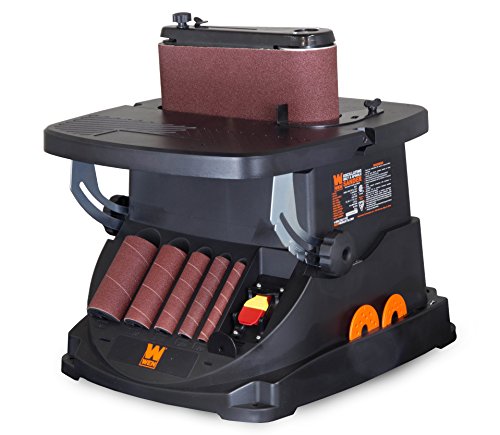
WEN Oscillating Belt and Spindle Sander
What We Like
- Includes five spindle drum sizes
- Onboard storage for accessories
- Oscillating belt and spindle action
- Comes with beveling work table
Trade-offs
- 4 x 24 inch belt is narrower than some competitors
- Only includes 80-grit sandpaper
Five included sanding drums, from 1/2 inch up to 2 inches, allow work on a variety of curved openings and contours. The spindle oscillates 58 times per minute, which helps prevent clogging and burning during detailed work. Onboard storage keeps the multiple throat plates and drum sizes organized, so everything needed for a job stays together.
You do trade some belt sanding capacity for that spindle specialization. The 4 x 24 inch belt is serviceable for smaller parts, but it can’t match the longer platen of a dedicated belt sander like the WEN 6502T for flattening or squaring longer stock. At 27 pounds, it’s a manageable size for a crowded shop, though its 18.5-inch depth still demands a dedicated spot on the bench. If your projects lean heavily toward curved moldings, template work, or musical instrument parts, this sander’s organized, multi-spindle approach delivers. For users who need to remove significant material on flat surfaces, a machine with a larger belt becomes a more logical companion.
DEWALT 4 x 36 Belt and 8 Disc Sander

What We Like
- Adjustable dust port for belt or disc use
- Separate die-cast aluminum belt tables
- Two-in-one belt and disc sanding design
- 7.0 AMP motor for demanding applications
Trade-offs
- Belt is narrower than the 6" models like the JET JSG-96
- Disc is smaller than the 12" on the Shop Fox W1712
A 2-1/2-inch dust port with an adjustable control knob lets you optimize suction for either the belt or the disc. This feature keeps your workspace cleaner and helps maintain visibility during sanding operations. Separate die-cast aluminum tables for the belt are designed to ensure stability, accuracy, and flexibility.
Its cleaner operation does come with a trade-off in sanding capacity. The 4-inch belt is narrower than the 6-inch belts on models like the JET JSG-96, and the 8-inch disc is smaller than some dedicated disc sanders. This limits its suitability for rapid stock removal on very wide pieces. For general shop tasks, sharpening, and finishing work where dust management is a priority, the DEWALT offers a focused and practical package.
Product photos
JET Benchtop Drum Sander

What We Like
- Open-end design handles 20-inch wide panels
- Self-cooling drum protects wood and abrasive
- Variable feed speed for precise control
- Five-year warranty for long-term peace of mind
Trade-offs
- At 73 pounds, it's a permanent benchtop fixture
- Requires separate dust collector purchase
- Light passes only; not for heavy dimensioning
Its open-ended drum sands panels up to 20 inches wide, which is ideal for flattening wide glue-ups, face frames, or cutting boards too large for a single pass. Built for finish sanding and light dimensioning of wood, the self-cooling drum helps protect abrasive strips and is recommended for figured woods that can tear out in a planer. A 1 HP motor powers the die-cast aluminum and steel build, and the design handles stock from 1/32″ to 3″ thick.
The trade-off is its singular focus. This is a dedicated drum sander, not a versatile combo unit like the JET 6 x 48 Belt and 9 Disc Sander also in this guide. You’re committing bench space and budget to one specific task, thicknessing and finishing flat stock. It also demands a dedicated 550 CFM dust collector, adding to the setup. For the right shop, however, that specialization is its greatest strength, turning a tedious hand-sanding chore into a repeatable, machine-driven process.
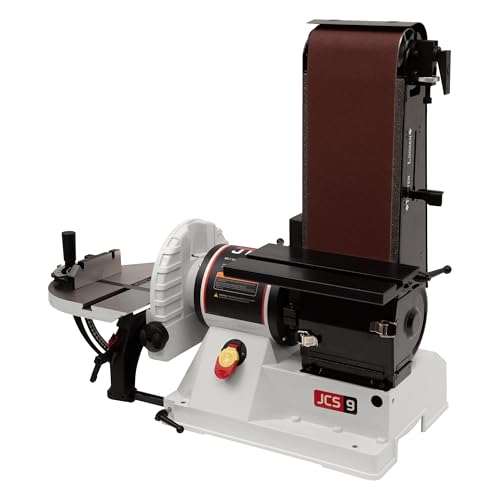
JET 6 x 48 Belt and 9 Disc Sander
What We Like
- Large cast iron table with 90° and 45° stops
- Graphite-coated platen runs cooler for longer belt life
- Rubber-coated drive drum reduces belt slippage
Trade-offs
- At 91 pounds, it's a substantial, stationary benchtop fixture.
- Its 31-inch width demands significant shop space.
A 3/4 HP motor driving a full 6-by-48-inch belt means this sander doesn’t flinch at heavy stock removal or long sessions shaping hardwoods. The cast iron construction and a table that locks solidly at any angle make it a fixture for precision work, suited for a workshop that demands durability and consistent performance over light duty or portability. It’s built for the woodworker or fabricator who treats a sander as a core machine, not an occasional tool.
At 91 pounds, this sander becomes a solid, permanent fixture on your workbench, unlike lighter models like the 35.5-pound BUCKTOOL. Its large cast iron table can be set at preset stops for vertical or horizontal belt sanding, providing flexibility for different projects. A graphite-covered steel platen runs cooler to increase machine and belt life, which supports long-term use.
BUCKTOOL Bench Belt Disc Sander

What We Like
- Direct-drive motor eliminates belt tension adjustments
- Belt tilts fully for horizontal and vertical sanding
- Cast aluminum tables and base reduce vibration
- Combines disc and belt functions in one CSA-certified unit
Trade-offs
- 35.5 lb weight demands a sturdy, permanent benchtop
- 6-inch disc is smaller than many 8-inch competitors
The direct-drive motor shaft is the core of this sander, doing away with belts, pulleys, and the constant tweaking they require. That makes the Bucktool a true set-and-forget machine for the woodworker tired of maintenance interrupting their flow. Its 0-90 degree belt tilt and cast aluminum worktables provide the solid, multi-angle sanding foundation needed for everything from flattening boards to shaping curved pieces, all driven by a quiet 3/4 HP motor.
That simplicity does involve a trade-off in flexibility. The fixed-speed operation and 6-inch disc cannot match the variable finesse or larger surface of a model like the JET 6 x 48 Belt and 9 Disc Sander. This sander excels in a workshop where reliable, straightforward operation on a dedicated bench is more valuable than having the widest range of specialized sanding options.
Product photos
Shop Fox 6 x 48 Belt 12 Disc Sander

What We Like
- 12-inch disc provides a large sanding surface
- Long 48-inch belt handles sizable workpieces
- Combination design offers two sanding methods
- Benchtop form factor saves floor space
Trade-offs
- Lacks the oscillating function of a dedicated spindle sander
- Belt orientation may not suit all contour sanding tasks
The 12-inch disc is the standout feature here, giving you a vast, flat surface to dress the edge of a tabletop or square up a cabinet door without constantly repositioning the workpiece. Combined with the long 6×48 belt, this Shop Fox sander is built for handling larger components and serious material removal.
Unlike the VEVOR or RIKON oscillating spindle sanders, this model lacks a spindle for sanding inside curves. It is a belt and disc combo sander. For shops with a separate spindle sander, it can serve as a primary station for other sanding tasks.
BUCKTOOL 2×42 Belt Sander Grinder Combo

What We Like
- High-speed belt ideal for metal
- Belt tilts and swivels for complex angles
- Tool-free belt tension and tracking
- Dedicated tables for metal and wood
Trade-offs
- 2-inch belt width limits surface area
- Fixed speed lacks versatility for fine woods
A 2×42 belt moving at 4480 feet per minute provides the high-speed abrasion required for shaping metal and sharpening tools. Its belt housing can swivel to vertical and the belt itself tilts up to 90 degrees, enabling precise angle work on long pieces or complex profiles. Two cast worktables offer stable support for grinding metal on the iron table or working wood on the aluminum one, making it a dedicated station for focused material removal.
That limits its efficiency for wider wood surfaces. It’s a specialist. For a workshop that primarily processes metal, its speed and adjustable work geometry are major assets. For a shop needing to smooth large panels of wood, the narrower belt becomes a constraint.
Product photos
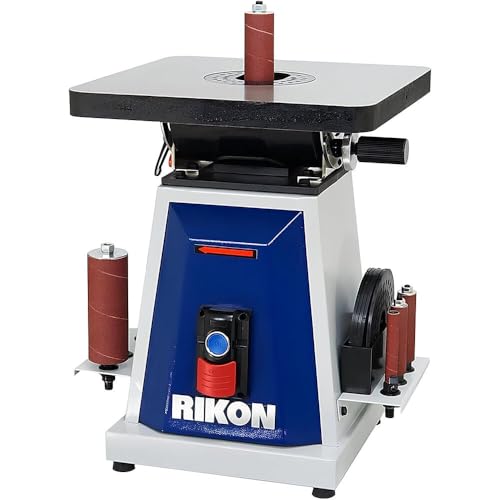
RIKON Power Tools 50-300 Benchtop Sander
What We Like
- All-steel and cast iron construction for durability
- Five spindle diameters from 1/2 to 2 inches
- Oscillating action provides efficient abrasive cutting
Trade-offs
- Lacks a sanding belt found on some combo units.
- Its 23.5-inch length requires significant bench space.
At 76 pounds with an all-steel build, the RIKON 50-300 is a heavy-duty benchtop sander. That weight and material mean it stays put on the workbench, providing a stable base for the fast, accurate sanding of curved edges it’s designed to do. It includes five spindle diameters from 1/2 inch to 2 inches and six table inserts for working with different shapes.
The machine’s specialization for curved edges and its substantial weight mean it is best suited as a dedicated station. For shops needing to sand both curves and flat surfaces in one footprint, a combined belt and spindle sander like the listed VEVOR model offers a different approach at 37.5 pounds.
Product photos
How We Evaluated Benchtop Sanders
Our evaluation was based on detailed research of specifications, manufacturer documentation, and aggregated expert round-ups. We cross-referenced this with patterns in owner feedback to identify consistent strengths and trade-offs across dozens of models. The key criteria were the sander’s primary function (belt, disc, spindle, or combo), its capacity for different workpiece sizes, and its effectiveness at dust control to maintain a clean workspace.
Build quality and design features that impact long-term usability were also considered. This approach highlights the design choices that make each model suited for specific workshop needs.
What To Look For In Benchtop Sanders
Your workshop’s needs dictate the right tool. A general-purpose combo sander offers flexibility, while dedicated machines excel at specific tasks like smoothing curves or flattening panels.
Focus on the sanding method (belt, disc, or spindle), the size of workpieces you handle, and the machine’s dust collection to keep your shop clean and your work visible.
Primary Sanding Method
Benchtop sanders are defined by their abrasive action. A belt sander, whether on a stationary belt sander or a tabletop belt sander, is ideal for rapid stock removal and shaping edges. A disc sander provides a flat, rigid surface for squaring ends and fine finishing. An oscillating spindle sander is essential for sanding inside curves and complex contours. Many models combine two methods, like a belt and disc, offering great versatility for a general shop.
Workpiece Capacity and Size
The physical dimensions of the sander dictate what you can work on. Belt length (like 4×36″ vs. 6×48″) and disc diameter (6″ vs. 12″) determine how much surface area contacts the abrasive. For large panels, a wide drum sander or a long belt is necessary. Conversely, a compact combo sander suits smaller projects and saves bench space. Consider not just the tool’s footprint, but the space needed around it to maneuver your workpiece safely.
Dust Control and Shop Cleanliness
Sanders generate a tremendous amount of fine dust. Effective collection is crucial for visibility, safety, and shop cleanliness. Look for machines with integrated, well-sized dust ports that connect directly to a shop vacuum or dust collector. Some models have adjustable or dual ports to service both belt and disc functions. Good dust control is a fundamental feature for any productive workshop.
- Check the dust port size and shape against your existing vacuum hose.
- Look for onboard storage for sanding sleeves or table inserts to reduce clutter.
- Ensure the work tables lock securely and offer useful angle stops for repeatable results.
- Verify the machine’s weight; a heavier cast-iron base greatly reduces vibration during use.
Match the sander’s core function to the task you perform most often in your shop.
Benchtop Sanders Compared
The following table compares key specifications across all ten recommended benchtop sanders to help you see the differences at a glance.
| Product | Sander Type | Motor Power/Speed | Belt/Disc/Spindle Size |
|---|---|---|---|
| VEVOR Oscillating Belt and Spindle Sander | Oscillating belt & spindle | 2400 RPM | 24" x 3.86" belt; 5 sleeves (1/2" to 2") |
| WEN Benchtop Belt and Disc Sander | Belt and disc | 4.3 Amp | 4 x 36 inches belt; 6 inches disc |
| WEN Oscillating Belt and Spindle Sander | Oscillating belt and spindle | 3.5-amp; 2000 RPM | N/A |
| DEWALT 4 x 36 Belt and 8 Disc Sander | Belt and disc | 7.0 AMP | 4" x 36" belt; 8" disc |
| JET Benchtop Drum Sander | Drum sander | 1 HP induction | 10" drum; 20" max panel width |
| JET 6 x 48 Belt and 9 Disc Sander | Belt & disc | 3/4 HP, 115V | 6" x 48" belt; 9" disc |
| BUCKTOOL Bench Belt Disc Sander | Belt disc | 3/4 HP fully enclosed | 4 x 36 inches belt; 6 inches disc |
| Shop Fox 6 x 48 Belt 12 Disc Sander | Belt/Disc Combo | N/A | 6 in. x 48 in. belt; 12 in. disc |
| BUCKTOOL 2×42 Belt Sander Grinder Combo | Belt sander grinder | 1/3 HP, 3.5 Amp | 2" x 42" belt; 6" grinding wheel |
| RIKON Power Tools 50-300 Benchtop Sander | Oscillating Spindle Sander | ½ HP | 5 spindle diameters (½” – 2”) |
Frequently Asked Questions
Which Benchtop sander is the best?
The best benchtop sander depends entirely on your primary workshop tasks. For a versatile station that handles both contour sanding and belt work, the VEVOR Oscillating Belt and Spindle Sander is an excellent overall choice. If you need aggressive stock removal on large pieces, a heavy-duty model like the JET 6 x 48 Belt and 9 Disc Sander is superior. Reviewing the different types of sanders can clarify which function aligns with your projects.
What are some good benchtop sanders for woodworking?
Good woodworking benchtop sanders cover shaping, finishing, and curve sanding. The WEN Oscillating Belt and Spindle Sander is superb for detailed curves and interior cutouts. For flattening wide panels, the JET Benchtop Drum Sander is a dedicated solution. A reliable all-arounder for foundational work is the BUCKTOOL Bench Belt Disc Sander. Our full guide to sanders for woodworking delves deeper into these applications.
What company makes the best sanders?
There is no single best company, as different brands excel in different categories. JET is known for its heavy-duty, professional-grade stationary tools, while DEWALT offers strong performance for demanding workshop applications. Brands like WEN and BUCKTOOL provide good value in the budget and mid-range segments. The best brand for you is the one whose tool design and warranty best match your specific needs and budget.
Which brand of sanding discs is considered the best?
Brand preference for sanding discs and belts is highly subjective and often based on the specific abrasive material (aluminum oxide, ceramic) and backing durability needed. Popular and widely available brands include 3M, Norton, and Diablo. It’s often more important to match the grit sequence and abrasive type to your material (wood vs. Metal) than to focus on a single brand name. Many users find that buying higher-quality abrasives, regardless of brand, significantly improves finish and longevity.
What’s the difference between a belt sander and an orbital sander?
A benchtop belt sander uses a continuous loop of abrasive on two drums for fast, linear material removal, ideal for shaping and aggressive smoothing. A handheld orbital sander uses a vibrating pad that moves in small, random orbits to create a fine, scratch-free finish without leaving swirl marks. They are complementary tools, not substitutes.
The Bottom Line
For a workshop needing a single, organized station for both spindle contour work and belt sanding, the VEVOR Oscillating Belt and Spindle Sander is our top recommendation. If your budget is tight, the WEN Benchtop Belt and Disc Sander delivers reliable combo functionality, while metalworkers should look directly to the specialized BUCKTOOL 2×42 Belt Sander Grinder Combo. Ultimately, the most important factor is honestly matching the sander’s primary function to the task you perform most often on your bench.
