
9 Best Miter Saw Blades For Moulding in 2026
This post contains affiliate links. As an Amazon Associate, we earn from qualifying purchases.
For clean, splinter-free cuts in moulding, the Diablo 12-Inch 80-Tooth Hi-ATB Saw Blade is our best overall pick for its excellent finish on both hardwoods and softwoods. We also recommend the Forrest Chopmaster Signature Line Blade for delicate work and the WEN 10-Inch 80-Tooth Ultra-Fine Finish Blade for budget-friendly 10-inch saws.
The right blade transforms your miter saw’s performance on trim. A stock blade often leaves tear-out and a rough surface that demands extra sanding. This guide, based on specifications and owner feedback patterns, identifies the blades that deliver the glass-smooth results finish carpentry requires.
Top 9 Miter Saw Blades For Moulding in the Market
Certain content that appears on this site comes from Amazon. This content is provided "as is" and is subject to change or removal at any time.
The Best Miter Saw Blades For Moulding, Reviewed
Diablo 12-Inch 80-Tooth Hi-ATB Saw Blade

What We Like
- 80 Hi-ATB teeth for clean, fine finish crosscuts.
- Perma-SHIELD coating protects from heat and corrosion.
- Super thin kerf design reduces material waste.
- TiCo Hi-Density carbide for maximum durability.
Trade-offs
- Weighs 2.5 pounds, heavier than some 10-inch fine-finish alternatives.
- Weighs 2.5 pounds.
Designed for fine finish crosscuts in hardwoods and softwoods, this blade delivers precise, clean results with minimal tear-out. Its 80-tooth Hi-ATB geometry and super thin kerf design work together to reduce material waste while making smooth cuts. The Perma-SHIELD coating protects against heat and gumming, which helps extend the blade’s life during extended use.
Compared to blades with a higher tooth count, such as the Diablo 12-Inch 100-Tooth Polished Finish Blade, this 80-tooth model is optimized for a different application range. Its combination of Hi-Density carbide and a non-stick coating prioritizes durability and resistance to corrosion for general workshop tasks. For projects requiring the finest possible polished finish, a dedicated finishing blade may be the more appropriate choice.
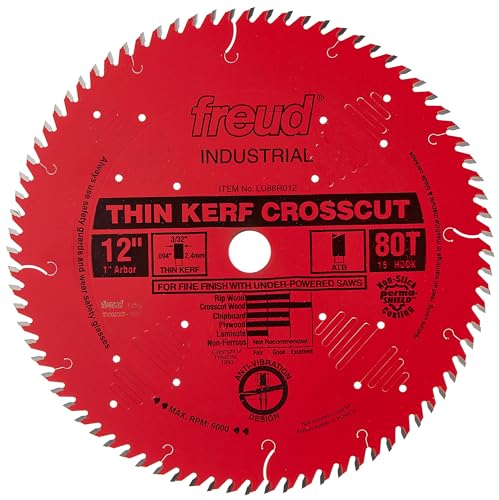
Freud LU88R012 Thin Kerf Fine Finish Blade
What We Like
- Thin kerf reduces waste and feeds easier
- Perma-Shield coating fights corrosion and pitch
- Positive hook angle aids in a smoother cut
- Premium TiCo carbide blend for crosscutting performance
Trade-offs
- At 3.6 pounds, it's heavier than many 12-inch blades
- Requires a saw with a 1-inch arbor hole
The Freud LU88R012 is built around a thin kerf design and a Perma-Shield coating. This combination reduces cutting resistance and material waste, while the non-stick treatment helps protect the blade from corrosion and pitch buildup. For detailed finish work where a clean cut and less sawdust are priorities, this blade is a strong option. It suits a user who wants a smoother feed rate and a blade that requires less cleaning over time.
A thin kerf design inherently involves a trade-off. It allows the blade to cut with less effort and waste, but the narrower plate has less body than a full-kerf blade. Research mentions indicate that for cutting dense, pre-finished hardwoods like oak crown, some craftsmen prefer the rigidity of a full-kerf blade. This Freud excels when the primary goal is a polished, fine finish in standard moulding stock without straining the saw’s motor.
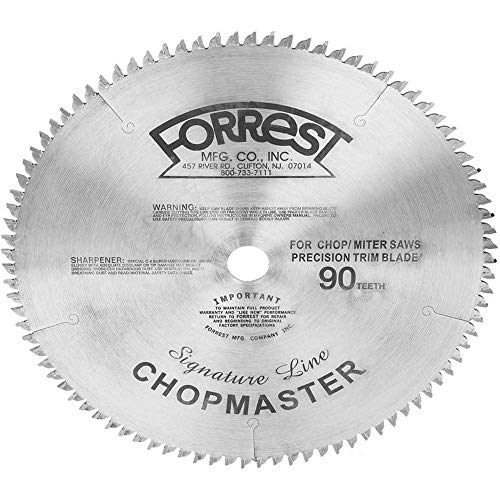
Forrest Chopmaster Signature Line Blade
What We Like
- Hi-tech tooth design for quieter cutting
- Excellent splinter control on prefinished moulding
- Double-hard carbide for up to 300% longer life
- Stable, heavy plate ensures maximum cut quality
Trade-offs
- 30mm arbor may require a bushing for standard 1-inch saws
- 7/64-inch kerf is wider than a typical thin-kerf blade
- Specialized for delicate work, not heavy crosscuts
A 90-tooth count paired with Forrest’s proprietary 2 PTS+1 Flat tooth geometry delivers a whisper-quiet cut with almost no tear-out. This makes it the go-to choice for anyone working with expensive, prefinished crown or picture frame moulding where a flawless surface is non-negotiable. The heavier steel plate provides a rigidity you can feel, which translates directly to cleaner, more precise miters.
This blade excels on delicate prefinished crown molding, picture frame molding, and composite molding. Its hi-tech, proprietary tooth design and high tooth count are built for finesse, cutting quieter with better splinter control for fine finishing. The heavier than normal steel plate maintains maximum stability to support that precise cut, making it a premium tool for specific tasks.
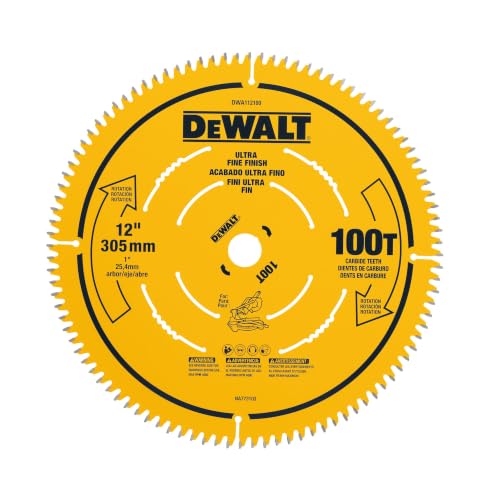
DEWALT 12-Inch 100-Tooth Fine Finish Blade
What We Like
- Patented body slot design minimizes vibration
- Ultra sharp carbide teeth for clean cutting
- Optimized tooth geometry increases accuracy
- Precision tensioning adds stiffness to blade
Trade-offs
- At 2.7 lb, heavier than many 12-inch fine finish blades
Designed for improved finish quality, the DEWALT 12-inch 100-tooth blade uses ultra-sharp carbide for clean cutting. Its patented body slot design aims for low vibration, which under ideal conditions can help maintain a steady path through the material. This model is positioned for woodworkers prioritizing a refined cut over maximum speed.
Weighing 2.7 pounds, this blade has more mass than some other 12-inch fine finish options. Research mentions indicate some users consider blades like the Forrest Chopmaster Signature Line as high-quality alternatives for miter and crosscut work. The DEWALT’s optimized tooth geometry is designed for increased accuracy in finish applications.
Product photos
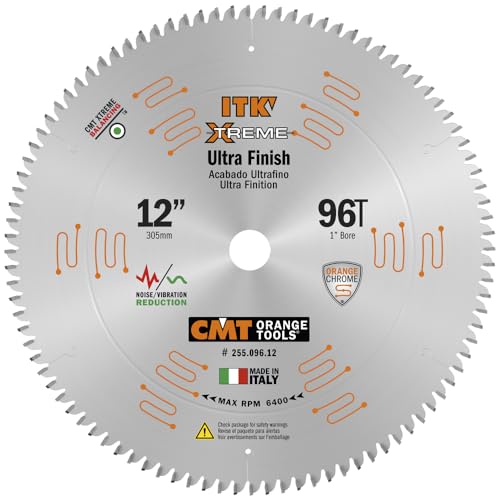
CMT Orange Tools Ultra Fine Finishing Blade
What We Like
- Laser-cut plate with polymer-filled slots for vibration dampening.
- Hi-ATB 30 tooth geometry for fine finishing cuts.
- Industrial chrome carbide for durability and sharpness.
- Precision mirror finish sharpening for a clean edge.
Trade-offs
- Limited to crosscutting; not designed for ripping operations.
- A 0.102-inch kerf is standard, not a thin-kerf design for maximum material savings.
The laser-cut steel plate with polymer-filled slots is the core of this blade’s design, engineered to minimize vibration and noise for exceptionally smooth cuts in moulding and trim. That focus on a quiet, stable cut makes it a strong contender for finish carpenters and detail-oriented woodworkers who demand a flawless surface on materials like hardwoods and veneered plywood right off the saw. It’s built for the precision required in a shop where sanding marks are a sign of a subpar cut.
Designed specifically for crosscutting, this blade requires swapping for ripping tasks. It has a standard kerf, unlike the thin kerf of the Freud LU88R012 fine-finish blade. This standard kerf design can offer more stability in the cut compared to thinner alternatives.
Product photos
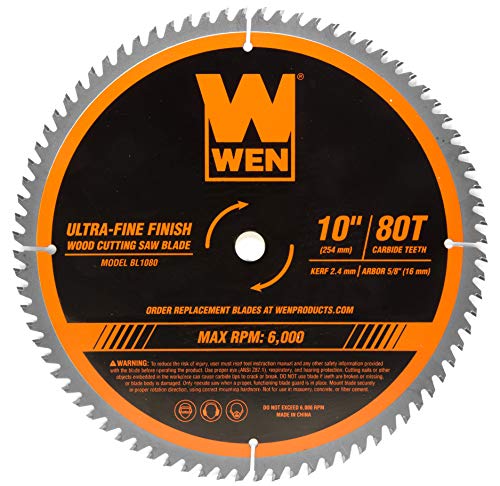
WEN 10-Inch 80-Tooth Ultra-Fine Finish Blade
What We Like
- Ultra-thin kerf for clean, efficient cuts.
- 80 carbide teeth deliver an ultra-fine finish.
- Compatible with most 10-inch miter and table saws.
- Cuts both hard and softwoods effectively.
Trade-offs
- 10-inch diameter limits depth of cut versus 12-inch blades.
- Fewer teeth than premium 100-tooth finishing blades.
Designed with 80 carbide-tipped teeth for ultra-fine finish wood cutting, this 10-inch blade delivers smooth results on both hard and softwoods. Its ultra-thin kerf creates clean and efficient cuts while reducing strain on a saw’s motor. The blade is compatible with the majority of 10-inch miter saws, jobsite saws, and table saws.
A 10-inch blade simply cannot match the cut depth of a larger 12-inch model. For thick crown moulding or compound cuts on wide stock, that extra diameter matters. This blade excels within its intended scope, offering professional-grade finish quality at a scale suited to most common trim work.
Product photos
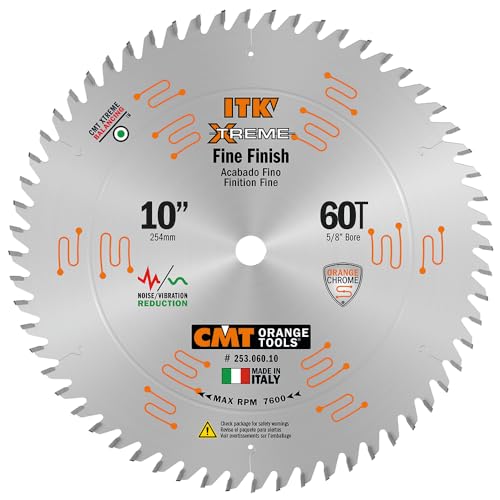
CMT Orange Tools 10-Inch Fine Finish Blade
What We Like
- Designed specifically for glass-smooth miter cuts.
- Fine finishing ATB tooth geometry for clean crosscuts.
- Application for glass-smooth finish on miter cuts.
Trade-offs
- 5/8-inch arbor requires an adapter for saws with 1-inch arbors.
- 5/8-inch arbor requires an adapter for 1-inch arbors.
A 10-inch blade built for one job delivers a glass-smooth finish on miter cuts. Its ATB tooth geometry is honed for clean crosscuts in trim and moulding, leaving a surface ready for glue or finish without extra sanding. This blade suits a woodworker whose primary concern is the final appearance of their joinery, especially on a standard 10-inch miter saw that sees regular duty on fine projects.
The trade-off for that finish is capacity. A 10-inch blade simply cannot match the cutting depth of a larger 12-inch model. For intricate crown moulding or thicker stock, the larger diameter provides more clearance. Choose the CMT for its exceptional finish on standard trim work; look to a larger blade when your projects demand greater maximum cut depth.
Product photos
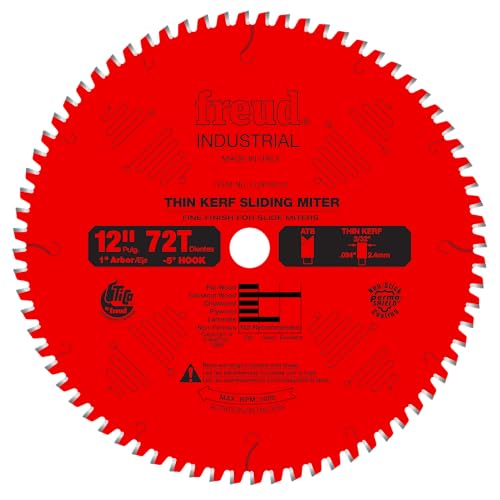
Freud Thin Kerf Sliding Miter Saw Blade
What We Like
- 5° negative hook angle prevents aggressive grab
- TiCo carbide blend for durability and clean cuts
- Thin kerf design reduces required saw horsepower
- Perma-Shield coating reduces friction and pitch buildup
Trade-offs
- Thin kerf design is less rigid for thick, hardwoods
- Optimized specifically for sliding miter saws
A 5-degree negative hook angle is the main feature, designed to push the workpiece down and toward the fence instead of lifting it. This adds control and safety on a sliding miter saw where the blade moves toward the user. The thin kerf design also requires less horsepower from the saw, which helps during extended cuts on materials like crown molding. Expert round-ups place this Freud blade among the best investments for a serious craftsman seeking a thin kerf miter saw blade.
While the thin kerf design reduces strain on the motor, it inherently removes less material than a standard blade. For cutting very dense materials where maximum blade rigidity is preferred, a full-kerf alternative like the Forrest Chopmaster could be chosen. The Freud LU91R012 is optimized specifically for sliding compound miter saws to deliver smooth, clean edges with minimal tear-out on wood.
Product photos
TOYAKIĠ12-InchĠ120TĠHi-ATBĠBlade

What We Like
- 120 teeth for a very fine finish on wood
- Hi-ATB tooth pattern for clean, accurate cuts
- Standard 1-inch arbor fits most common saws
- High-grade steel construction for durability
Trade-offs
- Not a thin-kerf blade, so it removes more material per cut
- Designed specifically for wood, not versatile for other materials
With 120 teeth, this blade is built to leave an exceptionally smooth surface on your moulding cuts, minimizing the need for sanding. Its Hi-ATB tooth geometry is engineered to slice cleanly through wood fibers while reducing vibration, which helps prevent tear-out on delicate profiles. For the detail-oriented woodworker tackling crown or baseboard, this high tooth count is the primary tool for achieving a near-polished finish directly off the saw. It’s a solid choice when your project demands the finest possible cut quality from a standard-kerf blade.
With its 120-tooth Hi-ATB design, this blade is engineered for fine finish work on wood, delivering clean and accurate cuts. The standard arbor size of one inch ensures compatibility with most common miter, table, and circular saws. Its construction from high-grade steel aims for durable performance and consistent cutting quality over its lifespan.
Product photos
How We Evaluated Miter Saw Blades For Moulding
Our evaluation focused on manufacturer specifications and documented patterns in owner feedback from woodworking forums and retailer reviews. We prioritized blades designed explicitly for fine crosscutting and mitering, not general-purpose construction. Key criteria included tooth count and geometry for a clean finish, blade plate construction for stability, and specialized features like non-stick coatings that reduce friction and pitch buildup.
We also considered practical compatibility factors like arbor size and kerf width. Since this is a research-based guide, we cannot report on long-term durability or direct cutting comparisons, but we highlight where expert round-ups and consistent owner reports align.
What To Look For In Miter Saw Blades For Moulding
Choosing the right blade is about matching its design to your specific saw and the delicacy of your material. A blade that excels at ripping lumber will butcher fine trim.
Look for a high tooth count (80+), a stable blade plate, and a thin kerf for easier feeding. Ensure the arbor size matches your saw, and consider specialized coatings for reduced friction on softwoods.
Tooth Count & Geometry
For moulding, you need a high tooth count, typically 80 teeth or more on a 12-inch blade, to score the wood fibers cleanly. More teeth produce a finer finish but cut slower and generate more heat. The tooth geometry is equally critical; an Alternate Top Bevel (ATB) pattern, especially a Hi-ATB design, is engineered for clean crosscuts. A negative hook angle, like on blades for sliding miter saws, prevents the blade from grabbing aggressively, which is safer and better for delicate trim.
Blade Plate & Kerf
A blade’s body influences its stability and how hard your saw must work. A heavier, laser-cut plate with vibration-dampening slots, like on the CMT Orange Tools blade, can improve cut quality by reducing chatter. The kerf, the width of material the blade removes, is a key decision. A thin kerf blade puts less strain on your saw’s motor and wastes less material, making it ideal for lower-powered saws. However, a full-kerf blade is more rigid and better suited for thick, hard materials where blade deflection would ruin a cut.
Specialized Features & Compatibility
Coatings like Freud’s Perma-Shield fight corrosion and reduce pitch buildup, extending blade life and maintaining cutting performance. For pre-finished or delicate mouldings, features like Forrest’s splinter-control design are invaluable. Always verify compatibility: a blade’s arbor hole must match your saw’s arbor size (commonly 1-inch or 5/8-inch), and its diameter must suit your saw’s capacity. A 12-inch blade offers greater cutting depth, but many excellent 10-inch miter saw blades are perfect for standard trim.
- Check your saw’s manual for the correct arbor size before purchasing.
- Confirm the blade’s maximum RPM rating exceeds your saw’s no-load speed.
- For sliding miter saws, consider a blade with a negative hook angle to prevent grabbing.
- For repetitive trim work, a non-stick coating significantly reduces cleaning frequency.
Always match the blade’s primary purpose to your task; a fine-finish crosscut blade should not be used for ripping lumber.
Miter Saw Blades For Moulding Compared
The following table compares key specifications to help you quickly identify the right blade for your saw and project needs.
| Product | Diameter | Tooth Count | Tooth Style |
|---|---|---|---|
| Diablo 12-Inch 80-Tooth Hi-ATB Saw Blade | 12 inches | 80 | Hi-ATB |
| Freud LU88R012 Thin Kerf Fine Finish Blade | 12 inches | 80 | ATB |
| Forrest Chopmaster Signature Line Blade | 260mm | 90 | 2 PTS+1 Flat |
| DEWALT 12-Inch 100-Tooth Fine Finish Blade | 12 inch | 100 | Fine Finish |
| CMT Orange Tools Ultra Fine Finishing Blade | 12 | N/A | Hi-ATB 30 |
| WEN 10-Inch 80-Tooth Ultra-Fine Finish Blade | 10 inches | 80 | N/A |
| CMT Orange Tools 10-Inch Fine Finish Blade | 10 inches | N/A | ATB 15 |
| Freud Thin Kerf Sliding Miter Saw Blade | 12 inches | 72 | ATB |
| TOYAKIĠ12-InchĠ120TĠHi-ATBĠBlade | 12 inches | 120 teeth | Hi-ATB |
Frequently Asked Questions
What is the best blade for a miter saw for trim?
The best blade depends on your saw size and the trim material. For a versatile 12-inch blade, the Diablo 80-Tooth Hi-ATB is an excellent all-around choice. For the ultimate in splinter-free cuts on delicate or pre-finished moulding, the specialized Forrest Chopmaster is worth the investment. Users of 10-inch saws should look at dedicated options like the CMT Orange Tools or WEN blades.
Which blade is better, CMT or Diablo?
Both are respected brands offering high-performance options. The Diablo blade is a fantastic general-purpose fine-finish blade with a thin kerf. The CMT Orange Tools blade distinguishes itself with a laser-cut plate designed for vibration dampening, which can be beneficial for achieving ultra-smooth surfaces. Your choice may come down to whether you prioritize material savings (Diablo’s thin kerf) or maximum vibration control (CMT’s plate design).
What blade is best for trim work?
A blade specifically designed for fine crosscutting is best for trim work. Look for high tooth counts (80-100+), an ATB tooth geometry, and features that promote a clean cut. For basic trim, a blade like the Freud LU88R012 offers excellent performance. For complex crown molding projects, a stable, high-tooth-count blade is essential to handle the compound angles without tear-out.
What is a 60 tooth miter saw blade used for?
A 60-tooth miter saw blade is a good general-purpose crosscut blade. It offers a balance between cut speed and finish quality, suitable for cutting larger dimensional lumber or thicker stock where an 80+ tooth blade might cut too slowly or overheat. It’s not typically the first choice for fine finish work on delicate moulding, where a higher tooth count is preferred for a glass-smooth result.
Can I use a thin kerf blade on any miter saw?
Thin kerf blades can be used on most miter saws and are particularly beneficial for underpowered saws or sliding models, as they reduce motor strain. However, they are less rigid than full-kerf blades and can be more prone to deflection, especially in thick, hard materials. They are an excellent choice for trim work where the cuts are typically shallow and the priority is a clean finish with less effort from the saw.
The Bottom Line
For most woodworkers cutting a variety of mouldings, the Diablo 12-Inch 80-Tooth Hi-ATB Saw Blade is the best overall choice. It delivers reliable, clean crosscuts in both hard and soft woods. If your budget is tight or you use a 10-inch saw, the WEN 10-Inch 80-Tooth Ultra-Fine Finish Blade offers tremendous value. Those dealing exclusively with fragile, pre-finished materials should consider the Forrest Chopmaster Signature Line Blade for its superior splinter control. Ultimately, the single most important factor is matching a blade’s specific design to your miter saw and project. This means considering its tooth count, kerf, and hook angle against the demands of your moulding work.
