
10 Best Saw Blades For Cutting Aluminum in 2026
This post contains affiliate links. As an Amazon Associate, we earn from qualifying purchases.
For clean, durable cuts in aluminum, our best overall pick is the Diablo Thick Aluminum Cutting Saw Blade for its burr-free TCG geometry and heat-resistant coating. For professionals, the Oshlun TCG Saw Blade offers superior control, while the Benchmark Abrasives TCT Blade is our top choice for compact saws.
Choosing the wrong blade leads to gummed-up teeth, rough edges, and premature wear. A blade engineered for aluminum’s soft, sticky nature is essential for smooth, safe cuts. This guide compares ten top options based on specifications, manufacturer data, and patterns in owner feedback, helping you match a blade to your specific saw and project needs.
Top 10 Saw Blades For Cutting Aluminum in the Market
Certain content that appears on this site comes from Amazon. This content is provided "as is" and is subject to change or removal at any time.
The Best Saw Blades For Cutting Aluminum, Reviewed
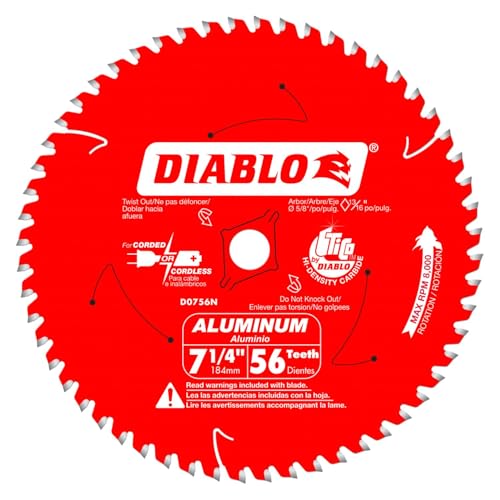
Diablo Thick Aluminum Cutting Saw Blade
What We Like
- TCG geometry provides clean, burr-free cuts
- TiCo carbide and tri-metal brazing for extreme durability
- Perma-SHIELD coating fights heat, gumming, and corrosion
- Laser-cut stabilizer vents reduce vibration and noise
Trade-offs
- 7-1/4" size limits depth of cut vs. larger blades
- Tool-only product; no case or blade wrench mentioned
Diablo’s D0756N blade is engineered for thick aluminum, handling stock from 3/16″ to 7/16″. Its TiCo Super-Density carbide and Triple Chip Grind tooth geometry are built for longevity and deliver clean, burr-free cuts that can reduce rework. The Perma-SHIELD coating protects against heat and corrosion, while laser-cut stabilizer vents reduce vibration to improve cutting accuracy.
The 7-1/4″ diameter makes it a perfect match for standard circular and miter saws. It can’t match the maximum cutting depth of a 12-inch Freud Medium Stock Aluminum Blade for really deep material, which is the trade-off for its excellent portability and compatibility. For most aluminum cutting tasks in a shop or on a jobsite, this blade’s blend of cut quality, durability, and manageable size hits the sweet spot. It justifies its place as a primary, go-to option.
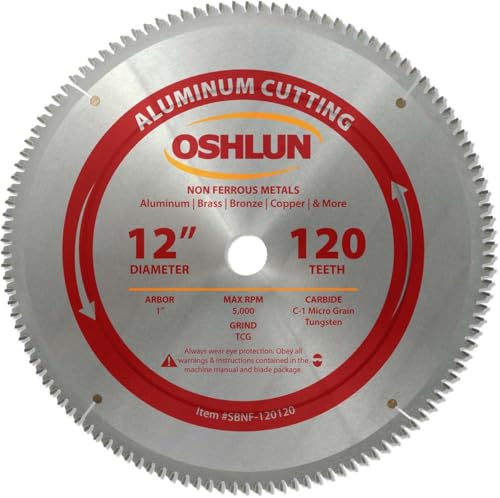
Oshlun TCG Saw Blade for Aluminum
What We Like
- Professional Grade C-1 carbide for durability
- Negative hook angle for safe, controlled cuts
- Triple Chip Grind teeth for clean cuts in aluminum
- Copper-plugged expansion slots reduce vibration
Trade-offs
- At 3.0 pounds, it requires a powerful saw motor
- 1-inch arbor limits compatibility to larger saws
The 12-inch diameter and 120-tooth TCG design deliver exceptionally clean, precise cuts in aluminum, making it a serious choice for shop work where finish quality matters. Its Professional Grade C-1 carbide and negative hook angle are built for demanding, repeated use, offering the control and longevity a professional needs. This blade is for the user who prioritizes a flawless cut and long-term value over immediate convenience.
The 3.0-pound weight and 1-inch arbor mean this blade is not a universal fit; it demands a sturdy saw with the correct spindle. For a user with a standard 10-inch miter saw needing a fine finish on thinner stock, the Janchi Ultra Fine Finish Saw Blade offers a similar tooth grind on a slightly lighter, more common platform. The Oshlun is the heavier-duty foundation for a dedicated setup.
Benchmark Abrasives TCT Circular Saw Blade

What We Like
- Fits compact 5-3/8" circular saws perfectly
- Precision tooth geometry for clean, square cuts
- Wide compatibility with major low-RPM saw brands
- Engineered for multiple non-ferrous materials
Trade-offs
- 6.5-inch diameter limits depth of cut
- Designed for non-metals, not steel or iron
- Smaller size not suited for large miter saws
Its 6.5-inch diameter and fit for 5-3/8-inch arbors make this blade a direct match for compact circular saws from brands like Ryobi and Skil. That specific compatibility is the key reason it stands out for users who need a dedicated aluminum-cutting blade for a smaller, more portable saw. The 60-tooth TCT design and wide material range mean you can switch from cutting aluminum trim to PVC pipe without a blade change. This is ideal for light fabrication and multi-material DIY projects where space and tool size are constraints.
Its 6.5-inch diameter and compatibility with 5-3/8-inch circular saws make this blade a dedicated fit for compact, handheld tools, so it’s a natural choice for jobsite trimming or shop work on sheet materials. The tooth geometry is engineered for clean cuts in aluminum, brass, copper, PVC, and fiberglass, which allows users to switch between these non-metal materials without changing blades. For larger stationary saws handling bigger profiles, a full-size 12-inch blade would cover a wider cutting arc.
Product photos
Freud Medium Stock Aluminum Blade
What We Like
- Premium TiCo carbide for nonferrous metals
- Thin kerf design for faster feed rates
- Corrosion-resistant Silver Ice coating
- Specifically designed for aluminum cutting
Trade-offs
- 96-tooth count focuses on finish over aggressive removal
- Requires a saw with a 1-inch arbor hole
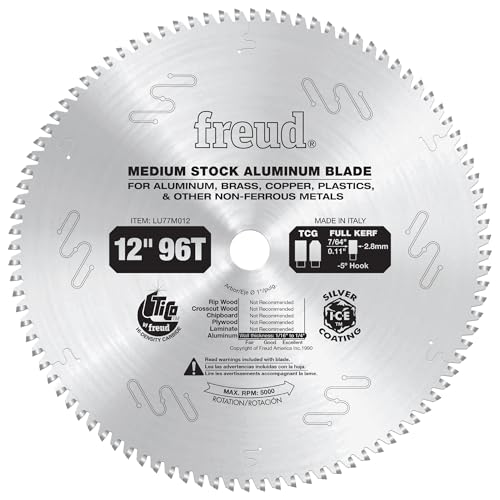
The Freud LU77M012 features a .110-inch kerf, a narrow cut that reduces material waste and eases the load on your saw motor. Its 96 TCG teeth are designed for cutting nonferrous metals. The blade’s Silver Ice Coating helps resist corrosion and pitch build-up during use.
The blade’s plate is .087 inches thick. Freud’s TiCo HI-Density Carbide blend is made specifically for nonferrous metals to extend tooth life. With a -5° hook angle, the teeth engage the material at a shallower angle.
Product photos
TOMAX TCG Aluminum Saw Blade

What We Like
- TCG grind for smooth cuts on aluminum
- Electrophoretic coating resists rust
- Construction-grade carbide for long life
- Lifetime warranty guarantees durability
Trade-offs
- 10-inch diameter limits cutting depth versus 12-inch blades
- 80-tooth count is coarser than 100-tooth fine-finish blades
A lifetime warranty is the standout feature here, signaling a blade built for the long haul. The 80-tooth TCG grind and corrosion-resistant coating make it a reliable workhorse for general aluminum and non-ferrous metal cutting. This blade suits a workshop user who values predictable performance and doesn’t want to worry about replacement costs down the line. It’s a pragmatic choice for repeated cuts on plastic, aluminum stock, and similar materials.
The trade-off is in specialization. Its 10-inch size and 80-tooth configuration deliver clean, durable cuts but won’t match the ultra-fine finish of a blade like the Janchi 100T. For cutting thicker aluminum plate, a larger 12-inch diameter would provide greater capacity. Think of the TOMAX as your dependable daily driver for aluminum, not a specialized finisher or a max-capacity option.
Product photos
DEWALT Reciprocating Saw Blade Set
What We Like
- Tall, thick profile for straight cuts in heavy metal
- Bi-metal design provides flexibility and durable edge
- Storage case organizes and protects the set
Trade-offs
- Reciprocating saws are less precise than circular saws for aluminum
- Case is made in China, unlike the blades
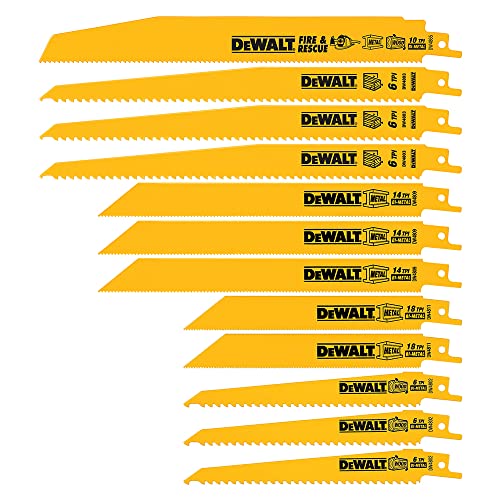
DEWALT claims this blade set offers up to 50% longer life on average across their range compared to their prior generation, which could mean fewer blade changes during a big job. The tall, thick blade profile is designed for straight cuts and added durability in heavy metal and demolition applications. Its bi-metal construction aims to provide both flexibility and a long-lasting cutting edge.
Reciprocating saws are typically used for demolition and rough cuts, not for the fine, precise work achieved with a circular saw and a dedicated TCG blade. The product’s features focus on durability and straight cuts in tough applications, not on finish quality. Choose this set for its stated durability in demanding cutting tasks where a rough edge is acceptable.
Product photos
MASTEC TCG Aluminum Saw Blade

What We Like
- High 100-tooth count for clean cuts
- TCG tooth design for aluminum and plastics
- Fits common 10-inch miter and table saws
- Manufacturer-backed replacement guarantee
Trade-offs
- 100 teeth require slower feed rates in thick stock
- 5/8-inch arbor limits use on some industrial saws
The 100-tooth TCG design is the key here, delivering exceptionally clean, burr-minimized cuts in aluminum sheet and extrusions. This makes the MASTEC blade a strong fit for a fabricator or serious DIYer who prioritizes a fine finish over raw cutting speed. It’s built for the common 10-inch miter or table saw found in home shops, turning that standard tool into a precise aluminum cutter.
The 100-tooth TCG grind is designed for clean, smooth cuts in aluminum and other non-ferrous metals, a direct result of its high tooth density. This tooth geometry means material should be fed more slowly to prevent clogging, especially on thicker pieces. For applications where finish quality on thin-gauge material is the priority, the blade’s specification aligns with that task.
Product photos
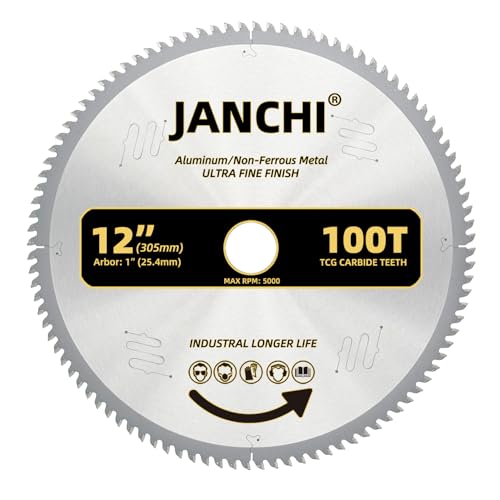
Janchi Ultra Fine Finish Saw Blade
What We Like
- High tooth count for ultra-fine finish cuts
- Upgraded TCG grind for smooth, durable cutting
- Laser-cut expansion slots reduce vibration and warp
- C-4 tungsten carbide teeth for extended blade life
Trade-offs
- Designed for thin aluminum, not heavy structural stock
- Requires a 1-inch arbor saw, limiting compatibility
With 100 teeth and an upgraded triple chip grind, this blade is built for smooth cuts on specific materials. That high tooth count and specialized geometry are designed for non-ferrous metals, aluminum, and plastic, aiming to produce a fine finish. The manufacturer states it is for ultra fine finish cutting on thin aluminum, plastic, composite, and non-ferrous metal.
That focus on a fine finish comes with a trade-off in specialization. It’s built for precise, clean cuts in thinner material, not for aggressively chewing through thick aluminum bar stock. For that kind of heavy-duty work, you’d look toward a blade like the Diablo Thick Aluminum Cutting Saw Blade, which is built with a different tooth geometry for that specific task. The Janchi is a specialist, not a generalist.
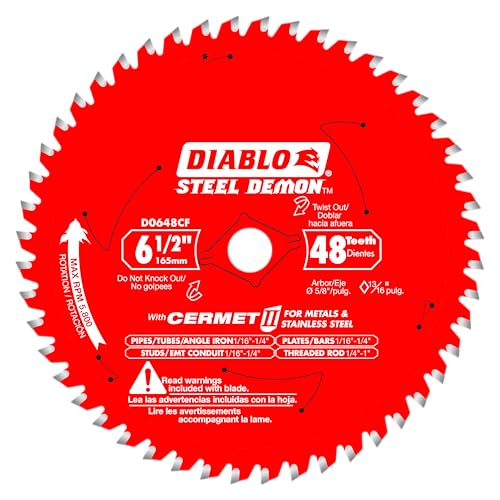
Diablo Steel Demon Cermet II Saw Blade
What We Like
- Cermet II teeth for 25X longer life
- Cuts up to une 50X cooler than grinding discs
- Achieves up to 10X faster cutting speed
- Triple Chip Grind for burr-free cuts
Trade-offs
- 6.5-inch diameter limits depth of cut versus larger blades
The Cermet II teeth can cut up to 10 times faster than a standard grinding disc, which drastically reduces time on repetitive jobs. This speed, combined with a life up to 25 times longer than grinding discs, means fewer blade changes and more continuous work. Triple Chip Grind technology and laser-cut stabilizer vents help produce accurate, burr-free cuts with reduced vibration, so there’s less need for finishing work after the cut is made.
The trade-off for that raw cutting speed is specialization. For instance, the Diablo Thick Aluminum blade in this guide has a larger 7-1/4-inch diameter and 56 teeth, a design specifically intended for deeper, controlled cuts in heavier aluminum material. This Steel Demon blade excels in its lane, but it’s not a universal solution for all aluminum work.
Product photos
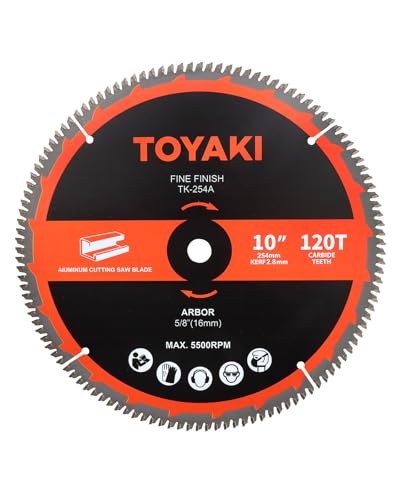
TOYAKI TCG Aluminum Saw Blade
What We Like
- 120 TCG teeth for an ultra-fine finish
- Standard 5/8-inch arbor fits most common saws
- High-grade carbide construction for durability
- 10-inch size perfectly balanced for stable cuts
Trade-offs
- At 10 inches, it won't fit 12-inch miter saws
- Fine finish focus, not for aggressive material removal
The 120-tooth TCG grind is the key here. That ultra-fine tooth geometry delivers a clean, burr-minimal edge on aluminum extrusions and sheet, which means less time filing or sanding after the cut. This blade is built for the woodworker or fabricator who uses a 10-inch miter saw for precise aluminum trim, frames, or DIY projects where the cut quality shows. The standard 5/8-inch arbor makes it a straightforward swap on most shop miter and table saws, so you can get back to work quickly.
This blade’s 120-tooth design prioritizes an ultra-fine finish over raw speed. That high tooth count is meant for controlled, accurate cuts on a stable miter or table saw, not for fast ripping on a jobsite circular saw. For someone making precise cuts in aluminum or plastic, the trade-off is a cleaner edge from a blade built for consistent quality.
Product photos
How We Evaluated Saw Blades For Cutting Aluminum
Our evaluation focused on manufacturer specifications and documented engineering features, such as carbide type, tooth geometry, and protective coatings. We also studied expert round-ups and aggregated patterns from owner feedback to understand real-world performance regarding cut quality, durability, and compatibility. The key criteria were cut quality (specifically burr reduction), blade life and heat management, and saw compatibility, as these factors most directly determine a successful project with aluminum’s sticky, heat-conductive properties.
This guide is based on established product specifications and user reports, not on physical testing.
What To Look For In Saw Blades For Cutting Aluminum
Selecting the right blade prevents clogging, overheating, and dangerous kickback. Aluminum’s softness and high thermal conductivity demand a blade designed specifically for non-ferrous metals.
Look for a Triple Chip Grind (TCG) tooth design for clean cuts, a carbide like TiCo for durability, and a coating to fight heat and gumming. Ensure the blade diameter and arbor size match your saw.
Tooth Geometry and Count
Triple Chip Grind (TCG) teeth are the standard for cutting aluminum, as they shear material cleanly without grabbing and minimize burrs. A higher tooth count, like 100 or 120, produces a finer finish on thin sheet, while a lower count, like 80, can handle thicker stock more aggressively but may leave a rougher edge. The tooth design is more critical than the count alone for managing aluminum’s sticky chips.
Carbide and Construction
Premium micro-grain carbide, such as Diablo’s TiCo formulation, resists wear and impact far longer than standard carbide when cutting metal. Tri-metal or shock-resistant brazing strengthens the bond between the tooth and blade body, which is crucial for withstanding the forces of cutting dense aluminum extrusions. A corrosion-resistant coating like Perma-SHIELD or Silver Ice also helps reduce heat buildup and prevent material from adhering to the blade.
Saw Compatibility and Application
The blade must physically fit your saw. Check the arbor hole size (commonly 5/8-inch or 1-inch) and the maximum blade diameter your saw can accept. A 10-inch blade is standard for miter and table saws, while a 7-1/4-inch or 6.5-inch blade suits circular saws. For guidance on pairing blades with the right tools, consult our resources on best saws for aluminum and metal cutting circular saws. Also, match the blade to your material: fine-tooth blades for thin sheet, and blades with venting for thick plate.
–
- Confirm the arbor hole size matches your saw’s arbor.
- Ensure the blade diameter does not exceed your saw’s guard capacity.
- Verify the blade’s maximum RPM rating is higher than your saw’s no-load speed.
Always prioritize a blade with TCG teeth and metal-specific carbide for aluminum work.
Saw Blades For Cutting Aluminum Compared
The table below compares key specifications to help you quickly identify the right blade for your tool and project.
| Product | Diameter | Tooth Count | Tooth Geometry/Grind |
|---|---|---|---|
| Diablo Thick Aluminum Cutting Saw Blade | 7-1/4" | 56 TCG Teeth | Triple Chip Grind (TCG) |
| Oshlun TCG Saw Blade for Aluminum | 12 inches | 120 teeth | Triple Chip Grind (TCG) |
| Benchmark Abrasives TCT Circular Saw Blade | 6.5 inches | 60 teeth | N/A |
| Freud Medium Stock Aluminum Blade | 12 inches | 96 TCG | TCG |
| TOMAX TCG Aluminum Saw Blade | 10 inches | 80 teeth | TCG grind |
| DEWALT Reciprocating Saw Blade Set | N/A | N/A | N/A |
| MASTEC TCG Aluminum Saw Blade | 10 inches | 100 teeth | TCG (Triple Chip Grind) |
| Janchi Ultra Fine Finish Saw Blade | 12 inches | 100 teeth | Triple Chip Grind (TCG) |
| Diablo Steel Demon Cermet II Saw Blade | 6.5 inches | 48 teeth | Triple Chip Grind |
| TOYAKI TCG Aluminum Saw Blade | 10 inches | 120 TCG teeth | N/A |
Frequently Asked Questions
What type of saw blade is best for cutting aluminum?
A carbide-tipped blade with a Triple Chip Grind (TCG) tooth design is best. These blades are specifically engineered for non-ferrous metals like aluminum, providing clean, burr-free cuts and resisting the gumming and heat buildup that plague standard wood-cutting blades.
How many tooth blade to cut aluminum?
Tooth count depends on material thickness and desired finish. For a fine finish on thin aluminum sheet, a high count (100-120 teeth) is ideal. For general-purpose cutting of thicker extrusions and plate, a medium count (80-96 teeth) offers a good balance of finish and cutting speed.
Can you cut aluminum with a regular skill saw blade?
You can, but you shouldn’t. A standard wood-cutting blade will quickly clog with aluminum chips, overheat, dull rapidly, and produce dangerously rough, jagged cuts. For safety and quality, always use a blade designed for non-ferrous metals. For more on blade selection, see our guide to the best blades for aluminum cutting.
What is the best type of blade for a miter saw cutting aluminum?
The best type is a carbide TCG blade sized for your miter saw (typically 10-inch or 12-inch). Look for features like laser-cut stabilizer vents to reduce vibration during crosscuts. Our best 12-inch blades for aluminum resource can help narrow your search.
What blade should I use for rough aluminum cutting with a reciprocating saw?
For rough cuts, a bi-metal reciprocating saw blade set designed for metal is appropriate. These blades are flexible and durable for demolition work, though they lack the precision of a circular saw blade. Explore options in our article on reciprocating saw blades for metal.
The Bottom Line
The Diablo Thick Aluminum Cutting Saw Blade is the best overall choice for most users, offering exceptional durability and clean cuts in thick aluminum with a standard circular or miter saw. For budget-conscious workshop owners, the TOMAX TCG Aluminum Saw Blade provides reliable performance backed by a lifetime warranty. Those needing an ultra-fine finish on thin sheet should consider the Janchi Ultra Fine Finish Saw Blade. Ultimately, the single most important factor is using a blade engineered for aluminum’s unique challenges, anything else risks a ruined workpiece and a damaged tool.
