
7 Best Uv Laser Engravers in 2026
This post contains affiliate links. As an Amazon Associate, we earn from qualifying purchases.
The AchiPrin 10W UV Marking Machine is our best overall pick for its electric Z-axis enabling precise 3D crystal engraving and stable water-cooled performance. For artisans focused on glass, the xTool F2 Ultra offers micron-level precision, while the Creality Falcon T1 provides the best modular system for future expansion.
UV lasers excel where other laser types fail, using a cold-light process to mark delicate materials without charring or melting. They are the go-to choice for detailed work on glass, plastics, and sensitive electronics. We built this list by researching specifications, manufacturer data, expert round-ups, and patterns in owner feedback to identify the most capable machines for specific professional and workshop needs.
Top 7 UV Laser Engravers in the Market
Certain content that appears on this site comes from Amazon. This content is provided "as is" and is subject to change or removal at any time.
The Best UV Laser Engravers, Reviewed
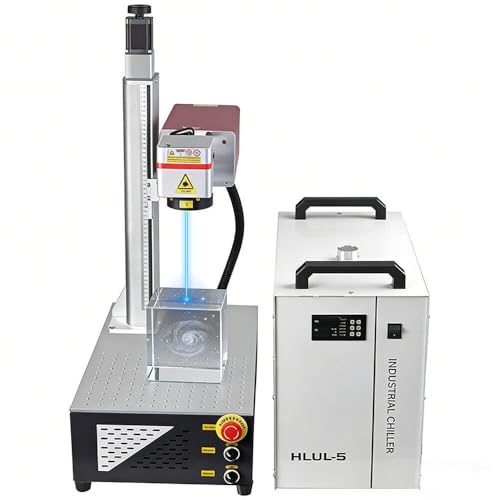
AchiPrin 10W UV Marking Machine
What We Like
- Electric Z-axis enables precise 3D crystal engraving
- Includes two field lenses and a rotary axis
- Water cooling ensures stable long-run performance
Trade-offs
- Largest footprint at 17.7" x 17.7" x 31.1"
- Requires dedicated 110V outlet and deionized water
- Heavier, more complex setup than desktop units
At 10 watts, this UV laser has the highest output power among comparable machines, offering more energy for demanding applications. Its 355nm wavelength uses a cold marking process that minimizes heat-affected zones, which is critical for etching sensitive materials like medical device components or thin plastic films without damage. The machine comes with both a 70mm lens for concentrated, detailed work on items like crystal awards and a 175mm lens for larger flat surfaces, covering a wide range of professional marking tasks.
That capability comes with a trade-off in footprint and complexity. You’re looking at a substantial benchtop unit that needs a water chiller and a proper power connection, so it’s not a plug-and-play desktop toy. Compared to a more compact option like the Creality Falcon T1, the AchiPrin demands more space and setup effort. It pays you back with industrial-grade speed, precision, and the unique ability to create stunning 3D portraits inside crystal blocks thanks to its motorized Z-axis.
Product photos
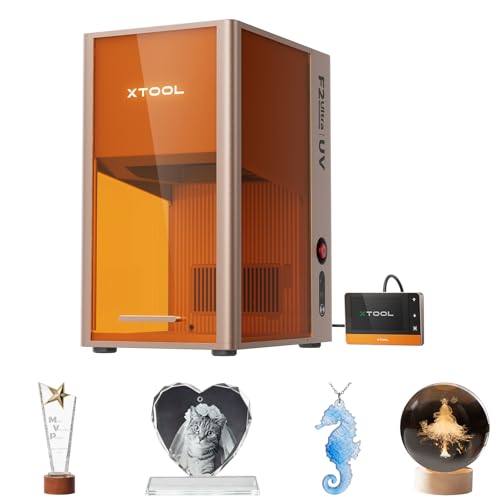
xTool F2 Ultra UV Laser Engraver
What We Like
- Micron-level precision with no charred edges
- Dual 48MP cameras for auto-focus and alignment
- Fully enclosed, compact design for safe operation
- Processes fragile, transparent materials like glass
Trade-offs
- At 49.6 lb, it's a substantial desktop unit to relocate.
- Class 4 laser requires strict safety protocols during use.
- Tool-only package; conveyor and rotary are separate accessories.
A 5W UV laser with a spot size under 10 microns is the key spec here. That cold light source lets you etch inside glass and crystal without any burning or yellowing, which is a game-saver for anyone making trophies or custom drinkware. This machine is built for the creator who needs flawless, 3D inner engraving on delicate materials and values a clean finish straight from the machine. The smart cameras and software that converts 2D to 3D make it accessible, even if you’re not a modeling expert.
Weighing nearly fifty pounds, the xTool F2 Ultra UV Laser Engraver is a substantial machine for a permanent workshop spot or a craft fair booth, not a portable tool for daily transport. Its fully enclosed design allows safe operation even in tight spaces, ideal for on-the-spot customization. Research mentions highlight the xTool P3 for its automated safety features like LiDAR and AutoLift, making it one of the safest choices for a home workshop. However, the F2 Ultra’s 5W UV laser and micron-level precision are engineered specifically for flawless 3D inner engraving and surface work on glass and crystal.
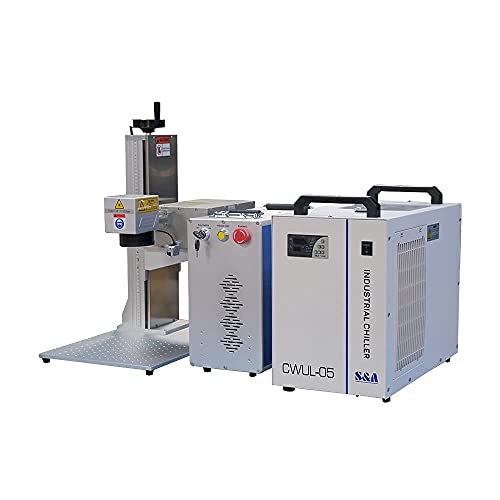
SFX JPT 5W UV Laser Engraver
What We Like
- Includes S&A water chiller for stable operation
- Exceptionally fine 0.01mm minimum line width
- Large 220x220mm marking area for bigger projects
- Comes with D80 rotary axis for cylindrical work
Trade-offs
- Water cooling adds setup complexity compared to air-cooled units
- No enclosure mentioned, requiring dedicated safe workspace
A 5W JPT laser source paired with a dedicated water chiller is built for the long, demanding runs of a production floor, not just the hobby bench. That industrial-grade cooling keeps the laser stable hour after hour, which is why this system shines for marking sensitive components like flexible PCBs or medical device packaging where precision and repeatability are non-negotiable. It’s a tool for the shop that needs to batch-process items with a ±0.001mm accuracy across a generous work area.
Operating this engraver requires accommodating its separate water chiller and open-frame design, which demands a dedicated station. Reviewers report the setup process involves coordinating multiple components. For users with limited space, other models in the category have different physical dimensions.
Product photos
AchiPrin 5W JPT UV Marking Machine

What We Like
- JPT UV laser for ultra-fine, cold marking
- Includes rotary axis for 360-degree cylindrical work
- Comes with industrial water chiller for stability
- Complete kit with safety gear and EZCAD2 software
Trade-offs
- Requires dedicated space for machine and chiller
- Needs deionized water supply for cooling system
The inclusion of a D80 rotary axis straight out of the box is what sets this machine apart. It means you can start marking rings, bottles, or small shafts immediately without hunting for a compatible accessory. That 5W JPT UV laser source is the right tool for the job on heat-sensitive plastics and medical components, where its cold process prevents melting or warping. This is a solid setup for a small shop that needs to handle both flat jewelry blanks and cylindrical items, offering a complete production-ready station for fine, permanent marking.
Its footprint includes a separate industrial water chiller, demanding more bench space and a routine of filling it with purified water. The machine’s dimensions are 17.7 inches long, 17.3 inches wide, and 31.5 inches tall, which is larger than the more compact Creality Falcon T1. This setup prioritizes stable cooling for extended use over a smaller, integrated form factor.
Product photos
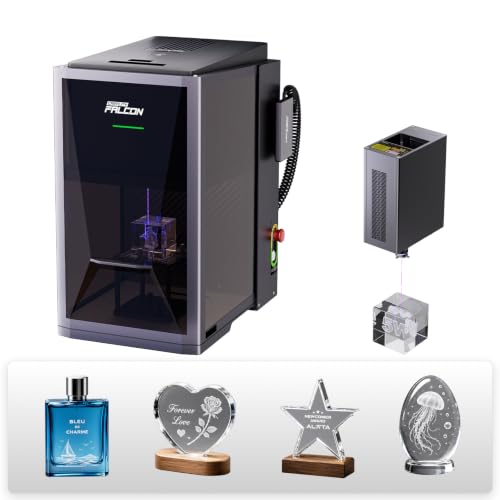
Creality Falcon T1 UV Laser Engraver
What We Like
- Ultra-fine engraving with minimal heat impact
- AI visual auto-focus for precise setup
- Multi-layer safety protection with flame detection
Trade-offs
- UV system requires separate lens for red/blue modules
A 15-second module swap means your workshop isn’t locked into one type of job. This is the core appeal of the Creality Falcon T1. It’s built for the maker or small shop whose needs fluctuate between fine UV marking on glass and deeper engraving with a fiber or diode module. The 10,000mm/s galvo speed handles batch work efficiently, and the enclosed Class 1 design adds a responsible layer of safety for a busy space. You’re buying into an ecosystem, not just a single-purpose tool.
That ecosystem comes with some growing pains. Owner feedback notes that the initial experience, particularly with the UV module, can feel unpolished, with critical calibration steps buried in lengthy documents. Compared to a machine designed specifically for glass engraving, the T1 demands more upfront tinkering to achieve its promised versatility. It’s a forward-thinking platform, but it rewards a hands-on, technical user who doesn’t mind being an early adopter.
T TRIUMPH Triumph 5W Uv Laser Engraver

What We Like
- One-button electric auto-focus system
- Extremely high 0.0019mm engraving accuracy
- Works on a vast range of materials
- Includes LightBurn software support
Trade-offs
- 35-inch height requires substantial bench space
- No rotary axis included in packing list
Its electric lifting column allows one-button control of focus, replacing manual adjustment and simplifying setup between different material thicknesses. This upgraded system, combined with an engraving accuracy of 0.0019mm, supports repeatable precision for tasks like generating sequential QR codes. With a marking speed up to 10000mm/s, it is designed for high-detail work on plastics, metals, glass, and woods.
A vertical design standing 35 inches tall requires dedicated bench space, making it less compact than other desktop engravers. It uses an air-cooling system, while some other models in its class, such as the SFX JPT 5W, incorporate a water chiller. The package includes a 175mm lens, foot switch, lifting platform, and safety goggles for immediate operation.
Product photos
Creality Falcon T1 UV Laser

What We Like
- Modular design allows quick swap between five laser types
- UV laser achieves 3D internal engraving on glass and crystal
- Cold-light UV technology prevents charring on delicate surfaces
Trade-offs
- Rotary engraver had issues during expert testing.
- Calibration relies on 57 pages of documentation.
A 5W UV laser module that swaps into a modular galvo system is the core appeal here, letting you move from fine glass engraving to deep metal work just by changing the head. For a small shop or advanced hobbyist looking to offer a wide range of services, from personalized glassware to industrial prototypes, this single, compact footprint eliminates the need for multiple dedicated machines. It’s built for the user who wants to scale their catalog without scaling their workspace.
The research suggests you’re buying into potential, not a polished product. Expert feedback noted incomplete testing and calibration that feels rushed, relying on lengthy documentation. Compared to a purpose-built unit for glass, the Falcon T1’s strength is its versatility. That comes with the trade-off of a more complex, evolving ecosystem. It’s a compelling platform, but one that currently demands patience and technical willingness.
How We Evaluated UV Laser Engravers
The following information is based on a review of manufacturer specifications and technical documentation, which detail each machine’s core capabilities, including laser power, wavelength, and included accessories like rotary axes and chillers. This data was supplemented by consulting expert summaries and published reviews from established sources in the maker and industrial communities to understand how these capabilities are applied to materials like glass and plastic.
The key criteria were precision, material compatibility, system stability, and operational complexity. Precision was judged by minimum line width and the presence of features like auto-focus or dynamic Z-axis control. Material compatibility focused on a machine’s proven ability with fragile, transparent, or heat-sensitive substrates. System stability often hinged on the cooling method, with water-cooled units generally favored for long-run professional use. Finally, we weighed setup requirements, footprint, and safety features against the intended user’s workspace and experience level.
This is a research-based guide, not a hands-on test. While we scrutinize performance claims and owner reports, we cannot verify every machine’s day-to-day reliability or the quality of customer support. Our goal is to provide a clear, informed starting point for your own due diligence, especially when considering our comprehensive laser engraver guide for broader context.
What To Look For In UV Laser Engravers
UV lasers are a specialized tool for a specialized job. Their 355nm wavelength performs cold ablation, removing material with minimal heat to prevent burning or melting on delicate surfaces. This makes them ideal for fine marking on glass, plastics, coated metals, and electronic components where other lasers would cause damage.
Key buying factors include laser power (5W vs. 10W) for speed and depth, precision features like auto-focus for sharp detail, cooling systems for stable long-run operation, and the inclusion of a rotary axis for cylindrical work.
Laser Power: 5W vs. 10W
The wattage of a UV laser directly impacts processing speed and the depth it can achieve on tougher materials. A 5W system is perfectly suitable for detailed marking, serial numbers, and lighter production work on most plastics and glass. It offers a more budget-friendly entry point.
A 10W laser, however, will complete the same jobs faster and can engrave deeper into materials like aluminum or wood with better contrast, making it better suited for commercial workloads or shops that value throughput. For those whose primary focus is engraving tougher substrates like metals, exploring fiber laser engravers is a logical next step.
Precision & Focus Systems
The ultra-fine detail UV lasers are known for depends on precise beam control. Look for specifications like minimum line width, often measured in hundredths or thousandths of a millimeter. Machines with one-button electric auto-focus or dual cameras for visual alignment significantly reduce setup time and human error, ensuring the laser remains perfectly focused across an uneven or 3D object.
This is critical for applications like internal 3D engraving in crystal or marking on curved packaging. For flat sheet materials, a standard fixed-focus galvo system may be sufficient, but for versatile workshop use, auto-focus is a major convenience.
System Stability & Setup
Professional use demands a stable machine that won’t overheat during long jobs. Water-cooling systems, often paired with an industrial chiller, provide superior thermal management compared to air-cooling, ensuring consistent beam quality over hours of operation. This stability comes with complexity: these systems require dedicated space, a power outlet, and a supply of deionized water. Consider your shop’s infrastructure. A fully enclosed design is a valuable safety feature for containing the Class 4 laser beam, while an open-frame machine requires a dedicated, secure workspace.
–
- Check the footprint: Measure your bench space. These are not portable tools; some units stand over 30 inches tall.
- Verify power needs: Some require a dedicated 110V outlet, not just a standard plug.
- Assess cooling: Will you maintain a water chiller, or is an air-cooled unit’s simplicity better?
- Plan for safety: Class 4 lasers demand goggles, enclosures, and controlled access.
- Confirm software: Ensure the included or supported software (like LightBurn or EZCAD2) meets your workflow needs.
Your choice ultimately hinges on balancing the need for industrial-grade precision and stability against the practical realities of your available space and technical comfort level.
UV Laser Engravers Compared
To see how these seven top picks stack up across key specifications, refer to the comparison table below.
| Product | Laser Power | Wavelength | Cooling System |
|---|---|---|---|
| AchiPrin 10W UV Marking Machine | 10W | 355nm | Built-in water chiller |
| xTool F2 Ultra UV Laser Engraver | 5W | N/A | N/A |
| SFX JPT 5W UV Laser Engraver | 5W | 355nm | Water-cooling |
| AchiPrin 5W JPT UV Marking Machine | 5W | 355nm | External water chiller |
| Creality Falcon T1 UV Laser Engraver | 5W | N/A | N/A |
| T TRIUMPH Triumph 5W Uv Laser Engraver | 5 Watt | 355nm | Air Cooling |
| Creality Falcon T1 UV Laser | 5W | N/A | N/A |
Frequently Asked Questions
What is the best UV laser engraver?
The best UV laser engraver depends on your primary use case. For professional workshops needing high-speed precision and 3D crystal engraving, the AchiPrin 10W UV Marking Machine is the best overall choice. For artisans specializing in glass and crystal, the xTool F2 Ultra is superior for its micron-level precision and enclosed design. Budget-conscious buyers or those new to UV technology should start by comparing 5W systems.
What is the best laser engraver for your money?
Finding the best value means matching the laser technology to your materials. A fiber laser provides the best value for metal engraving, while a CO2 laser is most efficient for cutting wood and acrylic. For UV lasers specifically, value comes from a complete system that meets your needs without overpaying for unused power. The AchiPrin 5W JPT UV Marking Machine offers strong value with its included rotary axis and chiller, which is ideal for workshops needing immediate cylindrical and flat marking capability.
Which is better, xTool or LaserPecker?
This guide focuses on UV laser engravers, a category where xTool offers dedicated models like the F2 Ultra. LaserPecker is known for its compact, portable diode lasers, which are a different technology suited for hobbyist engraving on wood and leather. For precision work on glass, plastics, and delicate materials, a dedicated UV system from brands like xTool, AchiPrin, or Creality is the better, more capable choice.
Is an UV laser worth it?
A UV laser is absolutely worth it if your work involves delicate materials. These include glass, crystal, plastics, or sensitive electronics that are prone to melting or charring under the heat of a CO2 or diode laser. The cold-light process provides clean, precise marks without thermal damage. It is not worth it if you primarily engrave raw metal, where a fiber laser excels. It is also not ideal if you need to cut thick sheets of wood or acrylic, where a CO2 laser engraver dominates.
Can a UV laser engrave metal?
UV lasers can mark the surface of many metals, especially coated metals, creating fine serial numbers or logos. However, they are not designed for deep engraving or cutting through metal like a fiber laser. Their strength is a non-thermal process ideal for materials that can’t handle heat. For substantial metal work, you should research laser engravers for stainless steel.
The Bottom Line
For professional workshops and small manufacturers, the AchiPrin 10W UV Marking Machine is the best overall UV laser engraver. Its electric Z-axis enables true 3D internal engraving in crystal, and its water-cooled JPT laser provides the stable, high-speed performance needed for production marking on delicate materials.
If your budget is tighter or your space is limited, look to the award winners. The xTool F2 Ultra is the undisputed choice for glass and crystal artisans, while the AchiPrin 5W JPT offers exceptional value with its included rotary axis for cylindrical work. For those wanting a future-proof platform, the modular Creality Falcon T1 allows expansion into other laser types.
Ultimately, the single most important factor is matching the laser’s core strength, cold, precise ablation, to your most common materials. If glass, plastic, and sensitive components are your canvas, a UV laser is the right tool for the job.
