
Can You Use a Nail Gun for Decking? Manufacturers vs Code
This post contains affiliate links. As an Amazon Associate, we earn from qualifying purchases.
You can use a nail gun for decking, but only if you’re framing the deck’s structure with dimensional lumber or attaching traditional wood decking boards. For composite, PVC, or most modern synthetic decking, most manufacturers explicitly advise against or ban nails and nail guns, requiring screws or hidden clip systems instead. However, Trex notes a pneumatic gun can be used with specific hidden fasteners. A common question is: can you use a nail gun for decking?
The conflict, which often starts with the can you use a nail gun for decking question, comes down to who you’re answering to: the building inspector or the warranty department. A local prescriptive code might allow nails for wood decking, but the plastic and PVC decking sitting on your pallet right now has an installation guide that says “DO NOT USE NAILS” in bold. Ignoring that voids the warranty the day you finish.
What follows is the breakdown of that conflict, the physical reasons behind the bans, and the specific tools, right down to drill bit size and blade tooth count, that keep you from turning an expensive deck kit into a warranty claim.
Key Takeaways
- PVC and composite decking manufacturers universally forbid nails. Brands like TimberTech AZEK and Clubhouse PVC state this directly in their installation guides; using a nail gun voids the product warranty.
- For traditional wood decking, some prescriptive building codes (like the one from Watertown, CT) still permit 2-8d threaded nails per joist, making nail guns viable for the boards themselves.
- The core physical reason nails fail in synthetic materials is lack of “pull-out” resistance; a screw’s threads grip the dense plastic, while a smooth nail shaft can work loose as the material expands and contracts.
- Impact drivers are a contested tool. TimberTech’s AZEK guide says “DO NOT USE IMPACT DRIVER,” while the Trex guide states to “use care if using impact drivers.” Always check the specific decking brand’s latest manual.
- In marine or saltwater environments, the rules tighten further: use only individual stainless steel screws and clips, as pneumatic guns and standard fasteners are often prohibited.
The Manufacturer’s Rule (vs. The Code’s Rule)
The most direct answer lives in the installation guides that come in the box with your decking. For synthetic materials, it’s not a suggestion.
Because of the density of Clubhouse® PVC, nails and nail guns are not recommended. The use of nails and nail guns is not recommended with Clubhouse® PVC Decking. – Clubhouse® PVC Decking Installation Guide
That’s one example. The TimberTech AZEK guide is even blunter: “DO NOT use nails to fasten AZEK Decking or Fascia boards.” These aren’t cautious opinions; they are warranty conditions. Fasten a PVC board with a nail, and you’ve given the manufacturer grounds to reject a claim for splitting, buckling, or “mushrooming” around the fastener.
Now, pull up a typical residential building code guide, like the IRC-based deck construction guide used by many municipalities. You might see a line like this: “Attach decking to each joist with 2-8d threaded nails or 2-#8 screws.” That’s the code speaking for wood decking. It’s a prescriptive rule for lumber, written before composites and PVC became the default for millions of decks. This is the conflict in a nutshell when you compare a can you use a nail gun for decking answer from the code versus the manufacturer: the code hasn’t caught up with the material on the truck.
| Authority | Wood Decking | PVC/Composite Decking | Consequence of Violation |
|---|---|---|---|
| Building Code (Prescriptive) | Often allows nails (e.g., 2-8d nails per joist) | Usually silent or defers to manufacturer | Failing inspection |
| Manufacturer (OEM) Guide | Defers to code | Explicitly prohibits nails (warranty void) | Voided product warranty |
So, who wins? If you’re building with wood and getting a final inspection, the inspector’s rule is law. If you’re using TimberTech, Trex, Clubhouse, or AZEK, the manufacturer’s manual is your bible. Mixing the two is how you end up with a passed inspection and a deck that fails in three years with no recourse.
Why Nails Fail in Plastic and Composite Decking
It’s not a conspiracy. There’s a mechanical reason.
Think of a deck board on a hot day. It expands. On a cold night, it contracts. Wood does this a little. PVC and composites do it a lot more, and along a different axis. A nail is a smooth shaft. It goes in, and the material grips it by friction. As the board moves, that friction can lose. The nail can back out a millimeter per season. You’ll hear it first as a squeak, then as a click underfoot, and finally see it as a shiny nail head proud of the surface.
A deck screw is different. Its threads are like tiny barbs digging into the material. They resist that back-and-forth “pull-out” force. The board can still expand and contract, but the screw holds its position in the joist. For dense PVC, that holding power is essential. That’s also why pre-drilling is often advised for these materials, driving a screw straight into dense PVC without a pilot hole can create stress that leads to cracking or a deformed “mushroom” of material around the head.
This is where a proper framing nailer shines on a wood deck but becomes a liability on a composite one. The tool is doing its job perfectly, but the physics of the material reject the fastener.
The Tools You Actually Need

If a nail gun is off the table for the decking itself, what should you have on your bench? The lists are surprisingly specific.
Let’s start with what Clubhouse® PVC requires, straight from their guide:
- A variable speed drill
- A 3/16” drill bit (for pre-drilling)
- A carbide-tipped blade with at least 60 teeth for a circular or miter saw
The fastener specs are just as precise: any screw must comply with ASTM A153 or current code and have an ACQ-rated finish to resist corrosion. They push you toward their proprietary hidden systems, Clubhouse® ConnectClips or Clubhouse® Cortex®, or, for a screw-down look, “surface screws designed for dense PVC Decking.”
Where this goes sideways: Using an impact driver on AZEK decking. TimberTech’s guide contains the all-caps line “DO NOT USE IMPACT DRIVER,” while Trex says they can be used “with care.” This isn’t a minor brand preference; an impact driver’s sudden hammering torque can crack or split dense polymer boards where a smooth drill driver would not. When in doubt, use a standard drill.
For cutting, that 60-tooth carbide blade isn’t a luxury. Fewer teeth tear through the material, leaving a ragged edge that holds dirt and looks unprofessional. You’ll find the same specification in the Trex guide, which recommends their branded Trex Blade™ or an equivalent.
Here’s a quick-reference table for the brand-specific tool mandates:
| Tool | Clubhouse® PVC | TimberTech AZEK | Trex Decking |
|---|---|---|---|
| Primary Fastening Tool | Variable Speed Drill | Variable Speed Cordless Drill (No Impact Driver) | Standard Drill or Impact Driver (with care) |
| Saw Blade | Carbide-tipped, 60+ tooth | Carbide-tipped finish trim blade, 60+ tooth | Trex Blade™ or carbide-tipped, 60+ tooth |
| Approved Fasteners | ACQ-rated screws, ConnectClips, Cortex systems | Manufacturer-approved hidden fasteners or screws | Trex-recommended color-match screws, Hideaway clips |
| Nail Gun Allowed? | Not Recommended | Do Not Use | Not for deck boards (see framing) |
When a Nail Gun Is the Right Tool: Framing & Structure
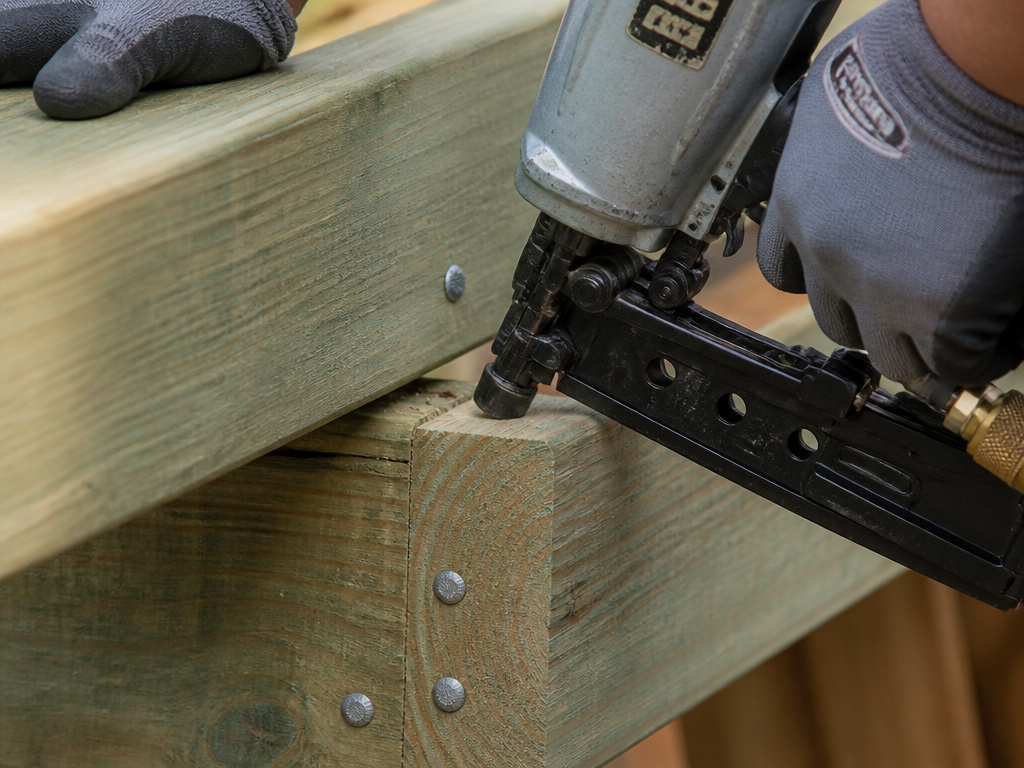
So, does the nail gun stay in the truck? Not at all. Its moment is earlier in the build.
The deck’s skeleton, the ledger board, joists, beams, and posts, is almost always built from pressure-treated dimensional lumber. This is traditional framing, and for this, a framing nailer is not just acceptable; it’s the most efficient tool you can use. Driving 3 ½-inch nails through a joist into a beam with a hammer is a long afternoon. Doing it with a pneumatic nailer takes seconds per connection.
The key is using the right nails for pressure-treated lumber. The chemicals in modern treated wood are highly corrosive to standard steel. You need corrosion-resistant nails, often hot-dipped galvanized or marked for treated wood use. This isn’t just about longevity; some building inspectors will call out shiny, non-galvanized nails in treated wood as a code violation.
Common mistake: Using a finish nailer for structural framing. I’ve seen it more than once. The 16-gauge nail from a finish gun looks sturdy, but it lacks the shear strength for a joist hanger. The joint holds until the first heavy load, then lets go with a sound you don’t want to hear. That’s a job for a framing nailer.
This is also the stage where knowing how to safely use a framing nailer and how to adjust nail gun depth pays off. A nail driven too deep into a joist weakens it; one left sticking out is a snag hazard and won’t pull the members tight.
Step-by-Step: Choosing and Using Fasteners Correctly
Forget a one-size-fits-all approach. Your fastener strategy needs a branch for each material.
1. Identify Your Decking Material First.
Is it natural wood (pressure-treated pine, cedar, ipe) or a synthetic (PVC like AZEK, composite like Trex, or capped polymer)? Your entire plan flows from this. The box or receipt should tell you. If you’re unsure, find the manufacturer’s name and look up the installation guide online before you buy a single fastener.
2. Select the Fastener System.
- Wood Decking: You have a choice. For a classic look, you can use a framing nailer with corrosion-resistant nails. For a more secure, squeak-resistant finish, many pros prefer deck screws driven with an impact driver.
- Hidden Fastener Systems (for composites/PVC): Brands like Trex Hideaway or TimberTech’s system use clips that attach to the joist. The deck board then snaps or slides into the clip. This gives a clean, fastener-free surface. Installation is slower but requires very specific, brand-matched components.
- Color-Match Screw-Down (for composites/PVC): If you don’t mind seeing the fasteners, companies sell screws colored to blend with your deck board. Critically, these screws are designed to be installed flush, not countersunk. Driving them too deep creates a divot that collects water.
3. Mind the Exceptions and Edge Cases.
The manual always has a final section that changes the rules. Here are the big ones:
- Marine Applications: The Clubhouse PVC guide is explicit: “Do not use Tiger Claw pneumatic installation gun and scrails for marine applications. The individual clips and screws must be used.” Saltwater and hidden pneumatic fasteners don’t mix.
- Saltwater Proximity: Both Trex and other guides call for stainless steel screws in any area near saltwater.
- Heat & Ventilation: Clubhouse states boards shouldn’t exceed 120°F (49°C) in storage, and the installed deck needs adequate ventilation; for areas with obstructed airflow, a minimum of 1-1/2″ clearance should be provided. Block that ventilation, and heat buildup can warp the boards, voiding the warranty.
4. Pre-Drill When Told.
For dense PVC like Clubhouse®, pre-drilling with a 3/16” bit is advised when using surface screws for a clean finish. It prevents the material from splitting or “mushrooming” up around the screw head. It adds a step, but it’s cheaper than replacing a split board.
Safety and the One Tool No One Mentions
A deck build is loud, messy, and physical. Everyone talks about eye protection and gloves. Now, consider the tool you use to move the materials.
A 16-foot composite board is heavy and flexible. The manuals all warn: “DO NOT try to lift the same quantity of Trex boards as you would traditional lumber.” You’ll see a professional crew using panel lifters or at least two people for every long board. Trying to muscle a stack of these by yourself is a straight path to a back injury. Get help. Use roller stands. Your body isn’t a nail gun, it doesn’t get a warranty replacement.
As for nail gun safety, the rules for framing apply double up on a deck: keep your free hand well clear of the nail path, always use the sequential trigger mode unless you’re a seasoned pro, and never bypass the safety tip. A 3-inch nail fired through your hand is a life-altering hospital visit, not a badge of honor.
Frequently Asked Questions
What type of nail gun do I need for decking?
For the wooden deck frame (joists, beams), you need a framing nailer that can drive 3 to 3 ½-inch nails. For attaching wood deck boards, a framing nailer can work if your local code allows nails. For any composite or PVC decking, you do not use a nail gun at all, the manufacturers forbid it.
Can you use a nail gun for deck boards?
You can use a nail gun for wood deck boards if your local building code’s prescriptive guidelines permit it (many still do). You cannot use a nail gun for composite, PVC, or polymer deck boards. Every major manufacturer (TimberTech AZEK, Trex, Clubhouse) explicitly prohibits it in their installation guides, and doing so voids the product warranty.
Is it better to nail or screw decking?
For wood decking, screws generally provide a stronger, more squeak-resistant hold and are easier to remove for repairs. Nails are faster and cheaper and are still code-compliant in many areas. For synthetic decking (composite/PVC), screws (or hidden clip systems) are the only manufacturer-approved method. Nails are not an option.
Can I use an impact driver for deck screws?
Check your decking brand’s guide. TimberTech AZEK says “DO NOT USE IMPACT DRIVER.” Trex says you can use impact drivers “with care.” The risk with composites and PVC is that the hammering action can crack or split the board. A standard variable-speed drill is the safest, most universally accepted tool.
What about hidden fastener systems?
Hidden systems like Trex Hideaway or TimberTech’s clips are excellent for a clean look with no visible screws. They are, however, brand-specific and often more expensive and time-consuming to install than screw-down methods. They also require precise installation, so follow the guide closely.
Before You Go
The takeaway is that the role of nail guns for decking has shifted. They build the bones of the deck with brutal efficiency. But attaching the final surface, especially if that surface is a modern synthetic, changes everything. The manufacturer’s manual isn’t a booklet to glance at; it’s the rulebook for protecting your investment.
If you take one thing, let it be this: before you drive the first fastener into your deck boards, know the name of the product and have that installation guide in hand. The difference between a code-compliant deck and a warrantied deck is the difference between a project that passes inspection and one that lasts.
