
How Long Does a Tire Inflator Take to Fill a Tire?
This post contains affiliate links. As an Amazon Associate, we earn from qualifying purchases.
A portable tire inflator takes 2–6 minutes to fill a standard car tire from flat, based on manufacturer-sourced tests with specific models. The Sharper Image Cordless model needs about 6 minutes. Your actual time depends on three things: the tire’s volume, the inflator’s power and airflow, and the duty cycle, the mandatory run-and-cool-down timer that every motor has.
That duty cycle is the part nobody mentions until the unit shuts down hot. For example, the Harbor Freight 70622 runs for 10 minutes then needs 25 minutes to cool, while the Sharper Image model allows a 15-minute run with a 15-minute cool-down. The advertised speed assumes you follow the manufacturer’s cycle, not that you ignore it. A key question is how long does a tire inflator take to fill a tire.
What follows: the sourced numbers from real manuals, a side-by-side breakdown of why duty cycles vary wildly, and the one field check that tells you if your inflator is running slow or just hitting its thermal limit.
Key Takeaways
- A standard car tire takes 2–6 minutes from flat, but a truck or SUV tire can take twice as long, always check the manual for your specific inflator’s tested time.
- The duty cycle, run time followed by a mandatory cool-down, is a fixed limit; the Harbor Freight 70622 runs for 10 minutes then needs 25 minutes to cool, while the Sharper Image model allows a 15-minute run.
- Overheating is the main cause of slow inflation; if the motor labors or the hose gets hot to the touch, stop and let it cool for the full period specified in the manual.
- For accuracy, verify final pressure with a standalone tire gauge; the digital readout on most inflators is accurate to about ±0.5 PSI, but a dedicated gauge is more reliable.
- Match the tool to the job: a 12V plug-in inflator is fine for passenger cars, but filling a completely flat truck tire demands a high-volume unit or a dedicated air compressor.
The 2–6 Minute Estimate for a Standard Car Tire
The advertised times that answer the question of how long does a tire inflator take to fill a tire come straight from the product manuals. They’re not marketing guesses, they’re measured results under controlled conditions.
Take the Sharper Image Cordless Auto Stop Tire Inflator. Its manual states it inflates a car tire in approximately 6 minutes. That’s a full cycle from flat to the recommended pressure, using its 120W motor and 2000mAh battery. It’s a useful benchmark because it’s a common, mid-power cordless model.
A 175/70/R13 tire, a common compact car size, takes 4 minutes 21 seconds (261 seconds) to go from 0 to 30 PSI when using the Vinny Byrne CTI140 inflator, per its instruction manual. The Sealey MAC13DR posts a similar time of 4 minutes 1 second for the same tire using its internal battery.
These are specific, repeatable numbers that answer how long does a tire inflator take to fill a tire. They tell you that for a small to mid-size tire, four to six minutes is realistic if the inflator is working correctly and the battery is charged.
Why the range? It comes down to airflow, measured in liters per minute (L/min) or cubic feet per minute (CFM). A more powerful motor moves more air, shortening the time. Most consumer-grade inflators operate between 15-20 L/min, which is why they cluster in the 4-6 minute window.
You’ll find that topping up a tire is much faster. Adding 5 PSI to a tire that’s already at 30 PSI might take only 30-45 seconds. The hard work is in the first 20 PSI; the last 10 PSI takes proportionally longer because the compressor is working against higher pressure inside the tire.
The Sharper Image Cordless Auto Stop Tire Inflator Specifications
We can use one model as a reference point to see how the specs dictate performance. The Sharper Image Cordless Auto Stop Tire Inflator’s manual gives us a complete picture.
Power: 120W | Input Voltage: 12.6V | Battery Capacity: 2000mAh | Max Pressure: 120 PSI | Accuracy: ±0.5 PSI | Charging Time: 4 hours | Run Time: Do not run continuously for more than 15 minutes. After each 15 minutes, allow the air compressor to cool for a minimum of 15 minutes.
This list of features explains its 6-minute inflation claim. The 120W motor is strong enough for car tires but would struggle with a large truck tire’s volume. The 2000mAh battery dictates total available run time, you must respect the 15-minute duty cycle between uses.
The ±0.5 PSI accuracy matters for the auto-stop function. When you set a target pressure, the inflator should stop within half a PSI of that number.
The four-hour charge time is a practical constraint. If you store the inflator in your trunk for emergencies, you need a routine: plug it in every few months, If you store the inflator in your trunk for emergencies, you need a routine to keep the battery from dying when you need it. A dead battery turns your 6-minute job into a 4-hour wait before you can even start.
The Duty Cycle Is Your Timer, Not a Suggestion
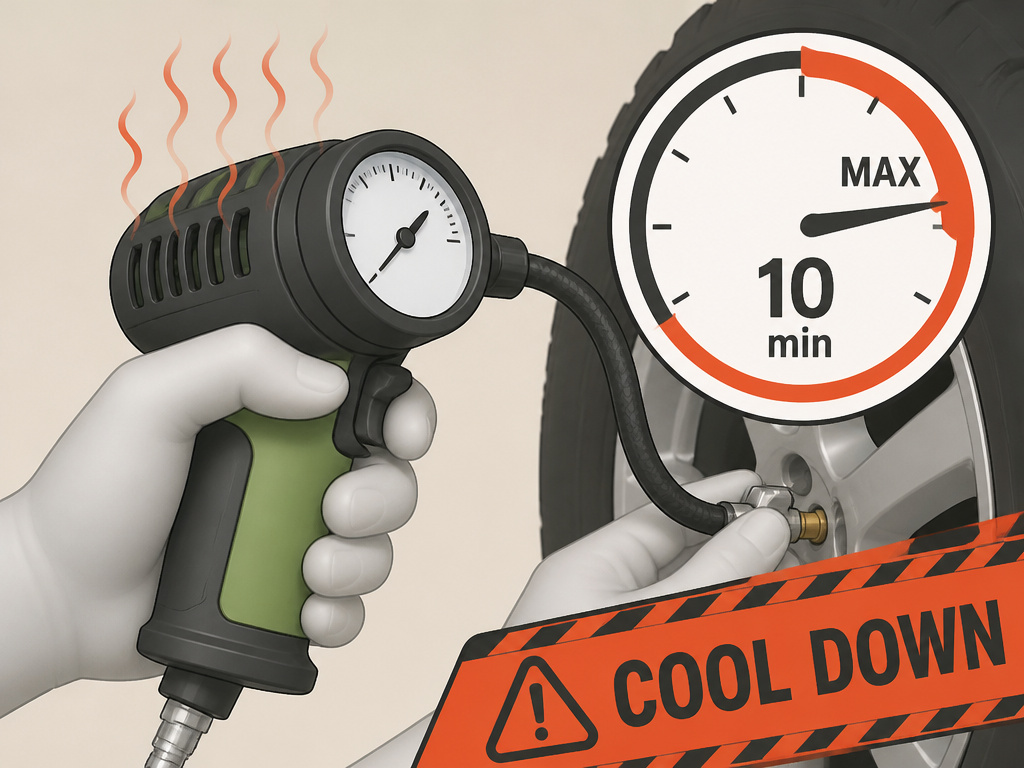
This is where most people get surprised. Your inflator has a maximum continuous run time, followed by a mandatory cool-down period. This duty cycle protects the motor from overheating and burning out. Ignoring it is the fastest way to turn a slow fill into a no-fill.
Manufacturers disagree on the exact numbers, which tells you the limit is mechanical, not arbitrary. Here’s how four different models compare:
| Inflator Model | Max Continuous Run Time | Required Cool-Down Time | Source |
|---|---|---|---|
| Sharper Image Cordless | 15 minutes | 15 minutes | Sharper Image Manual |
| Sealey MAC13DR | 15 minutes | 10 minutes | Sealey MAC13DR Manual |
| Harbor Freight 70622 | 10 minutes | 25 minutes | Harbor Freight 70622 Manual |
| Harbor Freight 70680 | 10 minutes | 15 minutes | Harbor Freight 70680 Manual |
The Harbor Freight 70622 has a very strict cycle: 10 minutes on, 25 minutes off. If you’re filling a large truck tire from flat, you will hit that limit. The motor will get hot, the performance will drop, and you must stop. The unit isn’t broken; it’s protecting itself.
Where this goes sideways: Running an inflator past its duty cycle to finish a tire. The motor overheats, the internal wiring insulation can degrade, and the next time you use it, the pump will be weaker or fail entirely. That 10-minute timer is a fuse for the motor’s life.
You can feel when an inflator is approaching its limit. The case gets warm, not just ambiently warm but hot to the touch around the motor housing. The sound changes from a steady hum to a labored, lower-pitched groan. If you smell a faint scent of hot electronics or burnt dust, you’ve already pushed it too far. Stop immediately and let it cool for the full recommended period.
Why Is My Air Compressor Taking So Long to Fill Up?
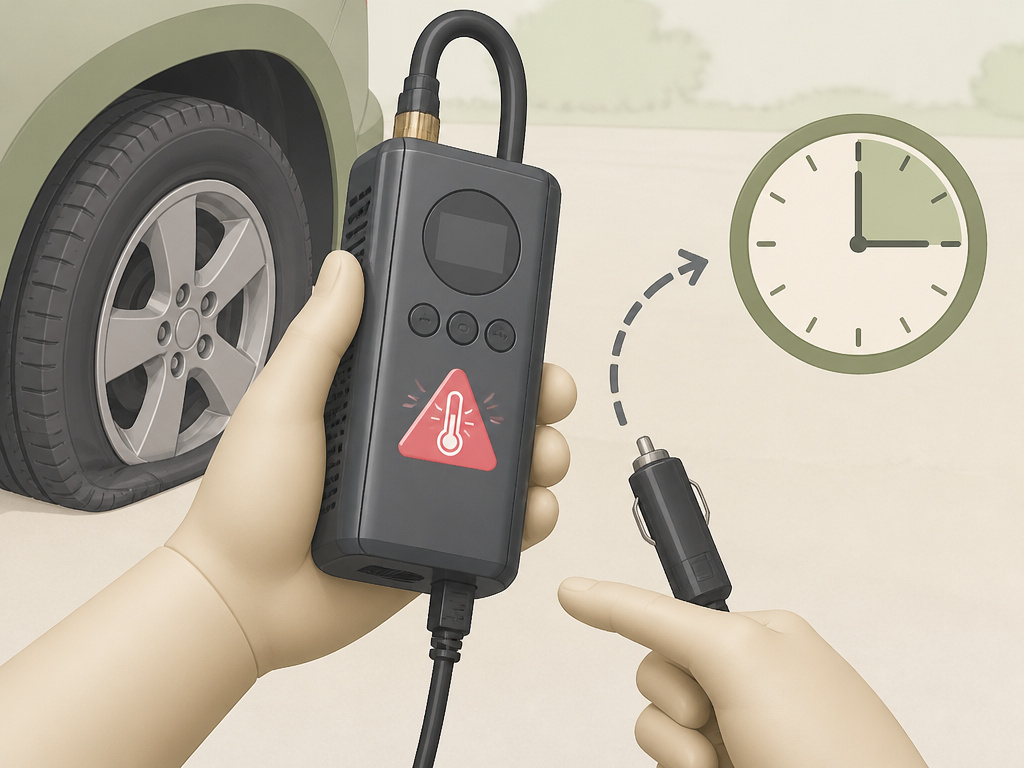
When an inflator drags on well past the expected time, the problem is usually one of three things, all tied to that duty cycle.
First, the battery or power source is weak. A 12V socket in your car might only deliver 10 amps, while the inflator wants 15. The result is slower motor speed and reduced airflow. Using an extension cord or a multi-socket adapter often drops the voltage further, stretching a 4-minute job into 10.
Second, there’s a leak you’re fighting. It might be at the valve stem connection, the chuck isn’t sealed tight, or a tiny puncture in the tire itself. You’re adding air, but it’s escaping just as fast. You’ll hear a faint hiss at the valve if the connection is bad. The fix is to ensure the chuck is pushed down firmly and locked parallel to the hose, as shown in the Harbor Freight 70680 manual’s diagram.
Third, and most common, you’ve ignored the duty cycle and the motor is heat-soaked. An overheated motor loses efficiency dramatically. It’s not moving as much air per revolution. The only fix is to stop, disconnect the power, and let the unit cool for the full recommended time, which is the entire 15 or 25 minutes the manual states.
A hot motor is a slow motor. Let it cool for the prescribed period, even if the tire is only half full. Rushing it guarantees the next fill will be even slower, and the one after that might not happen at all.
The 4 Tools That Replace a $200 Service Visit
You don’t need a professional-grade air compressor for home tire care. These four tools, used together, handle 99% of inflation tasks.
- A Portable Tire Inflator. This is your workhorse. For most households, a model like the Sharper Image Cordless or a similar 12V plug-in unit is perfect. Look for one with an auto-stop function and a clear digital display. It’s the core of your kit for home tire inflation.
- A Standalone Tire Pressure Gauge. This is your referee. The gauges built into inflators, while decent, can drift. A dedicated digital or dial gauge is the final authority. Check pressure with this after the inflator stops.
- A Tire Tread Depth Gauge. While you’re checking pressure, a quick tread check takes five seconds. It’s the difference between catching a balding tire and an unexpected blowout.
- A Valve Stem Tool and Core Remover. A leaking valve core is a common cause of slow leaks. With this $3 tool, you can tighten or replace the core in minutes, often solving the “slow fill” problem permanently.
Using a portable tire inflator is straightforward, but pairing it with a standalone gauge turns a guess into a precise task. The inflator does the heavy lifting; the gauge ensures it stopped at the right place.
How to Inflate a Tire Without Over-Inflating
The auto-stop function is helpful, but it’s not infallible. Here’s the sequence that prevents over-inflation, which can damage tires and create a safety hazard.
Start with the cold tire pressure number from your driver’s door jamb, not the maximum PSI molded on the tire sidewall. Set your inflator’s target 2 PSI below that cold recommendation. For example, if your door sticker says 35 PSI, set the inflator to 33 PSI.
Start the inflation. Monitor the digital readout. When the inflator stops, disconnect the hose and immediately check the pressure with your standalone gauge. The pressure will often read 1-2 PSI higher than the inflator’s target because the act of disconnecting the hose releases a tiny burst of air.
If you’re still under the recommended pressure, reconnect the inflator and add air in short, 1-2 PSI bursts, checking with your gauge after each burst. This stop-check-burst method avoids overshooting.
Common mistake: Trusting the inflator’s auto-stop as the final word. The disconnect blast and gauge error can add up to 3 PSI over your target. Always verify with a separate tool.
Why does this matter? Over-inflation by just 5 PSI reduces the tire’s contact patch with the road, leading to uneven center wear, a harsher ride, and reduced traction, especially in wet conditions. It’s a subtle change with a direct cost.
Portable Inflator vs. Air Compressor for Speed
When does a portable inflator’s 4-6 minute time become a liability? When you’re dealing with high volume or frequent use.
A tire inflator vs air compressor comparison comes down to airflow and duty cycle. A portable inflator might move 15-20 L/min. A small pancake air compressor delivers 2-4 CFM (about 55-110 L/min). It can fill that same standard car tire in under a minute and immediately move to the next tire without a cool-down break.
The trade-off is portability and noise. The inflator fits in your trunk and runs off your car battery. The air compressor needs a 120V outlet, is loud, and requires setup. For a single flat tire on the roadside, the inflator wins. For a full seasonal tire changeover for all four car tires, the air compressor saves you half an hour.
If your needs are in the middle, like filling a truck tire or a large SUV tire, you need to check the inflator’s capability. Some models, like the Harbor Freight 59624, are rated for longer runs at higher pressure (40 minutes at 40+ PSI), making them a hybrid option. Our guide on whether you can fill a truck tire with a portable unit breaks down those specifics.
Safety and Stopping Point Guidance
The manuals are unanimous on a few critical safety rules that directly impact how long the job takes and how safely it finishes.
Wear gloves. The Toys For Trucks 92RS200 manual is direct: “Always wear gloves. Some exposed parts may become hot during use.” The metal hose fittings and the inflator head itself can get hot enough to cause a minor burn, especially near the end of a duty cycle.
Wear eye protection. The Harbor Freight 70622 manual mandates ANSI-approved safety goggles. A damaged valve stem or a failing tire can release air and debris under pressure.
Never run the inflator in an enclosed space with a running vehicle. The operating instructions for multiple models warn against this due to carbon monoxide risk. You need fresh airflow for the inflator’s motor anyway, so work outside.
Finally, know when to stop entirely. If the inflator makes an abnormal noise or smells of overheating, switch it off and let it cool for the full cool-down period. Forcing it to continue will not get you to your pressure faster. It will break the tool.
Frequently Asked Questions
How long does it take for a portable tire inflator to work?
For a standard car tire (like a 175/70/R13), expect 4 to 6 minutes from completely flat to a normal driving pressure of around 32 PSI. Top-ups of a few PSI take under a minute. Always consult your specific inflator’s manual for its tested time.
Why is my air compressor taking so long to fill up?
The most common reasons are a weak power source (low battery or under-powered 12V socket), a small air leak at the valve connection, or an overheated motor that has exceeded its duty cycle. Check connections, ensure full power, and let the unit cool completely if it’s hot to the touch.
Are portable tire inflators worth it?
Absolutely. For the cost of one service station visit, a reliable portable inflator gives you years of convenience and safety. It allows you to maintain perfect tire pressure at home, which improves fuel economy and tire life, and it’s a genuine emergency tool for flats. We’ve reviewed the best portable tire inflators to help you choose.
Is it okay to over inflate tires by 2 psi?
Technically, most tires can handle a slight overage, but it’s not recommended. Consistent over-inflation by even 2 PSI accelerates center tread wear and can make the ride uncomfortably stiff. More importantly, it’s a sign you’re not checking pressure with a reliable gauge. Always aim for the manufacturer’s recommended cold pressure.
Before You Go
The right answer is your inflator’s manual, the one with the duty cycle and the tested inflation time for a specific tire size. Print that page and keep it with the tool.
If your inflator is taking longer than the manual says it should, diagnose in this order: power source, valve seal, then duty cycle. The fix is almost always in that sequence. And if you’re shopping, remember that speed is just one spec. The accuracy of inflator gauges and the robustness of the duty cycle matter more for long-term use than shaving 30 seconds off a fill.
For most people, a 6-minute fill is perfectly acceptable. It’s the price of a tool that fits in your trunk and works off your car battery. Want it faster? That’s when you step up to a different class of tool altogether.
