
How to Cut Metal With a Reciprocating Saw: Step-by-Step
This post contains affiliate links. As an Amazon Associate, we earn from qualifying purchases.
To cut metal with a reciprocating saw, you need three things: a fine-toothed bimetal blade (18-24 TPI for most jobs), a secured workpiece, and the saw set to a low or medium speed. For a clean cut, let the blade do the work, forcing it can damage the blade. Learning how to cut metal with a reciprocating saw is key to success.
That “let the tool do the work” advice is the part that feels wrong. You’re holding a vibrating machine that sounds angry. The instinct is to push. Push through the vibration, push through the chatter, push to make it go faster. That’s how you ruin a blade quickly. The real job is managing the machine’s energy so the teeth can bite cleanly.
What follows is the sequence that actually works for how to cut metal with a reciprocating saw: how to pick the blade that matches your metal, clamp it so it doesn’t scream, set the speed that won’t overheat the teeth, and finish the edge so it’s safe to handle. Proper technique helps achieve a usable cut.
Key Takeaways
- Use a fine-toothed metal cutting blade. Select the correct blade for the type of material being cut.
- Clamp everything. A workpiece that can shift will snag the blade, causing a violent kickback that can wrench the saw from your hands.
- Set the speed to low or medium for metal. High speed can overheat the blade.
- Let the blade cut. Applying excessive pressure bends the blade, creates harmonic vibration, and is the fastest way to snap it.
- Wear safety glasses with side shields during all cutting operations.
Before You Start: The Non-Negotiables
This tool has an exposed, fast-moving blade that throws hot, sharp debris. The manuals are not kidding.
Before you start: Wear safety glasses with side shields, regular glasses are not enough. Clamp your workpiece securely to a bench or sawhorse. Never hold the material with your hand or foot. Verify there are no hidden electrical cables or pipes in your cutting path.
The University of Maryland tool guide states you must hold the saw firmly with both hands and keep the shoe pressed against the work. If the blade binds, the saw can kick back forcefully. That’s not scare talk. It’s physics.
The Heart of the Job: Picking the Right Blade
This is where most people get the first step wrong. You wouldn’t use a bread knife to carve a turkey. Don’t use a wood-cutting blade on metal.
Metal cutting blades have finer teeth, and wood cutting blades have longer teeth. Forcing a wood blade through metal will damage the blade.
| Blade Type | Best For | Teeth Per Inch (TPI) | What Happens If You Use the Wrong One |
|---|---|---|---|
| Bimetal | Steel, pipe, rebar, all-purpose metal | 14-24 | The right choice. Lasts 5-10x longer than carbon steel. |
| Carbide Grit | Cast iron, fiberglass | Grit, no teeth | Used for hard, brittle materials. |
| Carbon Steel | Light-duty, one-time cuts in thin metal | 18-32 | Dulls quickly, often snaps under moderate pressure. Economical but disposable. |
For many metal cutting jobs in the process of how to cut metal with a reciprocating saw, a bimetal blade is a good choice. The high-speed steel teeth are welded to a flexible spring steel body. They stay sharp, and the body can take the bending stress of a reciprocating saw.
The number of teeth is an important factor in blade selection. Blade tooth count should be appropriate for the material thickness. Select a blade with an appropriate tooth count for the thickness of the metal you are cutting.
Our dedicated guide on metal cutting blades breaks down the top performers for every budget.
Setting Up Your Saw and Workpiece
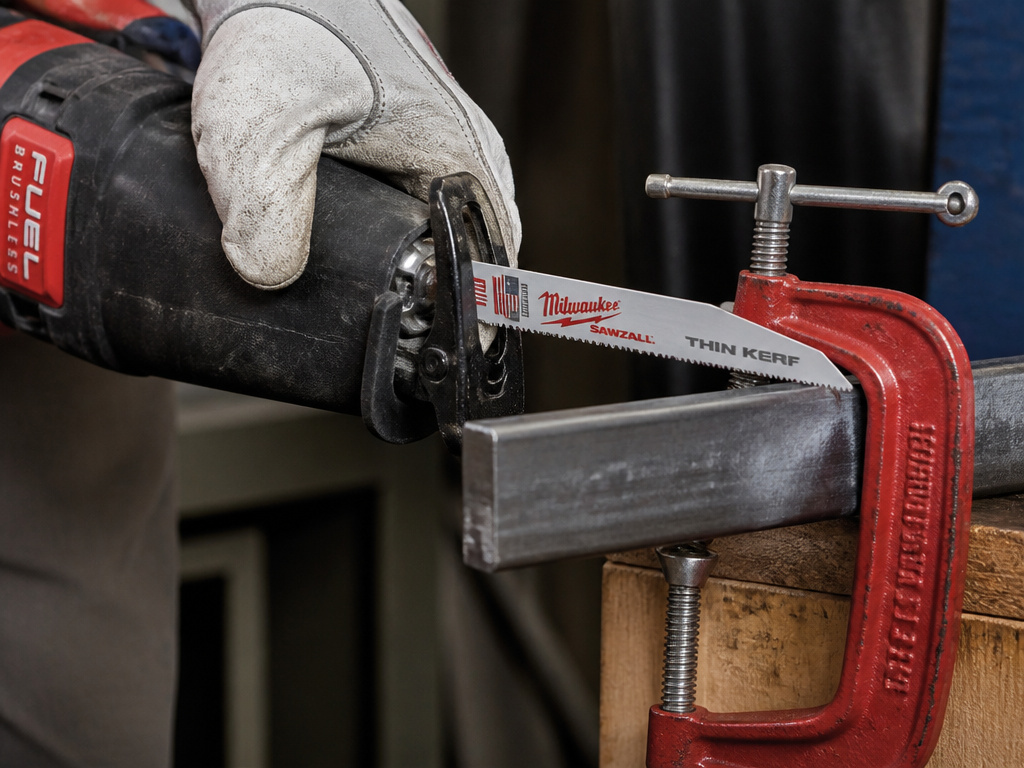
You have the right blade for cutting metal. Now, make the saw and the metal ready to cooperate.
Install the blade securely according to your saw’s manual.
Place the rocker shoe against the work when cutting. The Draper Tools RSAW710SF manual is explicit: DO NOT operate the saw without the adjustable foot. Operating without the adjustable foot is unsafe.
Third, clamp your metal. This is not a suggestion. The Amazon Basics manual says to secure the workpiece with a vise and cut close to it. Use C-clamps, a bench vise, or locking pliers. If the workpiece is not clamped, the blade may bind.
For thin sheet material: ‘Sandwich’ the material between hardboard or plywood and clamp the layers to limit vibration and material tearing.
Plan your cut and ensure a safe workspace. Always wear safety goggles or safety glasses with side shields during all cutting operations.
The Speed Debate: Low, Medium, or High?
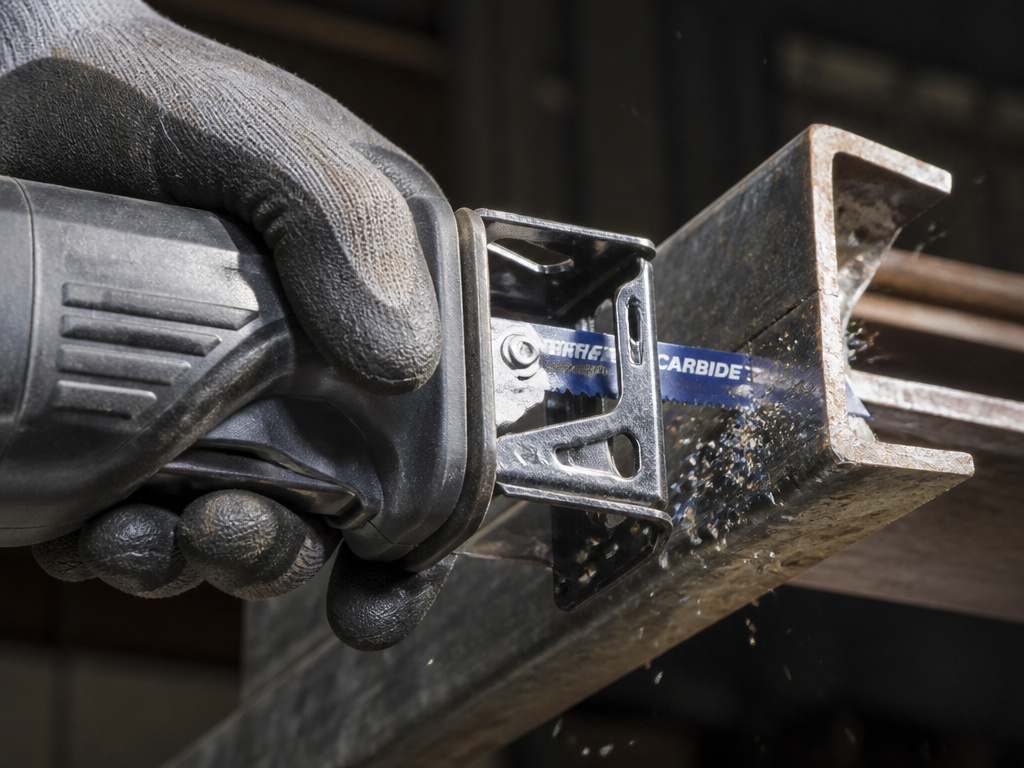
Manuals disagree on the exact setting, but the principle is universal: metal needs a slower stroke than wood.
- University of Maryland Guide: “Set on slow speed for cutting metals.”
- The Home Depot 6 AMP Reciprocating Saw Manual: “Run the saw at medium speeds when cutting metal.”
- Draper Tools RSAW710SF Manual: “Hard materials such as metals require lower stroke rates.”
They’re all pointing the same direction. Your saw’s variable speed trigger is your best friend. Start at the slowest speed that still cuts. You’ll hear a steady, rhythmic zzzt-zzzt-zzzt. If you smell burning metal or see the blade smoking, you’re going too fast and overheating the teeth. Speed up slightly only if the blade is just polishing the metal without biting.
The stroke rate specs from our fact sheet show these tools are capable of 0–2,800 strokes per minute. For steel, you’ll likely live between 1,500 and 2,200 SPM. Let the sound and the chip color be your guide. Silver or blue chips are fine. Brown or black dust means you’re burning it.
The 4-Step Process for a Straight, Clean Cut
This is the sequence. Skip a step, and you’ll know by the bad result.
1. Position and Brace. Stand with your feet shoulder-width apart, bracing the saw’s shoe firmly against the workpiece. Grip the main handle with your dominant hand and the front handle with your other hand. Your body is part of the stability system.
2. Start the Saw Off the Work. Squeeze the trigger and let the motor reach your chosen speed before the blade touches the metal. This prevents the blade from catching and jerking.
3. Initiate the Cut with the Shoe. Tilt the saw so the corner of the blade’s teeth contacts your mark. Lower the shoe flat to the work as the blade enters. Don’t plunge straight down.
4. Feed with Minimal Pressure. This is the hard part. Guide the saw along the line, but let the tool’s weight and the blade’s action do the cutting. You should feel a consistent vibration, not a struggling motor. If the motor bogs down, you’re pushing. Back off.
If the saw requires excessive pressure to cut, it is in need of a new blade. Change the blade before continuing the use the saw. . University of Maryland Dozuki Guide
The part nobody mentions: The last 10% of the cut is when the workpiece can pinch. Support the cutoff piece so it doesn’t fall and bend, snapping the blade as it exits.
Cutting Specific Types of Metal
Not all metal is created equal. Your technique tweaks slightly for each.
Cutting Steel Pipe or Conduit: This is the classic job. Use an 18 TPI bimetal blade. If possible, cut close to the vise as the Amazon Basics manual suggests. Rotate the pipe as you cut to keep the blade engaged evenly on all sides.
Cutting Angle Iron or Flat Stock: The sharp corners can catch the blade. Start your cut on a flat face, not on an edge. Go slow through the first corner.
Cutting Thin Sheet Metal (Under 18 Gauge): The sandwich method is mandatory. Without it, you’ll get a jagged, bent mess. A blade with 24 TPI or higher is also critical to prevent tearing.
Cutting Cast Iron Pipe: This is brittle. Use a carbide-grit blade, not a toothed one. Wear a dust mask, cast iron dust is nasty. Go slow to avoid cracking the pipe.
Cutting Stainless Steel: It’s tough and work-hardens. Use a sharp, high-quality bimetal blade designed for it, keep the speed low, and use cutting fluid to keep temperatures down. Our list of the best blades for stainless steel has proven options.
Troubleshooting Common Problems
You followed the steps, but something’s wrong. Here’s the quick diagnosis.
| Problem | Likely Cause | Fix |
|---|---|---|
| Blade bends or wanders | Workpiece is not clamped. | Stop. Re-clamp the metal securely. |
| Excessive vibration/chatter | Blade is too long for the cut, or speed is too high. | Use the shortest blade that reaches through; reduce speed. |
| Blade gets hot and smokes | Speed is too high; no cutting fluid on hard metal. | Reduce speed dramatically. Apply a few drops of cutting oil. |
| Cut is very slow, blade polishes | Blade is dull or TPI is too high for the thickness. | Install a new, sharper blade with a lower TPI. |
| Saw stalls under light pressure | Wrong blade type (e.g., wood blade). | Stop immediately. Install a correct metal-cutting Sawzall blade. |
If you’re tackling something especially thick, like a truck spring or solid bar, you need a specific blade for thick metal. A general-purpose blade will die a quick death.
After the Cut: Finishing and Tool Care
You’ve made the cut. The metal has a sharp, ragged edge called burr. Leaving it is a guaranteed cut on your hand later.
Deburr the edge. Run a metal file, a deburring tool, or coarse sandpaper along the fresh edge. A few passes will knock off the sharp whiskers. It takes thirty seconds and makes the piece safe to handle.
Clean your saw. Metal dust and chips are abrasive and conductive. Unplug the saw. Use a dry brush or compressed air to blow out the chuck mechanism and the vents. This grit is what grinds down internal parts prematurely.
Store blades properly. Don’t throw loose blades in a drawer. Use the plastic sleeve they came in or a blade holder. A nicked tooth can ruin a cut before you even start.
Is a reciprocating saw cost-effective for cutting metal?
A reciprocating saw offers a clear efficiency benefit for demolition, salvage, and jobs where a precise cut isn’t the primary goal. Its main advantage is speed and access; it can zip through metal pipe, rod, or sheet in places where a larger bandsaw or chop saw won’t fit. For infrequent or varied cutting tasks, it avoids the need for multiple specialized tools. The cost-effectiveness hinges entirely on using the correct fine-toothed metal cutting blade and running the saw at a medium or lower speed to prevent overheating and rapid blade wear. A dull blade that requires excessive pressure to cut wastes time and money, so swapping it promptly keeps the job moving. For thin sheet metal, sandwiching the material between plywood and clamping it reduces vibration and tearing, making a rough tool capable of a cleaner, more usable result.
Frequently Asked Questions
Can you use a reciprocating saw to cut through metal?
Yes. A reciprocating saw is one of the most versatile tools for cutting metal, especially in demolition, plumbing, and fabrication. With the correct blade and technique, it can cut steel, aluminum, copper, and cast iron.
What should you not do with a reciprocating saw?
Do not use a dull or incorrect blade. Do not cut material that is not clamped. Do not operate the saw with one hand. Do not force the blade, let it cut. Do not cut into walls or floors without checking for hidden wiring or pipes first.
Will a wood Sawzall blade cut metal?
It will make a mess and be destroyed almost instantly. The large, coarse teeth on a wood blade are not hardened for metal. They will dull, round over, and likely snap, potentially causing injury. Always use a blade rated for metal.
Which reciprocating saw is best for cutting through metal?
Any quality reciprocating saw with variable speed can cut metal. The more important factor is power (amps or volts) for sustained cuts. For thick metal, a corded model like the Makita M4500 or a strong cordless brushless model will have the endurance. The best tool is the one paired with the right blade for the job.
The Bottom Line
Cutting metal with a reciprocating saw isn’t about brute force. It’s a controlled process of matching the right blade to the material, securing everything that can move, and managing speed and feed pressure. The tool will fight you if you fight it. Guide it, don’t shove it.
If your first few cuts are slow and noisy, you’re doing it right. Speed comes from a sharp blade and confidence, not from leaning on the trigger. When you’re done, a quick deburr and tool cleaning turn a rough demolition cut into a usable piece of work. And if this tool isn’t right for your project, remember there are many other excellent saws that cut metal you can choose from.
That’s the real-win. You get a clean, safe cut, and your saw lives to fight another day.
