
How to Set up a Safe Home Workshop: Step-by-Step
This post contains affiliate links. As an Amazon Associate, we earn from qualifying purchases.
A safe home workshop is built on a system, not a checklist. It starts with a dedicated, well-lit space and is defined by four zones (cutting, assembly, finishing, storage), proper ventilation (8 litres/second per occupant for comfort), and electrical circuits that match your tools’ amperage. The real safety comes from habits: unplugging before blade changes, using push sticks on narrow rips, and wearing ANSI Z87.1 eye protection every single time.
That system approach is what most garage setups miss. They focus on buying the right tools but skip the shop layout, the air quality, and the muscle memory that prevents the two-thirds of workshop accidents linked to movement and clutter. A key part of this is learning how to set up a safe home workshop. Your space doesn’t need to be huge. It needs to be intentional.
What follows breaks down that system for anyone learning how to set up a safe home workshop: a four-zone layout that prevents collisions, the ventilation numbers you actually need, how to match an extension cord to a grinder’s amp draw, and the tool-specific rules, like the 10-inch minimum rip length on a table saw, that generic safety lists leave out.
Key Takeaways
- Design your shop with four distinct zones (cutting, assembly, finishing, storage) to separate hazardous operations from clean work and eliminate tripping over tools.
- Maintain a minimum workshop temperature of 16°C (13°C for heavy labor) and provide 8 litres/second of fresh air per person for comfort, as per the HSE HSG129 guide.
- Always use a push stick for any rip cut under 6 inches wide and never rip a workpiece shorter than 10 inches, following DeWalt’s table saw manual to prevent kickback.
- Match your extension cord gauge to your tool’s amperage, a 4.8A grinder needs a 16 AWG cord for a 50-foot run, to prevent voltage drop, overheating, and motor damage.
- Treat hearing and eye protection as a single unit; muffs must seal around your ears, not rest on your safety glasses, to achieve their rated noise reduction.
The 4-Step Zone Layout (And Why Floor Tape Beats Shelves)
Most garage workshops fail at layout. They become a storage room with a workbench. The HSE notes that almost two-thirds of reported workshop accidents stem from the movement of people, goods, and vehicles. You eliminate that risk by zoning.
Start with painter’s tape on the floor. Shelves and toolboxes come later. Mark out four zones:
- Cutting/Fabrication Zone: Home to the table saw, miter saw, and grinder. This is your high-hazard area. Nothing gets stored here except the tools in use and their dedicated push sticks or jigs.
- Assembly Zone: A clean, open bench with a vise. This area must stay clear of dust and metal shavings. Its only job is joining parts.
- Finishing Zone: Ideally separated by a curtain or partition. This is for sanding, painting, and staining. It needs its own dedicated ventilation or air filtration to contain fumes and fine dust.
- Storage Zone: Where all tools, materials, and hardware live when not in use. This zone needs clear aisles, at least 3 feet wide, for moving sheet goods and lumber without turning them into weapons.
Where this goes sideways: Putting the grinder next to the painting area. Metal sparks and solvent fumes are a fire combination waiting for an ignition source. The zones exist to prevent these silent, catastrophic conversations between tools.
The Harbor Freight manual for its angle grinder starts with “Designate a work area that is clean and well lit.” That’s zone one. Your first act of shop safety when learning how to set up a safe home workshop isn’t buying a fire extinguisher; it’s drawing lines on the floor that force you to put things away. Clutter is the primary trip-and-fall hazard in a confined space.
Light, Air, and Power: The Non-Negotiable Trio
You can have the best tools on the planet. If your shop is dark, stuffy, or underpowered, you’re working against yourself and inviting mistakes. These three elements are your shop’s life support system, and each has a numeric threshold.
Lighting is the easiest to fix. The goal is shadowless illumination at the work surface. For a typical two-car garage, ensure the work area is well-lighted from overhead LED fixtures, plus task lighting at every major station. The Lowe’s product document and Harbor Freight manuals all stress a “well-lighted” work area. A shadow across a cut line is how you miss by an eighth of an inch. A shadow near a spinning blade is how you lose a finger.
Ventilation is where most home shops are dangerously deficient. It’s not just about smell. The official UK HSE health and safety document HSG129 sets a minimum ventilation requirement of 5 litres/second per occupant. For comfort, meaning you can work for hours without headaches, it recommends 8 litres/second per person. In a sealed garage, you’re getting virtually zero.
For most workshops with only air leakage for ventilation, fans or additional air inlets are necessary.
That’s a direct quote from the guidance. Calculate your shop’s volume and ensure you provide adequate ventilation, as fans or additional air inlets may be needed in workshops with no means of ventilation other than air leaking in and out. For dust, use a dust collection system to control airborne particles from sanding or sawing wood.
Power is about more than outlets. It’s about delivering clean, stable current to your tools. The Harbor Freight general manual provides a crucial table for extension cords. For a tool like their 4.8A angle grinder (SKU 57287), running a 50-foot cord requires a minimum of 16 AWG wire. Try to run that grinder on a flimsy 100-foot 18-gauge cord, and you’ll hear the motor bog down before it eventually overheats. That voltage drop kills tools.
| Tool Amperage (at full load) | 25 ft Cord | 50 ft Cord | 100 ft Cord |
|---|---|---|---|
| 0 – 6A (e.g., 4.8A Grinder) | 18 AWG | 16 AWG | 16 AWG |
| 6.1 – 10A (e.g., many drills) | 18 AWG | 16 AWG | 14 AWG |
| 10.1 – 12A (e.g., small saws) | 16 AWG | 16 AWG | 14 AWG |
For stationary tools, consider using a dedicated circuit to prevent overloading. It prevents a tablesaw from tripping a breaker mid-cut, a startling event that can cause a dangerous reaction.
Tool-Specific Protocols: The Rules Behind the Guards
General safety rules are useless if you don’t know how to apply them to the tool in your hand. This is the gap between knowing you should be safe and actually being safe. We should clarify this point.
Table Saws are the most common source of severe workshop injuries. The DeWalt DWE7490 manual is brutally specific:
- Never rip a workpiece shorter than 10 inches. A short piece can’t be controlled against the fence and will kick back toward you at bullet speed.
- Always use a push stick for work 6 inches wide or less. Their recommended push stick length is 15.7 inches. This keeps your hands a safe distance from the blade.
- Never use the fence as a guide when crosscutting. That’s what the miter gauge is for. Using both at once pinches the blade and guarantees a kickback.
Angle Grinders are handheld hazard generators. The manual for the Harbor Freight 4.8A grinder states you must wear a full face shield over ANSI-approved safety goggles. Not one or the other. Both. It also warns that wheels exposed to humidity or freezing temperatures must not be used, as moisture can unbalance them. A wobbly wheel at 3,600 RPM explodes.
Drill Presses & Vises. The rule here is about securing work. The Harbor Freight metal cutting manual‘s first safety command is “SECURE WORK. Use clamps or a vise to hold work when practical.” A drill press can grab a loose piece and spin it like a propeller. I learned this the hard way early on with a circular saw. The workpiece bucked and became a missile. Now, if it’s not clamped, it’s not getting cut.
Easy to miss: The work rest on a bench grinder must be adjusted to maintain 1/8 inch or less from the wheel as it wears down. A gap wider than that allows small work to be pulled in and jammed, potentially shattering the wheel.
PPE: It’s a System, Not an Accessory
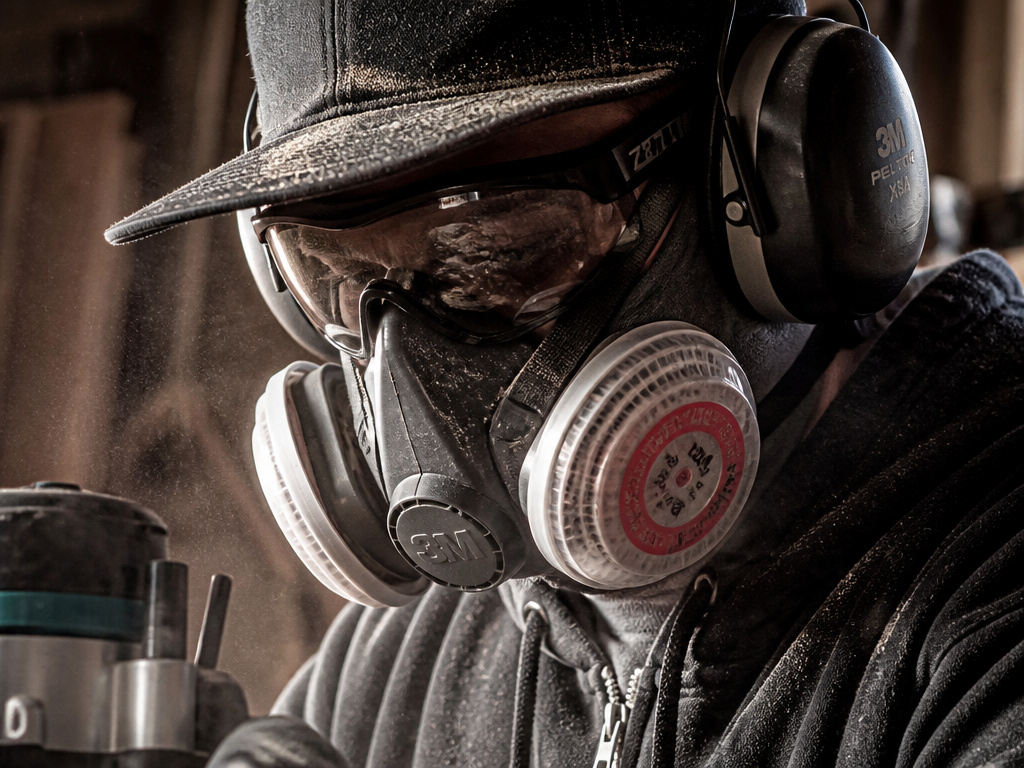
Personal protective equipment is your last line of defense. Treat it like a pilot’s pre-flight checklist: every item has a specific job, and skipping one compromises the whole system.
Eye Protection: This is mandatory. The Lowe’s document states you must “always wear safety goggles that comply with ANSI Z87.1.” Your everyday prescription glasses are not safety glasses. Look for the Z87.1 mark stamped on the frame. For grinding, add the full face shield as the Harbor Freight grinder manual dictates.
Hearing Protection: My strong opinion here is that most people wear over-ear muffs wrong. They rest the muff cups on the arms of their safety glasses, breaking the acoustic seal. That can cut the noise reduction rating (NRR) in half. Over-ear muffs should be designed to seal around the ears. Press them firmly until you feel the world go quiet. That’s the seal working.
Respirators: A dust mask from the hardware store is for pollen. For wood dust or metal fumes, you need a NIOSH-approved respirator with the correct filter cartridge (P100 for particulates). The Harbor Freight grinder manual explicitly calls for “NIOSH-approved breathing protection for the specific hazards in the work area.”
Gloves are a contentious topic. My stance is to never wear loose-fitting gloves near rotating tools like table saws, drill presses, or angle grinders. The material can catch and pull your hand into the tool. For handling rough lumber or sharp metal, well-fitting, cut-resistant gloves are fine, but never when your hands are near something that spins.
The Invisible Hazards: Dust, Fumes, and Vibration
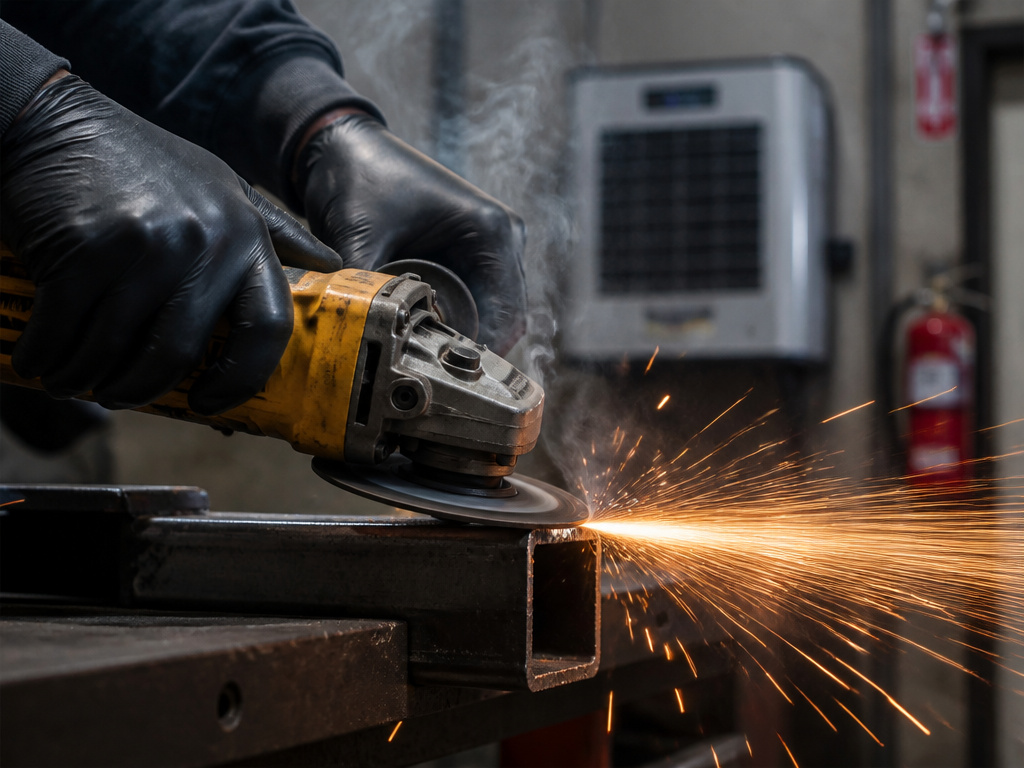
Some of the most serious risks in a workshop are the ones you can’t see coming at you. They accumulate.
Dust and Fumes: The DeWalt table saw manual includes a California Proposition 65 warning about carcinogens in wood and masonry dust. It advises working in a “well ventilated area” with approved respirators. Wood dust from species like oak or mahogany can cause serious respiratory issues over time. For fine dust, a shop air filter can help clean recirculated air.
Vibration: This is a slow, insidious injury. The Harbor Freight grinder manual has a dedicated vibration safety section. It warns that prolonged use can cause nerve damage (like white finger syndrome) and states that pregnant women or people with circulation issues should not use vibrating tools. It also gives a startling, practical tip: Do not smoke during use. Nicotine constricts blood vessels, amplifying vibration damage. Take breaks every hour to let your hands recover.
Electrical and Fire: Keep a fire extinguisher mounted at the shop exit. Your electrical safety plan should account for damp locations and emergency power shut-off.
Child, Pet, and Unattended Safety
Your workshop is a fascinating jungle gym to a child or a curious maze to a pet. The manuals are unanimous: “KEEP CHILDREN AWAY.” The Harbor Freight guide suggests making the workshop “kid proof with padlocks, master switches, or by removing starter keys.”
This means:
- Lockable storage for all tools, especially cordless ones with batteries.
- Secure all chemicals (stains, solvents, adhesives) in a high, locked cabinet.
- Unplug tools when not in use, and use a plug lock or switch cover on outlets.
- Never, ever leave a tool running unattended. The Harbor Freight rule is all caps: “NEVER LEAVE TOOL RUNNING UNATTENDED. TURN POWER OFF.”
It’s not just about preventing curious hands. It’s about establishing that the shop is a controlled environment, not a playroom. A single unattended moment is all it takes.
How to budget for a home workshop
Start by listing the core tools for your planned projects, then prioritize them. Your budget must allocate funds for essential safety gear like ANSI-approved safety glasses and NIOSH-approved respiratory protection before any power tool purchase. Factor in the cost of proper storage, lighting, and ventilation systems from the outset. A critical planning step is ensuring your electrical circuits can handle the tools you intend to use. Remember that a clean, well-lit, and uncluttered work area is a foundational safety requirement, not an optional upgrade.
What is the best flooring for a workshop
Your workshop floor must be clean, dry, and clear of trip hazards. Since most reported accidents involve the movement of people and goods, a clear floor path is essential. Ensure the area is free of oil, dust, and clutter that could cause slips or falls. Do not use power tools in damp or wet locations. The floor space around stationary tools like a table saw needs to remain unobstructed to allow for safe handling of materials, especially when ripping longer workpieces. A solid, level surface helps keep tools stable during use.
Frequently Asked Questions
What are the 5 most important safety rules in a workshop?
- Always wear ANSI Z87.1 eye protection, no exceptions.
- Keep your work area clean and well-lit to prevent trips and mis-cuts.
- Use the right tool for the job and always employ guards, push sticks, and clamps as designed.
- Know your material’s hazards (wood dust, metal fumes) and control them with ventilation and a respirator.
- Disconnect power before servicing or changing any blade, bit, or accessory.
How do I ventilate a home workshop with no windows?
You’ll need to create airflow. Use a combination of an exhaust fan mounted in a wall or door and a filtered make-up air inlet on the opposite side of the space. Pair this with a recirculating air filtration system to capture fine dust. Simply opening a door is rarely enough to meet the 8 litres/second per person comfort standard.
What size electrical circuit do I need for a home workshop?
At a minimum, you need one dedicated 20-amp circuit for your primary power tool (like a table saw). Ideally, you’d have two or three 20-amp circuits to separate your dust collector, compressor, and tool circuits. This prevents overloads and voltage drops. Always consult a licensed electrician for this installation.
Is it safe to use power tools in a garage in winter?
Yes, but temperature matters. The HSE HSG129 sets a minimum workshop temperature of 16°C (about 61°F). If you’re doing heavy physical labor, the minimum is 13°C (55°F). Cold muscles are injury-prone, and some tools and materials (like grinding wheels) can be damaged by freezing temps. Heat the space safely with a sealed-combustion heater, never a propane torch or open flame.
How often should I check my workshop’s dust collection system?
For a home shop, regularly inspect your dust collection system for clogs or damage. Empty the collection bin before it reaches capacity to maintain suction. The HSE requires professional examination of industrial Local Exhaust Ventilation (LEV) systems every 14 months (or 6 months for heavy metal grinding), which is a benchmark for having a pro check your setup if you use it frequently.
The Bottom Line
Setting up a safe home workshop is a set of habits you build into the foundation of your space. Start with the zones on the floor. Get the light and air moving. Match your cords to your tools. Then, focus on the specific, mandatory rules for each machine you own, the 10-inch rip minimum, the 1/8-inch grinder rest gap, the double-layer eye protection.
The goal is to build a space so intentionally safe that you can focus entirely on the work, not the worry. Your first purchase should be a roll of painter’s tape and a copy of your primary power tool’s manual. Your most important tool isn’t in a box; it’s the system between your ears. Now go draw some lines.
