
What Is an Electric Brake on a Power Saw: A User’s Guide
This post contains affiliate links. As an Amazon Associate, we earn from qualifying purchases.
An electric brake on a power saw is a system that uses an electrical current, often by reversing the motor’s polarity or injecting DC current, to bring the spinning blade to a rapid stop, typically within 5 to 10 seconds after you release the trigger. It’s designed to halt coasting for precision cuts and workplace efficiency, though manufacturers like Bosch explicitly state it is not a safety feature, while workplace safety regulators like the UK HSE view braking as providing safety benefits.
That 5-to-10-second window is where the entire debate lives. The UK’s Health and Safety Executive calls for a 10-second-or-less stop on new woodworking machines as a safety standard. Meanwhile, a tool like the Bosch 4412 promises a stop in “about five seconds.” The gap between those numbers isn’t academic; it’s the difference between a feature meant for clean cuts and one mandated for safe rundown, which is what is an electric brake on a power saw.
What follows is a breakdown of the electrical guts that make it happen, the real-world trade-offs you’ll notice in the shop, and a clear guide on what to do when yours starts to slow down, which begins with understanding what is an electric brake on a power saw.
Key Takeaways
- An electric brake stops the blade electrically, usually by reversing motor polarity, and is distinct from mechanical clamps or flesh-sensing systems like SawStop.
- Manufacturers like Bosch explicitly warn that “the brake action of this saw is not intended as a safety feature,” prioritizing precision over protection.
- If your saw’s brake doesn’t consistently stop the blade in its advertised time (e.g., ~5 seconds), stop using the tool and service it immediately, a slowing brake often signals worn brushes or a dirty commutator.
- The primary benefit is accuracy, eliminating blade coast that can widen a cut line, especially critical on expensive hardwoods or complex miters.
- Consider pairing a brake with a sturdy, cast base and a tool known for good control against kickback; the sudden stop can transfer torque.
How Does an Electric Brake Work?
The process is a neat bit of electrical jiu-jitsu. When you release the trigger on a saw with an electric brake, the tool doesn’t just cut power. It briefly feeds a reverse-polarity current back into the motor.
Think of the motor as a spinning electromagnet. Under normal operation, the alternating current pushes it in one direction. The brake throws a switch, sending a pulse that pushes back against that spin. This creates a magnetic drag that arrests the rotation far faster than friction alone. In technical terms, it’s often DC injection braking: a shot of direct current into an AC motor to induce a stationary magnetic field.
You’ll hear the difference. A saw without a brake winds down gradually. One with a functioning electric brake stops much more abruptly.
This reversal of current creates a stationary magnetic field in the motor stator. The spinning rotor cuts through this field, which induces a current in the rotor. That current creates its own magnetic field opposing the stationary one, resulting in a rapid deceleration torque that stops the blade.
The components that pull this off live inside the motor: the commutator and the carbon brushes. These parts handle the current reversal every time you hit the brake, which is why they’re the first to show wear.
Electric Brake vs. Non-Braked Saw: What Changes?
The most immediate difference is time. A standard circular saw blade can take many seconds to coast to a stop. An electric brake aims to do that in under 10 seconds, with specific models like the Bosch 4412 and 4212L targeting about five seconds.
But the real impact isn’t on the clock; it’s on your cut line.
Blade coast is a real issue. That extra half-revolution after you release the trigger can tug the saw a millimeter off your mark. On a crosscut or a miter, that’s the difference between a perfect joint and a visible gap. The brake eliminates that variable. The brake provides a definitive stop, so you can lift the saw confidently, knowing the blade is already still. This is a huge benefit for finish carpentry or any project where “close enough” isn’t.
The trade-off is mechanical stress. That rapid deceleration sends forces through the motor and gear train that a coasting stop does not. It’s why manufacturers caution against using the brake as an on/off toggle for rapid, repetitive cuts. You’re asking the brushes and commutator to handle that current reversal dozens of times a minute, which accelerates wear.
| Aspect | Saw with Electric Brake | Standard Non-Braked Saw |
|---|---|---|
| Blade Stop Time | 5–10 seconds | Many seconds of coasting |
| Cut Precision | High; eliminates coasting drift | Variable; depends on user technique |
| Motor Wear | Higher stress on brushes/commutator | Standard operational wear |
| Best Use Case | Precision trim, miters, hardwoods | General construction, rough framing |
| User Experience | Definitive stop, less hand fatigue from waiting | Natural coast-down, requires more patience |
Is an Electric Brake a Safety Feature? Here’s the Conflict.
This is the most important point to unpack, because the manual says one thing and common sense says another. Open the user manual for a Bosch 4412 or 4212L, and on page seven you’ll find this exact warning in bold: “The brake action of this saw is not intended as a safety feature.”
Bosch is clear. The brake is for precision. It’s to give you a clean, predictable cut in wood where a coasting blade would ruin your work. The guard system, they reiterate, is your primary safety device.
Now, open the HSE woodworking machine brakes guide (WIS38). This UK safety regulator states that braking provides “safety benefits” and is required to bring work equipment “to a safe condition in a safe manner.” Their standard? A stop within 10 seconds or less on new machines where there’s a risk of contact during rundown. They mandated retrofits for entire classes of saws by specific deadlines between 2003 and 2008.
So who’s right? Both, from their own vantage points.
The manufacturer is managing liability and emphasizing that a brake doesn’t replace the guard or safe practice. The regulator is defining a measurable engineering standard that reduces the window of exposure to a spinning blade after a cut. The brake functions as a safety adjunct by shortening the hazardous rundown period, even if it wasn’t marketed as one.
This distinction matters when you’re evaluating a tool and asking the what is an electric brake on a power saw question. Don’t buy a saw for its electric brake thinking it’s a magic shield. It isn’t. But understand that in a regulated workshop, that 10-second stop isn’t just a nice-to-have, it’s a compliance requirement with a real safety outcome.
Tools and Saw Types Where You’ll Find Electric Brakes
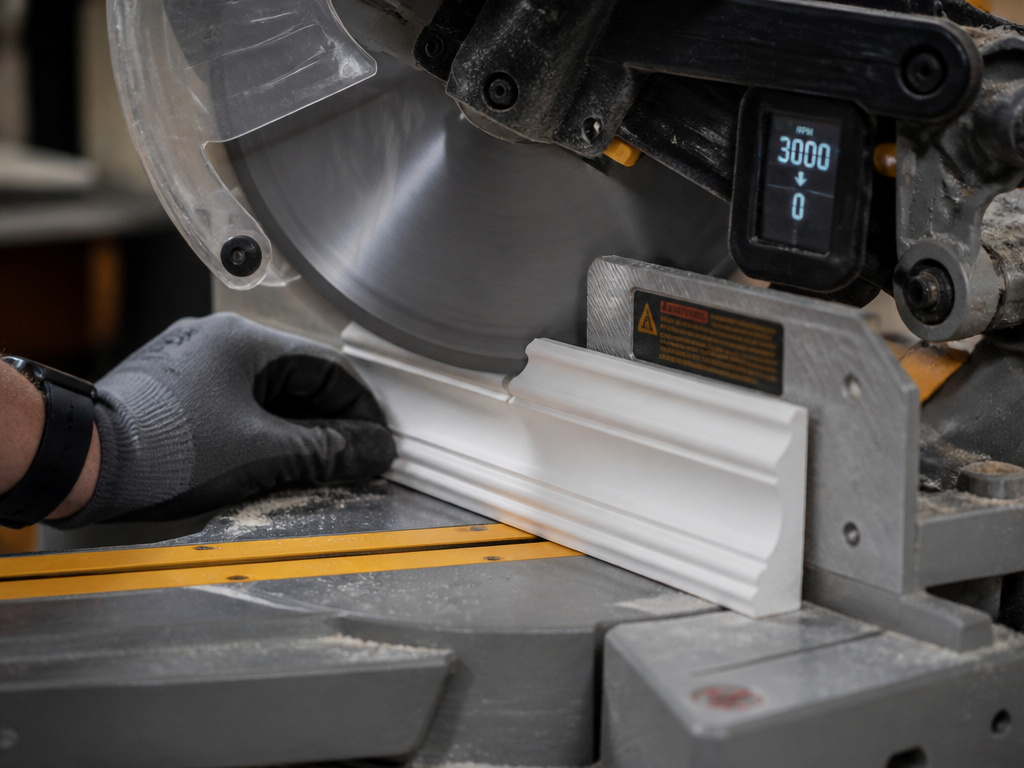
Electric brakes are most common on stationary and benchtop tools where precision is paramount and the motor design allows for it. You won’t typically find them on bargain-bin corded saws or most cordless models due to the added circuitry and cost.
Miter Saws: This is the flagship category. Models like the Bosch 4412 and 4212L are classics. The brake is invaluable here because you’re often making multiple precise cuts in a sequence. Waiting 20 seconds for the blade to stop between each cut on a crown molding job is a special kind of workshop torture.
Table Saws: Higher-end cabinet and contractor saws sometimes include an electric brake. On these larger machines, the benefit is twofold: precision for finish cuts and reduced time before safe blade changes. Remember, this is entirely different from a SawStop system, which uses a cartridge to detect skin contact and is purely a safety mechanism.
Circular Saws: Less common, but available on some premium corded models. The utility is debatable here, as a circular saw is often used for rougher work where the stop time matters less.
Where this goes sideways: Assuming any saw with a brake is inherently safer. Safety comes from procedure, guards, and techniques to prevent kickback, not from a faster-stopping blade alone.
The brake’s effectiveness is tied directly to the motor types at play. They work with both brushed and brushless motors, but the implementation differs. Brushed motors use the physical commutator and brushes to handle the current reversal. Brushless motors, controlled by sophisticated electronics (often a VSD), can achieve braking even more efficiently and with less part wear.
The Pros and Cons: Is the Extra Cost Worth It?
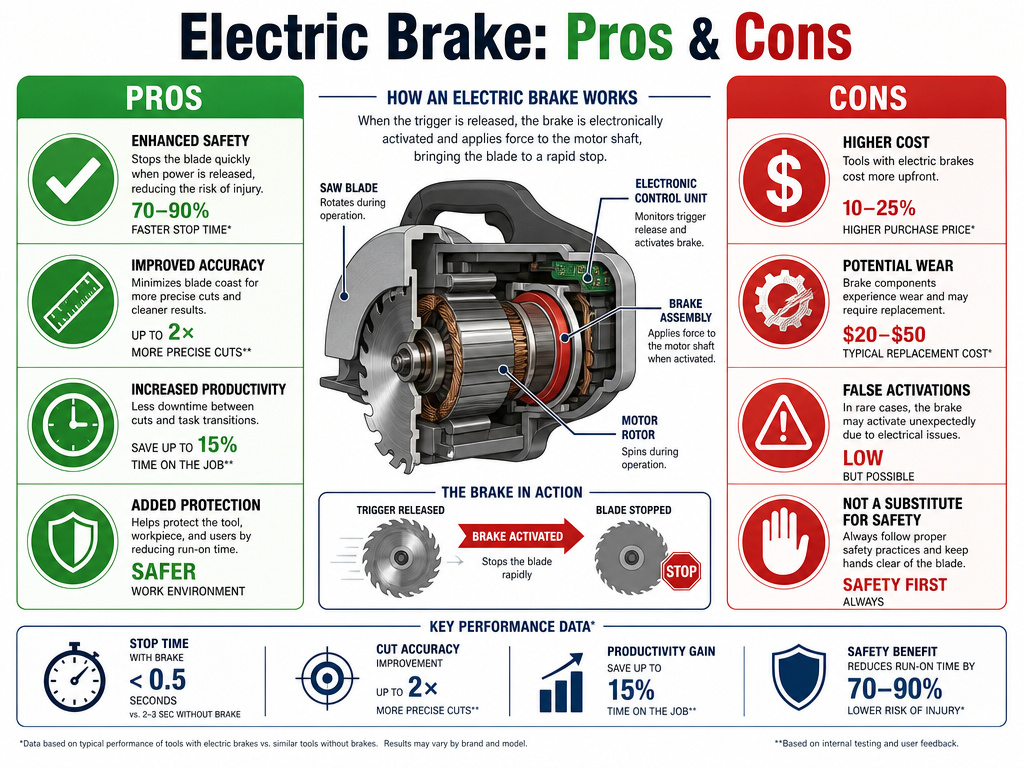
You’re paying for performance, not protection. Consider what you gain against what you give up.
Pros:
- Precision: The number one benefit. No coast means no drift. Your cut line ends exactly where you command.
- Efficiency: Less waiting between cuts translates to a faster workflow, especially on repetitive tasks.
- Reduced Fatigue: Lifting a still saw from the workpiece is physically easier than maneuvering a heavy tool with a spinning blade.
- Workshop Compliance: For professional shops, a sub-10-second stop may be required to meet regulations like those outlined in the HSE WIS38 document.
Cons:
- Increased Cost & Complexity: The brake system adds to the tool’s price and introduces more components that can fail.
- Accelerated Wear: The brushes and commutator face additional stress. You will likely replace them sooner than on a non-braked saw used similarly.
- Not a Safety Panacea: It’s crucial to internalize the manufacturer’s warning. This does not replace fundamental power tool safety practices or proper guard use.
- Potential for Over-reliance: Some users develop a bad habit of relying on the brake instead of following through safely with a cut, which can lead to other accidents.
For whom is it worth it? If you regularly work with expensive hardwoods, do fine trim, or need to batch-process precise cuts, the electric brake is a justifiable upgrade. For rough framing, deck building, or general construction, the cost and potential maintenance headache are hard to recommend.
Troubleshooting a Slowing or Failed Electric Brake
A brake that’s getting lazy is a tool that’s telling you something. The Bosch manuals are unambiguous: if the brake does not consistently stop the blade in its advertised time (e.g., ~5 seconds), do not use the saw and have it serviced immediately.
Here’s what’s usually happening, in order of likelihood:
- Contaminated Commutator/Brushes: This is the most common culprit. Sawdust is an abrasive and a partial insulator. Over time, it cakes onto the motor’s commutator, the copper contact ring the brushes press against. This layer disrupts the clean electrical contact needed for the brake to work effectively. The stop becomes sluggish and inconsistent.
- Worn Carbon Brushes: These are consumable parts. The constant arcing and friction of normal use, compounded by the extra action of braking, wear them down. Short brushes make poor contact, leading to a weak braking torque.
- Failed Motor Component: Less common, but possible. A shorted winding or faulty capacitor within the motor itself can prevent the brake circuit from functioning.
If performance doesn’t return, stop. This isn’t a fix; it’s a diagnostic hint.
Servicing an electric brake isn’t a casual DIY task, especially on double-insulated tools. The manual states it should be performed only by a qualified service technician using identical replacement parts. You’re dealing with high-current components and precise alignments.
How to Use and Test Your Saw’s Electric Brake
Using the brake is simple: it engages automatically the moment you release the trigger. There’s no separate button or switch. The key is to integrate it into your workflow safely.
Step-by-Step Safe Use:
- Make your cut as normal, holding the saw firmly.
- Release the trigger completely and wait for the definitive stop. Listen for the abrupt silence.
- Confirm the blade is still before lifting the saw from the workpiece. Never assume.
- Set the saw down in a safe location.
Testing the Brake:
You should test a new saw’s brake and periodically check it. Here’s how:
- Secure the saw or place it on a stable surface. Ensure the blade is clear of any material.
- Pull the trigger briefly to spin the blade up to full speed.
- Release the trigger and start a stopwatch (or mentally count “one-one-thousand, two-one-thousand…”).
- The blade should come to a complete stop within the advertised time, around 5 seconds for many models.
- Repeat this test. Consistency is as important as speed. If the time varies wildly or significantly exceeds the advertised stop time (e.g., about five seconds for Bosch models), the brake needs attention.
| Symptom | Likely Cause | Immediate Action |
|---|---|---|
| Blade stops in ~5 seconds consistently | Normal operation. | None needed. |
| Stop time is significantly slower than advertised | Brush wear or commutator contamination. | The saw should be serviced. |
| Stop time is inconsistent (fast one time, slow the next) | Intermittent contact from dirty commutator or failing brushes. | Stop using the saw. Service is required. |
| No braking action at all; blade coasts normally | Complete brake circuit failure, severed wire, or extremely worn brushes. | Do not use the saw. Immediate professional service required. |
Key Features to Pair with an Electric Brake
If you’re investing in a braked saw, you want a tool that can handle the forces and justify the precision. Don’t pair this feature with a flimsy frame.
- Solid Base Construction: Look for a cast aluminum or magnesium base, not stamped steel. The brake’s sudden stop transmits torque back through the tool. A rigid base prevents flex and maintains alignment, which is critical for the accuracy you’re buying the brake for.
- Quality Fence and Guides: A precise brake is wasted if the saw’s fence wobbles or the miter detents are sloppy. Ensure these key components of a circular saw are well-made.
- Anti-Kickback Systems: A brake doesn’t prevent kickback. Good kickback control through riving knives, splitters, and proper blade design is a separate, essential safety system.
- Dust Collection Port: Keeping dust out of the motor is the best preventative maintenance for the brake.
Do brushless motors affect brake durability?
Brushless motors, common in modern cordless tools, can offer advantages for braking systems. Since they are electronically controlled, the braking function is managed by the same circuitry that runs the motor. This precise control can allow for consistent braking force. The absence of physical brushes also eliminates a wear component that could be affected by the repeated electrical surges of a braking cycle. For tools with large blades or high inertia, proper system design is critical to handle the energy dissipation during rapid stops and prevent damage to the motor or electronics.
Frequently Asked Questions
Should I start my chainsaw with the brake on or off?
This question confuses two different systems. An electric brake on a power saw is an electrical motor stop. A chainsaw’s chain brake is a mechanical clutch that physically locks the chain. For a chainsaw, you typically start it with the chain brake engaged (on) as a safety precaution. They share the word “brake” but work on entirely different principles.
How does an electric brake work?
It works by reversing the electrical current in the motor after you release the trigger. This creates a magnetic field that opposes the motor’s rotation, causing rapid deceleration. The most common method is DC injection braking, where a pulse of direct current is fed into an AC motor.
Do electric handbrakes come off automatically?
No. The term “handbrake” usually refers to a parking brake on a vehicle. An electric brake on a power saw is not a parking brake; it’s a dynamic braking system that activates automatically upon trigger release to stop the blade’s rotation. It doesn’t “come off”, it engages to stop, then disengages when the blade is still.
How to use an electric brake?
You don’t actively “use” it; it’s automatic. Simply release the trigger switch fully after a cut. The brake engages, stopping the blade. The correct user action is to wait for the blade to come to a complete stop before moving the saw or lifting it from the workpiece.
Before You Go
The electric brake is a feature of nuance. It’s an engineering solution for precision, wrapped in a debate about safety labeling. Its value isn’t universal.
If your work involves finish carpentry, detailed miters, or any task where a wandering blade costs money and time, the brake is a legitimate tool that pays for itself in control. Just remember to pair it with a saw built well enough to handle it, and never let its quick stop make you complacent about the essential safety protocols that keep your fingers where they belong.
One final, essential rule: the moment that stop becomes inconsistent, your next move isn’t to troubleshoot deeper. It’s to unplug the saw and call for service. A slowing brake is the clearest signal your tool’s internals are wearing out, and pushing it further is how small problems become expensive ones.
