
Cordless Air Compressor Pros and Cons: Is It Worth It?
This post contains affiliate links. As an Amazon Associate, we earn from qualifying purchases.
For most home users, a cordless air compressor offers unmatched portability for tire inflation and small tasks, but its lower air delivery (CFM) and duty cycle limits make it a poor match for continuous tool use like sanding or grinding.
That’s the core trade-off. The freedom from a cord is real, but the physics of a battery-powered pump imposes hard limits that a corded model simply doesn’t have. Understanding those limits, spelled out in the manuals, is how you avoid buying the wrong tool for the job, which is why a review of cordless air compressor pros and cons is essential.
What follows is a breakdown of the real pros, the tangible cons, and the manufacturer specs that decide where a cordless compressor works and where it fails, which is the essence of the cordless air compressor pros and cons question. We’ll look at duty cycles, air volume, and the one spec sheet number that matters most.
Key Takeaways
- Maximize the recommended duty cycle, which varies by model; for example, Makita specifies a maximum 50% duty cycle, while DeWalt recommends a 50%-75% average to prolong life.
- CFM at your required PSI is the only performance metric that matters for tool use; a 1.2 SCFM pump cannot run a 5 CFM sander.
- Built-in pressure gauges are often “not trade-approved”, the IAN 497055_2504 manual advises checking with a certified gauge for accuracy.
- Cordless compressors pump ambient air, including humidity, directly into tires or tools; a corded tank setup allows moisture to condense and drain.
- Cold weather cuts battery capacity and thickens oil, slashing runtime and increasing pump strain before the motor even starts.
The Freedom of No Cord (And What It Actually Means)
Portability isn’t just about moving a tool. It’s about reaching the problem. A flat tire in a driveway, an air mattress at a campsite, a basketball at the park, a cordless compressor turns these from chores into five-minute fixes. The best battery powered air compressors pack enough punch for these jobs without you hunting for an outlet or unraveling 100 feet of hose.
But that freedom has a mechanical cost. To be light and cordless, the pump and motor are small. A small motor can’t move as much air as a big one. This isn’t a quality issue; it’s a law of thermodynamics. The Makita AC001G, a robust model, delivers 1.2 SCFM. A basic corded pancake compressor typically delivers significantly higher CFM than most cordless models. That’s the difference between topping off a tire and running a framing nailer all day.
The part nobody mentions: That portable convenience means it’s pumping whatever air is around it. On a humid day, you’re putting warm, moist air into a cold tire. The water vapor can condense inside, accelerating corrosion of the wheel rim. A tank compressor lets much of that moisture fall out and drain.
So the “pro” of portability is genuine. The “con” is that it comes bundled with inherent performance and environmental limits you must work around, a key part of the cordless air compressor pros and cons.
The 50% vs. 75% Duty Cycle Split
This is where the manuals get specific, and where generic advice fails. Duty cycle is the ratio of run time to rest time within an hour. Exceed it, and you overheat the pump.
Manufacturers don’t agree on the number.
| Model | Recommended Duty Cycle | What It Means for You |
|---|---|---|
| Makita AC001G | Maximum 50% | Run 30 minutes, rest 30 minutes in any hour. |
| DEWALT DCC1054 | 50%-75% average | Run 30-45 minutes, rest 15-30 minutes per hour to “prolong life.” |
| VONROC CR503DC | Max 10 min continuous | Not for runs over 10 minutes; requires a cool-down break. |
| IAN 497055_2504 | Max 15 min continuous | Will auto-shutoff after 15 minutes; requires a 15-minute rest. |
The DEWALT DCC1054 manual states a 50%-75% average duty cycle (30-45 minutes run time in any given hour) is recommended to prolong life, even though its pump is capable of continuous running.
The takeaway? Most cordless compressors are not designed for continuous use, with strict duty cycle limits, though some industrial models like the Atlas Copco B-Air 185-12 are designed for extended runtime. Even the most forgiving guideline (DeWalt’s 75%) means planning for a quarter-hour of downtime every hour. If your project involves an air-hungry tool like a pneumatic impact wrench or a die grinder, these stop-and-go cycles will derail your workflow. For inflating four car tires or a pool toy, it’s irrelevant.
Performance Reality Check: CFM, PSI, and Tools
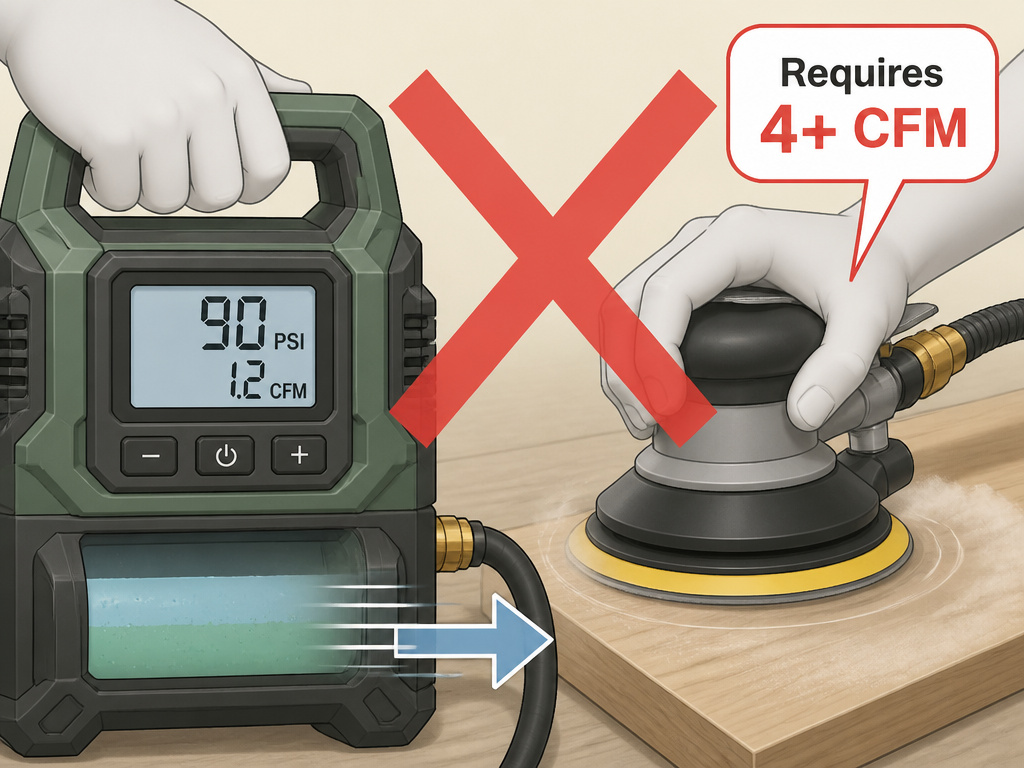
We should clarify something. Cordless compressors are brilliant inflators. They are mediocre power sources for pneumatic tools. The distinction hinges on CFM (Cubic Feet per Minute), the volume of air a tool consumes.
- Inflation is a short, high-pressure job. A tire needs, say, 35 PSI. The compressor builds pressure in the tank and delivers it in bursts. Even a modest CFM can handle this.
- Tool operation is a continuous, high-volume demand. Common pneumatic tools like air ratchets often require a continuous CFM supply that exceeds the output of most cordless compressors. The compressor must produce that air in real-time.
Here are the hard numbers from the source sheets:
- Makita AC001G: 1.2 SCFM
- 40V Tractor Supply Model: 0.7 SCFM @ 90 PSI
- Einhell (I.-Nr.: 210217): 1.34 CFM @ 102 PSI
Now, look at a common tool:
- Orbital Sander: Typically requires several CFM. * Small Die Grinder: Typically requires several CFM.
See the mismatch? The tool needs 4-8 times more air than the compressor can provide. The tank will empty in seconds, and the pump will run non-stop, immediately violating its duty cycle and overheating. This is the single biggest reason people are disappointed with cordless power tools in this category. They bought a compressor expecting it to run tools, but it’s only designed for inflation and very light, intermittent tool use.
For true tool operation, you’re looking at a different class of machine. This is the fundamental choice in any portable vs stationary air compressor debate.
Battery Life and the Cold, Hard Truth
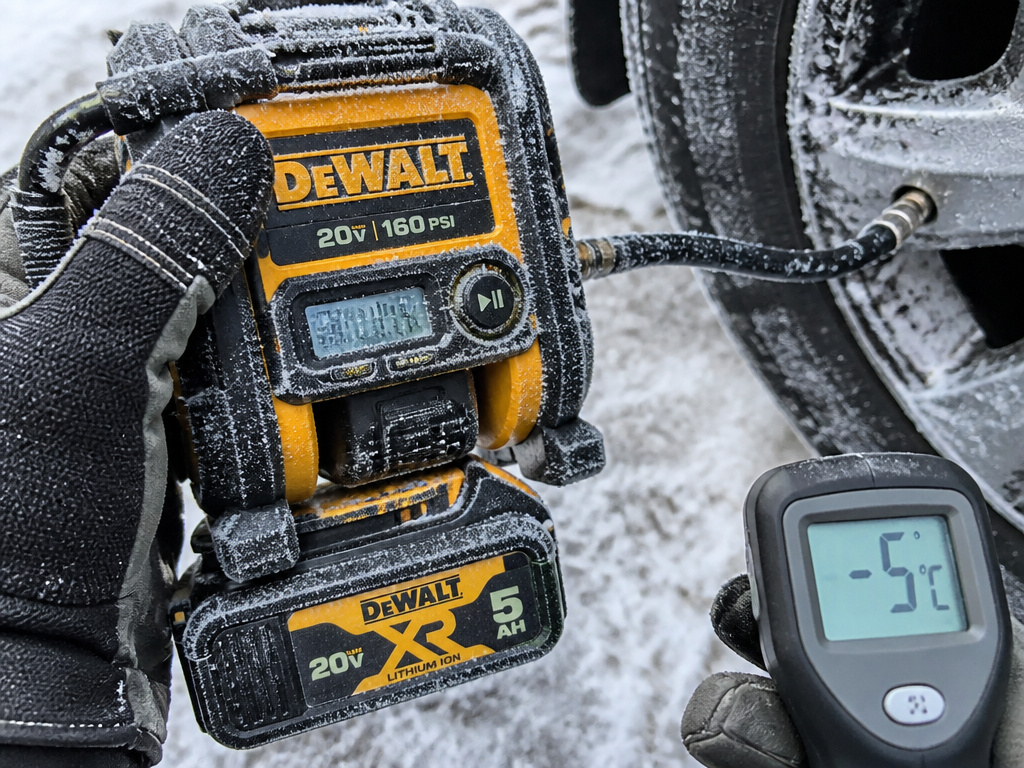
The battery is the lifeline, and it’s the most temperature-sensitive part of the system. A lithium-ion battery’s chemical reactions slow down in the cold. What the manual says and what happens in your driveway in January are two different things.
The Ferrex 12V Mini Air Pump manual is blunt: it’s not for professional use and not for large volumes. In cold weather, its already-limited capacity shrinks further. You might get one tire done instead of three. More powerful models like
Furthermore, the oil in the pump (or the sealed lubrication in an oil-free pump) thickens in the cold. The motor has to work harder against this internal resistance from the moment you start it. This extra load drains the battery faster and creates more heat, pushing you closer to the duty-cycle limit before you’ve even finished your first task.
Before you start: Check the operating temperature range. Operating temperature ranges vary; for example, the Einhell (I.-Nr.: 210217) manual specifies +5°C to 40°C, while the IAN 497055_2504 lists 4°C to 40°C. Running outside these ranges can void warranties and damage the pump.
Safety and Maintenance: The Non-Negotiables
A cordless compressor is still a pressure vessel. The safety rules don’t change because the cord is gone.
- Drain the Tank. Every. Single. Time. The Makita AC001G and DEWALT DCC1054 manuals mandate this. Water from condensed air rusts the tank from the inside. A rusty tank can rupture.
- Use Rated Accessories. The VONROC CR503DC manual requires all hoses and fittings to be rated for 160 PSI or 150% of max system pressure. A burst hose is a dangerous whip.
- No Explosive Atmospheres. This is in nearly every manual. The compressor motor can create sparks. Using it near gasoline fumes is a fire risk, and some models, like the VONROC CR503DC, also warn against operation in dusty environments.
- Don’t Breathe the Air. The 40V Lithium-Ion Air Compressor manual explicitly warns that air directly from the compressor is not safe for breathing, it can contain carbon monoxide, oil vapors, or particles.
These aren’t suggestions. They’re the conditions under which the tool was certified to standards like UL or 2006/42/EC.
Cordless Compressor vs. Portable Tire Inflator
This is a common point of confusion. Is there a difference? Absolutely.
A portable tire inflator (like many cordless units) is designed for one job: moving air into an enclosed space (tire, ball, mattress) until a target pressure is reached. It’s often tankless, small, and has an auto-shutoff.
A true cordless air compressor has a tank, a pressure switch (cut-in/cut-out), and a regulator. It stores energy (compressed air) for later use, which provides a buffer for tools that demand short, high-volume bursts. The presence of a tank and a standard quick-connect coupler is the giveaway.
The Atlas Copco B-Air 185-12 blurs this line, it’s a tankless screw compressor designed to run tools for a full shift, but it’s an industrial-grade exception that proves the rule. For home users, if it has a tank and a coupler, it’s a compressor. If it’s a handheld gun that plugs directly into a tire, it’s an inflator. Knowing which you have sets realistic expectations. For a deep dive on this choice, see our comparison of portable tire inflators and air compressors.
The Verdict: Who Is It Really For?
So, after the specs and the warnings, where does a cordless air compressor fit?
Get one if:
- Your primary needs are inflating car, bike, and sports equipment tires.
- You value portability above all else for roadside or remote use.
- You have very light, intermittent pneumatic tool needs (like a brad nailer for a few shots).
- You’re already invested in a major tool battery ecosystem (like DeWalt 54V).
Look at a corded model if:
- You need to run air tools for more than a few minutes at a time (sanders, grinders, impact wrenches).
- You have a fixed workshop space with accessible power.
- You need higher air volume (CFM) for larger tires or continuous operation.
For many, the ideal setup is two tools: a cordless air compressor in the car for emergencies and a capable pancake air compressor or larger stationary unit in the garage for real work. One covers mobility, the other covers performance. Trying to force one tool to do both is how you end up frustrated with a dead battery and a half-inflated tire.
Battery ecosystem compatibility (tool brands)
Your choice of cordless air compressor is often tied to the brand of batteries you already own. Many models are designed to work within a specific power tool ecosystem, using the same battery packs as drills, saws, and other tools from that manufacturer. This can be a major advantage, saving you from investing in a separate battery and charger system. Before buying, check which battery platform the compressor uses. If you are already committed to a particular brand, sticking with it for your compressor can simplify your workflow and reduce overall costs.
Overheating issues
Cordless compressors are prone to overheating if pushed too hard. Manufacturers specify strict duty cycles to prevent this. For example, Makita recommends a maximum 50% duty cycle for its compressors, while DeWalt suggests a 50% to 75% average duty cycle for longer life on the DCC1054 model. Smaller, tankless pumps have even tighter limits, with some rated for a maximum of only 10 or 15 minutes of continuous operation before requiring a cooldown period. Ignoring these limits can shorten the tool’s lifespan and pose a safety risk. Always follow the specific run and rest times in your manual.
Frequently Asked Questions
Are battery-powered air compressors any good?
They are excellent for their intended purpose: portable inflation. For filling tires, sports balls, or air mattresses, they are convenient and effective. They are not good as primary power sources for high-consumption pneumatic tools in a workshop setting.
What are the downsides of oil-free air compressors?
The main trade-off for maintenance-free convenience is noise and lifespan. Oil-free pumps run hotter and louder than oil-lubricated ones, and their components (often plastic or composite) tend to have a shorter service life under heavy use. They are perfect for light, intermittent duty.
Is the DeWalt cordless air compressor any good?
Based on its manual, the DEWALT DCC1054 is a serious tool. Its 54V battery system, 10L tank, and 50%-75% duty cycle recommendation position it at the higher end of cordless performance. It’s suitable for more demanding inflation tasks and very light tool use, but it still obeys the same CFM and duty cycle limits as any cordless model.
Can a cordless air compressor run an impact wrench?
It depends entirely on the impact wrench’s CFM requirement and the compressor’s output. A small 1/2-inch impact wrench can need 4-5 CFM. Most cordless compressors output 1-2 CFM. The result would be a few seconds of torque before the tank empties, followed by a long wait for it to refill. For consistent use, a corded compressor is the right choice.
How long do the batteries last?
It varies wildly by model and task. The IAN 497055_2504 has a 2000mAh battery and a maximum continuous operation time of 15 minutes. The 40V Lithium-Ion Air Compressor (Tractor Supply) claims 40 pump-up cycles per charge. Runtime varies by model and task; check the specific manual for performance estimates. Cold weather will significantly reduce this.
Before You Go
The math is straightforward. If your air needs are measured in minutes and PSI, topping off tires, managing seasonal pressure changes, handling small inflatables, a cordless compressor is a brilliant, liberating tool. If your needs are measured in hours and CFM, sanding a deck, running a mechanic’s shop, you’re in corded or stationary air compressor territory, and possibly even the gas vs electric debate for remote sites.
Trust the manuals, not the marketing. The duty cycle warnings and CFM ratings are there because engineers know where these tools fail. Match the tool to the task you actually have, not the one you imagine. That’s how you avoid buying a very convenient disappointment.
