
How to Use Thread Tape on Air Fittings: Step-by-Step
This post contains affiliate links. As an Amazon Associate, we earn from qualifying purchases.
To use thread tape on NPT air fittings, wrap 2-4 turns of PTFE tape clockwise around clean, dry male threads, starting at the first full thread and pulling it tight. Avoid tape overhang, and tighten the joint 1.5 to 2.5 turns past finger-tight with a wrench. For natural gas or CNG lines, use yellow, gas-rated PTFE tape specifically.
That’s the consensus method, and it works. But if you’ve ever followed it and still ended up with a hissing leak or a shredded tape mess, you’re not alone. The real world of air fittings, with its vibration, heat cycles, and conflicting manufacturer advice, adds a few critical layers the simple instructions skip. Understanding how to use thread tape on air fittings correctly is key to avoiding these common issues.
What follows is the step-by-step, but also the disagreements: when one manual says “tape only” and another says “never use tape,” and the physical reasons a fitting sealed at the bench starts weeping on the third day of use, which is why the how to use thread tape on air fittings question has nuance.
Key Takeaways
- Wrap PTFE tape clockwise, starting at the first full thread, for 2-4 tight turns. Covering every thread prevents galling in stainless steel.
- For natural gas or compressed natural gas (CNG) lines, use yellow, gas-rated PTFE tape; its higher density seals better and provides a visual safety marker.
- Tighten NPT fittings 1.5 to 2.5 turns past finger-tight with a wrench. Overtightening a lubricated taped joint is easy and can crack fittings.
- Clean threads are essential. Old sealant, oil, or dirt creates a leak path and causes tape to bunch and shred.
- Some manufacturers, like VIAIR for air compressors, explicitly recommend thread sealant paste and advise against using tape. Always check your tool’s manual first.
When to Use Thread Tape (and When to Absolutely Avoid It)
Thread tape has one job: to seal the spiral leak path in tapered pipe threads, known as NPT (National Pipe Taper). The tape fills the microscopic gaps between the male and female threads as you tighten them together. It also lubricates, which is the whole reason you get into trouble with overtightening.
Common mistake: Using PTFE tape on any threaded connection. It only works on tapered NPT threads. On straight threads, compression fittings, or flared fittings, tape does nothing but cause leaks.
Use PTFE tape on:
- NPT air hose fittings (the most common type in workshops)
- Pipe threads on compressors, regulators, and manifolds
- Gas line connections (using the specific yellow tape)
Never use PTFE tape on:
- SAE O-ring boss fittings (they seal with an O-ring, not threads)
- Compression fittings (they seal by compressing a ferrule)
- Flared fittings (they seal with a metal-to-metal cone)
- Any connection with an integrated rubber seal or gasket
If you’re unsure, a quick guide to your air hose fittings can save you a messy, leaking do-over.
The Tape vs. Thread Sealant Disagreement
Here’s where the clean theory gets muddy. Open the manual for a VIAIR 400C air compressor and it states plainly: “Use thread sealant for proper fitting installation. Thread tape is not recommended.” Yet, the British Fluid Power Association (BFPA) publishes a detailed guide on how to apply PTFE tape, and an independent investigation report (IR257) found taped fittings held seal at 410 bar (nearly 6,000 PSI).
So who’s right? Both are, for their context.
| Source | Recommendation | Likely Reasoning / Context |
|---|---|---|
| VIAIR Corp. Manual | Use thread sealant. Tape not recommended. | Prevents tape shreds from contaminating small compressor valves and air tools. Ensures a more foolproof seal for all users. |
| BFPA Guide & IR257 Report | PTFE tape is effective when applied correctly. | Industry-standard for hydraulic/pneumatic threads. Provides lubrication and a reliable seal at extreme pressures. |
| Spears Manufacturing | For Head Adapters, use ONLY 2-3 wraps of tape; for Female Adapter transition to metal pipe, use ONLY 5 to 5-1/2 wraps of tape. | Tape is prone to user error (wrong wraps, bunching). Paste fills threads more consistently but must be chemically compatible. |
The VIAIR stance is a liability and contamination guard. A tiny shred of tape can travel and clog a critical orifice in a pneumatic tool. Thread sealant paste, or “pipe dope,” flows into the threads and sets without creating debris. For most general shop air fittings, properly applied tape is perfectly fine, which is the core of how to use thread tape on air fittings. But if your compressor manual says no tape, listen to it. You can’t argue with a voided warranty.
The 6-Step Process for Applying PTFE Tape
This is the hands-on part. Get it wrong, and you’ll be fixing air leaks sooner than you’d like.
Step 1: Clean the Threads Thoroughly
Wipe the male threads with a clean, dry rag. Dig out any old, hardened sealant paste with a pick or small wire brush. Any grease or debris creates a channel for air to escape and prevents the tape from bedding down into the thread roots. The surface should be dry and metallic-bright.
Step 2: Select the Right Tape
For standard compressed air lines, general-purpose white PTFE tape works. For natural gas, propane, or CNG, you must use yellow, gas-rated PTFE tape. As noted in industry reports, gas-rated tape is denser (typically around 0.1mm thick and not pre-stretched) and is colored for safety identification. Yellow, gas-rated PTFE tape is widely available from various manufacturers.
Step 3: Start at the First Full Thread
Hold the fitting. Find the first complete thread ridge, not the chamfered lead-in at the very end. Press the tape end here. The BFPA guide is adamant: start at the first full thread. Sources disagree on covering the first thread: the IR257 report found that leaving the first thread bare caused galling, while the BFPA advises commencing with the 1st full thread and not applying tape to the thread lead-in chamfer.
Step 4: Wrap Clockwise, Pulling Tight
Wrap in the direction of the threads, clockwise for standard right-hand threads. Use your thumb to keep tension. You’re not just laying tape on; you’re stretching it slightly so it sinks into the thread grooves. A loose wrap will spiral and bunch when you screw the fitting in.
Step 5: Apply 2-4 Overlapping Turns
Make 2 to 4 complete revolutions, overlapping each wrap by about half the tape’s width. The goal is 2-3 uniform layers of tape covering the threads. More is not better. Over-taping makes the assembly difficult, can over-stress female fittings, and often causes leaks as the excess tape shears and rolls.
Step 6: Tear Off and Press Down
Tear the tape cleanly and press the loose end down firmly with your thumb to secure it. Ensure zero tape overhangs the end of the threads. An overhang can peel off, travel downstream, and cause the very contamination warnings you read in manuals.
Wrap the tape in the same direction as the thread form, commencing with the 1st full thread. Apply between 2-3 full revolutions of tape, pulling the tape firmly into the threads without causing the tape to break. Ensure that no tape overhangs the end of the connection. . BFPA (British Fluid Power Association) Application Guide
How Tight is Right? The Torque Question
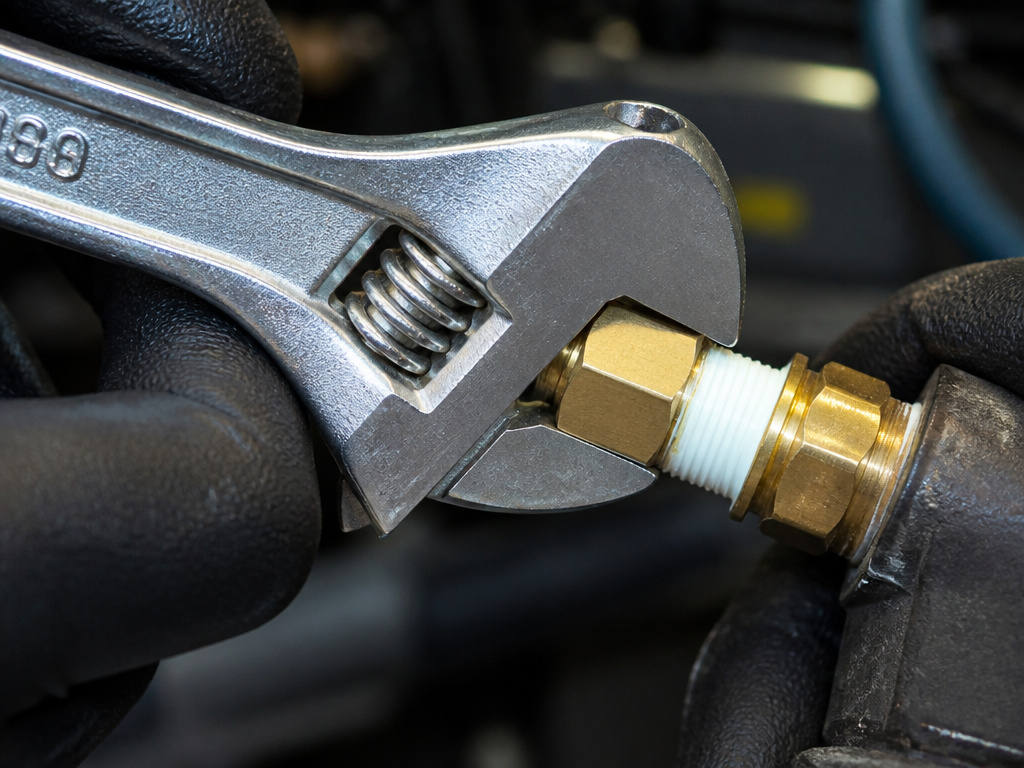
This is the step that separates a lasting seal from a broken fitting. NPT threads are tapered; they get tighter the farther you screw them in. PTFE tape is a superb lubricant, which means your old “good and tight” muscle memory will lead you to overtighten by a factor of two.
Do not crank on it. Sources provide different guidance: Spears Manufacturing recommends tightening threaded joints 1-2 turns beyond finger tight, while the IR257 report and ASME standards suggest 1.5 to 2.5 full turns past finger-tight with a wrench. The required number of turns past finger-tight can vary based on fitting size and thread engagement.
Some manufacturers give specific torque values. VIAIR, for instance, recommends 10-11 ft-lbs for 1/8-inch fittings and 16-18 ft-lbs for 1/4-inch and 3/8-inch fittings when using thread sealant. If you use tape, use these numbers as an upper limit, your final tightness will likely be slightly less.
The feel matters. As you wrench, the resistance will build steadily. When it feels firmly snug, stop. If you feel a sudden, easy yielding, you’ve likely stripped the softer aluminum threads common in air tools. That’s a one-way ticket to a permanent air compressor leak.
Troubleshooting: Why Is It Still Leaking?
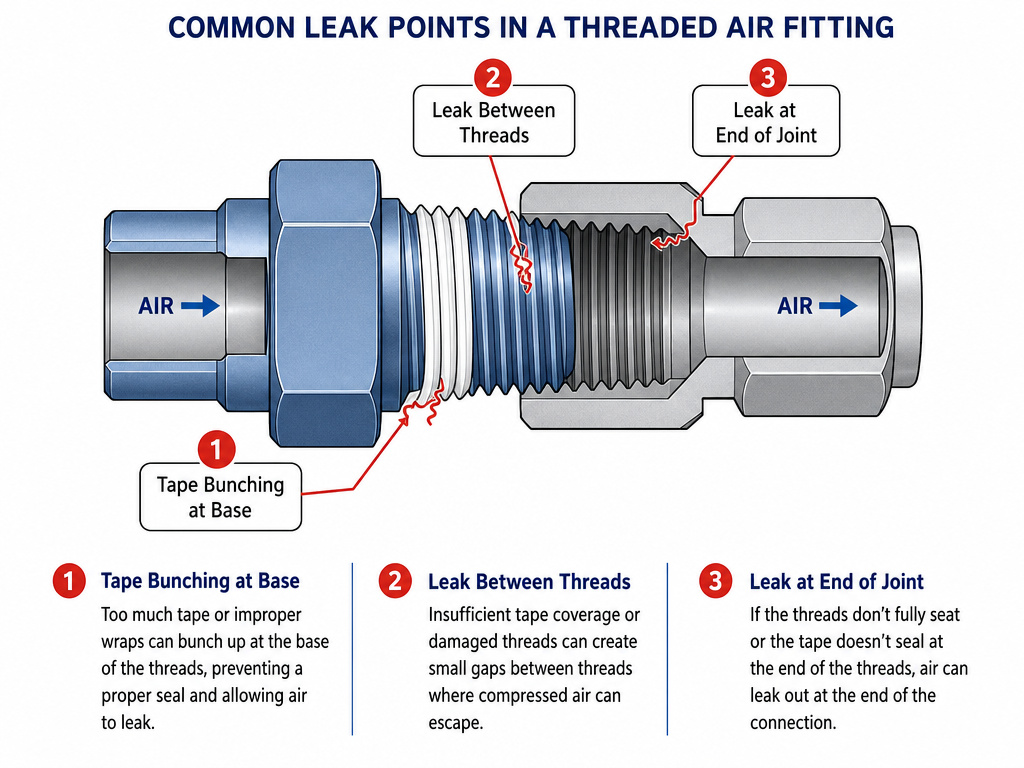
You followed the steps. It looked perfect. But there’s a hiss. Don’t just crank it tighter. Diagnose.
- Tape is Bunching at the Base: You started on the chamfer, not the first full thread. The tape had nowhere to go but pile up. Disassemble, clean, and re-wrap.
- Leak from Between Threads: You likely used too few wraps or didn’t pull the tape tight. The tape isn’t filling the thread valleys. Two perfect, tight layers beat four sloppy ones.
- Leak from the End of the Joint: You may have under-tightened. The tapered threads haven’t engaged enough to compress the tape. Tighten an additional half-turn. If that doesn’t work, the tape may have been damaged. Take it apart and check.
- Leak After a Few Days of Use: Vibration can work a joint loose, especially if it was barely past finger-tight. Check the tightness. Also, thermal cycling can cause slight expansion and contraction. For vibrating air tools, a paste alone is often the more reliable choice.
If you’re constantly battling leaks, your issue might be broader than one fitting. Review our guide on connecting an air hose to ensure your entire setup is sound.
Special Cases and Pro Tips
Not all fittings are simple brass NPT. Here’s how the rules change.
Stainless Steel Fittings: These are prone to galling, where the metals cold-weld and tear. The BFPA notes there are PTFE tapes specifically designed for stainless steel components. Their lubrication is critical. The IR257 report confirmed that covering every thread with tape prevents this galling.
Large Diameter Pipes (Over 1-1/4”): The Lowe’s/Oatey guide advises a hybrid approach for pipe sizes over 1 1/4 inch: wrap with tape first, then apply an approved pipe joint compound over the tape before assembly. The tape provides a backbone, and the compound fills any remaining imperfections.
Immediate Pressurization: One advantage of tape over some pastes is time. The IR257 report states fittings sealed with PTFE tape can be pressurized immediately after installation. Many anaerobic thread sealants require a 24-hour cure time, which is impractical for testing a new air line.
The “One-Wrap” Tape Exception: Some premium tapes are thicker and designed for a single wrap with a 50% overlap. If you’re using a product like this, follow its specific instructions, not the standard multi-wrap rule.
Remember, the goal is a sealed, reliable system. Choosing the right hose material and durable air couplers is just as important as sealing the threads.
Frequently Asked Questions
Do you use thread tape on air fittings?
Yes, PTFE thread tape is commonly and effectively used on NPT air fittings to seal and lubricate the connection. However, always check your specific tool or compressor manual first, as some manufacturers (like VIAIR) explicitly recommend thread sealant paste instead.
What is the correct direction to wrap Teflon tape?
Always wrap Teflon (PTFE) tape in a clockwise direction when looking at the end of the male threads. This is the same direction you will turn the fitting to tighten it, preventing the tape from unraveling and bunching.
How many wraps of Teflon tape should I use?
For most standard NPT air fittings, 2 to 4 tight, overlapping wraps is sufficient. Key standards disagree slightly: the BFPA recommends 2-3 revolutions, while the IR257 report says 3-4 turns.
Can I use Teflon tape on oxygen fittings?
No. You should never use standard PTFE tape on oxygen fittings. Oxygen service requires specially rated, non-combustible, and contaminant-free sealants. You should never use standard PTFE tape on oxygen fittings. Oxygen service requires specially rated, non-combustible, and contaminant-free sealants.
What’s the difference between white and yellow Teflon tape?
White tape is general-purpose. Yellow Teflon tape is gas-rated, made of higher-density PTFE, and is required for sealing natural gas, propane, and CNG lines. Its color also acts as a safety indicator that the line carries flammable gas.
Before You Go
The real secret isn’t in the number of wraps. It’s in the tension you pull with your thumb and the discipline to stop turning the wrench the moment the joint feels solid. A clean, dry thread with three perfect, tight, clockwise wraps will out-seal a messy six-wrap job every time.
When a manual tells you not to use tape, there’s usually a reason to protect sensitive components from tape shreds. In those cases, a thread sealant paste is the right tool for the job. But for the vast majority of workshop air lines, a roll of quality PTFE tape, applied with a little focus, is all the insurance you need against the hiss of a leak. Just don’t overthink it. And for goodness’ sake, don’t crank it like you’re trying to prove something.
