
10 Best Saw Blades For Miter Saw in 2026
This post contains affiliate links. As an Amazon Associate, we earn from qualifying purchases.
Our top recommendation for most woodworkers is the Diablo D1080X 10-Inch 80-Tooth Saw Blade for its excellent balance of smooth cuts and durability. For sliding miter saws, consider the Freud LU91R012, and for absolute precision, the Forrest Chopmaster. The wrong blade leads to chipped edges and splintered joints, especially on fine trim and sheet goods. The right one delivers a clean, ready-to-finish cut every time. We built this list through research into specifications, manufacturer details, and patterns in user feedback to help you choose confidently.
Top 10 Miter Saw Blades in the Market
Certain content that appears on this site comes from Amazon. This content is provided "as is" and is subject to change or removal at any time.
The Best Miter Saw Blades, Reviewed
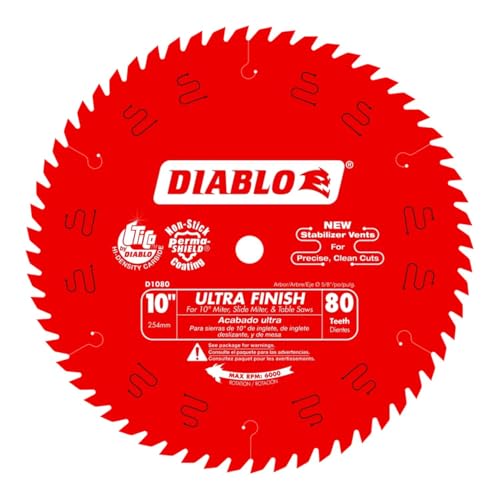
Diablo D1080X 10-Inch 80-Tooth Saw Blade
What We Like
- 80-tooth design for ultra-smooth cuts
- Premium carbide for long-lasting sharpness
- Reduced vibration design for stability
- Compact and lightweight for easy handling
Trade-offs
- 10-inch diameter limits cutting depth versus 12-inch blades
- 80 teeth cut slower in thick stock than a lower-tooth blade
The 80-tooth ATB grind is the key here, delivering the fine, splinter-free crosscuts you need for trim and finish work. Its premium carbide and PermaShield coating translate directly to a blade that stays sharper longer, resisting pitch and corrosion. This combination of a smooth finish and durable construction makes it a reliable, go-to blade for woodworkers and serious DIYers who demand precision from their 10-inch miter saw. It’s built to handle wood and composites with a level of finesse that turns a good project into a great one.
The trade-off for that smooth finish is cutting speed, especially in thicker hardwoods, where the high tooth count requires a more patient feed. It’s also a full-kerf blade, so it works best on saws with ample power. For those with a 12-inch sliding miter saw needing to tackle deeper cuts, a blade like the Freud LU91R012 offers a larger diameter and thin-kerf design that reduces strain on the motor. The Diablo D1080X excels within its intended scope, providing exceptional results for the vast majority of 10-inch miter saw applications.
Product photos
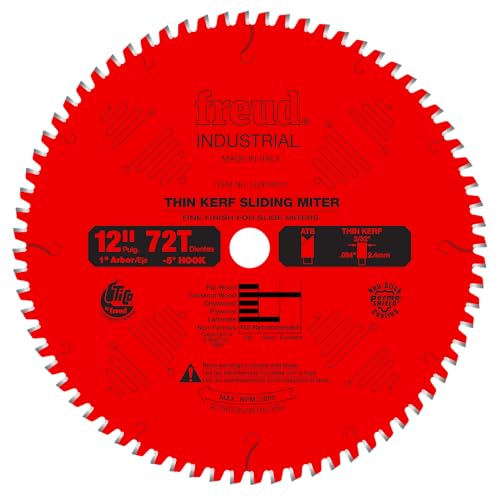
Freud LU91R012 12-Inch Thin Kerf Miter Saw Blade
What We Like
- Thin kerf design reduces strain on saw motors
- 5° negative hook angle prevents aggressive grabbing
- Perma-Shield coating reduces friction and pitch buildup
- Premium TiCo carbide blend for clean crosscuts
Trade-offs
- Thin kerf is less rigid than a full kerf blade
- Optimized for sliding miter saws, not radial arm saws
- 72-tooth ATB grind is for crosscuts, not ripping
A 5° negative hook angle paired with a thin kerf design makes this blade a specialist for sliding miter saws. That combination tames the blade’s aggressiveness on a sliding saw’s longer stroke, pushing the workpiece down against the fence instead of lifting it. The result is cleaner, safer crosscuts in hardwoods and sheet goods with less strain on your saw’s motor. It’s the right pick for anyone running a sliding compound miter saw who wants to minimize tear-out and maximize cut quality without bogging down.
A thin kerf design means this blade removes less material than a standard one, which eases the workload on your saw’s motor. That same narrow cut can be more prone to flexing under side pressure compared to a full-kerf blade like the Ridge Carbide RS11280-1. For precise crosscuts in trim and fine woodworking, it delivers clean results. Freud engineered this blade specifically for sliding compound miter saws to provide smooth, tear-out-free finish cuts.
Product photos
Forrest Chopmaster 12-Inch 80-Tooth Saw Blade

What We Like
- Heavy steel plate ensures maximum cutting stability
- Double-hard C-4 carbide for extended blade life
- 80-tooth design produces tight, splinter-free miter joints
- Works with all makes of chop and miter saws
Trade-offs
- Specific 1-inch arbor may need an adapter for some saws
The heavier-than-normal steel plate is the defining feature here, providing a level of rigidity that virtually eliminates blade deflection during a cut. That stability translates directly to the shop floor as perfectly tight miter joints with no bottom splintering. This blade is built for the woodworker who prioritizes flawless joinery in hardwoods and dense materials, where even a slight wobble can ruin a piece. The double-hard carbide teeth are a logical match, engineered to hold that sharp edge through extended use.
That premium performance comes with physical heft. At 3.6 pounds, this is a notably substantial blade, so it pairs best with a powerful, stable miter saw. If your saw struggles with full-kerf blades or you primarily cut softer woods, a lighter thin-kerf option like the Freud LU91R012 might be a more efficient choice. The Forrest Chopmaster is a specialist’s tool, trading easy handling for unwavering cut quality.
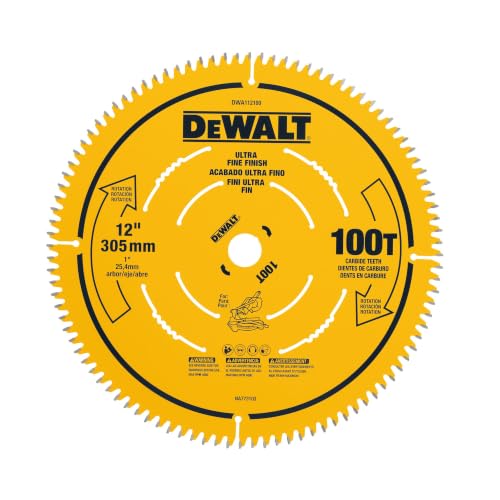
DEWALT DWA112100 12-Inch 100-Tooth Miter Saw Blade
What We Like
- Ultra sharp carbide for exceptionally clean cuts
- Patented slot design reduces vibration during operation
- Precision tensioning adds stiffness for improved accuracy
- Optimized tooth geometry enhances cutting precision
Trade-offs
- The 100-tooth count focuses solely on fine finishes, not speed
A 100-tooth ultra-sharp carbide blade delivers a crosscut so smooth it often needs no sanding. This DeWalt blade is built for the woodworker who needs cabinet-grade results right off the miter saw, especially on delicate moldings or expensive hardwoods. Its patented body slots fight vibration, and the precision tensioning keeps the plate stiff, so you get cleaner, more accurate cuts with less chatter. It’s a purpose-built tool for finish work, not rough framing.
Designed for an improved finish quality, this 100-tooth blade prioritizes smooth cuts over fast ones. Its high tooth count and optimized geometry aim for accuracy, making it a specialist for final trim and detailed woodwork. The blade’s patented body slots are intended to reduce vibration during operation.
Product photos
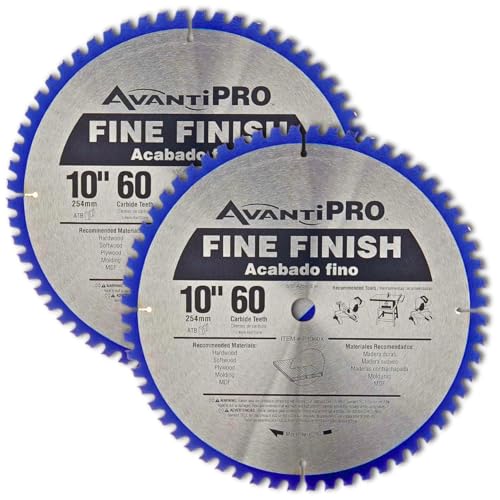
AvantiPro by Freud 10-Inch 60-Tooth Saw Blade 2-Pack
What We Like
- 60-tooth carbide blade for smooth cuts in wood and laminates
- Laser-cut vents reduce vibration and noise
- Two-pack offers convenience and cost savings
- Suitable for both miter saws and table saws
Trade-offs
- 10-inch size is not compatible with 12-inch miter saws
- 60-tooth design is less ideal for ultra-fine finish cuts than 80+ tooth blades
- Pack of two may be overkill for infrequent users
The two-blade pack is the concrete feature that defines this offering. Having a second blade ready to go means you can swap in a sharp one immediately when a project calls for it, avoiding downtime. That makes this set a practical choice for DIYers or pros who run their miter saws frequently and want to minimize interruptions. The 60-tooth carbide design delivers clean enough cuts in plywood and trim work to keep most users happy, and the laser-cut stabilizer vents help maintain accuracy by keeping blade wobble in check.
The AvantiPro by Freud 10-Inch 60-Tooth Saw Blade 2-Pack is a value set designed for fine-finish cuts in wood, plywood, and laminates. Its 60-tooth carbide-tipped design aims to reduce splintering and tear-out for smoother surfaces. Laser-cut stabilizer vents are included to minimize vibration and heat buildup, which helps improve cutting accuracy during extended use.
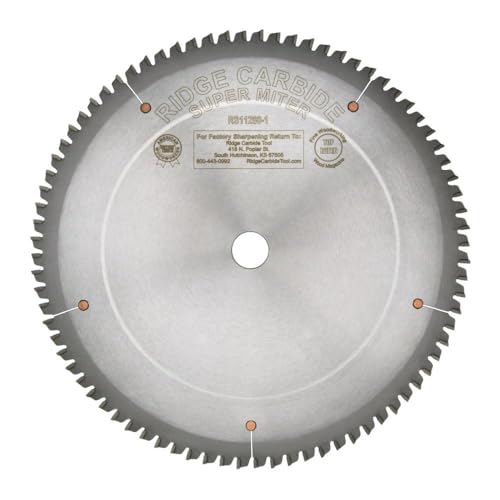
Ridge Carbide Tool Co. RS11280-1 Saw Blade
What We Like
- Full kerf and 0.087-inch plate for rigid, precise cuts
- AR 4+1 grind keeps blade straight during cutting
- Optimized for fine crosscutting on miter saws
- Negative hook angle reduces grab for safer operation
Trade-offs
- Full 0.125-inch kerf removes more material per pass
- 3.4-pound weight demands a powerful saw motor
A 0.087-inch plate and full kerf give this blade exceptional stability, which is the foundation for clean, dead-straight crosscuts in hardwoods and sheet goods. This is a blade built for precision, not speed. The -2-degree hook angle and 80-tooth AR 4+1 grind work together to slice through material without aggressive grabbing, leaving a finish that often needs little sanding. It suits a woodworker who prioritizes cut quality above all else and has a miter saw with enough power to handle the heft.
The trade-off for that rigidity is a thicker kerf that creates more waste and demands more from your saw’s motor compared to a thin-kerf option like the Freud LU91R012. This isn’t a general-purpose blade; it’s a specialist. You wouldn’t reach for it for rough dimensioning or thin trim. For dedicated crosscutting on a stationary miter saw, however, its design delivers a level of accuracy that justifies its focused purpose.
CMT Orange Tools 12-Inch Sliding Miter Saw Blade

What We Like
- Non-stick PTFE coating reduces friction and gumming.
- Laser-cut sound dampening slots for quieter operation.
- Tri-metal brazing for durable tooth attachment.
Trade-offs
- 0.122-inch kerf requires more power than a thin-kerf blade.
- Weighs 2.0 pounds, lighter than some premium 12-inch blades.
- Hook angle of -5 degrees is less aggressive for ripping.
The laser-cut plate and tensioning ring promote stability, which is critical when you’re trimming expensive cabinet panels and can’t afford tear-out. The non-stick coating is a smart touch, helping to keep the blade clear of sticky glue residues from laminates.
The trade-off is in the cut. Its full 0.122-inch kerf and -5-degree hook angle make it a dedicated crosscutting specialist, not a generalist. It demands a well-powered saw to drive that wider plate through the material. For a more versatile blade that still handles sheet goods well but with less drag, consider the thinner-kerf Freud LU91R012. The CMT blade, however, is the one you reach for when the finish is everything.
Product photos
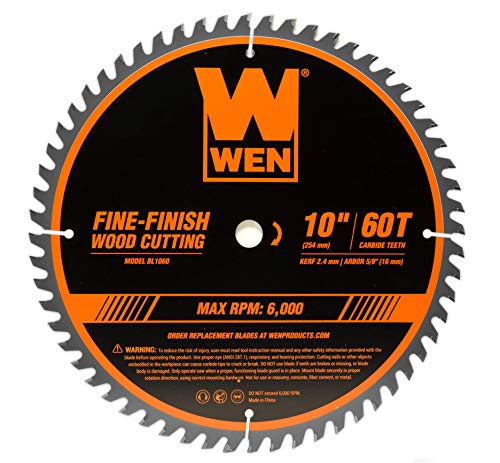
WEN BL1060 10-Inch 60-Tooth Fine-Finish Saw Blade
What We Like
- 60 carbide teeth for fine-finish wood cuts
- Ultra-thin kerf for clean, efficient cuts
- Cuts both hard and softwoods
- Compatible with most 10-inch miter and table saws
Trade-offs
- A 10-inch blade limits depth of cut versus 12-inch options
- Fine 60-tooth design is less suited for heavy ripping
With 60 carbide-tipped teeth, this blade is designed for fine-finish wood cutting, a purpose reflected in its ultra-thin kerf that provides clean and efficient cuts. It fits the majority of 10-inch miter saws, jobsite saws, and table saws, making it a straightforward option for common workshop tools. The blade is rated for up to 6000 RPM and is intended for slicing through both hard and softwoods.
Its specifications place it in the essential fine-finish category for home workshop projects. When compared to other blades like the 12-inch Forrest Chopmaster, the WEN model has a smaller diameter and lower weight, which are typical differences between 10-inch and 12-inch blades. For the price, it covers fundamental crosscutting needs without complex features.
Luckyway 12-Inch Miter Saw Blade 2-Pack

What We Like
- Two-blade set covers general and fine-finish cuts
- Tungsten carbide teeth for wear and heat resistance
- Compatible with major 12-inch miter saw brands
- Cuts hardwoods, softwoods, plywood, and embedded nail wood
Trade-offs
- Maximum speed rating of 4,500 RPM.
- Pack includes only two blade types.
Getting a 32-tooth general-purpose blade and an 80-tooth fine-finish blade in one pack means you can tackle a jobsite’s worth of cuts without needing to stop and resharpen. The tungsten carbide teeth are tough enough for embedded nails, which happens more often than you’d think on renovation work. This makes the Luckyway 2-pack a logical choice for contractors or serious DIYers who need a sharp blade on hand for dirty work and a clean blade for trim, all without a big upfront investment.
The Luckyway two-pack offers a convenient and budget-friendly solution, making it a practical choice for work that causes significant wear. Its 0.106-inch kerf is a standard width, and the pack includes both a 32-tooth blade for general purpose work and an 80-tooth blade for a finer finish. This combination helps users make quick, smooth, and accurate cuts in materials like hardwood, plywood, and even wood with embedded nails, according to the product description.
Product photos
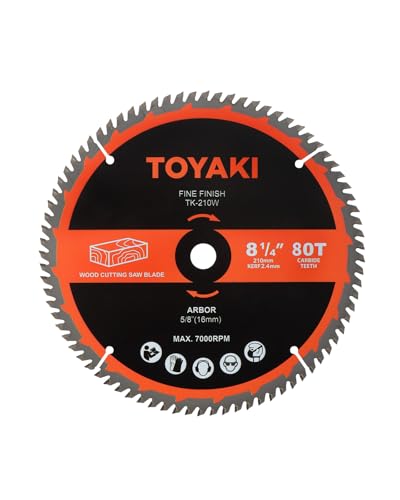
TOYAKI 8-1/4-Inch 80-Tooth Miter Saw Blade
What We Like
- Ultra-sharp carbide teeth for fine finishing.
- Versatile for miter, table, and circular saws.
- Lightweight, balanced design for stable cutting.
- 80-tooth design minimizes splintering in wood.
Trade-offs
- 8.25-inch diameter limits maximum cut depth.
- Not suitable for full-size 10-inch or 12-inch miter saws.
An 8-1/4-inch diameter makes this blade the clear choice for compact miter and table saws. The 80 ultra-sharp carbide teeth are built for a smooth, clean finish with minimal tear-out, which is exactly what you need for trim work or fine woodworking on a smaller machine. It’s a professional-grade blade that fits the niche of smaller-diameter tools perfectly, offering precision where full-sized blades simply won’t fit.
The trade-off is obvious: you’re buying a blade for a specific class of tool. For its intended compact saws, however, the balanced 0.8-pound design and 2.4mm plate provide a stable, vibration-free cut that belies its small size.
Product photos
How We Evaluated Miter Saw Blades
This guide is based on a review of manufacturer specifications for dimensions, materials, and tooth geometry. It also considers expert recommendations and common user experiences to assess performance and durability.
The most critical criteria were tooth count and design for cut quality, kerf width for motor strain and material waste, and blade plate construction for stability. We prioritized features that matter for miter saws specifically, like negative hook angles for safer crosscuts and specialized coatings for cutting laminates. A limitation of this research-based approach is that we cannot verify precise blade life or performance on every material type under controlled conditions.
What To Look For In Miter Saw Blades
Choosing the right blade transforms your miter saw from a rough-cutting tool into a precision instrument. The goal is to match the blade’s specifications to your most common tasks, whether that’s fast framing cuts or flawless finish work on expensive hardwood.
Focus on tooth count for finish, kerf width for your saw’s power, and blade diameter for compatibility. A higher tooth count (80+) yields a smoother cut but works slower. A thin kerf is easier on motors but less rigid than a full kerf.
Tooth Count & Design
Tooth count is your primary control over cut quality and speed. Blades with 24-40 teeth are for fast, rough cuts in construction lumber. A 60-tooth blade is a versatile all-rounder, while 80 to 100 teeth are for ultra-smooth, splinter-free finishes on trim and hardwoods. The tooth geometry also matters: an Alternate Top Bevel (ATB) grind is standard for clean crosscuts, which is the primary function of a miter saw. For more on blade designs, see our guide to saw blade types.
Kerf Width
Kerf is the width of the cut the blade makes. A thin kerf removes less material, reduces strain on your saw’s motor, and is ideal for lower-powered tools or cutting expensive hardwoods where you want to minimize waste. A full kerf uses a thicker, more rigid blade plate that resists deflection for straighter cuts in dense material but demands more power. Understanding the difference between thin and full kerf blades is key to matching the blade to your saw’s capability.
Blade Diameter & Arbor Size
This is a fundamental compatibility check. The most common sizes are 10-inch and 12-inch blades; using the wrong size is a safety hazard and will not fit your saw’s guard. The arbor size, the hole in the blade’s center, must match your saw’s arbor shaft. Most 10-inch miter saws use a 5/8-inch arbor, while 12-inch models typically use a 1-inch arbor. Always verify your saw’s manual. For specific recommendations, explore our reviews of 10-inch miter saw blades and 12-inch miter saw blades.
- Check your saw’s manual for the correct blade diameter and arbor size before purchasing.
- Ensure the blade’s maximum RPM rating exceeds your saw’s no-load speed.
- Look for laser-cut expansion slots to help dissipate heat and reduce vibration.
- Consider a non-stick coating (like Perma-Shield or PTFE) to reduce pitch buildup when cutting softwoods or composites.
A good rule of thumb: more teeth for a finer finish, a thinner kerf for a less powerful saw, and always double-check the diameter and arbor.
Miter Saw Blades Compared
The following table summarizes the key specifications of our top picks to help you compare them at a glance.
| Product | Diameter | Tooth Count | Arbor Size |
|---|---|---|---|
| Diablo D1080X 10-Inch 80-Tooth Saw Blade | 10 inches | 80 teeth | 5/8 inch |
| Freud LU91R012 12-Inch Thin Kerf Miter Saw Blade | 12 inches | 72 ATB grind | N/A |
| Forrest Chopmaster 12-Inch 80-Tooth Saw Blade | 12 inches | 80 teeth | 1 inch |
| DEWALT DWA112100 12-Inch 100-Tooth Miter Saw Blade | 12 inches | 100 teeth | N/A |
| AvantiPro by Freud 10-Inch 60-Tooth Saw Blade 2-Pack | 10 inches | 60 | N/A |
| Ridge Carbide Tool Co. RS11280-1 Saw Blade | 12 inches | 80 teeth | 1 inch |
| CMT Orange Tools 12-Inch Sliding Miter Saw Blade | 12 inches | N/A | N/A |
| WEN BL1060 10-Inch 60-Tooth Fine-Finish Saw Blade | 10 inches | 60 carbide-tipped teeth | 5/8 inch |
| Luckyway 12-Inch Miter Saw Blade 2-Pack | 12 inches | 32T & 80T blades | 1 inch |
| TOYAKI 8-1/4-Inch 80-Tooth Miter Saw Blade | 8.25-inch | 80 | 5/8-inch |
Frequently Asked Questions
What is the best miter saw blade for cutting trim?
For cutting trim and molding, you need a blade with a high tooth count (80 to 100 teeth) for a splinter-free edge. Look for a thin kerf design and a negative hook angle, which helps prevent the blade from grabbing and tearing the delicate wood fibers. Our picks for blades for trim and specialized blades for moulding are excellent starting points.
How often should I replace my miter saw blade?
Replace your blade when you notice a decline in cut quality, such as increased tear-out, burning, or a need to force the cut. For a carbide-tipped blade used regularly, this could be after several months of heavy use. Dull blades are unsafe and inefficient. Keeping a spare, like those in our best miter saw blades list, ensures you’re never stuck with a dull edge mid-project.
Can I use a table saw blade on my miter saw?
Yes, if the diameter and arbor size match. Many blades are marketed for both tools. However, miter saw blades are optimized for crosscutting and often have a higher tooth count and a specific hook angle for that purpose. A general-purpose table saw blade might not deliver the same fine finish on crosscuts. For a broader look, see our guide to circular saw blades.
What’s the difference between a chop saw blade and a miter saw blade?
The terms are often used interchangeably, as both tools perform crosscuts. Historically, “chop saw” referred to a basic vertical-cut saw, often for metal. Today, blades for cutting wood on a miter saw or a modern “chop saw” are essentially the same. The key is to select a blade based on the material you’re cutting, not the tool’s name. Our resource on chop saw blades covers compatible options.
Why does my new miter saw blade vibrate or make noise?
Vibration can be caused by an improper installation, a blade that isn’t suited to your saw’s power (e.g., a full-kerf blade on a low-powered saw), or a blade that is out of balance. Ensure the blade is mounted correctly and securely, the arbor washers are clean, and you’re using a blade with appropriate kerf and tooth design for your saw and material.
The Bottom Line
For most woodworkers and finish carpenters, the Diablo D1080X 10-Inch 80-Tooth Saw Blade is the best overall choice, delivering exceptionally smooth cuts and lasting sharpness for a wide range of fine woodworking tasks.
If you’re on a tight budget, the WEN BL1060 provides solid performance, while those needing blades for rough jobsite work should consider the Luckyway 2-pack. For sliding miter saws, the Freud LU91R012 is purpose-built to reduce motor strain.
Ultimately, matching the tooth count and kerf to your specific projects and your saw’s power is the single most important step to achieving clean, precise cuts every time.
