
What Is a Cyclone Dust Separator: How No Moving Parts Work
This post contains affiliate links. As an Amazon Associate, we earn from qualifying purchases.
A cyclone dust separator is a mechanical device that uses centrifugal force, not a filter, to spin dust and debris out of an air stream. It’s a pre-cleaner that catches the bulk of material before it reaches your shop vacuum or dust collector, preserving suction and filter life. A single cyclone collects well above 90 percent of particles larger than about 10 micrometres, which is why it’s often paired with a final filter.
That 10-micrometre threshold is the whole game. It means your shop vac’s bag or pleated filter isn’t getting clogged with wood chips, sawdust curls, or drywall chunks. The motor runs cooler, the suction stays strong, and you’re not buying a new $40 HEPA filter every third project. The trade-off is physics: a cyclone can’t catch what it can’t spin out, which is why understanding what is a cyclone dust separator is key; the finest, most hazardous dust needs a second stage.
What follows is the shop-floor view. We’ll break down how the vortex actually works, why static pressure matters more than CFM for your vacuum, and where a what is a cyclone dust separator fits between a shop vac and a full dust collector. By the end, you’ll know whether adding one is your next best shop upgrade or an overcomplication.
Key Takeaways
- A cyclone works by centrifugal force alone, with no filters to replace, making it ideal for high-dust-load jobs like planing or sanding drywall.
- Its efficiency is measured by the d50 cut size, the particle size it catches 50% of the time. Typical d50 cut size for a reverse-flow, tangential cyclone is 5 to 15 um.
- Adding a cyclone creates static pressure loss. A general encyclopedia describes a typical range of 2–10 inches of water, while industrial models like Donaldson’s have specific ranges (e.g., 5.6–4.1 in. Wg for the Model 12); match the separator to your vacuum’s power.
- For combustible dusts like fine wood flour or metal powder, a standard cyclone is not an explosion-proof device and requires special safety planning.
- In a two-stage system, the cyclone is the coarse pre-cleaner; you still need a final filter like a HEPA bag or cartridge to capture the sub-micron particles.
How a Cyclone Dust Separator Works (No Moving Parts)
Dirty air enters the cyclone body at a tangent, not straight in. That’s the first rule. Imagine swinging a bucket of water in a circle, the water presses against the bottom of the bucket. Now replace the bucket with a sealed metal cone and the water with air full of sawdust. The tangential inlet forces the airstream into a tight, downward-spinning vortex along the wall of the cone.
Centrifugal force does the rest. The heavier dust particles get flung outward to the walls. They lose speed, slide down the cone’s slope, and drop into a collection bin at the bottom. The cleaned air, now swirling in a tighter inner vortex, reverses direction at the bottom of the cone and travels back up through a central outlet pipe at the top.
A reverse-flow, tangential cyclone separator generates a dual vortex: a main downward spiral that carries coarse dust to the collection bin, and an inner upward spiral that carries the cleaned air and finer particles out through the central outlet. This design creates the centrifugal force required for separation without any internal filters or moving parts.
The whole mechanism of what is a cyclone dust separator relies on inlet velocity. According to Donaldson’s specifications for their industrial models, inlet velocities range from 3,580 to 7,360 feet per minute for their Model 12 and Model 44-50. Faster inlet speed creates more centrifugal force, which improves separation efficiency for a given particle size. But there’s a trade-off: higher velocity also means higher static pressure loss, which we’ll get to. The shape is standardized, too. The “Stairmand” and “Lapple” designs from the 1950s are still the reference geometries engineers use today.
You’ll know it’s working right when you empty the bin. The material inside will be dry, coarse, and looks exactly like what went into your tool. If you see a fine powder coating everything, the inlet velocity is too low, the seals are leaking, or you’re trying to separate particles smaller than the cyclone’s design cut point.
The d50 Cut Size: What “Efficiency” Actually Means
Manufacturers love to say “99% efficient.” That’s a useless number on its own. The only efficiency rating that matters for a cyclone is the d50 cut size.
The d50 is the particle diameter that the cyclone will collect with 50% probability. Particles larger than the d50 are likely to be caught; particles smaller are likely to escape. For a typical shop-grade, reverse-flow cyclone like a common aftermarket unit, the d50 is in the 5 to 15 micrometre range. A high-efficiency industrial design has a typical d50 cut size of 4 to 7 micrometres.
To put that in shop terms. A human hair is about 70 micrometres thick. Fine beach sand is around 100 micrometres. The dust you see floating in a sunbeam is often 10–50 micrometres. So a shop cyclone will catch most visible dust, but it will let the truly fine, lung-hazardous particles, the ones under 5 micrometres, pass through to your vacuum.
This is why a cyclone is a pre-cleaner, not a complete solution. Its job is to offload the bulk. Your shop vac’s HEPA filter is the final defense. The beauty is that by removing the bulk, the HEPA filter lasts ten times longer and doesn’t choke the motor. The table below shows what gets caught where.
| Particle Type | Approximate Size (Micrometres) | Caught By Shop Cyclone? | Needs Final Filter? |
|---|---|---|---|
| Wood chips, coarse sawdust | 500+ | Yes | No |
| Fine sawdust (visible) | 50 – 150 | Yes | No |
| Drywall dust (visible) | 10 – 50 | Mostly | Yes |
| Respirable silica dust | < 5 | No | Yes (HEPA Required) |
Where this goes sideways: Choosing a cyclone based on a “99% efficiency” claim without checking the d50. A unit rated for 99% efficiency on 100-micron particles is useless if you’re sanding wood or drywall, where the hazardous dust is under 10 microns. Always ask for the cut size.
This performance gap is the single biggest reason to understand the d50. It tells you exactly what the tool is for. If you’re mostly cleaning up chips from a planer or drill press shavings, a cyclone is nearly a total solution. If you’re sanding for hours, you’re buying it to protect your vacuum’s filter, not to clean the air you breathe.
Cyclone vs. Shop Vac vs. Dust Collector: The Static Pressure Trade-Off
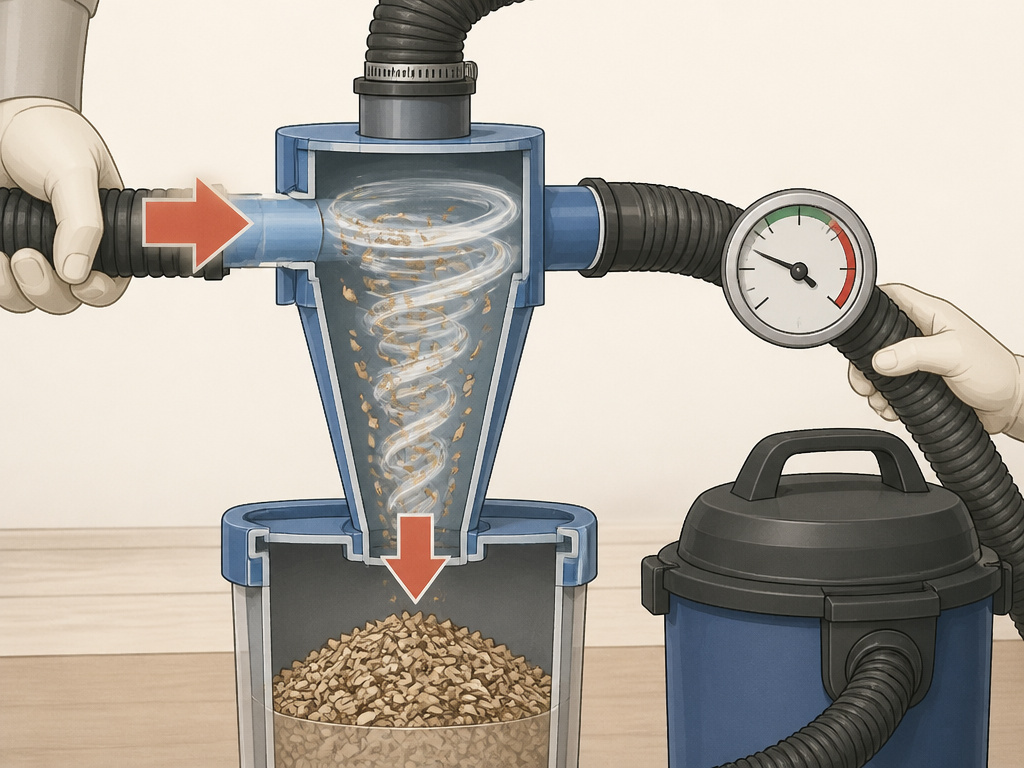
This is the decision that reshapes your shop. A cyclone isn’t a direct replacement for a shop vac or a dust collector; it changes how you use them. The key variable that dictates everything is static pressure, measured in inches of water gauge (in. Wg).
A shop vac is a high-static-pressure machine, designed to pull air through a long, narrow hose and a clogging filter. A dust collector is a high-airflow, low-static-pressure machine, typically moving large volumes of air but generating less static pressure than a shop vacuum, perfect for short, wide ducts.
Adding a cyclone introduces static pressure loss. That general encyclopedia figure of 2 to 10 inches of water is a starting point. Donaldson’s spec sheets show their Model 12 losing 4.1–5.6 in. Wg and their massive Model 44-50 losing 7.0–18.8 in. Wg. Your vacuum must have enough spare pressure capacity to overcome the cyclone’s static pressure loss and still pull chips through the hose.
| Tool Type | Primary Strength | Static Pressure Range | Best Paired With Cyclone For… |
|---|---|---|---|
| Shop Vacuum | High suction (pressure) | 60 – 120+ in. Wg | Single-tool hookups (sander, router). The cyclone protects the filter from rapid clogging. |
| Cyclone Separator | Bulk pre-cleaning | Creates 2 – 10 in. Wg loss | Must be matched to a vacuum or collector strong enough to handle the added pressure drop. |
| Dust Collector | High volume (airflow) | 5 – 12 in. Wg | Central ducted systems. A large cyclone acts as a pre-cleaner before the collector’s main filter bag. |
The math is simple but critical. If your shop vac’s static pressure capacity is significantly reduced by the cyclone’s pressure drop, you will have less suction available for actual work. That’s usually fine. But if you have a low-power vacuum and add a cyclone with a high pressure drop, you’ll starve the motor. The suction at the tool end will feel pathetic, chips will stall in the hose, and you’ll blame the cyclone when the problem is the mismatch.
For a central dust collection system, the calculus flips. Here, you’re choosing between a single-stage vs two-stage dust collector. A single-stage unit dumps everything directly into the collector bag. A two-stage system places a large cyclone in front of the collector. The cyclone catches the bulk of the material, so the collector bag only sees fine dust. This keeps airflow high and reduces how often you need to empty the main bag.
Reading a Real Spec Sheet: The Donaldson Model 12 Example
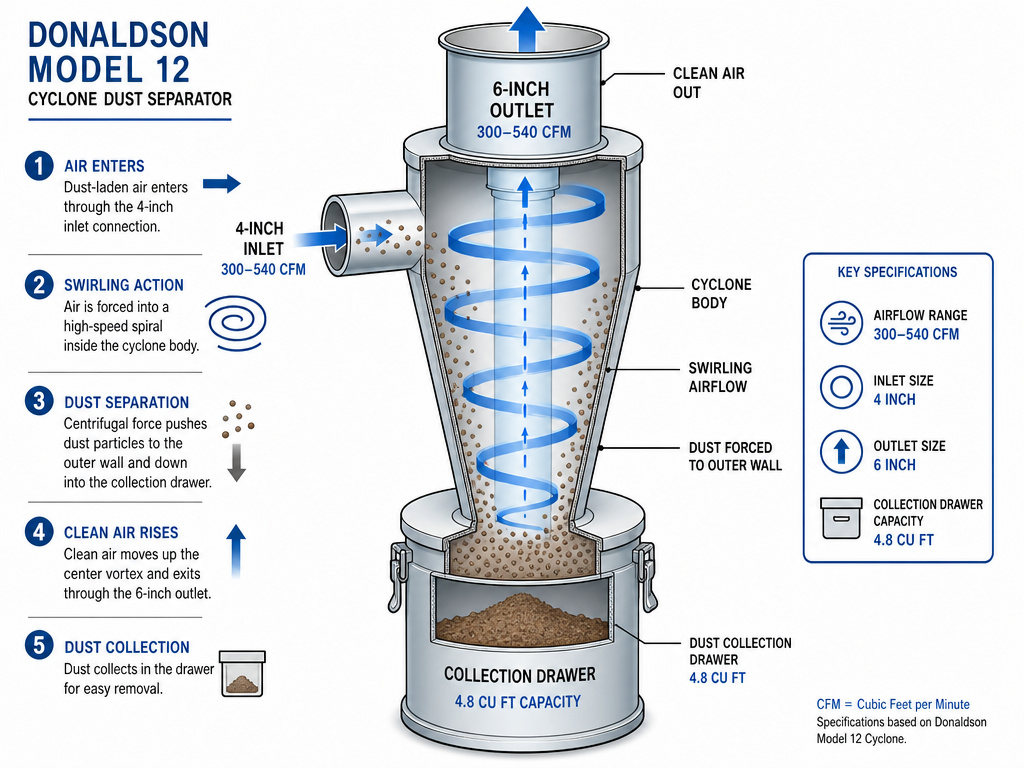
Industrial spec sheets cut through the marketing. We’ll examine the Donaldson Cyclone Model 12, a small industrial unit, using numbers from their official manual. This shows you what to look for even in a smaller shop model.
Airflow & Pressure: The Model 12 handles 300–540 CFM. Its external static pressure is 5.6–4.1 inches wg. Notice the pressure drops as airflow increases, that’s a fan curve, and it’s present on every blower. This means if you’re pushing the max 540 CFM, you only have 4.1 inches of pressure to work with after the cyclone.
Physical Connections: It has a 4-inch diameter air inlet and a 6-inch diameter air outlet. This tells you immediately what size ductwork you need. Mismatched sizes kill airflow.
Dust Capacity: The dust drawer holds 4.8 cubic feet; the optional hopper holds 12.0 cubic feet. For a small shop, 4.8 cubic feet is a week’s worth of planer chips. You’re not emptying it every hour.
The Afterfilter: The optional afterfilter for the Model 12 has 1 bag with 15 cubic feet of filter area. This is the secondary stage. After the cyclone spins out the chips, this bag catches the fine dust that escaped. In a shop setup, this is your shop vac’s HEPA filter.
Why does this matter for a DIYer? Because these same parameters. CFM, static pressure loss, inlet size, capacity, are what you must match when you look at any best cyclone dust separators for your shop. A unit with a 2.5-inch inlet won’t work well on a 4-inch dust collector port. A high-CFM cyclone will strangle a low-power shop vac. The specs tell the story the marketing copy glosses over.
Safety, Combustible Dust, and What the Manuals Warn About
This is the part most hobbyist articles skip, and it’s where the industrial manuals get deadly serious. Cyclones are excellent for woodworking. But if you’re working with certain materials, a standard cyclone is a potential bomb.
Donaldson’s installation manual has a clear warning: “Combustible materials represent potential fire and/or explosion hazards.” It states that standard equipment is not equipped with fire extinguishing or explosion protection systems.
The mechanism is well understood. Fine dust suspended in air at the right concentration is flammable. A spark from a motor, a static electricity discharge, or a hot piece of metal can ignite it. Inside a sealed metal cyclone, that ignition becomes a pressure explosion. Materials like fine aluminum powder, magnesium, certain wood flours, and powdered sugars are notorious risks.
Before you start: If you are collecting any dust that is explosible (wood flour, fine metal powders, certain plastics, food products), you must consult National Fire Protection Association (NFPA) standards like NFPA 652 and 664. A standard shop cyclone does not have explosion vents or suppression systems. Treat it as a hazard, not just a tool.
For the typical weekend warrior sanding pine, this is a low-probability concern. But if you’re machining powdered metal composites or sanding large volumes of exceptionally fine wood dust, you need to know the risk exists. The first line of defense is grounding the system to prevent static buildup. Use conductive hoses and ensure all parts are electrically bonded. The second is never to use a standard cyclone for known explosible dusts without a professional risk assessment.
This safety context is part of the broader Wikipedia entry on cyclonic separation, which details its use in heavy industries where these risks are managed daily. Your home shop isn’t a chemical plant, but the physics of combustion don’t care.
Setting Up Your First Cyclone: The 4-Step Leak-Down Test
You bought a unit like the popular Oneida Dust Deputy or a similar best cyclone collector. The kit is on your bench. Here’s the shop-floor sequence that prevents the most common first-timer frustration: weak suction.
- Assemble and Seal (Not Just Tighten). Dry-fit all components first. Then, use duct sealant (not tape) on every threaded connection and gasket face. A vacuum pulls air in through every microscopic leak, robbing suction at the tool. A hiss means a leak.
- Match the Hose IDs. If the cyclone has a 2-inch outlet and your shop vac has a 1.5-inch inlet, you need a reducing adapter. Avoid stepping down more than one size. Better to use a hose that matches the largest port and reduce at the tool end.
- Mount it Solidly. The unit will have weight when the bin is full. Mount it to a wall or a stable cart. A wobbly cyclone can tip over, breaking seals and spilling debris. Donaldson’s manuals even specify seismic ratings for their large units, your shop wall is fine.
- Run the Leak-Down Test. This is the tell. Plug your shop vac into the cyclone, turn it on, and let it run for 30 seconds. Then, place your hand completely over the cyclone’s inlet. You should feel strong suction holding your hand in place for at least 5-10 seconds before the vacuum motor sounds strained. If the suction dies instantly, you have a major leak, usually at the bin lid seal or a hose connection.
Following a disciplined workshop dust collection setup process from the start saves hours of troubleshooting. The goal is an airtight system. Your ears will tell you more than your eyes, a high-pitched whistling is a small leak; a rushing wind sound is a big one.
Frequently Asked Questions
What does a cyclone dust separator do?
It removes the bulk of coarse dust and chips from an air stream using centrifugal force before that air reaches your shop vacuum or dust collector. This prevents the vacuum’s filter from clogging quickly, maintains strong suction, and extends the life of expensive HEPA filters. It’s a pre-cleaner, not a final filter.
Are cyclone separators worth it for a home workshop?
Absolutely, if you use your shop vac for more than just sweeping floors. If you regularly generate chips (from a planer, jointer, or drill press) or large volumes of dust (sanding drywall, wood), a cyclone will pay for itself in saved filter costs and time not spent unclogging the vacuum. For occasional use, it’s likely overkill.
What’s the difference between a cyclone separator and a dust collector?
Cyclone separator is a component that uses centrifugal force for separation. A dust collector is a complete system that includes a motor, fan, filter, and collection bag. A cyclone can be a standalone pre-cleaner for a shop vac, or it can be integrated as the first stage of a two-stage dust collector vs shop vac system. The collector provides the airflow; the cyclone provides the initial separation.
Which is better, a metal or plastic cyclone body?
For home shops, a high-quality plastic (like ABS) is fine, lighter, and cheaper. Industrial units like the Donaldson Cyclone are heavy-duty metal to handle physical abrasion. Cyclone separators in general can tolerate high temperatures, often to 350 to 540 degrees Celsius in carbon or stainless steel. For non-combustible wood dust, plastic is sufficient.
Can I build my own DIY cyclone separator?
You can, and many plans exist using buckets and PVC. The challenge is engineering the inlet and vortex finder (the central outlet tube) to the correct geometry and ensuring it’s perfectly airtight. A homemade unit will work for chips but often has a much higher d50 cut size (poor fine-dust collection) compared to a commercially designed model. For reliable performance, a commercial kit is worth the investment.
Why is my cyclone separator losing suction?
Three likely causes, in order: 1) A leak in the lid seal or between hoses (most common). 2) The collection bin is full, blocking the air path. 3) The shop vac motor is underpowered for the static pressure loss the cyclone introduces. Start by doing the leak-down test described in the setup section.
The Bottom Line
A cyclone dust separator isn’t magic. It’s a simple, clever tool that offloads the dirty work from your shop vacuum. Its value isn’t in creating cleaner air, you still need a final filter for that. Its value is in making your entire dust collection system last longer and work harder.
The rule for adding one is mechanical: if your vacuum has enough static pressure reserve to spare the pressure drop the cyclone will introduce, it’s a straightforward win. If you’re running a basic, low-power vac, solve that first. In a well-planned complete dust system, the cyclone is the workhorse that keeps the expensive filters from becoming consumables. That’s the kind of efficiency that pays off every time you turn on a tool.
