
Heat Gun vs Hair Dryer: Which Should You Use?
This post contains affiliate links. As an Amazon Associate, we earn from qualifying purchases.
A heat gun is a high-temperature, precision tool for softening, shaping, or stripping materials, while a hair dryer is a low-temperature appliance for drying and gentle warming. The Wagner HT1000 heat gun runs from 369°C to 538°C (750°F to 1000°F); a typical hair dryer maxes out around 100°C. For tasks like paint removal or shrink tubing, the heat gun’s focused, stable heat is mandatory. For drying watercolors or a damp surface, a hair dryer’s gentle, wide airflow is the safer choice.
The temperature gap isn’t just a number on a box. It’s the difference between a tool that softens paint in seconds and one that just makes it warm, a key distinction in the heat gun vs hair dryer comparison. That gap determines what breaks, what works, and what catches fire when you push a tool past its design limits.
What follows is a breakdown of the engineering, the numbers, and the real-world consequences. This article explains temperature and airflow specs, the internal components that make them different, and a task-by-task guide to using the right tool without damaging your project or your equipment.
Key Takeaways
- Sources vary on heat gun ranges; one states they operate between 100°C and 760°C, while another states they provide heat from 50°C to 600°C+. Hair dryers typically max out at 50°C to 100°C. The SEEKONE 1800W model has an operating temperature range of 50°C to 650°C.
- Hair dryers have wide, diffused airflow that cools quickly; heat guns provide a focused, stable jet for consistent material heating.
- Using a hair dryer for high-heat tasks like paint stripping can overheat its motor within minutes, risking burnout or fire due to back pressure.
- For professional shrink wrap, vinyl application, or paint removal, a variable-temperature heat gun is essential. A hair dryer cannot deliver the required sustained heat. A hair dryer cannot deliver the required sustained heat.
- Match the tool to the thermal demand. A hair dryer is suitable for crafts and drying; a heat gun is for material work where precise, high heat is needed.
How Hot Does a Heat Gun Get vs. A Hair Dryer?
This is the core of the heat gun vs hair dryer debate. The numbers tell the story, but they vary by model. The Wagner HT1000 heat gun has a range of 369°C to 538°C (750°F to 1000°F). The WEN 1500 Watt model operates between 300°C and 600°C (572°F to 1112°F). On the extreme end, the SEEKONE 1800W and DIAFIELD 1850W models have maximum temperatures of 650°C. Most general-purpose heat guns blow air between 100°C and 760°C.
Hair dryer temperatures are a subject of disagreement among sources. Some, like Paint9Art, cite a range of 35°C to 54°C (95°F to 130°F). Others, like First Rate Tools, state 50°C to 100°C. A few sources claim maximums around 140°C, while others suggest a lower range of 26°C to 60°C.
Most heat guns blow hot air at a temperature between 100 – 760°C (200-1400°F). Hair dryers provide wide, gentle, inconsistent heat in the 50–100°C range. This order-of-magnitude difference defines their separate worlds of use.
The practical effect of the heat gun vs hair dryer difference is immediate. Try to strip paint, which requires 482°C to 649°C to soften the bond, with a hair dryer and you’ll stand there until the motor gives out. The paint will get warm, not pliable. The heat gun does it in passes, with the paint bubbling up for easy scraping. The difference isn’t about speed; it’s about reaching the material’s activation temperature at all.
| Tool Type | Typical Temperature Range | Peak Temperature (High-End Model) | Primary Thermal Characteristic |
|---|---|---|---|
| Heat Gun | 100°C – 760°C (200°F – 1400°F) | 650°C (1202°F) – SEEKONE 1800W | High, stable, focused heat |
| Hair Dryer | Sources vary (e.g., 50°C – 100°C) | Disputed (e.g., ~140°C) | Low, dissipating, wide heat |
The stability matters as much as the peak. A heat gun’s temperature curve holds steady at a set distance. A hair dryer’s temperature drops sharply because its high-volume airflow dilutes the heat before it reaches the surface. You might feel hot air at the nozzle, but by the time it hits your workpiece, it’s lost most of its thermal energy.
The Internal Design: Built for Two Different Jobs
They look similar, a handle, a barrel, a fan, but inside, they are engineered for opposite purposes. A heat gun is built like a furnace; a hair dryer is built like a fan with a warming element.
A heat gun’s components are rated for extreme, sustained heat. The heating coil is made of Nickel-Chromium (NiCr), which resists oxidation at high temperatures. It’s wrapped around a mica insulation tube. The internal wires are high-temperature silicone, and the airflow channel is narrow to create a high-pressure, focused jet. It includes safety components like an NTC thermistor and a thermal fuse to prevent meltdown.
A hair dryer uses lower-temperature resistance wire, a plastic housing, and a large diffuser duct. Its airflow channel is weak and wide, designed to move a large volume of air with minimal back pressure. There is no nozzle control or serious thermal protection beyond a basic ALCI plug for shock prevention.
This engineering dictates duty cycle. A heat gun like the Genesis GHG1500A is tested for runs of 20 to 60 minutes. A hair dryer is built for short bursts and is not built for long, sustained use at high temperatures. Push it longer on a high-heat setting against a surface, and you’re asking for failure.
Where this goes sideways: Using a hair dryer to thaw a pipe or warm a large vinyl sheet. The back pressure from holding it close instantly overheats the internal coils. You’ll smell a faint burning plastic odor within a minute or two, and the motor can burn out or even ignite nearby dust.
The airflow numbers are just as telling. A heat gun moves 250–500 liters per minute in a tight stream. A hair dryer might move similar volume, but it’s a broad cone that dissipates fast. For tasks like applying heat shrink tubing, that focused stream is everything. The hair dryer’s wide flow will blow the tubing away or heat it unevenly, leaving wrinkles.
Task-by-Task Comparison: When to Use Which Tool
This is the decision matrix. Don’t think about the tools; think about the material you’re working with and the temperature it requires. Here’s how they stack up for common jobs.
| Task | Required Temperature | Heat Gun Verdict | Hair Dryer Verdict | Key Reason |
|---|---|---|---|---|
| Paint Stripping | 482°C – 649°C (900°F – 1200°F) | Required | Ineffective & Risky | Hair dryer cannot reach softening point. |
| Shrink Tubing | Sources disagree on optimal temperature: one states 177°C – 260°C, while another states at least 150–160°C. | Ideal | Possible, but Poor | Uneven heat causes wrinkles; blows tubing. |
| Vinyl/Wrap Application | 60°C – 80°C (140°F – 176°F) | Ideal (Low Setting) | Marginal | Lacks precise, even heat; can overstretch. |
| Drying Watercolor Paint | Ambient to 60°C (140°F) | Overkill & Risky | Ideal | Lower heat prevents paper warping or burning. |
| Thawing Pipes | Steady heat >100°C | Effective | Inefficient | Cannot sustain enough BTUs to penetrate ice. |
| Removing Stickers/Adhesive | 100°C – 200°C (212°F – 392°F) | Fast & Effective | Slow but Works | Low heat works eventually on weak adhesives. |
For paint stripping, the heat gun is the only legitimate choice. The hair dryer’s output is a fraction of the needed temperature. You’ll waste an afternoon and likely overheat the dryer.
Shrink tubing is a common point of confusion. While a hair dryer can sometimes activate very thin tubing if held close, the result is often messy. A heat gun with a reflector nozzle delivers even, circumferential heat for a smooth, professional shrink in seconds. This is why for any electrical or professional work, a guide to heat gun temperature settings is your first read.
Crafts are the hair dryer’s domain. Drying watercolors, accelerating glue, or warming clay requires gentle, wide heat. A heat gun here is dangerous overkill. Its concentrated stream can scorch paper or create hot spots that warp your project. The hair dryer’s diffuse airflow is a feature, not a bug, for this work.
Safety Warnings and Common Failure Modes
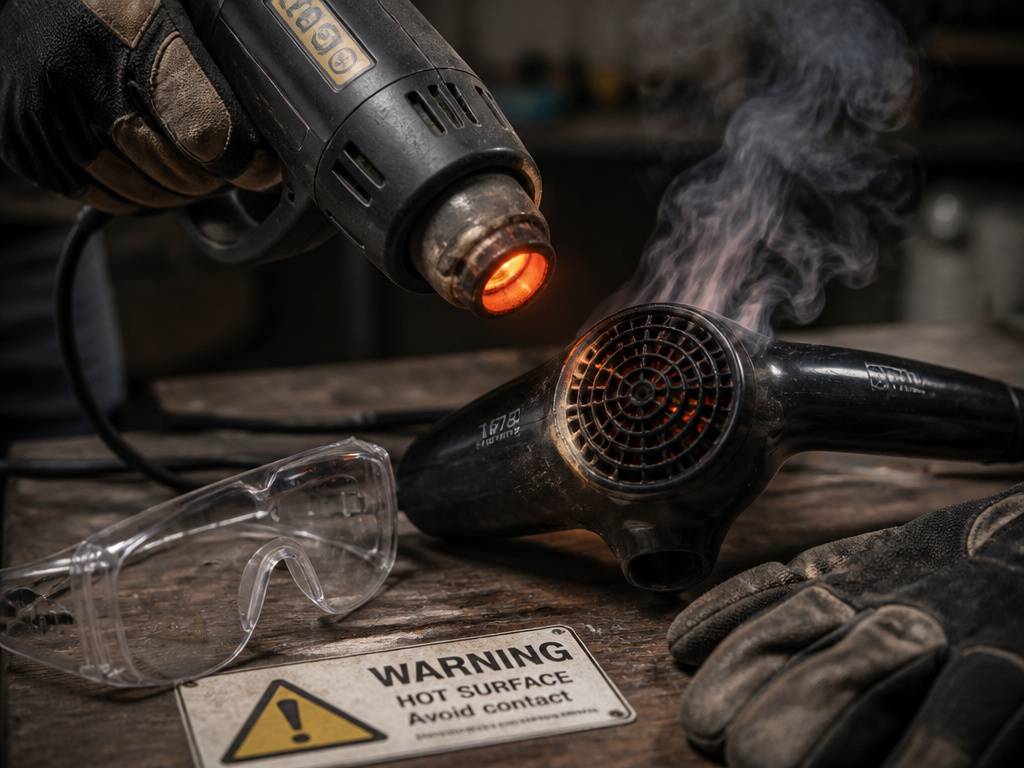
Before you start: Heat guns operate at skin-burning temperatures in seconds. Always wear gloves and eye protection. Never point a heat gun at flammable materials or liquids. Hair dryers lack overload protection for sustained material heating, pushing them can cause internal fires.
The failure modes are predictable because the designs are different. A heat gun’s primary risk is user error: igniting something, causing a burn, or breathing fumes from heated paint or plastic. Modern models have overheat protection that cycles the element off while the fan cools it.
If a hair dryer is held too close to a surface, it can instantly overheat the internal coils and burn out the motor, or even cause a small fire.
I learned this the hard way trying to soften an old label on a tool cabinet. The hair dryer got quiet, then emitted a sharp electrical smell. I unplugged it just before the magic smoke escaped. The motor was never the same. That’s a typical timeline: restricted airflow leads to rapid overheating, followed by a burned-out motor or melted internals.
Heat guns have their own nuance. Using a small-diameter nozzle concentrates heat in a tiny area. On an older model without precise temperature control, this can cause the gun to overheat and cycle off because the reflected heat is too intense. Newer digital models with precise temperature control adjust power to maintain a set temperature.
Can You Use a Hair Dryer as a Heat Gun? The Exceptions.
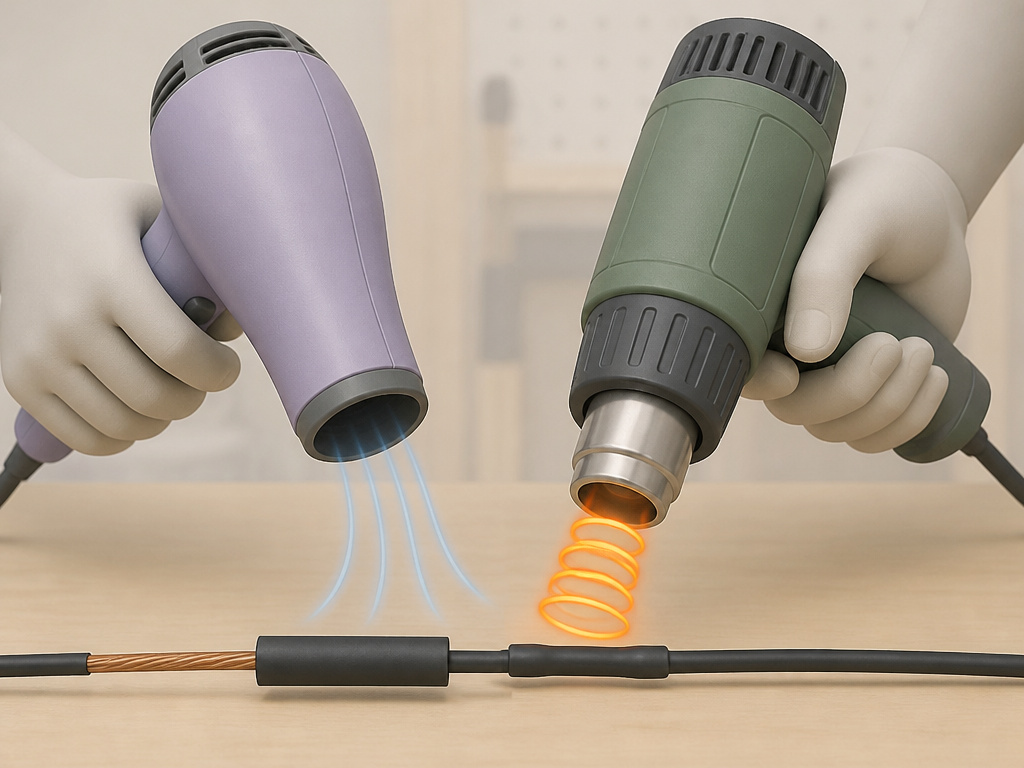
The blanket answer is no. But for a very narrow set of low-temperature, low-stakes tasks, a hair dryer can be a passable substitute for a heat gun in a pinch.
When a hair dryer might suffice:
- Softening weak adhesives on stickers or labels.
- Gently warming candle wax to smooth it out.
- Drying water-based paints or crafts where even, low heat is needed.
- Shrinking the thinnest, lightest-gauge shrink tubing, if you have patience and a steady hand.
When it absolutely will not work:
- Any paint stripping.
- Bending plastics like PVC or acrylic.
- Thawing frozen metal pipes.
- Removing vinyl graphics or window tint.
- Any task requiring sustained heat over 150°C.
The compromise is always time and quality. The hair dryer will take three times as long and deliver half the quality. For a one-time, non-critical job, that might be acceptable. For anything you care about, from a clean electrical connection to a smooth paint removal, the right tool is a heat gun.
Choosing the Right Tool for Your Projects
If your work involves materials, not moisture, invest in a corded variable-temperature heat gun. For most DIYers, a corded variable-temperature model is the starting point. It offers control for different tasks, from shrink tubing at 200°C to paint removal at 500°C.
- For all-purpose DIY: A variable-temperature model like the SEEKONE 1800W or a Wagner with a range of nozzles. * For crafts and electronics: A model with digital readout for precise control. * For heavy-duty stripping: A high-wattage gun (1500W+) with robust construction.
If your needs are purely for drying, hair, crafts, washed tools, a hair dryer is the tool. Look for one with multiple heat/airflow settings. For workshop drying, a dedicated professional blower dryer is actually a better choice than a hair dryer, as it’s built for longer runtimes.
The choice often comes down to thermal mass. A heat gun is designed to transfer a lot of heat into a small area quickly. A hair dryer is designed to evaporate moisture with warm, moving air. Confusing the two is how projects get ruined and tools get broken.
Frequently Asked Questions
Can a hair dryer melt solder?
It’s highly unlikely and not advised. Hair dryers lack the focused, stable heat required for soldering, as their maximum temperature is typically well below the melting point of solder. You risk overheating components without properly melting the joint. For any electronics work, a dedicated soldering iron or a temperature-controlled hot air rework station is the correct tool.
Is a heat gun better for vinyl wrap than a hair dryer?
Yes, unequivocally. Vinyl wrapping requires precise, even heat in the 60°C to 80°C range to activate adhesive and make the material pliable without overstretching. A heat gun’s focused airflow allows for controlled application. A hair dryer’s wide, cooler airflow can lead to wrinkles, weak adhesive bonds, and an unprofessional finish.
What can I use instead of a heat gun for shrink tubing?
For very occasional, small-gauge tubing, a hair dryer on its highest setting held very close can sometimes work poorly. A better alternative for a one-off job is a butane torch held at a distance, though this introduces a flame risk. For reliability and safety, a basic low-temperature heat gun is a modest investment that guarantees good results.
Can using a hair dryer as a heat gun damage it?
Yes, and quickly. Using a hair dryer for tasks that require holding it close to a surface restricts airflow, causing internal components to overheat. This can burn out the motor, melt plastic housings, or in worst cases, start an electrical fire. Hair dryers are not built for the duty cycle or thermal load of material-heating tasks.
How do I control a heat gun’s temperature?
Basic models have high/low switches. Better DIY models have a variable dial that adjusts power input, giving a range (e.g., 50°C–600°C). Professional models feature digital controls that let you set an exact temperature, which the gun maintains via internal sensors. Start low and increase until you get the desired effect on your material.
The Bottom Line
This isn’t a close call. A heat gun and a hair dryer are different tools engineered for different energy-transfer tasks. The 600-degree temperature gap is the whole story.
If you need to add significant heat to a material, to change its state, soften it, or bond it, you need a heat gun. Its stable, focused output is what makes those jobs possible. If you need to remove moisture or apply gentle warmth, a hair dryer’s diffuse airflow is the right and safe choice.
Trying to force one to do the other’s job doesn’t end with a slightly worse result. It ends with a melted tool, a burned workpiece, or a safety hazard. Match the tool to the thermal demand. For the vast majority of workshop and repair tasks, that means having a heat gun in your kit. Keep the hair dryer for the bathroom and the crafts table.
