
Types of Sandblasters Explained: How to Choose
This post contains affiliate links. As an Amazon Associate, we earn from qualifying purchases.
Types of sandblasters are defined by how they get abrasive media moving fast enough to clean or profile a surface. The four fundamental systems are siphon (suction), pressure pot, wet/vapor blasting, and centrifugal wheel (airless). Siphon blasters use air flow to pull media, ideal for light work. Pressure pots push media with pressurized air for heavy-duty stripping. Wet systems inject water to suppress dust. Centrifugal wheels mechanically throw media, suited for high-volume industrial tasks.
That push-versus-pull distinction decides everything from your air compressor needs to the job you can finish by lunch. Get the mechanism wrong, and you’ll burn through media, strain your compressor, and end up with a surface that coatings won’t stick to. The different types of sandblasters explained here determine that critical mechanism.
What follows is a breakdown of each system’s guts, how they work, the air and media they demand, and the specific jobs they were built to ace, as part of the types of sandblasters explained here. By the end, you’ll know which machine answers “clean my patio furniture” and which one answers “strip a bridge girder.”
Key Takeaways
- Siphon blasters need high air volume, not just high pressure, to create suction, a 5/16 inch nozzle demands 137 CFM at 100 psi.
- Centrifugal wheel machines are limited to ferrous (metallic) media like steel shot, unlike air systems that can run almost anything.
- Wet/vapor blasting, like Graco’s EcoQuip line, injects water to suppress dust but introduces slurry management and flash rust risk.
- Reusing media that has absorbed moisture guarantees instant clogs in the blast gun and a frustrating, non-productive mess.
How a Sandblaster Works (The Short Version)
All sandblasters do one thing: accelerate abrasive particles. The method changes the speed, control, and cost.
Think of it like throwing a baseball. A siphon system is like throwing underhand, it gets the ball moving using existing momentum. A pressure pot is a full-windup overhand throw. A centrifugal wheel is a pitching machine: consistent, powerful, but fixed in place. The energy source, your arm, a compressed air tank, an electric motor, changes how hard and how often you can throw.
The machine’s real job, as the types of sandblasters explained show, is delivering clean, dry air and a consistent flow of dry abrasive to the mixing point. Anything less, and performance falls off a cliff. That’s why your first check is always the air filter and media moisture.
A common fault is a clogged coalescing air filter or failed separator allowing damp air. This causes the metering valve to cake with wet abrasive and surge, making the blast stream pulse weakly instead of flowing steadily.
Siphon vs Pressure vs Wet: The Air-Powered Types
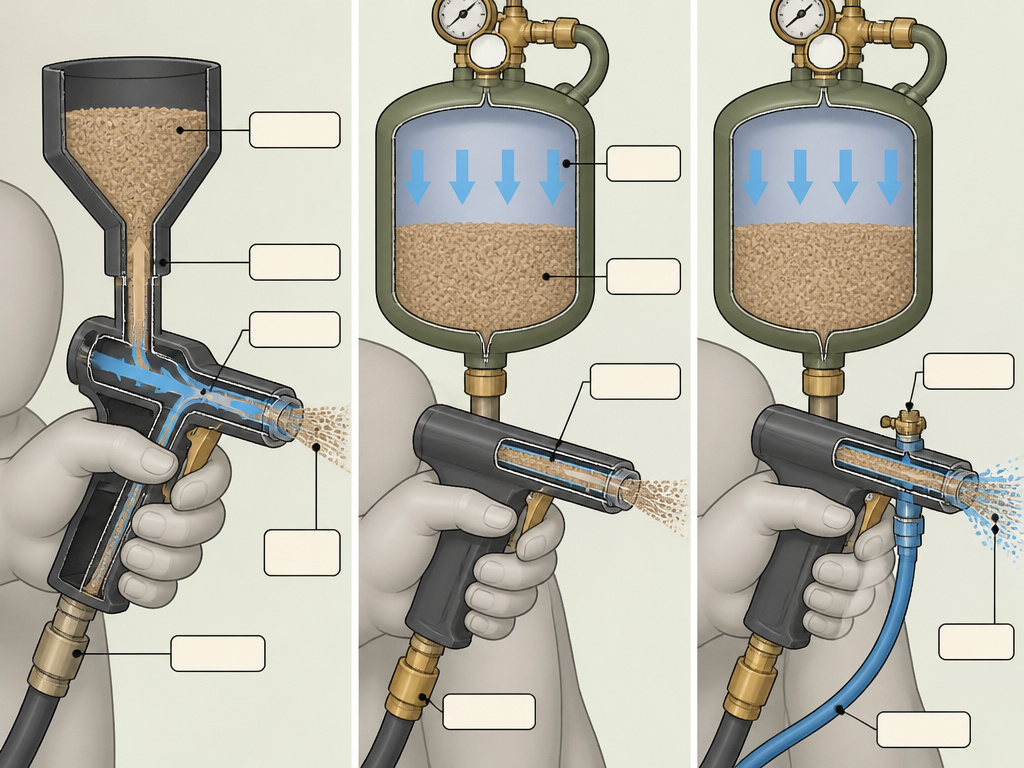
These three all use compressed air. The difference is where the air meets the media.
Siphon (Suction) Blasters use a venturi effect. High-speed air shooting past an intake tube creates a vacuum, sucking media up from a hopper below. It’s simple and the gun is light. The catch is air consumption. To create that suction, you need high air volume. A 5/16 inch Long-Venturi nozzle gulps 137 CFM at 100 psi. This air demand often exceeds the capacity of many home shop compressors.
They’re best for lighter work where you need a gentle touch, like cleaning a wood deck or stripping paint from delicate auto trim. For a full comparison of this style against its more powerful sibling, our guide on the siphon vs pressure sandblaster decision breaks down the trade-offs.
Pressure Pot Blasters are the industry standard for a reason. The media sits in a sealed, pressurized tank. When you pull the trigger, already-pressurized air pushes the abrasive from the pot, resulting in a much harder, more consistent hit. It’s more efficient on air than siphon systems.
These pots range from portable 3.5-cubic-foot units to industrial 160-cubic-foot vessels. They excel at stripping stubborn coatings like powder coat or mill scale from structural steel. The Wikipedia entry on sandblasting details the historical shift towards these pressurized systems for industrial use.
Wet/Vapor Blasters are a pressure pot with a water injection. Systems like Graco’s EcoQuip inject a fine water mist into the blast stream. This suppresses dust significantly, a lifesaver for indoor work or occupied sites. The water also keeps the surface cooler, preventing warping on thin metal.
The trade-off is slurry. You’re now dealing with a wet, contaminated mess that must be collected and disposed of properly. It also introduces the risk of flash rust on ferrous metals. These systems are a specialist’s tool, chosen when dust control is an absolute requirement.
| Blaster Type | How It Moves Media | Best For | Air Demand (at 100 psi) |
|---|---|---|---|
| Siphon (Suction) | Air flow creates vacuum to suck media | Light cleaning, delicate surfaces, DIY | Very High (e.g., 137 CFM for 5/16″ nozzle) |
| Pressure Pot | Pressurized air pushes media from sealed tank | Heavy stripping, industrial work, large areas | High, but more efficient than siphon |
| Wet/Vapor | Pressure pot with injected water mist | Dust-sensitive environments, indoor work | Similar to pressure pot, plus water pump |
The Centrifugal Wheel: Power Without Air
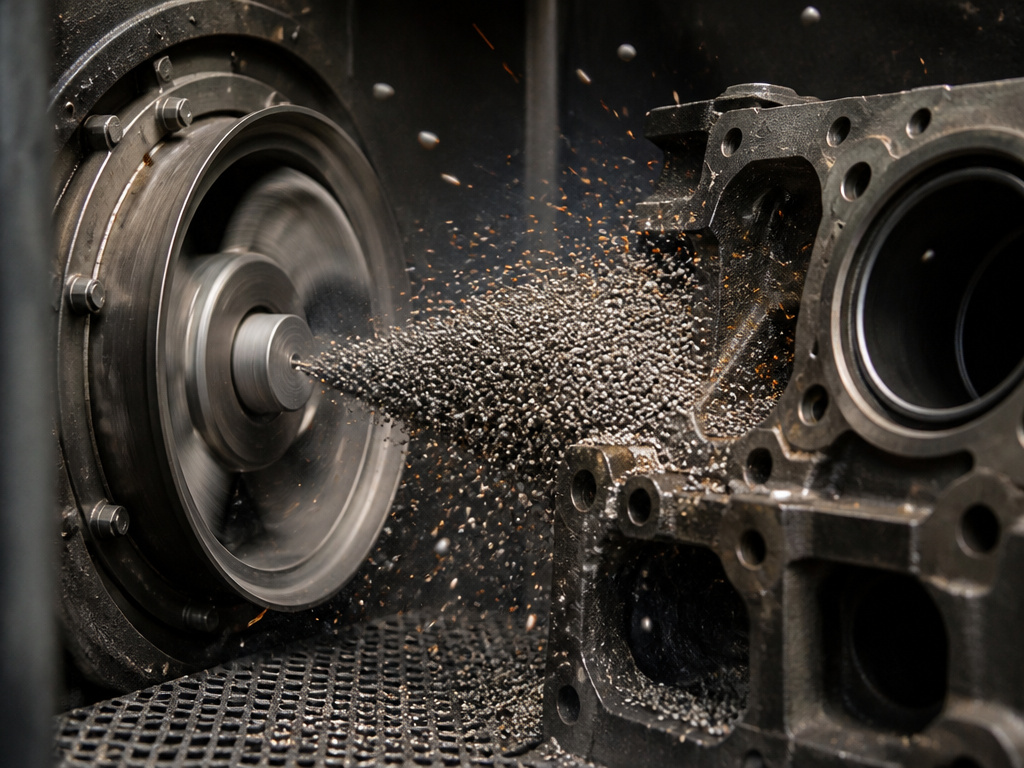
This is the other universe of blasting: airless. A centrifugal wheel machine uses a high-speed paddle wheel (spinning at 2,500+ RPM) to throw media. It’s like a supercharged, industrial-scale skid steer.
The efficiency is staggering. Shot blasting with a wheel can use only about 12 percent of the energy needed for the same work with air nozzles. It’s also incredibly consistent, perfect for automated lines processing thousands of same-sized parts, like engine blocks or castings.
The constraints are absolute. The wheel can only throw dense, ferrous media, steel shot or grit. It requires a large, fixed cabinet or room to contain the rebound. This makes it useless for field work or one-off, complex-shaped parts. You don’t operate a wheel blast machine as much as you feed it.
Matching the Machine to Your Actual Job
This is where most buying guides stop. They list types but don’t connect them to the noise, cost, and mess in your driveway or shop. We can correct that.
For the Hobbyist / Weekend Warrior:
You’re cleaning or prepping surfaces for projects like furniture or automotive parts. A small pressure pot blaster (like a 3.5-cubic-foot model from TP Tools or Campbell Hausfeld) is the realistic starting point. A siphon blaster sounds easier, but it will quickly overwhelm many typical home compressors. The pressure pot gets more work done with less air. A proper guide to using a sandblaster is essential here, filling the pot and setting the pressure correctly are the two steps everyone rushes.
For the Professional Shop:
If blasting is a revenue stream, you graduate to a large pressure pot system with real reclaim. Good media recovery can cut abrasive cost by an order of magnitude. You’ll also need a dust collector rated for the enclosure size, anywhere from 1500 CFM for a cabinet to 6000 CFM for a room. This isn’t optional; it’s a health requirement. For high-volume, repetitive work on metal parts, a centrifugal wheel cabinet becomes worth the investment.
When Dust is the Enemy:
This is the niche for wet/vapor blasting. Think historic restoration inside a museum, remediation in a populated area, or working on a surface where embedded dust would ruin the next step. You trade speed for cleanliness and accept the slurry hassle.
Skip this if: You only need to clean one small item. For a single set of wrought-iron chairs, renting a portable sandblaster or using a professional service often costs less than buying media and dealing with cleanup.
The Hidden Levers: Nozzles, Media, and Air
The machine is just the delivery system. The cut is determined by what’s coming out of the nozzle.
Nozzle Bore and Material directly control air consumption and wear life. The numbers are unforgiving (from the Fact Sheet):
- 1/4″ bore: 81 CFM at 100 psi
- 1/2″ bore: 338 CFM at 100 psi
A venturi-bore nozzle can boost productivity 30 to 40 percent at the same air flow compared to a straight bore. Nozzles are made of tungsten carbide for general use or boron carbide for the longest life with aggressive media. Replace them when the bore grows about 1/16 inch oversize, a worn nozzle drastically reduces efficiency and increases costs.
Abrasive Media is the actual cutting tool. The choice sets the result, and it’s a vast landscape. Aluminum oxide is sharp and fast. Steel grit cuts heavy scale. Glass bead peens and brightens without removing much base metal. For a deep dive, our resource on sandblasting media types is the next stop. The media size (mesh) matters too: 16 to 120 mesh is the typical range, with coarser cutting faster and leaving a deeper profile.
Your media must be bone dry. Reusing media that sat in humidity clogs the gun instantly. Reusing damp media is a common mistake that leads to immediate clogs and lost time.
Compressed Air is the fuel. It must be clean, dry, and abundant. A coalescing filter is essential to prevent damp air from entering the system. Moisture in the line is a major cause of poor performance and clogging.
Troubleshooting: When Your Blaster Isn’t Blasting
You’ve hooked everything up, pulled the trigger, and get a sad sputter. Here’s the diagnostic tree.
Low Pressure / Weak Blast:
- Check the nozzle. A worn nozzle is the first suspect. Measure the bore.
- Listen for leaks. A leaking pop-up valve in the pressure pot will bleed pressure.
- Verify compressor output. Is it actually reaching the required PSI at the required CFM? Your compressor might be undersized or failing.
Pulsing or Surging Stream:
- Check for moist media. Damp abrasive clumps in the metering valve, causing it to stick and release in chunks.
- Inspect the air filter. A clogged coalescing filter or failed separator is letting damp air into the system.
Excessive Dust Escape:
- Check dust collector filters. A torn filter cartridge or a non-firing pulse valve in the dust collector is the likely culprit.
How Do Gravity-Fed Sandblasters Work?
Think of a gravity-fed sandblaster as the underhand toss of the blasting world. It’s a simple setup where the abrasive media sits in a small hopper above the gun. Gravity feeds the media down into the air stream, where it’s propelled out of the nozzle. This design is easy to handle and perfect for smaller blasting jobs, making it a common choice for hobbyists and light cleaning tasks. It provides a gentler touch suitable for delicate surfaces where you want to avoid damage. However, its small capacity and lower power make it unsuitable for high-volume or professional business use, where speed and material removal are critical.
What’s the Difference Between Sandblasting and Shot Blasting?
The core difference is in the engine. Sandblasting, which today almost never uses actual sand, uses compressed air to fire abrasive. Shot blasting typically uses a centrifugal wheel spinning at high speed to fling metallic media. This wheel system is far more energy-efficient for large-scale work but is fixed in place, limiting it to automated, high-volume tasks like cleaning metal parts in a factory. It also only works with ferrous metallic media. In contrast, air-powered sandblasting systems are portable and can handle a vast range of media, from plastic to walnut shells, making them versatile for field work and complex, one-off projects.
Frequently Asked Questions
What is the best sandblaster for home use?
For many DIYers, a small pressure pot blaster is a practical choice. It balances power, air efficiency, and cost. Siphon blasters require very high air volume, which many compressors cannot supply. A good starting point is to review some recommended sandblasters built for home shop use.
Can I use regular sand in a sandblaster?
No, and you should not. Modern sandblasters almost never use silica sand because it causes silicosis, a serious and incurable lung disease. It is banned for open blasting in most jurisdictions. Use purpose-made, less hazardous media like coal slag, aluminum oxide, or crushed glass.
What’s the difference between sandblasting and soda blasting?
Sandblasting is a broad term for abrasive blasting. Soda blasting uses sodium bicarbonate (baking soda) as the media. It’s much softer, excellent for removing coatings without damaging the underlying substrate, perfect for cleaning fire damage or stripping graffiti from brick. For a full comparison, see our analysis of soda vs sandblasting applications.
Is a dustless blaster worth it?
Dustless blasting, or wet blasting, is worth it when dust control is your top priority. It suppresses over 90% of airborne dust, making it viable for indoor or sensitive sites. The trade-off is managing the resulting slurry and potential for flash rust. It’s a specialist tool, not a general upgrade. Learn more about the pros and cons in our guide to dustless blasting systems.
How much air compressor do I need for a pressure pot sandblaster?
You need a compressor that can deliver the CFM required by your nozzle at the pressure you want to run. For example, a 3/8″ Long-Venturi nozzle consumes 196 CFM at 100 psi. This level of air demand is typically beyond the capacity of most home shop compressors. Many home blasters use smaller nozzles and operate at pressures below 100 psi to match their compressor’s output. Always match the tool to your air supply, not the other way around.
Before You Go
The right blaster is the one that matches your most common job’s demands, not the one with the biggest tank or the shiniest gauge. For many users, a modest pressure pot that matches their compressor’s output is the right choice.
Remember the three non-negotiables: dry air, dry media, and a sharp nozzle. A cheap machine with those three things will outperform an expensive one without them every time. Start with a dry abrasive, master the setup on a scrap piece, and let the machine do the work. The rest is just managing the mess, and wearing your respirator. Every single time.
